Using Bitcoin collateral to borrow USDC at 1.7% on @ZestProtocol . Looping apyUSD in the morph vault for +17%.
This is @NotaStrategy
Stack Sats. Stay $NASTY 👊
Lending is what makes traditional finance function.
@syphercapital on what Bitcoin lending makes possible: auto loans, mortgages, business financing.
Zest Protocol is the leading Bitcoin lending protocol making that future real.
Everyone's asking the same thing now: how do I put my Bitcoin to work?
We're building the Bitcoin economy where your BTC moves, pays, and earns for you.
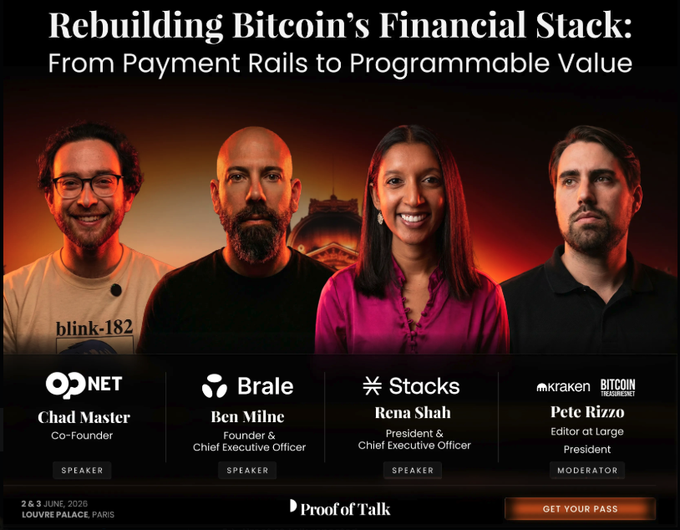
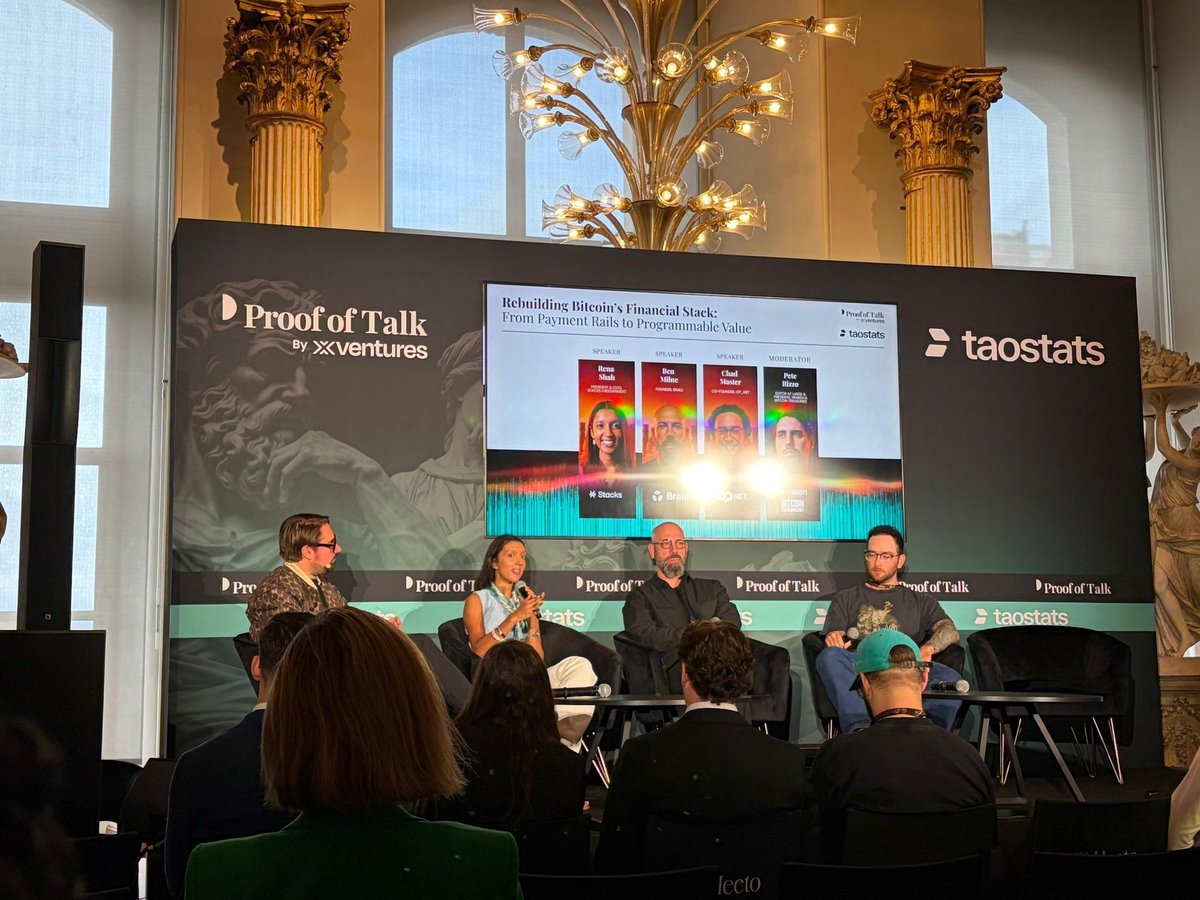
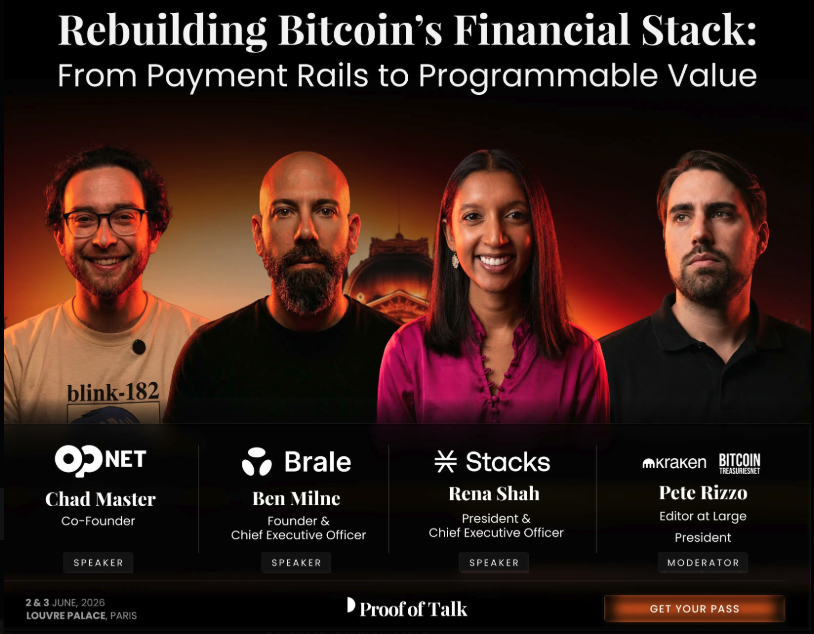
Catch @renashah at @ProofofTalk Paris tomorrow talking Bitcoin's financial stack from payment rails to programmable value.
She's joined by good company 👇
🟧 Bitcoin Staking Whitepaper, Fully Explained (9/10)
What gets built next: liquid staking, lending, and productive BTC
The whitepaper frames Bitcoin Staking not as an endpoint but as a
foundation. Section 9: the design is "intended as a foundation for
further development through community governance rather than a
static endpoint." Here's what becomes possible once meaningful BTC
capital sits on Stacks.
📌 The core idea
Bitcoin Staking parks real BTC capital on the network.
Once that capital is there, new financial primitives can be built
around it. The whitepaper names the most interesting directions.
None of these are live as part of the base protocol yet, they're
what the foundation enables.
📌 Direction 1: Liquid staking
From the whitepaper: "Pairing sBTC with STX in smart contracts
enables liquid staking protocols."
This is the big unlock. Recall the problem from earlier parts:
paired positions are locked for 6 months, and the paired STX earns
nothing. Liquid staking tokens (LSTs) tokenize that locked position,
so you hold something tradable and composable while the bond runs.
This is exactly the gap a protocol like StackingDAO is positioned
to fill, as it already runs STX liquid staking infrastructure.
📌 Direction 2: Self-custodial lending
From the whitepaper: the L1 timelock mechanism "establishes a
foundation for additional self-custodial Bitcoin primitives. A
natural extension is self-custodial lending, where users retain
custody of their BTC on L1 while borrowing against it on L2."
This is the thesis behind a protocol like Zest, the largest lending
protocol on any Bitcoin layer. Lock BTC, borrow stables against it,
put the borrowed capital to work, all without giving up BTC custody.
📌 Why this matters: the transaction fee loop
Recall Part 1: long-term, the whitepaper expects transaction fees
to become a major source of consensus yield. Liquid staking,
lending, DEX trading, and structured products all generate fees.
More BTC capital → more DeFi activity → more transaction fees →
larger miner BTC pool → healthier yield across all tiers.
This is the loop the whole design is reaching for.
📌 The ecosystem already forming around this
The pieces aren't hypothetical. On Stacks today:
- Lending: Zest (BTC-backed loans)
- DEX / liquidity: Bitflow
- Liquid staking: StackingDAO
- Yield engine: Hermetica (USDh, a yield-bearing stablecoin)
Bitcoin Staking gives these protocols more BTC capital to build on.
They, in turn, generate the activity that feeds miner economics.
📌 Direction 3: protocol refinement via governance
The whitepaper also lists ongoing refinements, all SIP-governed:
- Algorithmic parameter tuning (yield, capacity, ratio functions)
refined against real participation data.
- Auction mechanism improvements: sealed-bid variants, multi-round
structures to reduce gaming and improve price discovery.
- Anti-gaming measures (e.g. a 1:1 wallet mapping rule) as needed
during bootstrap.
The point: this is meant to evolve as real data comes in, not to
ship fixed forever.
📌 The honest caveat
Every one of these is forward-looking. "Enables" is not "ships."
The base protocol doesn't provide LSTs or lending itself, third
parties build them. And each added layer adds smart contract risk
on top of the base mechanism.
The vision is coherent. Whether it materializes depends on builder
execution, capital actually arriving, and those protocols proving
secure over time.
✅ Part 9 in one line
Bitcoin Staking is a foundation, not an endpoint. It enables liquid
staking (unlocking locked positions), self-custodial lending, and a
DeFi loop where BTC activity feeds miner yield. Forward-looking, and
dependent on builders and security.
Next, Part 10 (finale): the first participant, UTXO Management, and
the full picture.
Personal analysis, not financial advice. Always verify against the whitepaper.
🟧 Bitcoin Staking Whitepaper, Fully Explained (6/10)
The pairing mechanic almost no one is pricing in
STX pairing is denominated in USD value, not token count.
Sounds like a footnote. It isn't.
This single design choice shapes how BTC capital and STX demand
connect, and it behaves very differently depending on STX's price.
Here's the full breakdown.
📌 The rule (whitepaper 3.3)
To enter a protocol bond, you lock STX worth a minimum fraction
of your BTC commitment's USD value. The initial floor is 5%.
The word that matters is VALUE. You are not locking a fixed
number of tokens. You're locking a dollar amount, converted to
STX at lock time using a trailing-average STX/BTC exchange rate
derived from on-chain miner bid data.
📌 The formula (Appendix A)
Required STX (QSTX) = E × P_BTC × α ÷ P_STX
E = BTC enrolled
P_BTC = BTC price
α = pairing ratio (5%)
P_STX = STX price
P_STX sits in the denominator. That's the whole story.
As STX price falls, required token count rises. Inversely.
📌 Worked example: pairing 1 BTC
At BTC $73,000, the pairing requirement is $3,650 (5%).
That dollar figure is fixed. The token count is not:
STX $1.00 → 3,650 STX
STX $0.50 → 7,300 STX
STX $0.23 → ~15,870 STX
Same BTC. Same 5%. The cheaper STX gets, the more tokens
you must source to satisfy the same commitment.
📌 At scale: filling bootstrap capacity (3,000 BTC)
At BTC $73K, STX $0.23:
STX required = ~47.6M (about 2.63% of circulating supply, ~1.81B)
How that demand scales with STX price (BTC $100K assumption):
$0.23 → 65.2M STX (3.60% of supply)
$0.50 → 30M STX (1.66%)
$1.00 → 15M STX (0.83%)
$2.00 → 7.5M STX (0.41%)
Capacity is most STX-intensive precisely when STX is cheapest.
Not a forecast. Just arithmetic.
📌 Why you can't game it
The exchange rate isn't a spot price or an external oracle.
It's a trailing average of on-chain miner bids.
So you can't pump STX for a single moment to cut your pairing cost.
The averaging absorbs short-term manipulation, and per the
whitepaper, the same reference resists single-cycle distortion.
📌 The dynamic this creates, and the honest counterweight
USD-denominated pairing links BTC participation demand directly
to STX demand. If paired participation keeps arriving, lower STX
prices force larger token purchases, which is a form of structural
support on the buy side.
But this is conditional, not automatic. Two things must hold:
1. New paired participation must actually keep showing up.
No incoming demand, no buying. The mechanic does nothing on its own.
2. Reflexivity cuts the other way (whitepaper 8.1).
If STX falls, miner bids shrink, the BTC pool contracts, and
paired yield can compress, which can REDUCE the appeal of
participating in the first place.
So which force wins depends entirely on how durable BTC's demand
for self-custodial yield turns out to be. The mechanic is real.
Its direction is not guaranteed.
📌 What this means for you
If you hold STX:
The token is being repositioned from a yield asset into a pairing
asset. Its demand is now tied, in dollar terms, to how much BTC
capital wants in. That's a different thesis than "stack and earn."
If you hold BTC and plan to pair:
Your STX cost is a fixed % of your BTC value, sized at lock time.
A lower STX price means more tokens for the same dollar exposure.
The pairing is a cost of entry, not a yield source (see Part 2).
📌 The single thing to watch
Whether capacity actually fills, and whether the required STX is
bought on the open market or sourced OTC. That distinction
determines if any of this shows up as real buy pressure.
On-chain flows will tell the story. Announcements won't.
✅ Part 6 in one line
Pairing is denominated in USD value (5%), not token count, so a
lower STX price demands more tokens for the same BTC. That creates
a conditional buy-side link to BTC demand, offset by reflexivity,
and only real if paired participation actually materializes.
Next, Part 7: what happens after the first year? Bootstrap (PoX-5)
to full automation (PoX-6).
Personal analysis, not financial advice. Always verify against the whitepaper.
🟧 Bitcoin Staking Whitepaper, Fully Explained (10/10 — Finale)
The first participant, and the full picture
Nine parts on how Bitcoin Staking works. This finale ties it together
and grounds it in the first real-world move: the inaugural participant.
📌 The news: the first participant is in
UTXO Management, the Bitcoin-native asset arm of Nakamoto Inc.
(NASDAQ: NAKA), is the inaugural participant in Bitcoin Staking on
Stacks, deploying a portion of its existing BTC holdings.
The specific BTC amount has not been disclosed. For transparency:
UTXO and Bitcoin Magazine are both Nakamoto subsidiaries (per their
own disclosure). So read this as the ecosystem committing its own
capital first, proving the mechanism, rather than as fully external
adoption. The bootstrap is expected to go live later this year, with
the SIP governance process and technical specs still to follow.
No firm date yet.
📌 The pairing math, one more time (current prices)
If the bootstrap capacity of 3,000 BTC fills, at BTC ~$73K, STX ~$0.23:
STX required = ~47.6M (about 2.63% of circulating supply, ~1.81B)
Remember Part 6: pairing is denominated in USD value, not token count.
Lower STX price = more tokens needed for the same BTC.
📌 The full picture, the series in one frame
Where yield comes from (Part 1): not new, it's the 5-year-proven
PoX pool, funded by miners bidding BTC.
Who gets paid (Parts 2-3): paired BTC first (Tier 1), STX-only
second (Tier 2), reserve as buffer. STX-only still earns, but residual.
How you participate (Parts 4-5): pair BTC + STX for 6 months. Native
BTC (pure self-custody) or sBTC (DeFi composable). BTC can early-exit
forfeiting yield; paired STX stays locked the full term.
The price link (Part 6): USD-denominated pairing ties BTC demand to
STX demand, conditional on participation actually arriving.
The rollout (Part 7): managed bootstrap (PoX-5, ~1yr) → permissionless
automation (PoX-6).
The risks (Part 8): reflexivity is the core one. System health tracks
STX demand. Dampeners soften but don't remove it.
What's next (Part 9): a foundation for liquid staking, lending, and a
DeFi loop where BTC activity feeds miner yield.
📌 What the whitepaper claims it achieves
In its own words (Section 10): a way to earn BTC-denominated yield
while BTC stays self-custodied on L1, built on a proven mechanism
that has distributed over 4,200 BTC since 2021. Not a new token
incentive layer, not a custodial yield scheme.
📌 My honest read
The design is coherent and the whitepaper is unusually candid about
its own risks. The mechanism is real and now has its first committed
capital.
But the open questions are the ones that actually matter:
- Will participants beyond Nakamoto's own orbit arrive?
- Is the STX pairing bought on-market, or sourced OTC?
- Does capacity actually fill toward the 3,000 BTC target?
- And underneath everything, does BTC demand for self-custodial
yield hold up enough to keep the reflexive loop pointing up?
None of these are answered yet. Announcements don't answer them.
On-chain data will, as the bootstrap goes live.
📌 The bottom line
Bitcoin Staking is one of the more thoughtful attempts to make idle
BTC productive without breaking self-custody. The foundation is laid,
the first mover is in, and the mechanism is sound on paper.
Whether it becomes meaningful is now a question of execution and
real capital, not theory. That's the part worth watching.
✅ The series in one line
Bitcoin Staking redistributes a proven BTC yield pool to paired
BTC+STX positions, keeping BTC self-custodial. Sound design, honest
about its reflexivity risk, now facing the real test: does the
capital, and the demand beneath it, actually show up.
That wraps the 10-part breakdown. Thanks for reading through.
Everything here is sourced to the whitepaper and public data.
Personal analysis, not financial advice. Always verify against the whitepaper.