Big news: The @StakingRewards platform is joining @TheTieIO.
Since 2018 we've been building the trusted source for staking and on-chain yield data. Joining @TheTieIO makes it institutional-grade on a whole new scale. What this unlocks:
- Our customers gain access to The Tie's network of hundreds of institutions: hedge funds, asset managers, banks, exchanges, and custodians.
- The Tie's market intelligence and on-chain data come to the platform, and our staking and yield data comes to the The Tie's products used across that same institutional network.
- Our ratings stay independent. That doesn't change, it's the whole point of Staking Rewards.
We'll continue to operate the Digital Asset Yield Summit and Looping Collective independently under Finrate AG.
More below.
We pulled provider-level staking shares for every operator on @solana.
10 of them operate 24% of all staked SOL.
Across all 66 named providers we track, they cover 34% of staked SOL.
.@RobinhoodApp Chain's fees are down 93% since September 4, 2026. Yet dollar volume is up 6% and TVL is up over 10%.
This can largely be attributed to the gas limit being raised and fees that were lowered to meet increasing demand.
On September 4th the average gas price was 0.73 gwei. By September 14th it dropped to 0.08 gwei, an 89.6% drop that pushed fee per transaction down 93.6%.
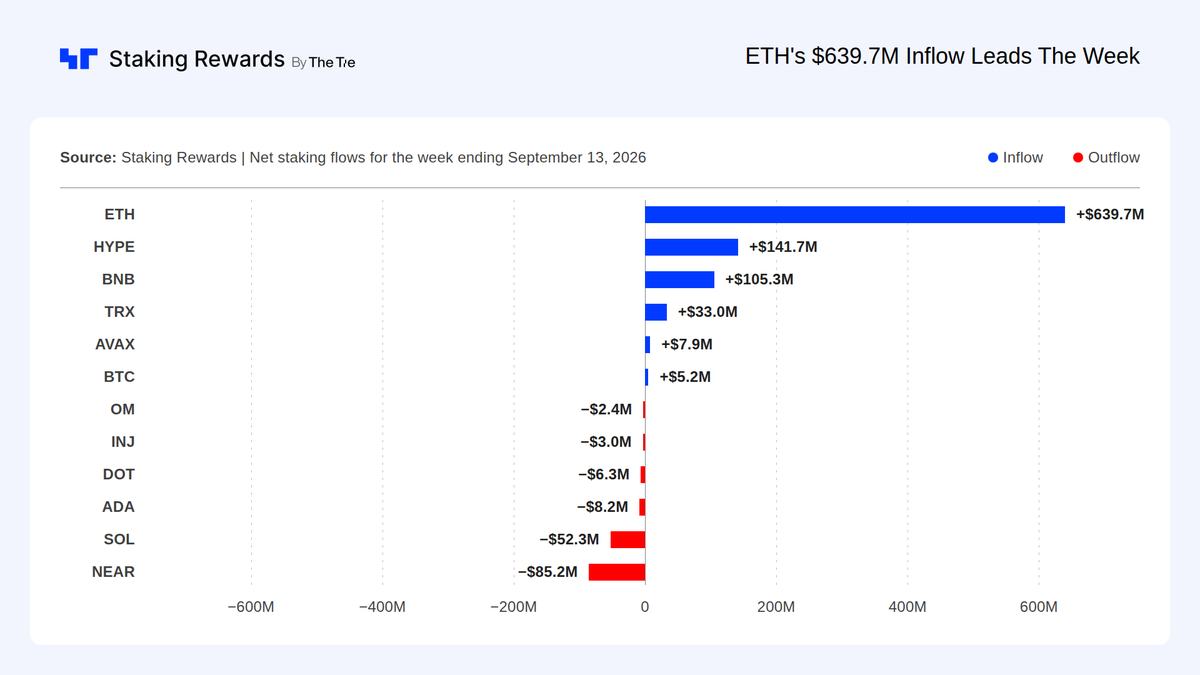
We priced the net staking flows across every network we track for the week ending September 13, 2026.
Six networks saw inflows and six saw outflows. @solana had over $52M in outflows. Last time we measured this on August 31, it had over $381M in inflows.
@ethereum took in the most at over $639M. That's more than four times the next network and more than every other inflow this week combined.
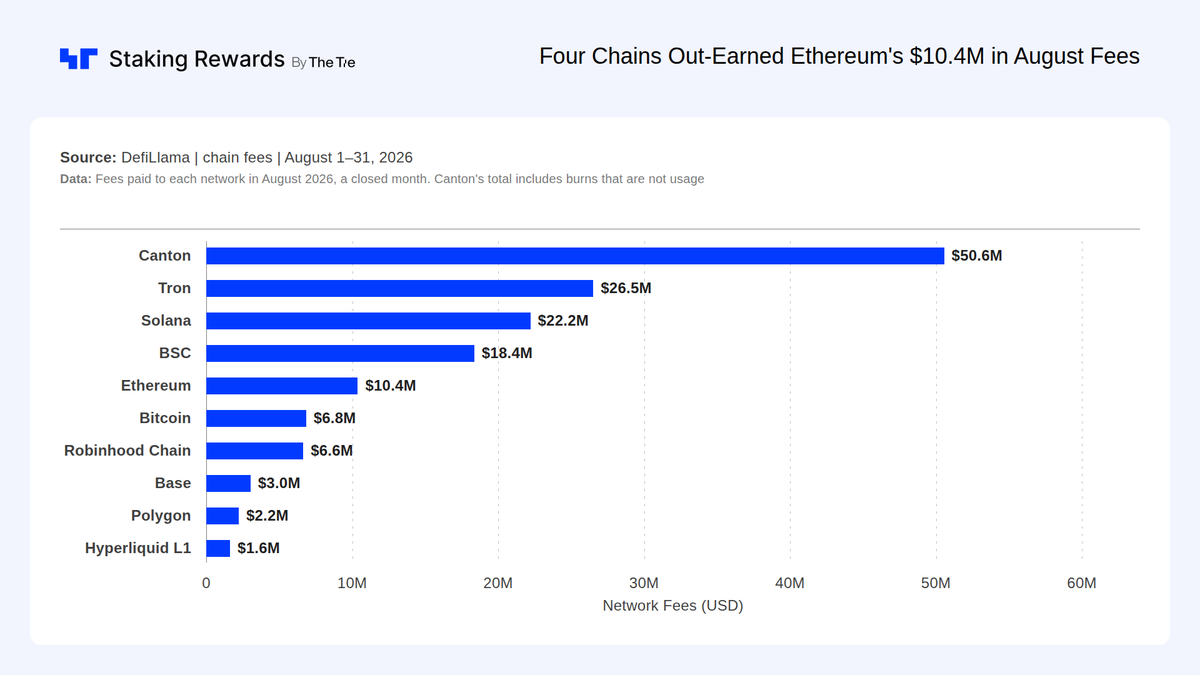
We pulled network fees for all of August across 10 chains.
@bitcoin and @ethereum are the largest by market cap, yet only collected $10.4M or less in fees during August.
4 smaller networks earned more, led by @CantonNetwork at $50.6M, almost 5 times Ethereum's total.
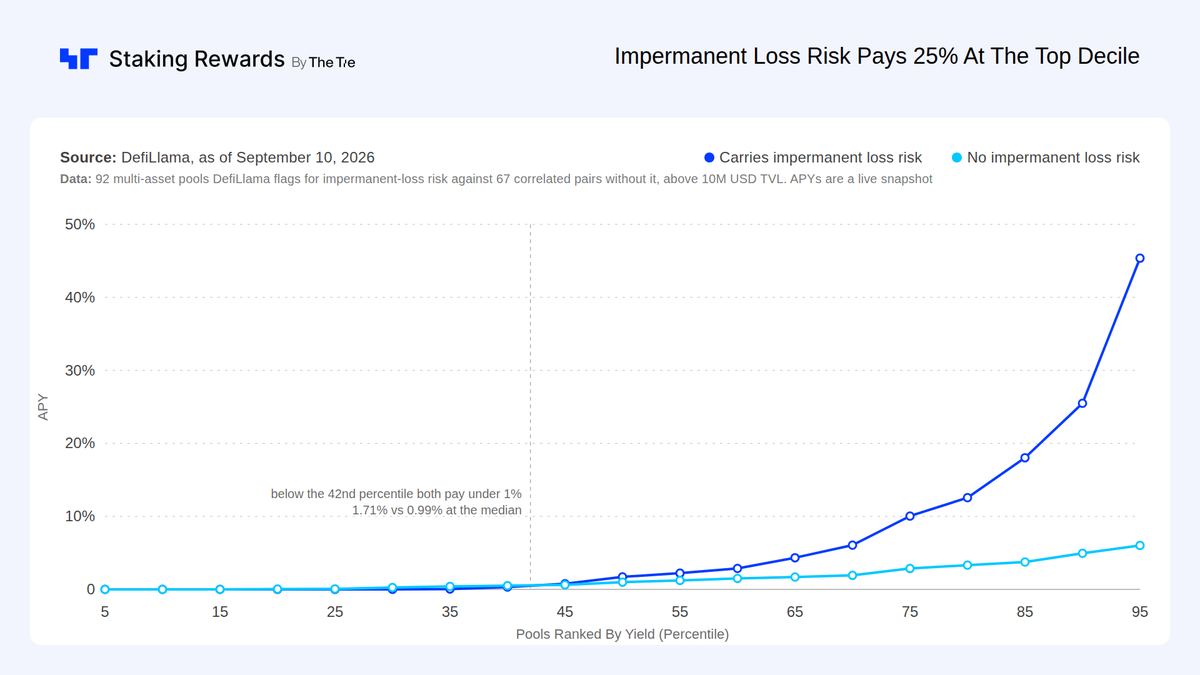
For most pools, it doesn't matter either way. Below the median, both types pay under 1%.
But look at just the top 10%, and IL risk pools are averaging 25% APY, versus only 5% for safe pools at that same level.
The upside exists. Most pools just never see it.
We compiled data from 92 multi asset pools that carry impermanent loss risk and stacked them against 67 similar pools that don't.
What the data showcased: the extra risk barely pays off unless you're already near the top.
.@injective halved its staking rate in January, 12.7% to 6.3% in a single week, after stakers voted for it, and there are more $INJ tokens staked today than there were before the vote.
The stake dipped 4.6% in the two weeks after, then recovered and has stayed strong since.
A DeFi pool advertising 10%+ APY loses a third of it 90 days later. 12.91% advertised becomes 8.48% earned.
Pools that started at 1–3% barely budge. Small yields are the ones that actually stay stable.
Here's the part that surprised us: it's not token incentives drying up. Most pools in every band pay 0% in incentives and the same drop happens anyway. The base rate is reverting on its own.
This is the best-case picture. Pools that failed or shut down aren't in this dataset so the true gap is wider than the chart shows.
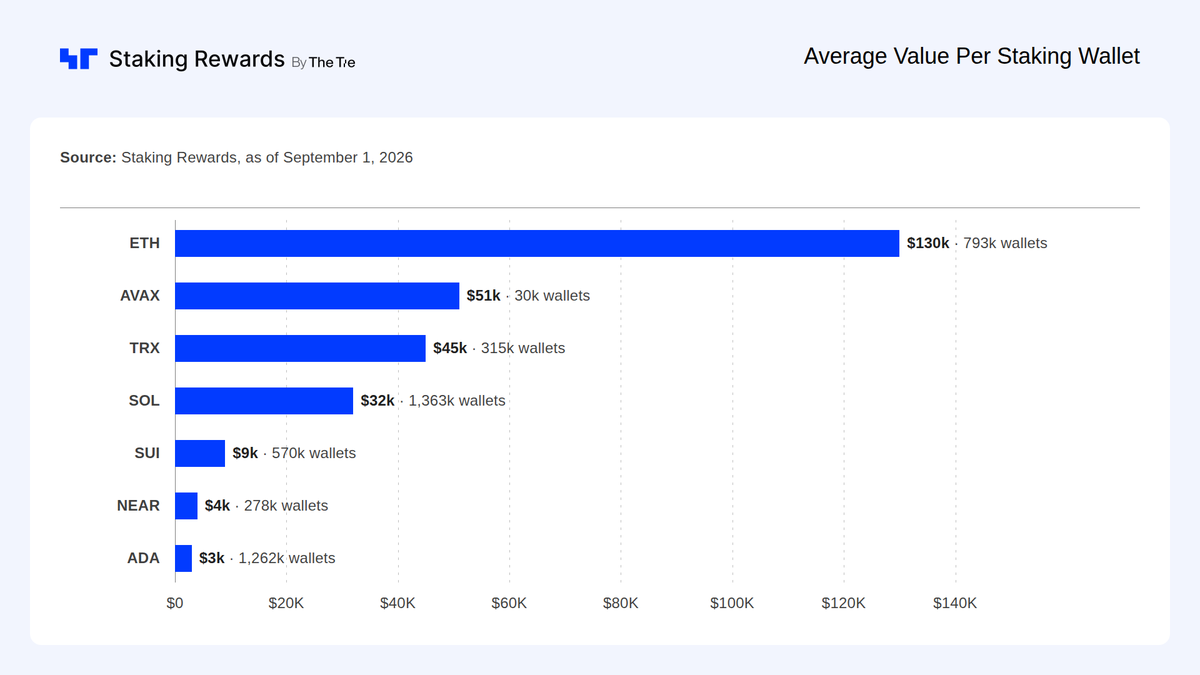
The average @ethereum staking wallet holds $130k while the average @Cardano staking wallet holds $3.3k, a 39x gap.
@Cardano and @solana both have more staking wallets than @ethereum but Ethereum still holds more than double their combined stake.
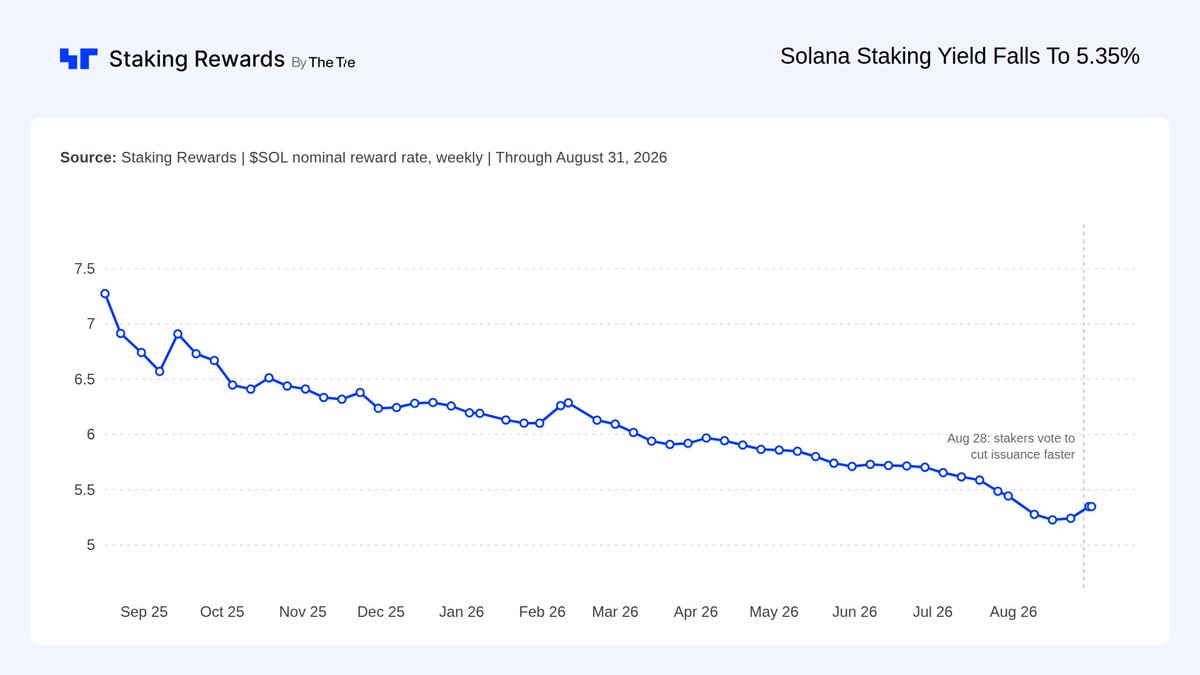
.@solana's staking yield has fallen from 7.27% to 5.35% over the past year, and no governance decision was needed to get there. That is simply what the existing disinflation schedule pays out as it runs.
Last week, @solana's stakers voted to make it fall faster. SGP-0002 doubles the annual disinflation rate from 15% to 30%.
It's still a mandate and not a network change. The emissions cut still needs a technical proposal and an activation before anyone actually earns less.
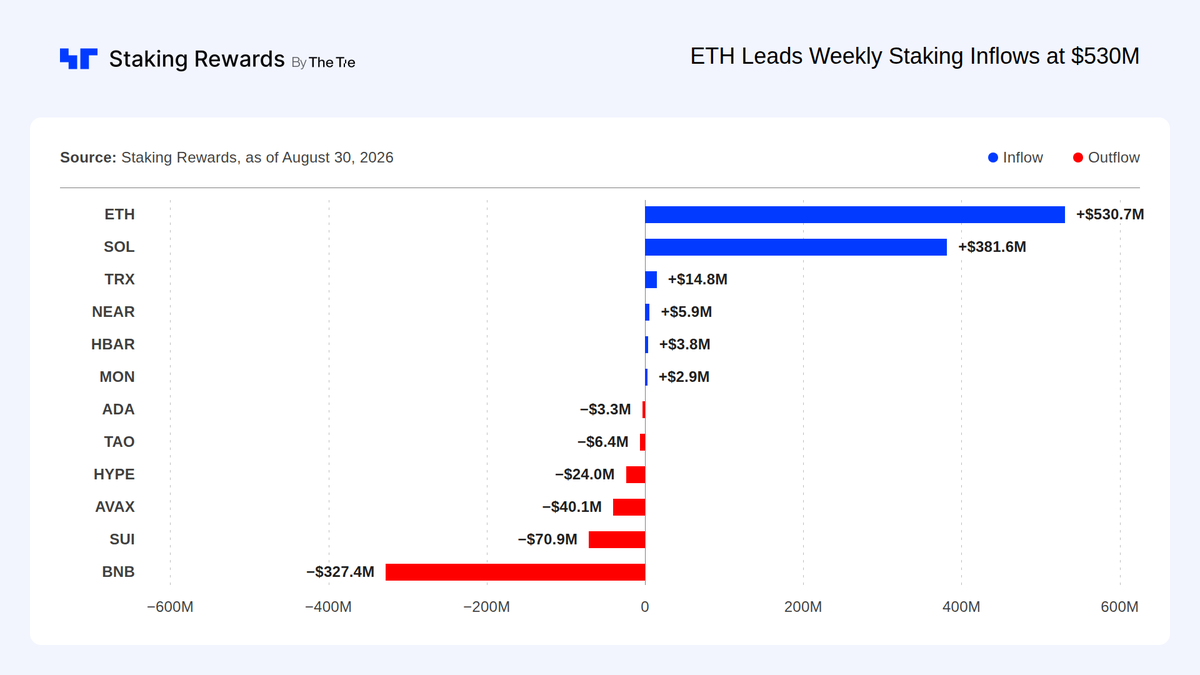
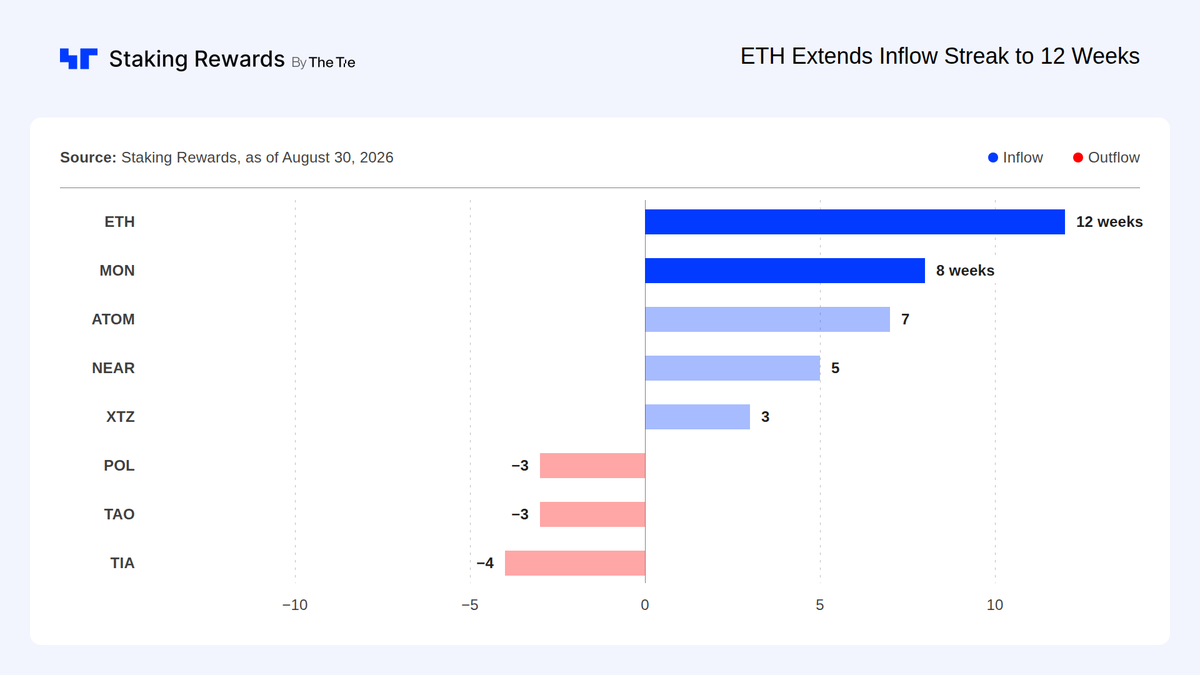
$ETH took +$530.7M into staking last week, its twelfth consecutive week of inflows. Across that run, the network has added 8.3% of its staked supply.
$SOL added +$381.6M, reversing the -$200.3M outflow we flagged the week before.
The other side: $BNB lost -$327.4M, the week's largest outflow, and $SUI -$70.9M.
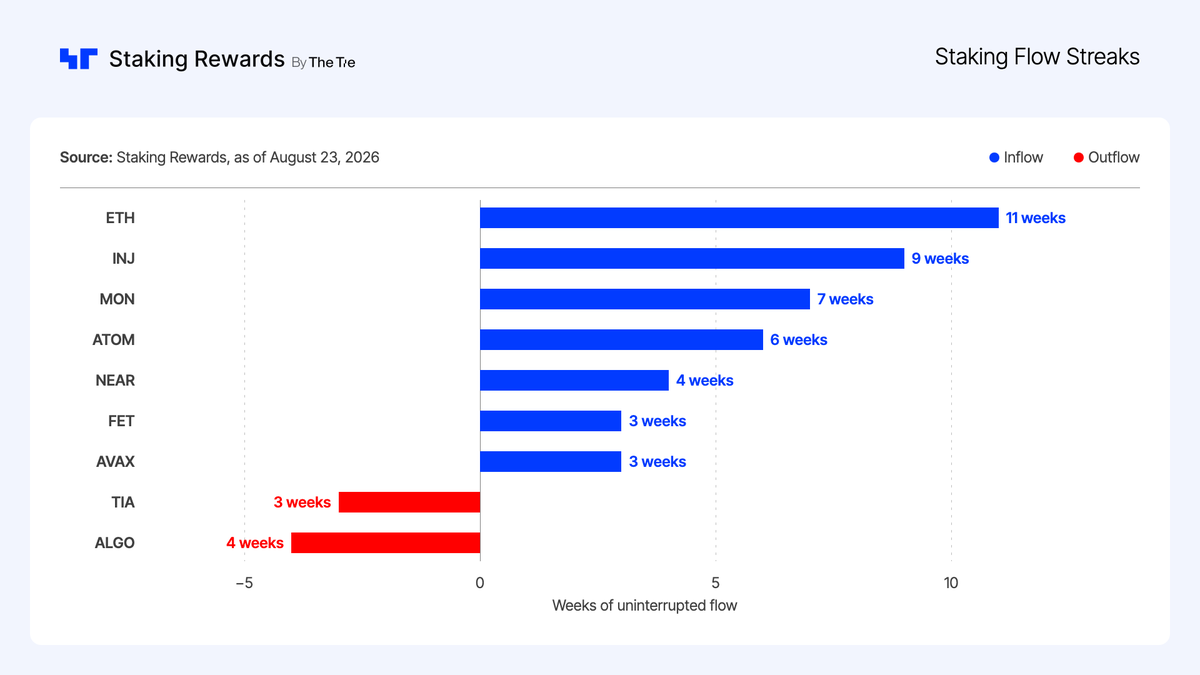
Four networks are now on runs of five weeks or more: $ETH at twelve, $MON at eight, $ATOM at seven, and $NEAR at five.
$TIA is the only sustained outflow, at four.
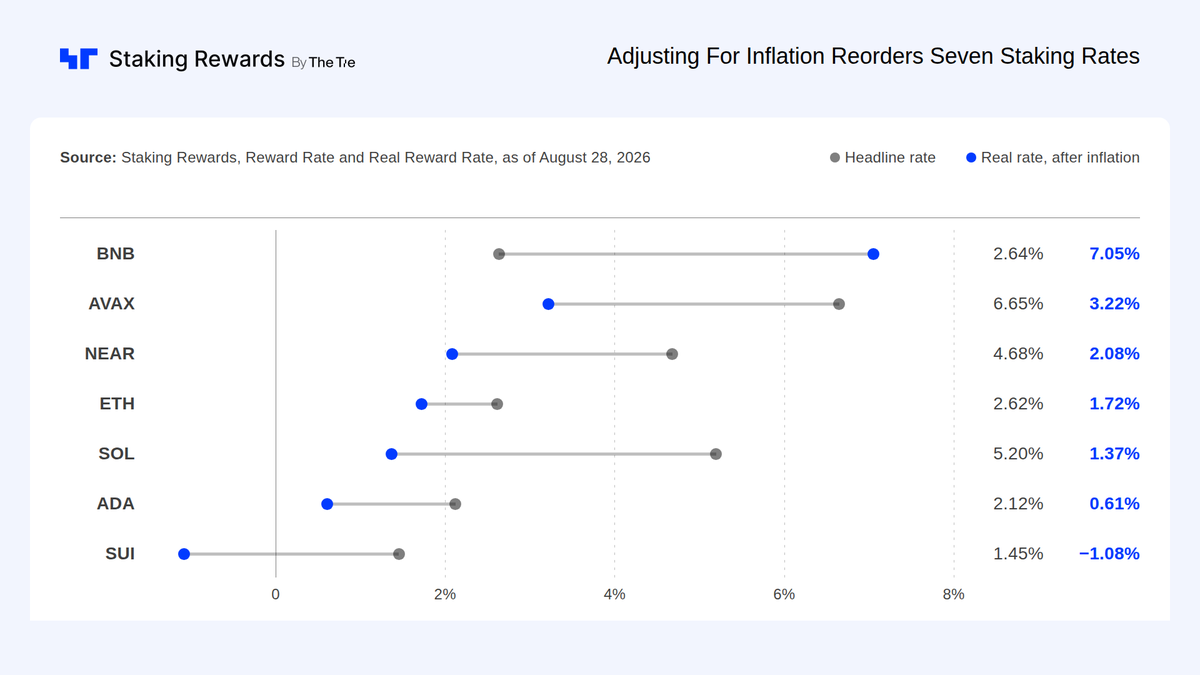
$AVAX pays the highest headline rate here at 6.65% and $BNB pays 2.64%, fourth of seven.
Account for what each token's supply is doing and the order inverts.
- $BNB's supply is shrinking so its real return is 7.05%, the highest on the board.
- $SOL drops from second by headline rate to fifth, 5.20% quoted against 1.37% real.
- $SUI turns negative at -1.08%: the balance grows, but the staker's share of the network does not.
The quoted rate tells you what you receive but doesn't tell you what you keep.
Ethereum has 74,000 fewer validators than it did in January and more ETH staked than ever.
The validator count fell from 977,091 to 903,125 this year while the average validator balance rose from 36.4 ETH to 47.1.
Operators are merging small validators into larger ones, which EIP-7251 made possible by lifting the 32 ETH cap on a single validator.
The count is going down for the opposite of the obvious reason.
The rally moved prices but not stake.
Across the ten largest staking networks, prices rose as much as +43.3% while tokens staked moved by less than 1.1% anywhere on the board.
Seven of the ten saw stake fall: only $AVAX (+1.07%), $ETH (+0.71%) and $NEAR (+0.58%) added.
Staking yields are set by issuance and participation, not by price.
.@ethereum's staking participation has climbed from 29.6% to 35.1% of supply this year, and stakers have now added to their positions for 11 straight weeks.
Six Ethereum researchers, including @drakefjustin, want to push the other way. EIP-8363 would burn a rising share of validator rewards as participation grows, so staking past half of all ETH earns nothing extra.
Stake keeps coming in as the protocol's own researchers propose paying it less.
$ETH added $754.9M of net new stake last week, its 11th straight week of inflows. The run now totals +7.8% of all staked ETH.
The rest of the board tilted the other way.
$SOL saw $200.3M leave staking in the week's largest outflow, with $HYPE, $ADA and $SUI behind it.
$BTC accounts for 1.9% of all staked value and 12.8% of all staking headlines since May, the widest gap between attention and capital on the board.
The mirror image: $HYPE holds 13.8% of staked value against 7.0% of headlines.
Outside @ethereum and @solana, the chains carrying the most stake draw the least coverage.
$TAO's staking reward rate rose 1.17pp to 17.55% last week, the biggest move across major PoS networks.
It rose because stake left: about $9.4M flowed out that week, and a fixed emission split among fewer stakers pays each one more.
$OM and $BNB followed at +0.47pp and +0.37pp.
By bringing indexing closer to the blockchain itself, @shinzonetwork is building a decentralized and verifiable way to access on-chain data.
Glad to contribute as the network takes shape and support Shinzo with institutional-grade infrastructure from the early testnet stage.