Check out the rules for our next Launchpad round! @starpowerworld @svpowergalaxry Heads up: Unminted $SVP in the Alpha Round can be minted in the Beta Round.
Also, a big shoutout to our core contributors: our Discord members, the Turkish fam, the StampedRats fam, and those who've been fueling our growth. Thanks for tuning in, and stay posted for more updates! 🚀#SRC20 #Solana #DePin
$STAMP will be the #1 coin in the Bitcoin ecosystem.
-Represents the most IMMUTABLE protocol in Bitcoin (Cant be pruned unlike Ordinals $ordi & Runes $dog)
- Binance tweeted about Stamps 4 times in the past year (More than Runes)
- #SRC20 atomic swaps coming soon
Is price attracted to Liquidity?
#SRC20 Cats/Rats/Dogs l will all join $UTXO world of Bitcoin Stamps ecosystem.
Every crypto degen knows $BTC.
All crypto degens will know about $STAMP on @kucoincom
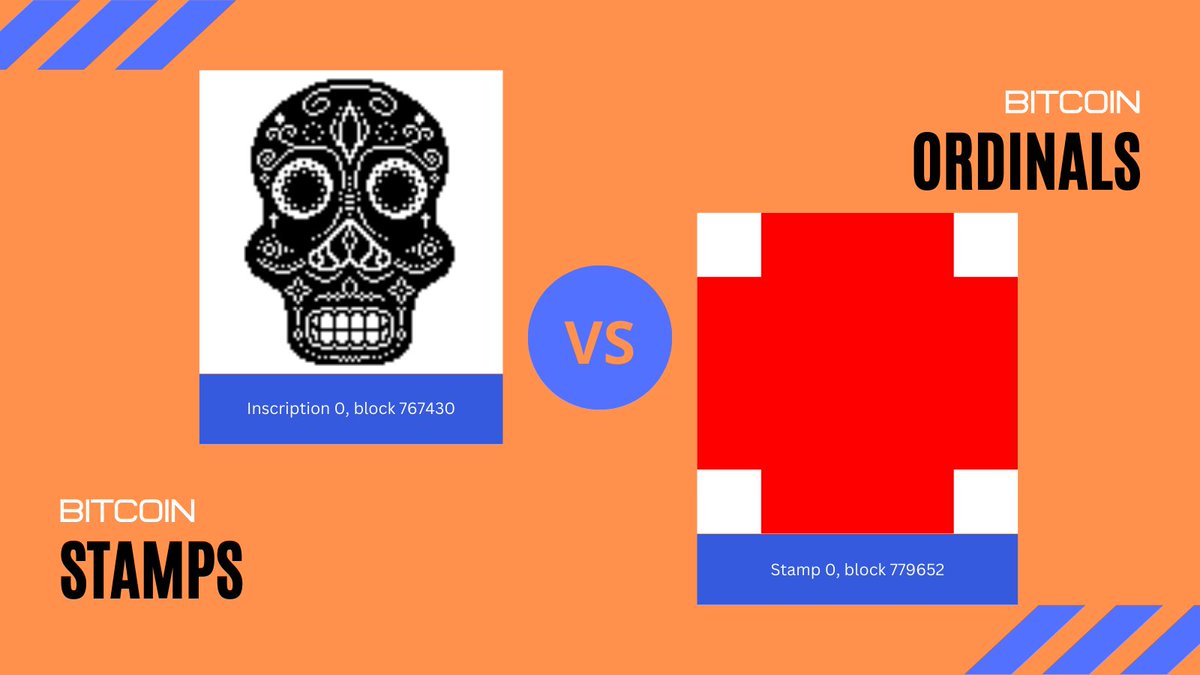
Bitcoin Ordinals vs Bitcoin Stamps. What are the key differences, can they be pruned, and how? Pros&Cons, explained like you are 5.
1) Ordinals store data in the witness section of a Bitcoin transaction, up to 4MB
2) STAMPS store data in the UTXO transactions, up to 7-8KB.👇💾
They are two different protocols and both achieve the same thing: securing data storage inside of the Bitcoin general ledger. They are both seen as an attack on Bitcoin L1 by the maximalist. Here is how they defer, in a lightly technical way. I will try to make it also visual.
The Bitcoin general ledger, aka the blockchain itself, lives in the nodes. We will get back to this part as it's fundamental to the Bitcoin blockchain itself and also to the longevity of these protocols. :)
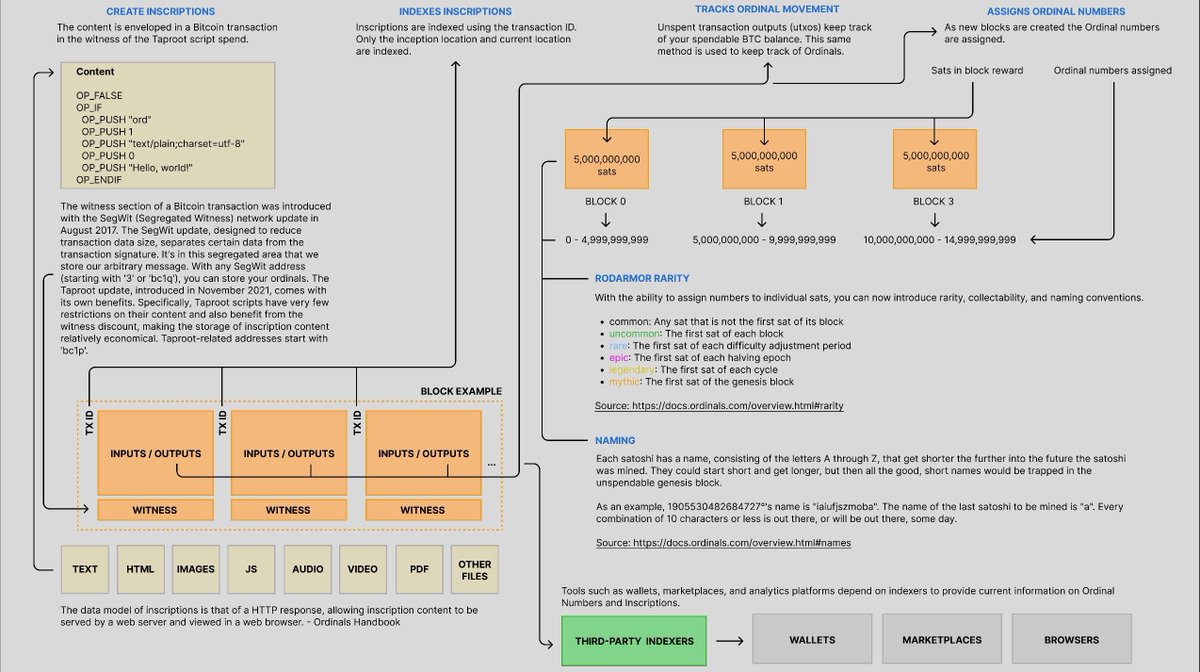
Bitcoin Ordinal Theory protocol was firstly released in January 2023, by his creator @rodarmor. High level explanation of the framework: it's a simple numbering system which allows us to identify, track, and transfer in a first-in-first-out way every single satoshis. How? By simply assigning incremental numbers to individual sats, based on the order in which they were mined in a block. Clear enough? Feel free to re-read this paragraph. 🙃
The numeric system solves the: what, where, from/to who, and when. We are now ready to take this to the next level, and talk about the how. How do we securely store arbitrary data onto the Bitcoin blockchain, within the Ordinal Theory protocol? The answer is, again, simple: inscriptions. They use the witness data portion in the transactions, embedded in each block. In this way it’s possible encode any arbitrary data into hexadecimal code, using the taproot script in the UTXOs (Unspent Transaction Outputs). In other fancy words, an inscription is literally an envelope used to store data in it, and safely move them around onto the blockchain. Infographic 👇below, by @ItsFranken.
The Bitcoin Stamp protocol was firstly introduced in March 2023 by @mikeinspace, to overcome one of the most critical drawback of Bitcoin Ordinal Theory: the possibility of data pruning. More on that later… High level explanation of the framework: they use a progressive numerical system embedded into the assets themselves, based on each transactions timestamps. The what, where, who and when do not really matter for Bitcoin Stamps. In other words it is just seen differently and in a more granular way. According to their creator, at the end of the day: ‘sats do not exist’. Now let’s move into the how.
STAMPS, using the Counterparty protocol, pushes the data directly in the transaction's description key. It’s a small piece of data included in each UTXOs. The envelope in this case is literally split into multiple tiny pieces that can be reassembled and reconstructed with (all) the transactions themselves. The data in this protocol are encoded in base64. To sum it up: Bitcoin Stamp assets are a set of multiple UTXO transactions. Contrary to Ordinals, the data are stored and split into multiple pieces, rather than in the witness data of a single transaction. Better to have a look at the below graph. 👇👇👇
Both protocols have pros&cons, let's dive deep into each of them. Starting with the latter: Stamps. The protocol preaches for making it close to impossible to prune its data, which is a major (existential) threat to any blockchain. In the case of Bitcoin Stamps, they adopt the meta-protocol of Counterparty: a Bitcoin side-chain active since 2014. They use the Bitcoin SegWit address format (starting with bc1q). The biggest PROs are related to the Counterparty protocol inheritance: you could use this protocol to either mint editions as well 1/1s. If you are familiar with the Ethereum smart contracts, despite this is not the same thing, the best analogy between STAMPS and ETH NFTs is the ERC-1155 standard.
Probably the biggest CONs are mainly related to the scalability and the cost to generate multiple outputs: each transaction description key have a data limit of approx. 80 bytes. Yes, you read it correctly: 1KB image must be split in dozen transactions. There it comes the maximum threshold of 7-8KB size limits. Also, only a handful of file formats are supported (JPG, GIF, PNG, or SVG). Everything above that size limit, would basically become nearly impossible to move or could potentially cause severe clogging of the blockchain. As an example: imagine changing a $100 bill into 400 quarter coins and have to carry them all with your bare hands.
Being Ordinals a slightly older and a bit more sophisticated protocol, the biggest PROs are about their scalability: recursion, parent-child provenance, delegation; are only few of the many possibility offered by the them. Another advantage which may also be view as a CONs, especially when compared to the other protocol, is that they are relatively cheaper by using a single witness data portion of a transaction. They require only one UTXO to be moved around. This UTXO will act as a pointer rather than a envelop like in the case of Stamps. They also have to rely on external indexers to keep the numeric system in order.
Now, some words about the data pruning: Bitcoin Ordinals are more easy to prune. Plot twist: this is a good thing for whomever is setting up a new node. Let's go deeper. What is a data prune and why is it bad? Basically, it is the removal of any kind of information previously stored onto the blockchain. It is a manual/automatic filtering of what is not considered essential to the transactions. The Bitcoin Ordinal's witness data portion of a transaction could be pruned. They are fundamentally easy to identify and ignore/remove. By whom? By a node.
On the contrary, Bitcoin Stamps are way more harder to prune, but not impossible. They use a 2/3 multi signature to create redundancy and keep the information stored in the individual UTXOs. Pruning a STAMP is technically possibile but not easy for a node operator. Saying that Stamps are harder to prune than Ordinals is objectively correct.
As of today there are almost 80 millions inscriptions (at this point if this is confusing, I have to apologise: an ordinal is not necessary an inscription) while there are almost 800 thousands Stamps. The market seems to have chosen which protocol is easier to use in the latest 18 months. However, it does not mean one or the other are inferior: they simply differ. Bitcoin Stamps can be "minted" on @Stampchain and bought/sold at @btcOpenStamp or @StampedNinja. Bitcoin Ordinals can be explored via @ord_io or @ordiscan_com and "inscribed" (which means mint) on @MagicEden or @trygamma, to name a few.
I hope you have now a much clear picture of the main differences between the two protocols. Before closing, I would like to emphasise what does it mean to run a node and why it's important (and easy). As I tried to technically highlight in this post, both Ordinals and Stamps rely on the general ledger. This is nothing else than ALL THE DATA STORED since Bitcoin inception. Block by block. Witness sections used by Ordinals and P2SH scripts used by Stamps, both co-exist in the SAME blockchain. Running a (full) node is a guarantee that the data will be preserved.
The SRC101 Genesis Asset (.btc domains) is now available for trading on OpenStamp! 🎉
Trade the first feasible domain name solution on Bitcoin Mainnet and secure your spot in the future of #Bitcoin identity. 🚀
Special thanks to @bitnameservice for bringing this innovation to life.
Start trading now and join the revolution! 🕹
https://t.co/4WLfWFbY4Z
#SRC101 #BTC #OpenStamp
All Runes holders are freaking out over a tiny @MustStopMurad mention.
Little men, wait till he deploys his own SRC20 meme with @btcOpenStamp in 120 second + have it on the oldest ledger forever.
So Tiny Men, you there? Or Has $STAMP scared you.
Permanence is the key 🔑
📢 FairPool: OpenStamp’s brand new SRC20 token minting model is live! 🚀https://t.co/EiySnRdGhl
Dear Stampers,
We’re always listening to and addressing the community’s feedback. We’ve noted concerns from many stampers about the previous minting model, such as paying minting fees & not receiving tokens along with the inconsistency in minting costs for different Stampers. To better serve you, we are thrilled to announce the launch of our new minting model: FairPool! 🚀✨
With FairPool:
① Fees for failed minting transactions will be refunded, avoiding losses from invalid transactions.
② It ensures a fair minting environment where all Stampers have consistent minting costs, preventing tokens from being minted by a few addresses in one go.
Additionally, FairPool introduces new features:
① For deployers, FairPool allows setting royalties to incentivize further token promotion.
② For minters, FairPool saves minting fees (multiple mintings only require one minting fee, though service fees may vary), eliminating Bitcoin’s native long-chain limitation (improving efficiency and reducing costs).
Thank you for your support and feedback. We look forward to providing our global community of Stampers with an exceptional minting experience with FairPool!
Today, a focus on the #pixelart of one of our most active StampMappers : Focus.src20
@focus268 has chosen to represent on #StampMap a rat from the famous Stamps collection: @StampedRats.
An original shape, and a very stylish rat with its glasses, don’t you think?
🟧 224 pixels
💎 224,000 $STMAP
Go follow him on X if you don't already follow him : @focus268
Thank you @focus268 for your involvement.
Do you also have a StampedRat in your wallet?
#Web3 #Bitcoin #SRC20 #stamp #utxo #stamps
The Bitcoin STAMPS protocol embeds images into the Bitcoin blockchain, enabling the integrity and immutability of digital art.
But how do they work?
Let's find out ⤵️
https://t.co/KsHFVewkED