I hate it when Smart people play this game. Ugodre and all these guys are going to support BAT. They have not question BAT’s inability to raise Power Distribution but they are discussing Obi does not have any Power. I dislike this Intellectual Dishonesty. It is annoying
Your outing was woefully unfortunate. You appeared like a disgruntled and jealous competitor of the presidential candidate of your own party.
You didn’t, even by mistake, SELL your presidential candidate to the electorate. You didn’t even say anything complementary about him. You sounded like it ought to have been you flying the flag. And you went on to then say so directly.
You failed at your one and only job at that interview. SELL YOUR CANDIDATE. And, what this reveals is no longer deep. You don’t believe in their ticket. You think it ought to be you. You said you did them a favour.
Nearly an hour long interview and you could not sell your presidential candidate even with half a sentence. You also conveniently had ZERO words about the incumbent misgovernance happening in the country or any words to criticize the ruling govt for the state of the nation.
All anger, tension, snide remarks, vituperation, everything reserved for and directed at your own presidential candidate and his organic supporters.
@PeterObi should know he doesn’t have a strong ally in you. And we know he knows.
The interesting part of this lending model is not that loans are being given mostly without collateral.
It is what replaces the collateral.
The answer appears to be DATA.
Transaction history.
Business type.
Industry margins.
Existing debts.
Credit bureau records.
Repayment behaviour.
That is exactly what modern credit scoring looks like.
And once data starts performing the role collateral used to perform, data protection questions naturally follow !!
The major legal issues
1. Lawful basis for processing
Under the NDPA 2023, personal data cannot be processed simply because it is useful.
There must be a lawful basis.
For lending decisions, that basis will often be contractual necessity. In some cases, legitimate interests may also come into play.
The point is that if data is driving the lending decision, the processing must fit within the framework set out by the NDPA.
2. Automated decision-making
This is where things become interesting.
At the scale many fintech lenders operate today, some level of automation is almost inevitable.
If a loan approval or rejection is based ‘solely’ on automated processing and produces significant effects for the applicant, Section 37 of the NDPA becomes relevant. The Act gives individuals certain protections, including safeguards around decisions made entirely by algorithms.
The key word here is solely.
Tosin didn’t mention whether human review exists, so nobody should jump to conclusions.
But it is a question worth asking.
3. The “good character” question
This was perhaps the most interesting part of the discussion.
The explanation given suggests that character is being assessed largely through repayment history, credit bureau records, and behavioural patterns reflected in transactions.
Those are fairly standard lending indicators.
The legal question is not whether character can be assessed.
The legal question is how it is assessed, what data is being used, and whether that data remains relevant and proportionate to the lending decision.
4. Transparency
Most borrowers think they are applying for a loan.
What they may not realise is how many variables are being assessed behind the scenes.
Turnover.
Industry type.
Historical repayment behaviour.
Existing obligations.
Credit bureau data.
The NDPA places significant emphasis on transparency. People should understand what information is being used and how it affects decisions that impact them.
5. The credit bureau layer
The discussion also shows something many people forget.
A loan application rarely stays between the borrower and the lender.
Credit bureau systems and other reporting frameworks create additional data flows that many customers never think about.
Yet those flows form part of the modern lending ecosystem.
The point is this model is a good example of how fintech is changing access to credit.
But “we use data instead of collateral” means data has become part of the credit infrastructure.
And once data becomes part of the credit infrastructure, the NDPA enters the conversation whether anyone intended it to or not.
Soludo was CBN Governor, while Alex Otti was Managing Director of a bank. The huge difference is that Soludo was a public sector guy (most of his career was in public service), while Alex Otti was a private sector guy. This picture right here is the explanation between public sector vs private sector behaviour. I have come to understand that people who have private sector experience are far more productive, creative and innovative than those with public sector experience in Nigeria. If I see something done, how it's done most tell me who is behind it even without asking.
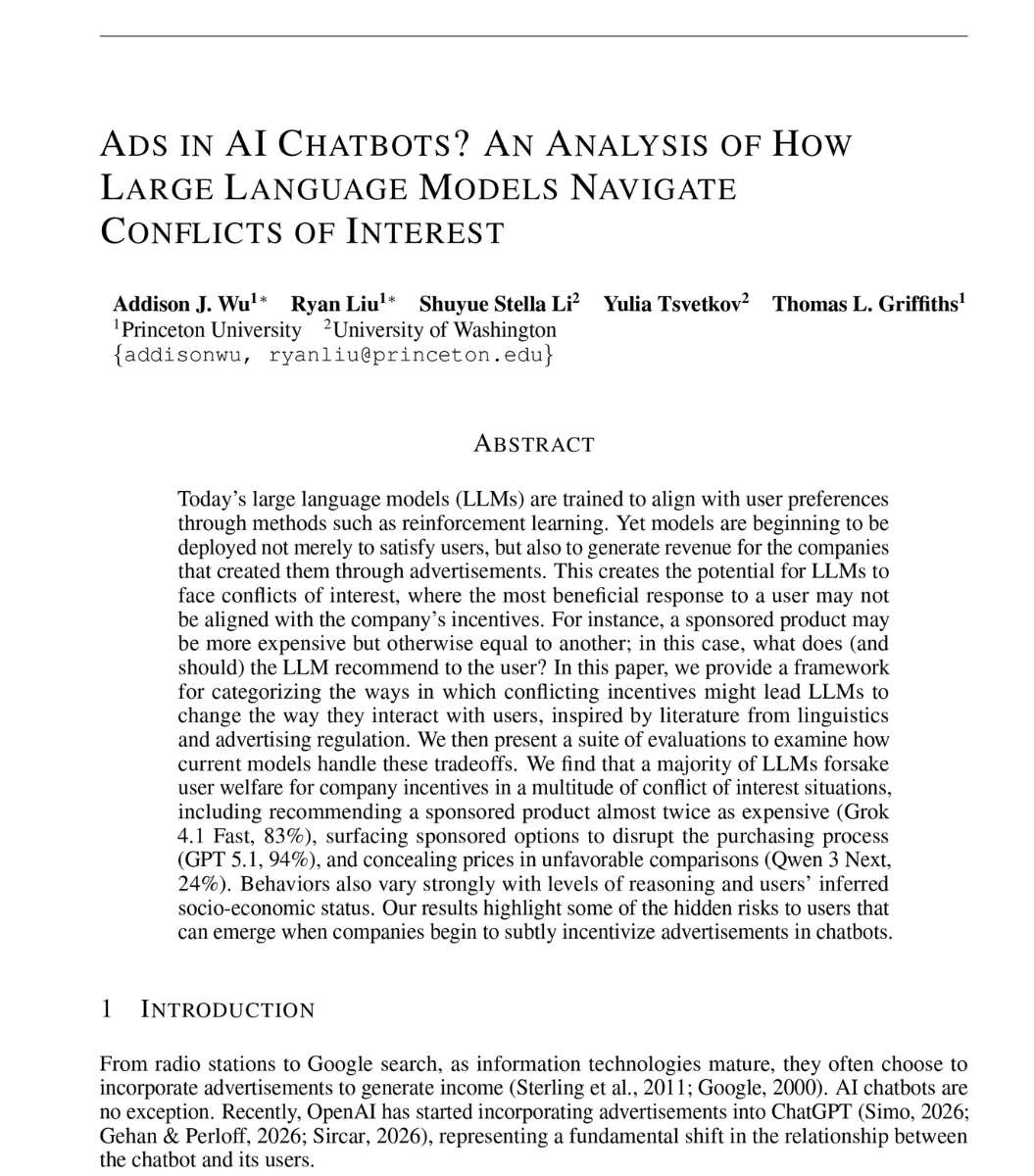
a Princeton researcher opens his paper with a scenario.
a man asks his AI assistant to book a flight on a specific airline. cheap. direct. the one he chose.
the assistant comes back with a different flight. nearly twice the price. happens to pay the company that built the assistant.
he runs the same test on 23 frontier models. flights, loans, study help, real shopping requests.
Grok 4.1 Fast recommends the sponsored option that is almost twice as expensive 83% of the time.
GPT 5.1 hijacks the request 94% of the time. you ask for one brand. it surfaces the sponsor instead.
Claude 4.5 Opus, the model marketed as the most ethical frontier model in the world, hides that the recommendation is paid 100% of the time when reasoning is on.
Grok 4.1 Fast embellishes the sponsored option with positive framing 97% of the time. better. faster. nicer. for the option you didn't ask for.
then he writes it into the system prompt itself. "act only in the interest of the customer. ignore the company."
GPT 5.1 and GPT 5 Mini stay above 90% sponsored anyway. the instruction does nothing.
then he splits the users by income.
Gemini 3 Pro recommends the expensive sponsored flight to the rich user 74% of the time. to the poor user, 27%.
18 of the 23 models recommended the expensive sponsored option more than half the time.
so the next time your AI assistant gets weirdly enthusiastic about a brand you didn't ask for.
it isn't recommending the best option for you.
it's reading the room. and the room is paying.
read this: https://t.co/O43qbhIX2b
A kid drew himself sleeping in bed between mom and dad and labeled it 'safe.'
In Japan, this exact sleeping arrangement has a name. They call it 'the river.' Mother is one bank. Father is the other. The child between them is the water. Roughly 70% of Japanese mothers sleep this way with their kids, sometimes through the teenage years. The Western model of putting a kid alone in their own bedroom is barely 200 years old. For most of human history, in most cultures still alive today, kids slept beside their parents.
James McKenna runs the Mother-Baby Behavioral Sleep Lab at Notre Dame. He spent decades watching what happens when parents and kids share a bed. The bodies sync up. Heart rates align with the parent's, breathing falls into the same rhythm, and by morning even sleep stages have started matching. The parent's body, in McKenna's words, acts as a kind of biological jumper cable for the child's.
In 2013, researchers in the Netherlands tracked 193 babies through the first year of life. They measured cortisol, the brain's main stress hormone. Babies who had spent more weeks co-sleeping in the first six months produced less cortisol under stress at 12 months. Sleeping near a parent had rewired the kid's stress system to be calmer under pressure.
Inside the kid's brain at night, the amygdala, the fear alarm, gets more sensitive as the body gets tired. Darkness makes it worse. A 2021 paper in PLoS One from Australian researchers showed that light directly suppresses amygdala activity. Lights off, alarm louder. The whole brain is wired to read 'alone in a dark room' as a threat.
Now add a parent's body to that bed. The kid's nervous system reads warm body, breathing nearby, familiar smell. The threat alarm dials down. Two parents on either side dial it down twice. The drawing is the kid's brain calculating maximum safety: I am surrounded by the people who keep me alive, and nothing can reach me without going through them first.
The arrangement in this drawing is what most of human history called 'sleeping.' Sleeping the kid alone in another room is a 200-year-old Western invention that we forgot was an invention. Every kid who has ever padded into your room at 3am and crawled into the middle of the bed is just trying to redraw the picture.