@dallaslones@shmidtqq@grok Not really a local model for the “regular” user due to its high hardware requirements.
Great model but it needs to run in the cloud right now to be truly useful.
@alexwg@SkunkWorks0x The Moonshots episodes are 🔥. Peter mentioned that some folks are asking for shorter duration shows. I just want to hear the mates’ insights on all the news each week whether it’s two long shows or five short ones.
Also wanted to mention @PeterDiamandis and @tonyseba both for their contributions on the concepts of Abundance and Exponential Growth. They're both people you should follow, along with @farzyness, for incredible insights into the amazing time that we're experiencing.
AI is changing our world in so many ways and the rate of change, the rate of improvement, is only accelerating!
I couldn't agree more! Data center opposition is growing seemingly exponentially. If the companies behind the centers either built solar power plants for the community/state or offered grants for individuals we might see some of that opposition weaken.
As for the water issue, I think most of it is due to propaganda. The majority of data centers run closed loop cooling systems (think of your car's radiator). There's no continual water usage in these systems.
A national sovereign wealth fund is possibly the best way to go to ease the transition to the new economy of abundance. The challenge would be the government. Meaning the government shouldn't raise barriers to the growth that AI is and will bring AND government mustn't allow bureaucratic siphoning to occur where certain individuals or entities with ties to govt. officials drain millions from the sovereign wealth fund for their own gain.
We are in the singularity right now. How we navigate the next few years is incredibly important.
@RepBrianFitz@SenFettermanPA@SenMcCormickPA@SenatorJColeman@RepStaats
@XFreeze I use Grok for most things, Claude has typically seemed to be better at coding tasks. With the new Oauth capability, I've plugged it into my Hermes agent and hit my subscription monthly limit!
AI is The King Maker
For most of human history, living like royalty was reserved for the very few. The aristocracy of the 18th and 19th centuries didn’t just have money, they had something far more valuable, people.
They had cooks who knew their preferences, butlers who managed their households, valets who helped them dress for every occasion, drivers who anticipated their schedules, and staff who handled security, maintenance, and logistics. These weren’t luxuries in the modern sense. They were the infrastructure of a comfortable life.
Today, most of us look at that lifestyle and assume it’s gone forever. It’s too expensive, too impractical and fundamentally incompatible with a modern egalitarian society.
We’re wrong.
The coming Age of Abundance, driven by artificial intelligence and robotics, won’t just make goods cheaper. It will recreate the lived experience of the aristocracy for everyone. Not through human servants, but through something far more powerful, intelligent agents and autonomous systems that work for us 24/7.
The End of Scarcity Thinking
Visionaries like @PeterDiamandis have long argued that we’re entering an Age of Abundance. Exponential technologies like AI, robotics, solar energy, biotechnology, and advanced manufacturing are driving the cost of fundamental goods and services toward zero. @tonyseba, in his work on technology disruption, has shown how entire industries can collapse in cost and transform in capability within a single decade.
When energy becomes nearly free, when food production is localized and automated, and when intelligence is abundant and on-demand, the economics of daily life change dramatically.
But abundance isn’t just about cheaper stuff. It’s about capacity. The aristocracy didn’t just own more things, they had more agency. Their time and attention were protected. Their environments were optimized. Their needs were anticipated.
That is what AI is about to deliver at scale.
Your Personal Staff of Agents
Imagine waking up in a world where you have your own version of a 19th-century household staff. Except these “servants” are tireless, infinitely patient, and get smarter every day.
Your Household Agent acts as a chief of staff. It knows your calendar, your energy levels, your family’s schedules, and your long-term goals. It doesn’t just remind you of meetings, it prepares context, surfaces relevant information and can even handle minor decisions within boundaries you define.
Your Kitchen Agent knows what’s in your refrigerator and pantry, understands your dietary needs and preferences and plans meals accordingly. As consumer robotics mature, this same agent will eventually direct physical systems to prepare food, turning “what’s for dinner?” into a solved problem rather than a daily decision.
Your Security and Home Agent monitors your property, manages maintenance, and coordinates with other systems. It doesn’t just detect problems, it works to prevent them.
Your Transportation Agent handles movement. Whether it’s preconditioning your vehicle or summoning an autonomous ride exactly when you’re ready to leave, the friction of getting from one place to another largely disappears.
These aren’t separate tools. They’re coordinated systems that share context about you. This is the critical difference between today’s AI and what’s coming. Most people still interact with AI as a sophisticated search engine or writing assistant. In the Age of Abundance, AI becomes infrastructure, persistent, proactive and deeply personalized.
Not Just Tools - But Leverage
The aristocracy didn’t become powerful because they worked harder than everyone else. They became powerful because they had leverage. Every hour of their day was multiplied by the efforts of others working in service to their goals.
AI is about to give that same leverage to everyone.
This doesn’t mean people will stop working or creating. It means the baseline of what’s possible for an individual will rise dramatically. The gap between what one person can achieve with a team of agents versus what they can achieve alone will be enormous.
We’re already seeing early versions of this with tools that can research, write, code, and manage workflows. But we’re still in the “chatbot” phase. The real shift happens when these capabilities become always-on agents that understand your world, remember your preferences and act autonomously within boundaries you define.
The Timeline
Some of these capabilities are closer than they appear. Software agents with strong memory and goal-directed behavior are already being built. The major limitation today isn’t intelligence, it’s reliable execution in the physical world.
Robotics will lag behind software agents by several years, largely due to manufacturing and cost curves. But the pattern is familiar, what begins as expensive and limited eventually becomes cheap and ubiquitous. The same trajectory that turned computers from room-sized machines into devices in every pocket will eventually bring capable robots into homes and businesses.
Peter Diamandis and Tony Seba have both emphasized that these transitions tend to feel sudden, even when the underlying technology has been improving exponentially for years. The moment when something moves from “impossible” to “obvious” is often surprisingly brief.
A New Kind of Status
If everyone can have their own version of an aristocratic household, what does status mean?
This is one of the more interesting questions the Age of Abundance raises. In the past, visible signs of wealth were largely about having more human attention directed at you. In the future, status may shift toward quality of agents, depth of personalization and freedom from friction.
The real luxury won’t be having servants. It will be having agents that know you so well they can handle the mundane so you can focus on what actually matters to you, whether that’s creative work, relationships, learning or simply living with less stress.
The Real Question
The technology is coming. The more important question is how we choose to use it.
Will we use widespread agentic systems to optimize for consumption and entertainment? Or will we use them to expand human capability, creativity, and connection?
The Age of Abundance doesn’t guarantee a better world. It guarantees a world brimming with limitless possibilities. What we do with that is still up to us.
The aristocracy of the past had servants. We’re about to have something better with systems that can think, remember and act on our behalf. The question isn’t whether this future is coming.
The question is what kind of life we’ll choose to live when it arrives.
Google just bet on agents over chatbots, and it fits a bigger pattern.
Google announced Gemini 3.5 Flash with a clear strategic focus: optimizing for agentic workflows rather than general conversation.
They’re de-emphasizing chatbot-style interactions and doubling down on planning, tool use, and multi-step execution.
This aligns with what we’ve been seeing from OpenAI and Anthropic, foundation models are increasingly absorbing agentic capabilities directly into the base model.
As this trend continues, general-purpose agent platforms that mostly add thin orchestration layers will face real pressure.
The opportunity appears to be shifting toward governance, vertical specialization, and deeper enterprise control, areas the base models don’t solve as easily.
How are you positioning your AI strategy as foundation models get better at agentic tasks?
#MadeWithAI #AgenticAI #Gemini #Google
Elon Musk lost his lawsuit against OpenAI. But the bigger question remains.
A jury ruled against Elon Musk in his case against OpenAI and Sam Altman. Many of his claims were dismissed due to timing (statute of limitations).
Musk’s core argument was that OpenAI had abandoned its original mission as a non-profit created to develop safe AGI for humanity.
OpenAI was founded in 2015 as a non-profit. It later created a capped-profit structure and took major investment from Microsoft. Moves that significantly changed its incentives and direction.
While the legal case is largely over, the underlying question is still relevant: Did OpenAI meaningfully move away from what it originally claimed to stand for?
This isn’t just about one lawsuit. It reflects a broader shift happening across frontier AI labs as they scale rapidly and attract massive capital.
Do you think OpenAI stayed true to its founding mission, or has it become something quite different?
#MadeWithAI #OpenAI #FutureOfAI
The quiet consolidation happening in agentic AI and what it means for builders.
We’re seeing foundation models increasingly absorb capabilities that used to live in separate agent platforms and tools.
Anthropic has been particularly aggressive with “unhobbling” Claude... turning latent abilities into polished vertical tools for design, legal work, and small business operations.
OpenAI appears to be moving in a similar direction with deeper agentic features inside their models.
This creates real pressure on general-purpose agent platforms that mostly add thin layers of orchestration and tool use on top of existing models.
However, this doesn’t eliminate the need for agentic systems. It shifts the opportunity toward governance, security, vertical specialization, and deep enterprise integration.
The question is evolving from “Which model should I use?” to “What part of the stack actually creates durable value?”
How are you thinking about this shift in your own AI strategy?
#MadeWithAI #AgenticAI #FutureOfAI
Claude vs Grok vs GPT-4o. Which is best for small businesses in 2026?
Quick comparison of the three leading AI models for small and mid-size businesses right now.
Claude (Anthropic)
→ Best quality reasoning & writing
→ Most reliable and safe
→ Best for complex or professional work
→ Slightly slower & more expensive
Grok (xAI)
→ Fastest responses
→ Strong personality + real-time knowledge
→ Best value (especially with X Premium)
→ Can be more opinionated
GPT-4o (OpenAI)
→ Best all-rounder
→ Strongest ecosystem (voice, vision, tools)
→ Most widely used
→ Very versatile
My take for most small businesses:
- Claude for high-quality work
- Grok for speed + personality
- GPT-4o when you want one model that does everything well
Which one are you using most in your business?
#MadeWithAI #Claude #Grok #GPT4o #SmallBusinessAI
Google just launched a new laptop category called Googlebook.
Google announced Googlebook, a new line of AI-native laptops built around Gemini Intelligence.
Key feature: Magic Pointer, an AI-powered cursor that gives contextual suggestions as you work.
It runs on an Android-centered OS (with ChromeOS elements) and will be made by Dell, HP, Lenovo, Acer, and Asus.
This is Google trying to create a more capable AI-first computing experience than traditional Chromebooks.
AI is moving from apps into the actual hardware we use.
Do you think dedicated AI laptops will catch on?
#MadeWithAI #Googlebook #Gemini #AILaptops
AI agents are now showing real self-improvement capabilities.
New research shows advanced agents can now create new skills and improve their own performance over time with little human help.
This is a notable step toward agents that can genuinely evolve on their own.
Self-improvement reduces the need for constant prompting and supervision.
This brings us closer to practical, low-maintenance AI teammates.
How valuable do you think self-improving agents will be for businesses?
#MadeWithAI #AgenticAI #SelfImprovingAI
AI is a critical piece of America's infrastructure. If you don't think it's important consider this:
- Right now AI has found cures for cancer and more are on the way
- AI is finding treatments/cures for diseases by matching up existing drugs to those diseases
- it's solving decade's (century) old math problems
- the technology is being used by businesses to run more effectively (answer customer questions "instantly" for example)
- the tech makes self-driving cars possible (Waymo, Zoox, May Mobility, Motional, Nuro and Tesla)
- it's used by millions of regular people to make their lives better
Just like the Industrial Revolution and the birth of the Internet, we can't imagine how life will be better for everyone because of this new invention.
The end of turn-based voice AI? Interaction Models just dropped.
Mira Murati’s Thinking Machines Lab released “Interaction Models.” AI that handles real-time, continuous interaction instead of rigid turn-taking.
It processes audio + video in micro-turns (~200ms), allowing natural interruptions, backchanneling, and simultaneous listening/speaking.
Demos show it counting workout reps while watching video, live translating while you speak, and collaborating in real time.
Voice AI is about to feel much more like talking to a real teammate.
This is a big architectural shift in “Made with AI”.
Is continuous interaction the future?
#MadeWithAI #InteractionModels #VoiceAI
@YouTube It appears that your latest Apple TV app update has broken the functionality of both the physical Apple TV remote and the remote app on iPhones.
Touchpad "scrolling" no longer works
Anyone else having issues?
When will this be fixed?
#Youtube#AppleTV #brokenInterface
Anthropic just rolled out major Claude updates with stronger agentic capabilities.
New Claude update brings improved multi-step reasoning, better self-improvement loops, and expanded autonomous tool use.
This is one of the more meaningful jumps in production-ready agentic AI recently.
Agents are becoming better at handling complex, ongoing workflows with less hand-holding.
Your digital teammate just got noticeably more capable.
This is “Made with AI” maturing fast. How are the new Claude features working for you?
#MadeWithAI #AgenticAI #Claude #Anthropic
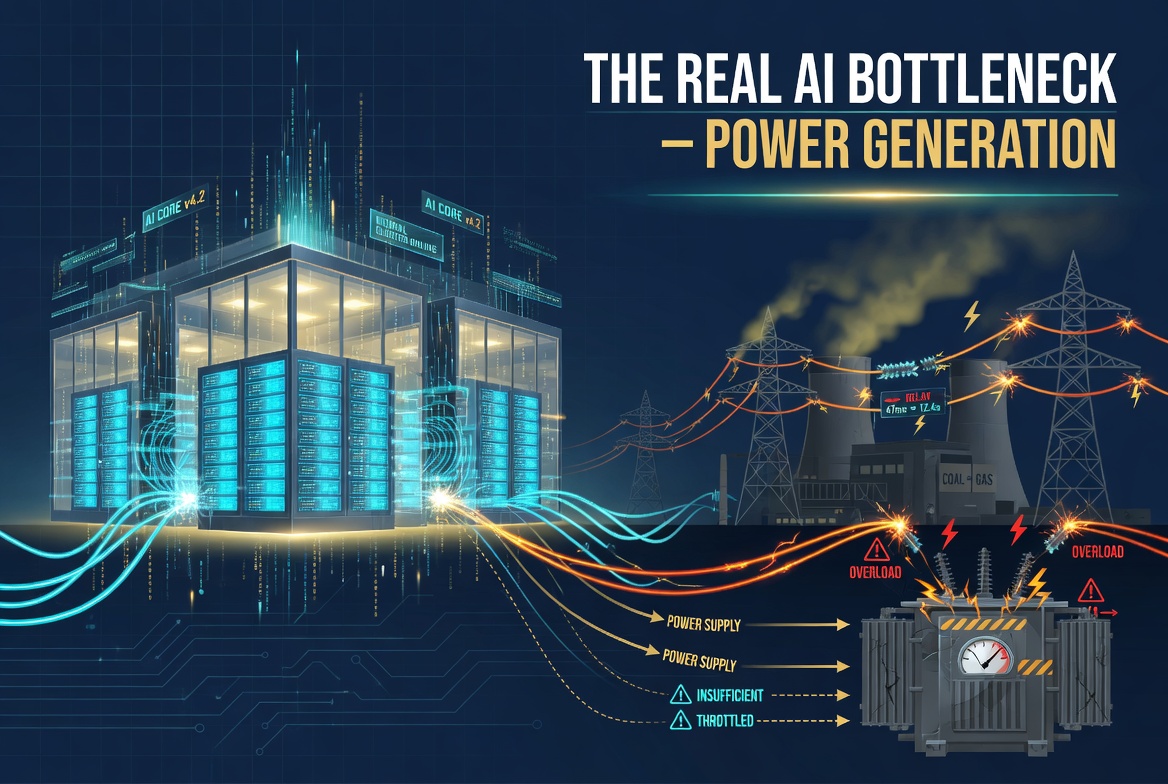
Elon Musk says the real AI bottleneck is power plants, not chips.
The biggest constraint on AI progress right now isn’t GPUs, it’s electricity generation and grid infrastructure.
Power plants and transformers are booked years out, creating huge delays for new data centers.
This is Jevons Paradox playing out at massive scale: the more capable AI gets, the more power it consumes.
(the better it gets, the cheaper it gets, the more people want it driving power requirements skywards)
Quakertown founders: the infrastructure layer behind “Made with AI” is hitting real physical limits.
How do you think the power shortage will affect AI adoption and costs for smaller businesses?
#MadeWithAI #AIInfrastructure #PowerShortage