The Permabull will tell you bears always lose. Bears who buy nothing do lose. So do bulls who sell nothing. The market does not pay for a permanent opinion. It pays for the right one, at the right time.
A lot of people learn Elliott Wave as a set of rules:
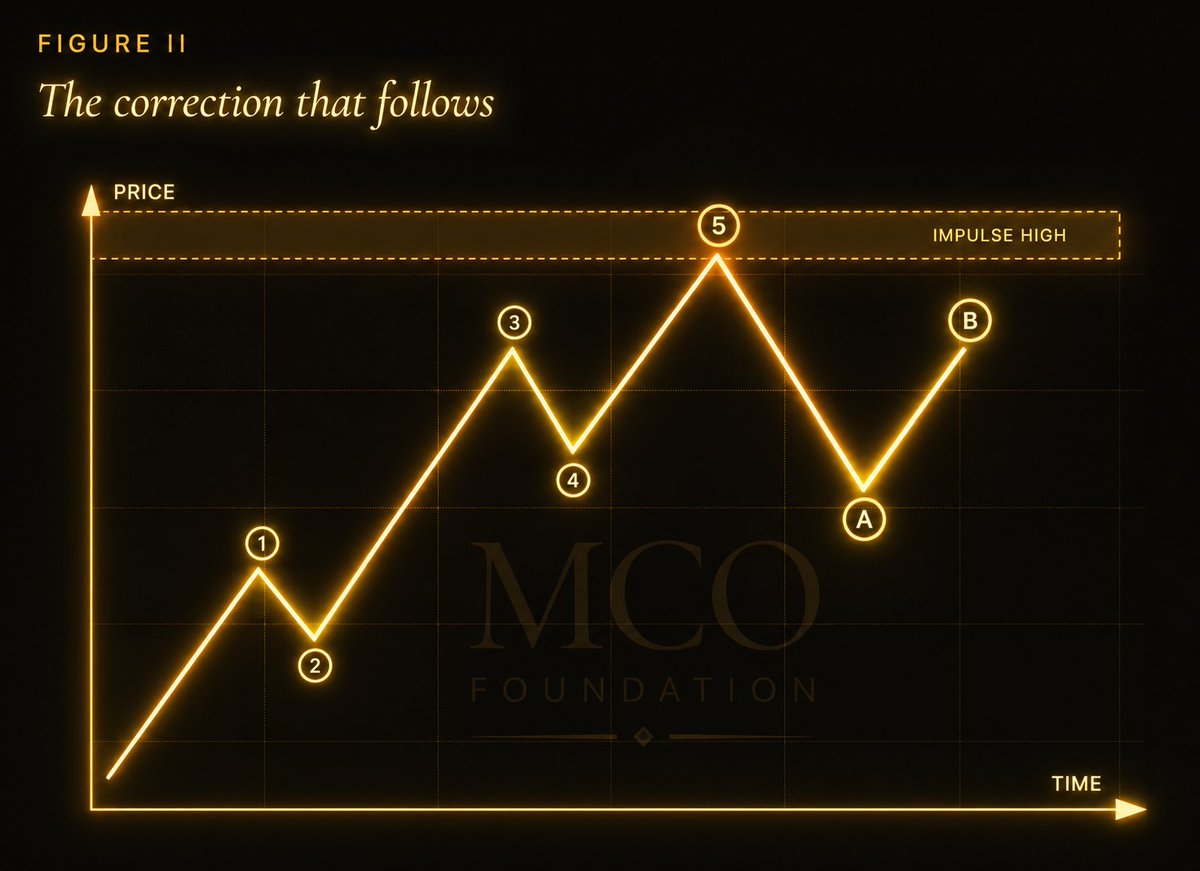
5 waves with the trend, 3 waves against it.
What often gets missed is that this actually makes intuitive sense when you think about how markets behave.
A trend needs work.
If a market is going to move from one price level to a much higher one, it rarely happens in a straight line. Buyers step in, some take profits, others doubt the move, new buyers enter, weak hands get shaken out. The trend has to continuously absorb supply on its way higher. That's why it tends to develop in multiple stages.
Corrections are different.
A correction is usually not trying to establish a new trend. It is simply the market pushing back against the previous move. Think of it like a pause, a reset, or a negotiation between buyers and sellers. It doesn't need the same degree of participation and commitment as a sustained trend move.
This is one of the reasons I find Elliott Wave so interesting.
The theory isn't really telling us that markets "must" move in 5s and 3s. It's observing that human behaviour tends to create these structures naturally.
Building confidence takes time.
Losing confidence is usually much quicker.
Maybe that's why trends often need five waves to develop, while corrections can get the job done in three.
Bitcoin has likely completed the typical Bear Market B-Wave rally.
In many bear markets, the B-Wave is the phase that convinces people the worst is over. It often produces a strong recovery, improving sentiment, bullish headlines, and renewed confidence. Many participants start believing a new bull market has already begun.
The problem?
B-Waves are usually corrective in nature. They can be powerful, but they often lack the impulsive structure seen at the start of sustainable bull markets.
If the recent rally was indeed a B-Wave, then Bitcoin may now be entering the C-Wave lower. That would represent the final phase of the bear market, a stage often associated with disappointment, fading optimism, and widespread capitulation.
What should traders watch?
- A failure to reclaim key resistance levels
- Corrective rallies rather than clear 5-wave advances
- Increasing bearish momentum after each bounce
- Sentiment shifting from "buy the dip" to frustration and apathy
Ironically, the C-Wave is often where the best long-term opportunities are created.
The crowd tends to be most optimistic near B-Wave highs and most pessimistic near C-Wave lows.
That's why understanding market structure matters more than following sentiment.
$BTC
Bitcoin is still following the roadmap I laid out 14 months ago when I said:
"When the next bear market hits, it won't be the time to panic sell. It might be one of the best buying opportunities of the decade."
There is a lot of fear in the market right now.
Ironically, the same people who wanted to buy Bitcoin at $120,000 often lose interest when it trades 50% lower.
That is exactly why bear markets create opportunity.
DAILY REMINDER
B-waves are one of the hardest parts of Elliott Wave because they often look like the trend has fully resumed. Price recovers, bullish news returns and traders slowly regain confidence, even though the market may still be inside a larger correction. Most B-waves retrace between 50% and 78.6% of Wave A, with the 61.8% level being especially common, but their exact structure is usually only clear in hindsight. BTC may currently be inside this kind of environment where the rally feels convincing while the larger corrective structure is potentially still unfolding. That is why patience, risk management and confirmation matter so much during B-wave conditions.
bitcoin:native