Wolves run stronger together! 🐺
The WPL Community Engagement Program empowers Starknet creators, rewarding impactful contributions that fuel our pack’s growth.
Private by Default? What We Learned at the Zama × Web3Bridge Workshop 👨💻
Yesterday, we brought builders, researchers and curious minds together in Lagos for a workshop centred around one theme: Confidential Onchain Finance.
We didn't want a panel where everyone simply nods along and takes turns giving speeches. So, we built the entire session around a single question and allowed people to disagree:
Can finance be private on a public ledger and still be trusted?
Why this question?
We opened with a simple picture. Imagine your salary, rent payments and savings balance pinned to a public noticeboard that anyone in the world can read, forever. That's how most blockchains work today.
Then we asked the room two questions: Who would put their entire financial life on a fully public ledger? And who thinks criminals would love a fully private one?
Those two questions capture the whole tension in a nutshell. Transparency makes blockchains trustworthy, but it can also make them unsuitable for institutions. Privacy addresses that problem, but it also makes regulators nervous.
Why confidentiality matters
The panel started with the problem. When every transaction is public by default, things break. Salaries leak. Trading strategies get front-run. Balances and identities get stitched together by anyone who cares to look.
We asked who needs confidentiality most: everyday users, businesses or institutions. We also discussed what's actually ready today versus what's still a lab experiment, across zero-knowledge proofs (ZK), fully homomorphic encryption (FHE) and multi-party computation (MPC).
FHE allows you to compute on encrypted data, while ZK allows you to prove that something is true without revealing the underlying data.
The Trust Dilemma
This is where the real debate happened: privacy versus compliance.
Is privacy in crypto a feature or a red flag for regulators? Can we build "compliant privacy" through mechanisms such as selective disclosure or viewing keys for auditors, or is that a contradiction? And perhaps the hardest question: who should hold the keys to access private data? Users, regulators, or no one?
We also brought the conversation closer to home. What does confidential finance mean for people in Nigeria and across Africa, where financial surveillance and fraud are both very real concerns?
For many people here, remittances and stablecoins aren't just theories. They're how money moves.
Then we sped things up with 15-second answers to questions like:
- What's the biggest myth about onchain privacy?
- Should privacy be the default or a choice?
Privacy should be the default, not a privilege users have to opt into. People shouldn't have to choose between using technology and protecting their personal information. Transparency should be by choice; privacy should be by default.
From debate to building
After the roundtable, the CEO of @Web3bridge presented on confidential onchain finance. I followed with a presentation on @raycashxyz , and @DefiPreacherr rounded off the day with a hands-on technical workshop.
We spent the morning debating whether confidential finance was possible. Then we explored how Zama's technology is making it possible and practical.
By the afternoon, participants were getting hands-on experience with how the technology works and how it can be integrated into their applications.
Where I've landed
Wanting privacy doesn't mean you have dirty hands or something to hide. It simply means you want the freedom to decide what information you share, with whom, and when.
Privacy on a public ledger isn't about hiding. It's about choosing who sees what.
The conversation isn't finished, but it's certainly clearer now than it was yesterday morning.
Huge thanks to @Zama, @randhindi@Web3Bridge , our panelists @Ebunayo08, @DefiPreacherr and @_peacejoel__, and everyone who showed up, participated and challenged ideas.
What do you think: should onchain finance be private by default? 👇
the wolf has always been here 🐺
through the trenches. the pumps. the nukes. the chaos.
most active Starknet degenz chose to endorse it.
to run it together.
as a pack.
$DEGENZ
bloodshot eyes. spirits high.
https://t.co/8IXqNKPyF0
When @Starknet said it was preparing for the quantum era, I never thought they would go this hard😳
You know how when your wallet gets compromised, you abandon it and create a new one?
Years of onchain history and reputation, wasted?
StarkNet just launched a wallet that rivals how we react to that.
___________
Is anyone's balls tingling? Cause mine are!
When I first saw the announcement about @Bramble_fi two days ago, I just thought, well it's probably another wallet. But I was wrong.
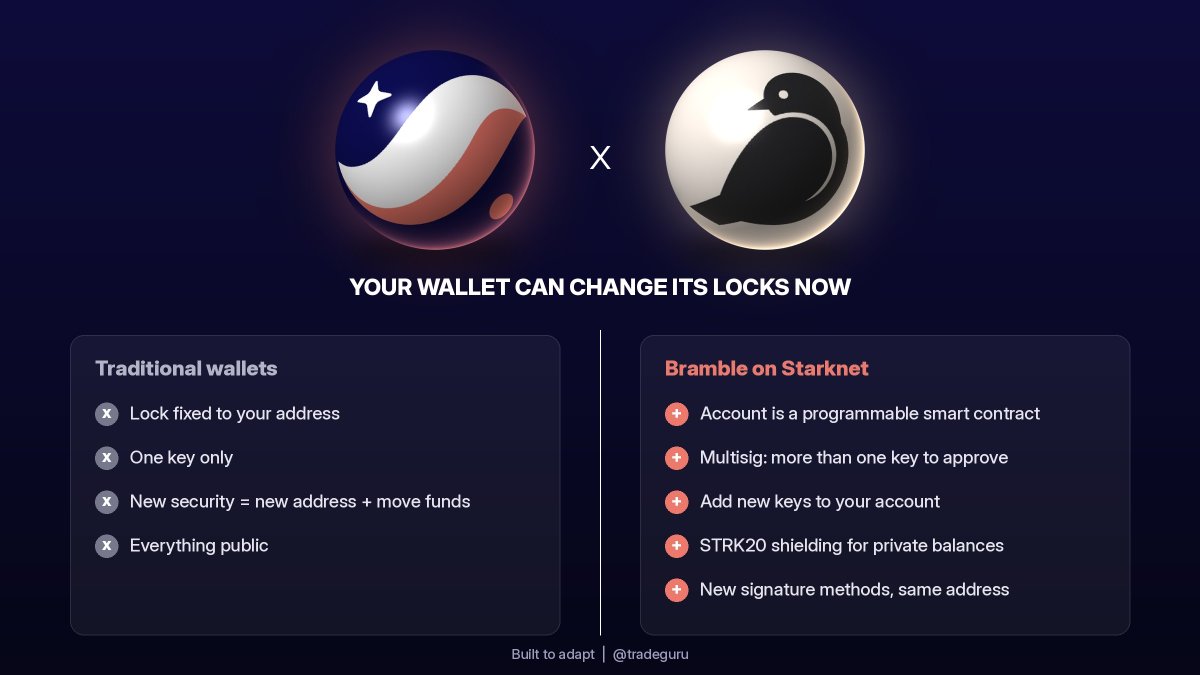
Bramble is a STRK20 privacy wallet with three major features:
✓ account abstraction
✓ multisig
✓ built-in privacy
But the real magic of this wallet isn't even a feature on this list.
This build by starknet gave me a good chance to look at an idea that had not crosed the boundaries of reasonning for most people:
A wallet security upgrade. https://t.co/yZ4TBKHRi5
On Bramble you don't just swap and store your crypto, you alone have full custody. Of course self-custody sounds boring because Rabby, Metamask and other basic wallets offer the same thing.
However, when you look at it from this angle, it changes how you see Starknet entirely.
In most wallets, your key is your account. If that key ever gets compromised, the only fix is to create a new wallet, and move everything.
On Starknet, you simply upgrade the security by swapping the compromised key, or set up a multisig.
You get to keep the same address and its history.
Bramble is live on mainnet but only as a Chrome extension for now. Download it only from https://t.co/WQ1hSlpZ9A, because fake links are already going around.
To be clear, this is Starknet preparing for quantum threats. Being able to adapt isn't the same as being fully protected, and the migration work is still going on.
I tested it by importing my EVM seedphrase, here's how I did it in tweet 2.
$SOL at $17: "dead chain"
$SOL at $70+: "I should've bought"
$NEAR at $1: "irrelevant"
$NEAR at $4+: "underrated gem"
and now there's @Starknet
if $STRK ever makes it back to $3+, will the narrative suddenly change again?
or are you waiting for the price to tell you what to believe?
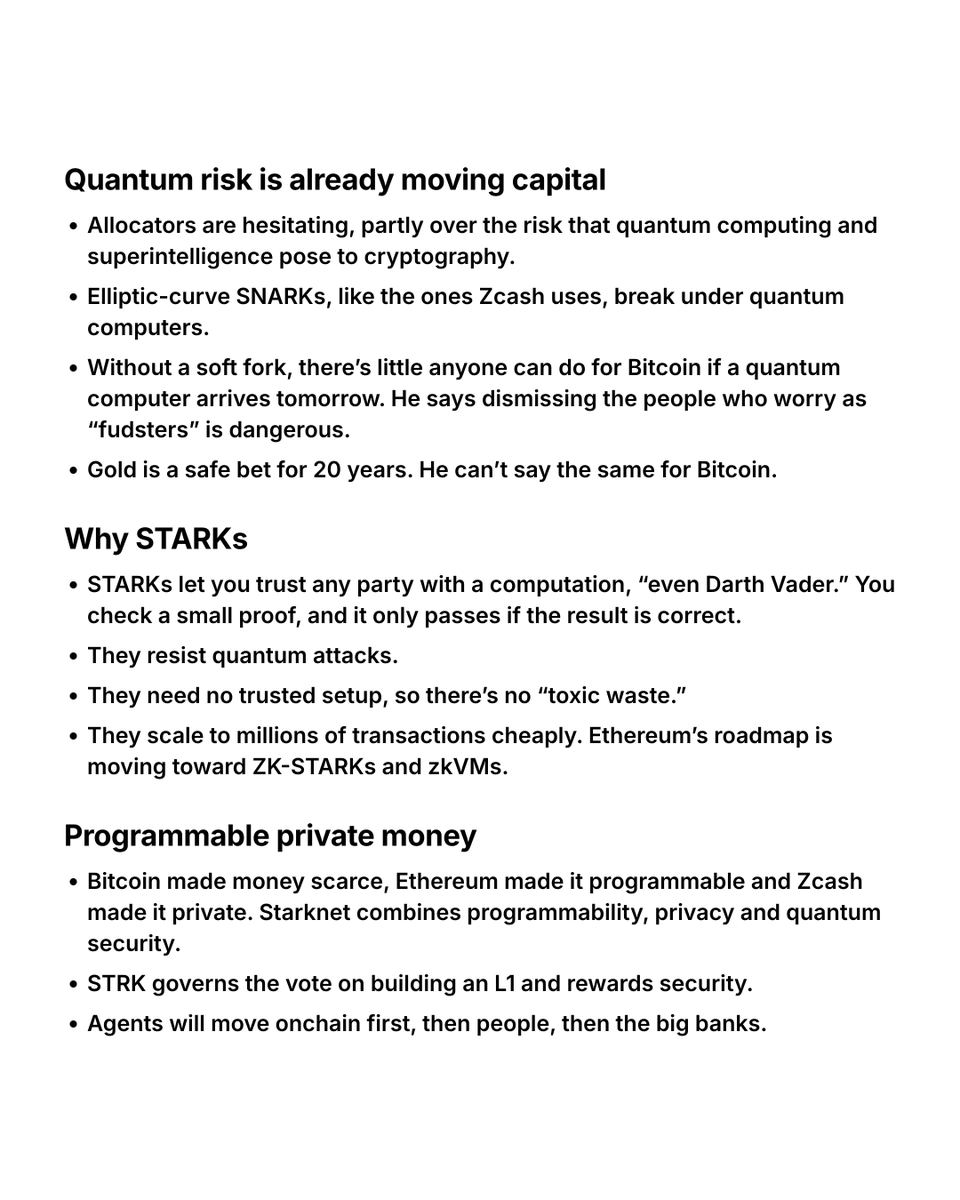
Vitalik Buterin recently raised an important concern: AI could accelerate mathematical breakthroughs that weaken cryptography we currently consider secure.
His warning goes beyond quantum computing, particularly questioning the long-term security assumptions behind lattice-based cryptography.
This makes @Starknet approach to cryptographic security worth watching.
Starknet has two important design advantages:
→ STARK proofs: They rely on hash-based cryptography rather than elliptic-curve assumptions, providing a foundation designed to withstand known quantum attacks.
→ Native account abstraction: Every account can define its own transaction authorization rules, making it possible to adopt alternative signature schemes without requiring a new wallet address.
Starknet has already demonstrated an experimental quantum-resistant wallet completing a mainnet transaction, showing how this flexibility can work in practice.
But there's an important distinction.
Vitalik's warning concerns potential AI-assisted attacks on cryptography, not proof that existing cryptographic standards have already been broken.
Starknet's hash-based proof system and flexible account design offer useful foundations, but they do not automatically guarantee protection against every future cryptographic breakthrough.
Blockchain security cannot depend on the assumption that today's cryptography will remain secure forever.
We need systems designed to evolve as the threats evolve.
And that's why Starknet's work on post-quantum security deserves attention.
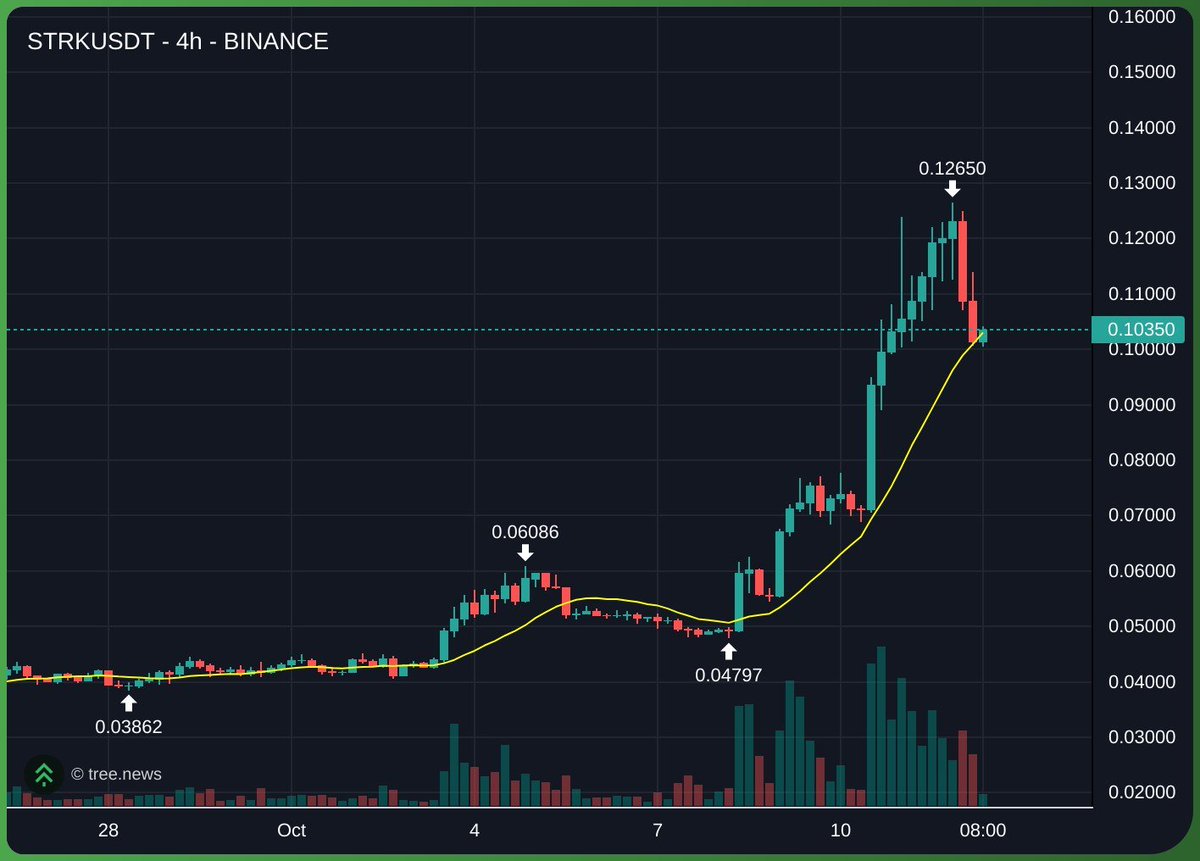
first healthy retracement $strk
looks incredible for next move
thesis remains the same re: mathematical breakthroughs keep accelerating in frequency & mindshare -> confluence with anth ipo schedule in the near future -> media heavily incentivized to keep pushing this narrative
Starknet brothers, welcome to the trenches.
You can now launch coins paired with $STRK from @Starknet, on StonkFun.
https://t.co/Lq5IOclKDH
Powered by @Sunrise.