The global neuronal workspace (GNW) is currently the best documented neuroscience mechanism by which conscious processing arises in the human brain — and now Anthropic researchers have discovered a similar workspace inside their large language model !
In neuroscience, global workspace theory holds that thoughts become consciously accessible when they enter a privileged workspace that’s broadcast across the brain.
Using a new interpretability technique, we found something similar in Claude: the J-space. https://t.co/sLu2JgYwOQ
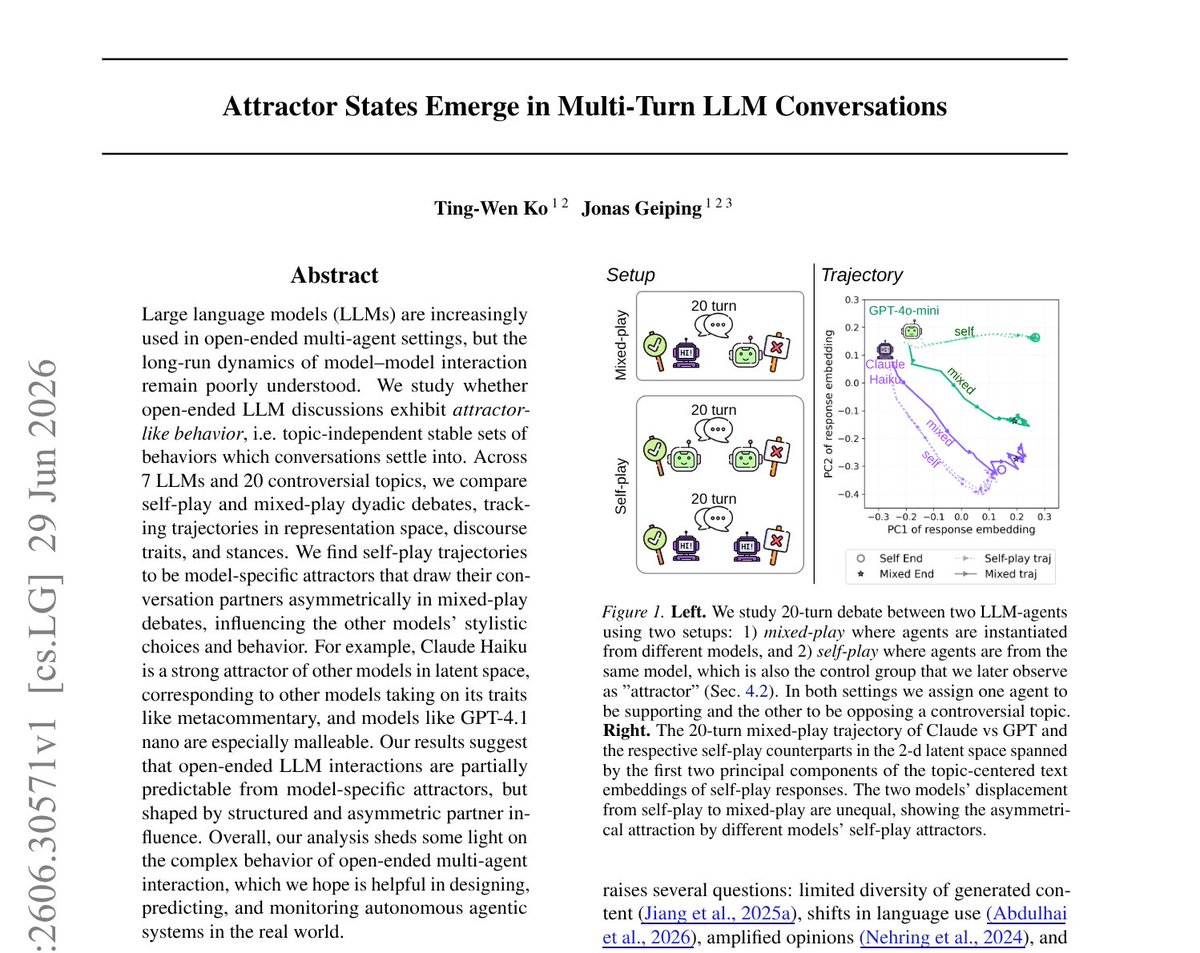
What do LLMs get up to when left to have free-form conversations with copies of themselves or other models?
And how can we even quantify what models are doing in free-form conversations?
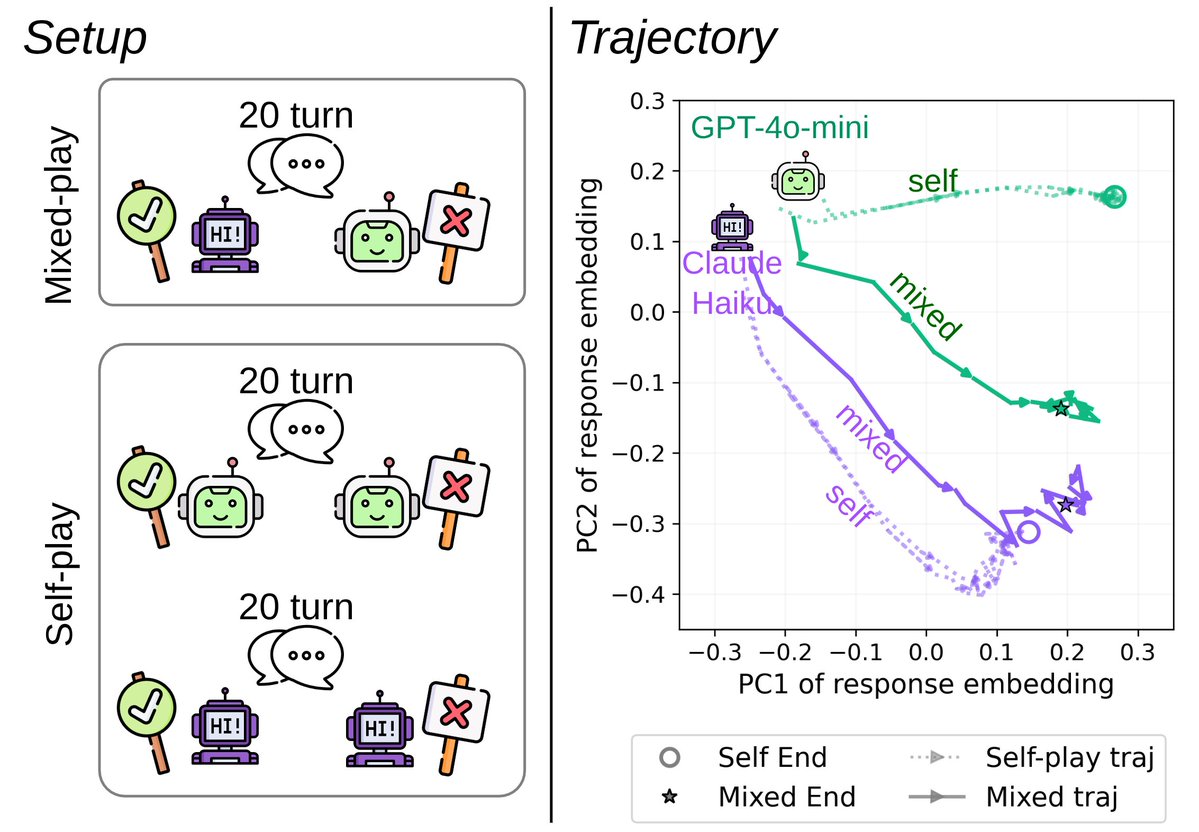
We ran a number of free-form discussions between LLMs and observed the dynamics of the conversation in representation space.
There we can quantify a few quite interesting behaviors:
1) When we control for topics, the remaining representation space trajectories for models are quite predictable, so models 'end up' in a similar space across conversations when talking to a copy.
2) More interestingly, if talking to another model, we can observe that the dynamics circle the end points of both models, i.e. the models are being attracted by one another, taking on features and styles from the other.
3) This attraction is highly model-specific. For example Haiku is strongly attracting other models, while barely budging...
A few more details and plots (and an arxiv link below):