The work of justice is more urgent than ever.
Public trust is fragile, access to justice remains uneven, and technology is reshaping courts. Yet democracy comes to life in state courts every day.
NCSC helps ensure justice is fair, equitable & efficient.
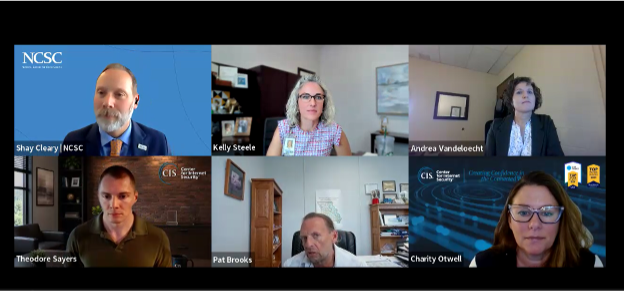
The exercise brought together professionals from courts of all sizes and levels across the country.
Thanks to our partners at JTC and @CISecurity for sharing their expertise and helping strengthen cybersecurity preparedness nationwide.
#Cybersecurity#Courts#StateCourts
375 court professionals. 46 states. One mission: stronger cyber resilience.
The 2026 Court Cybersecurity Virtual Tabletop Exercise, held recently, challenged participants to navigate a realistic cyber incident involving data exposure, record integrity, deepfakes & more.
@DukeJudicature Key findings point to a need for clearer standards, sustainable funding, statewide data collection, and stronger community partnerships.
The article also explore how courts can define success through stabilization, treatment connections, and individualized progress.
#Courts
How are mental health treatment courts evolving?
NCSC's Kendall Friend and Lisa M. Williams share national survey findings and emerging trends in the new edition of @DukeJudicature.
Read the article: https://t.co/0LVZ6INYcs
What can courts learn from online dispute resolution (ODR) pilots?
Define the problem, engage stakeholders, integrate existing systems, simplify the user experience & secure strong leadership.
Successful ODR programs are built around people and processes, not just technology.
Court technology takes more than tools. It takes the right people, processes, policies, and strategies to turn innovation into impact.
Join court leaders and industry experts at #eCourts2026, Dec. 7–9 in Las Vegas.
Register: https://t.co/lHQf4r7FWp
#CourtTechnology
➡️ Learn how NCSC and SEARCH are exploring these challenges and how the National Open Data Standards (NODS) can support more consistent criminal history reporting.
https://t.co/62a1HYVy3E
#CourtData#Data#StateCourts
Can a system reliably tell which disposition belongs to which charge?
Criminal cases can involve multiple charges and outcomes, and those relationships need to stay intact as data moves between court systems and justice partners.
Data quality isn’t just about whether a field is populated. It’s about whether the connections between data remain clear.
NCSC helps courts strengthen data quality, reporting, and interoperability across the justice system.
Justice technology is advancing rapidly - but do we have enough evidence to know what actually works?
NCSC's Jason Tashea discusses research gaps in justice technology and the need for stronger evidence on LSC's Talk Justice Podcast.
🎧 Listen: https://t.co/uljtD7r3U3
Justice technology has advanced rapidly over the past decade—but what actually works? In the latest episode of LSC's Talk Justice podcast, Jason Tashea from @StateCourts discusses the crucial knowledge gaps in justice tech research.
🎧️ Listen: https://t.co/kEQWlgnura
The Oklahoma Supreme Court will test AI-powered speech-to-text technology in a 3-year pilot in counties with court reporter shortages.
AI transcripts will be preliminary, not official; only certified court reporters can certify official transcripts.
https://t.co/pN54lg5wGw
⏰ Deadline TOMORROW! NCSC and @IAALS are seeking one state or local court to participate in the Uncomplicated Courts Initiative Pilot Project.
Get up to $30,000 and a year of hands-on support to simplify a high-volume civil case process.
Apply today: https://t.co/Gx63cXrvVt
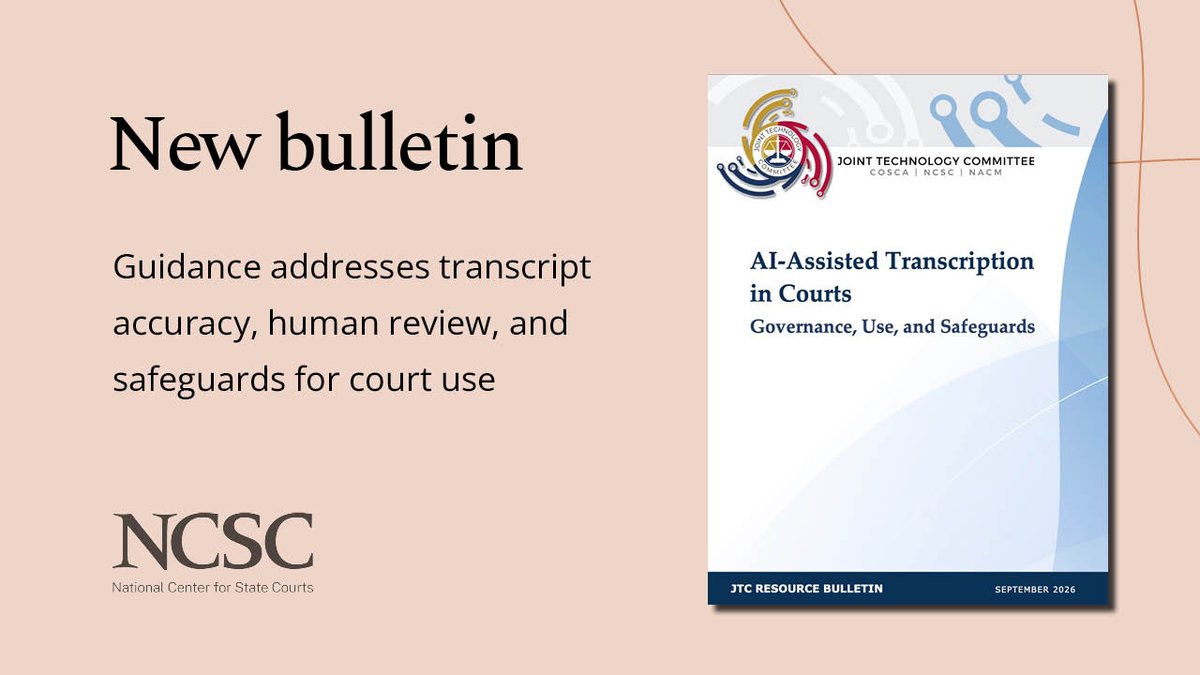
The bulletin also covers testing AI under real courtroom conditions, vendor and security considerations, and a phased approach to piloting and expanding use.
Read “AI-Assisted Transcription in Courts: Governance, Use, and Safeguards”: https://t.co/4whE8D7HEQ
#StateCourts
When AI generates a court transcript, what makes it an official record?
A new Joint Technology Committee bulletin explores that question, with guidance on accuracy, human review, confidentiality, and distinguishing AI-generated drafts from the official record.
📣 NCSC and @LegalLinkCA are partnering to bring Legal First Aid training to court-based navigators.
We’re seeking 5 court navigator programs to pilot new training modules and tailored live training in the new year.
🔗 Interested? https://t.co/lbQDgjrD81
#StateCourts#A2J
We are a proudly nonpartisan partner helping courts meet a polarized and evolving moment.
We invite you to join with us in this work and help bring America’s promise a little more within reach.
https://t.co/GUpE5Hb3cI
The work of justice is more urgent than ever.
Public trust is fragile, access to justice remains uneven, and technology is reshaping courts. Yet democracy comes to life in state courts every day.
NCSC helps ensure justice is fair, equitable & efficient.
The Arizona Supreme Court unanimously approved Grand Canyon University’s new College of Law, creating a new pathway for graduates to pursue attorney licensure, subject to state licensing requirements and court oversight.
https://t.co/KvA9meoxMo
#StateCourts@AZCourts@GCUNews49
Court dogs like Nutmeg are paws-itively making a difference! 🐾
These four-legged companions help ease stress and provide comfort to children navigating the court process. A little furry support can go a long way! 🐶
#StateCourts
Meet Nutmeg, a four-legged member of the Montgomery County court family! 🐾 Court can be a stressful and overwhelming experience for children, and Nutmeg is there to help. #pacourthousecompanions
After an October break, the TRI/NCSC AI Policy Consortium webinar series returns Nov. 18 to explore AI deepfakes and altered evidence—and what courts can do about these challenges.
🕛 Nov. 18 at 1 p.m. ET
Register: https://t.co/HoYLlxJTWS
#StateCourts#AI@TRIExecutives