Interesting point of comparison with Qian Xuesen. A tangent, but Qian always brings to mind my maternal grandfather, Gu Jingsheng, who worked alongside him. I call him “Black Brows” yeye. Here’s a bit I wrote on them:
China's Manhattan Project started not in a desert but in the borrowed barracks of a military sanatorium on the desolate western edge of Beijing. It drew home a small band of foreign-trained Chinese scientists who had skipped the revolution and the war and were now raring to “build the new nation.” The most famous was Qian Xuesen, China's Oppenheimer: a Caltech man and co-founder of America's rocket laboratory, whom the Red Scare had stripped of his clearance and then, in 1955, handed back to China. The US Navy Under Secretary who understood what was being discarded reckoned Qian worth five divisions and fought to keep him; he later called the affair "the stupidest thing this country ever did."
Qian was made first president of the newly established Fifth Academy of the Ministry of National Defence, charged with building the rockets that would one day carry the bomb. What the country could spare, it gave. Officers were seconded from the army, the few men who had trained abroad were called in, equipment was begged from ministries that had little to part with. What Qian inherited was a hundred and fifty-six fresh graduates, most of whom could not tell a missile from an artillery shell.
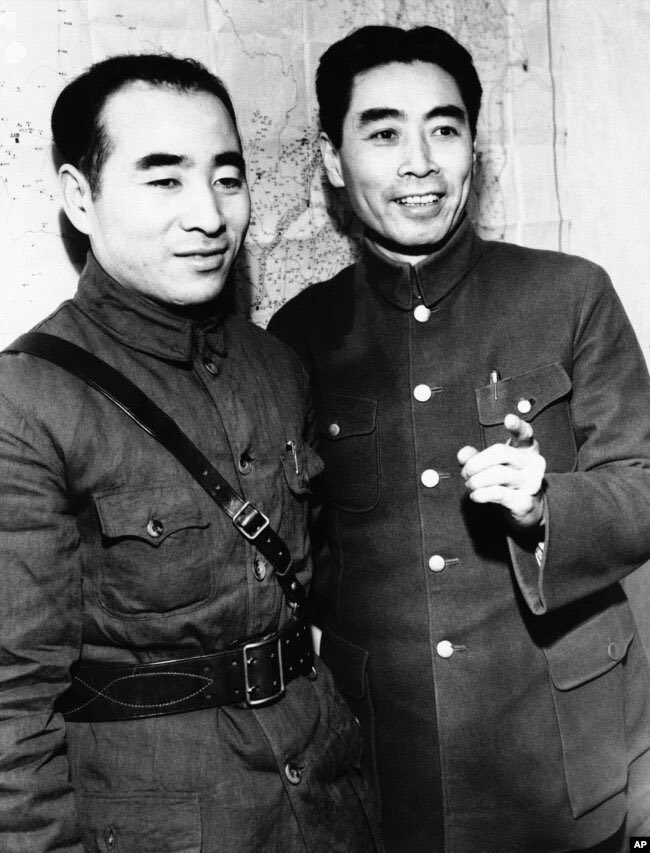
Qian was the scientific mind, or the CTO, if you like. The CEO, who would run the organisation, was Black Brows. He was the Party Secretary of the Fifth Academy and would be China’s answer to General Groves. He had not long hung up his fatigues from the Korean hills.
-
Through the fifties, China was still working out what kind of communist country it wanted to be. In April 1956, Mao decided to open it up to public discussion. He called it “letting a hundred flowers bloom, letting a hundred schools of thought contend.” Ideas right or wrong, he said, should be allowed to speak. The intellectuals welcomed it.
The discussion that followed ranged across democracy in its various forms, debates on the strains of socialism, which features of the Soviet model to keep or drop, and how to rein in the budding privileges of the Party cadres. People spoke without fear. Round-tables were convened in ministries and on university campuses, the papers carried the criticisms in full, and the speakers were not bashful about naming names. Chu Anping, editor of Guangming Daily, boldly criticised the Party for treating the country as its private dominion. He gave it a phrase that stuck: dang tian xia - party-as-realm. His point reverberated and he must have been feted around town.
There was certainly plenty of freedom of speech. But to paraphrase Idi Amin, there was not much freedom after speech.
By summer 1957 the rules had changed. What had been welcomed as candour was now classed as attack. Mao wrote in an internal essay that schools of fish were floating up to the surface of their own accord so there was no need to fish. Did he set a trap to begin with? Mao refused the characterisation. A trap, he said, was yin mou, a hidden scheme. What he had run was yang mou, an open one, because he had told the country in advance that ghosts and monsters had to come out of their cages before they could be annihilated. Chu Anping was branded and disgraced, and vanished a decade later in the Cultural Revolution.
He was just one of the 550,000 branded with the abominable label of “Rightist” in that period. Some twenty years later, in 1979, the Party would conclude that all but a handful of those names had been misclassified.
…
The Fifth Academy was a hub of exactly the kind of men the Anti-Rightist campaign liked best. Most of its senior people had studied abroad and returned with a temperament about intellectual life that did not take Chinese politics quite seriously enough. The West had its Red Scare, the East now had its White counterpart.
Each work unit was expected to find a fixed percentage of Rightists. And when none presented, most units would pad up the numbers with invented suspicion. The quota must be met.
At the Fifth Academy, the responsibility fell to Black Brows. He found the whole business ridiculous. A Party faithful, but not a Party sheep. Answerable to few, he filled the quotas with names that belonged to no one. By later official accounts, he kept dozens of senior scientists and a hundred more junior scientists off the dreaded list.
But he could not protect himself. In 1957, Laolao [grandmother] was teaching at the Beijing Party School. She was a true believer in the Party, who’d come through a more zealous formation than the grandfathers’. She took the Party's words literally. So when the Party said to be truthful, she did, and argued aloud against branding many of the slightly inquisitive students as Rightist deviants. She was soon labelled the rightest Rightist of the lot and sent down to a farm in Daxing, twenty miles south of Beijing.
A man who held the keys to the most secret programme in the country could not have a Rightist wife. Black Brows’ friends, comrades, and superiors pleaded with him to divorce her. Laolao sought a divorce to protect him too. She told him a marriage was only a piece of paper and it was enough that they remained married in their hearts.
Black Brows’ stubborn nature prevailed.
Chivalry has its costs, and it’s not always sensible. I am reminded of the proverb: neng qu neng shen, the true gentleman knows when to bend and when to stand tall. The wisdom of the bending tradition runs deep in our culture. Han Xin endured the humiliation of crawling between a butcher's legs and went on to win a kingdom. Black Brows wasn’t one for cost-benefit analysis.
Within the year, he was out of the Academy, stripped of his ranks, and left lingering at home until the next rupture took him away for over a decade. But Qian Xuesen and the Academy were preserved. On 16 October 1964, the bomb-makers’ device went up on a steel tower at Lop Nur, and the wits abroad said “you dan wu qiang”- China had a bullet but no gun. Two years later, on 27 October 1966, a Dongfeng-2A rose from the Jiuquan launch site with a live warhead in its nose, flew 894 kilometres across the Gobi, and burst 569 metres above the target…