Large language model validity via enhanced conformal prediction methods
Excited to share my work with Isaac Gibbs (@iswgibbs) and Emmanuel Candès https://t.co/muodAiM1Wj.
Question: how can we provide practical and rigorous validity guarantees for LLMs? (1/12)
See the arXiv draft for more theoretical results, simulations showing how our bounds can be used to inform experimental designs, and comparison of complete randomization vs. Bernoulli randomization!
https://t.co/WcyjpLHoIK
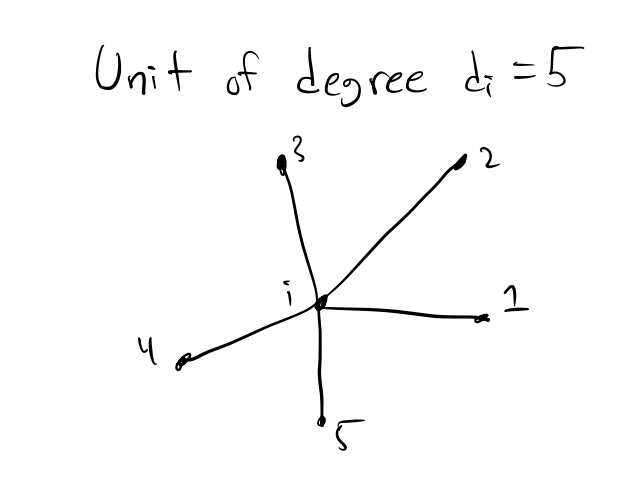
Excited to share new work with @jugander, Matt Eichhorn, and Christina Lee Yu on combining experimental design and outcome modeling for causal inference under network interference
https://t.co/WcyjpLHoIK
More broadly, these results suggest that rather than asking “what is a good estimator for a Bernoulli design” or “what is a good design for an IPW estimator” we should be asking “what are good estimator/design pairs”
[Please RT]
I’m recruiting PhD students to work with me at @UW!
I’m looking for students passionate about using computational methods to study how social platforms can be reimagined to enable better conversations, bridge political divides, and reduce the spread of misinfo.
>>>
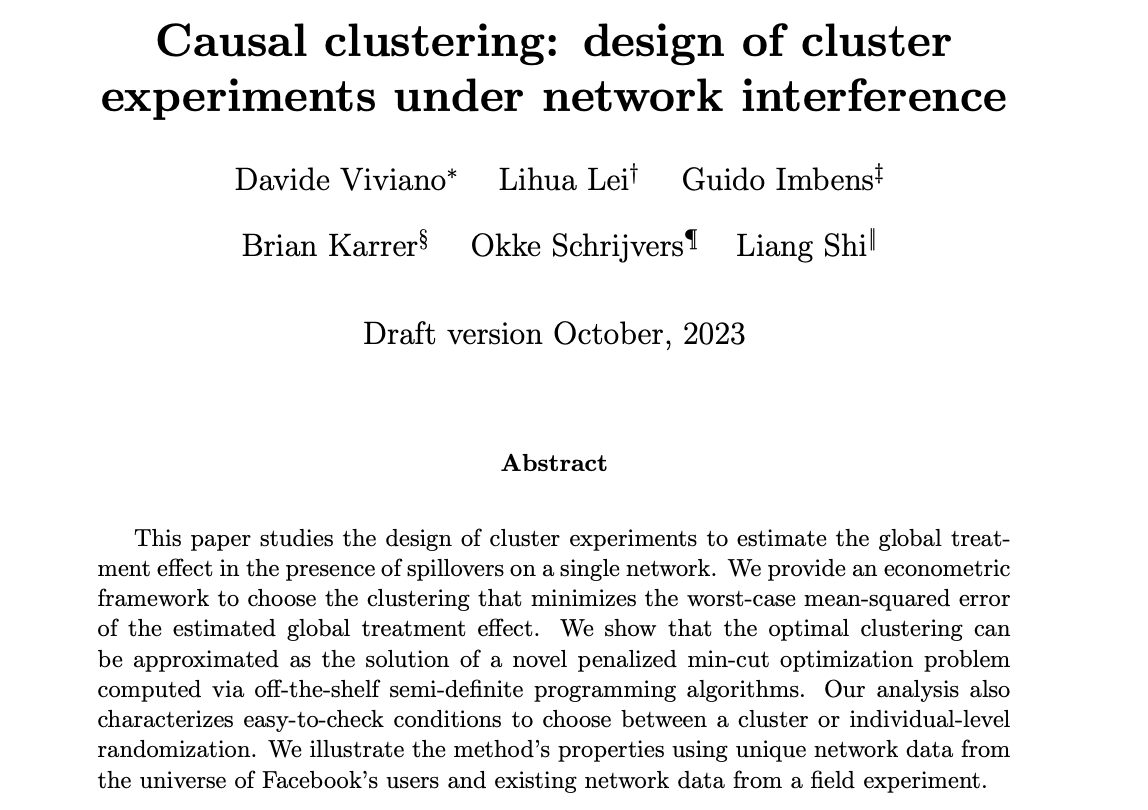
New working paper with a fantastic team of coauthors:
we study when and how to design cluster experiments with network spillovers.
https://t.co/1l676HeCGV
with @lihua_lei_stat , @guido_imbens, Brian Karrer, Okke Schrijvers, Liang Shi
A thread about CUPAC/CUPED - the tl;dr is that "CUPAC" is nearly equivalent to G-computation/Oaxaca-Blinder/imputation methods with a somewhat unusual choice of imputation model
https://t.co/tKF3JlfUdo
1/10
So CUPAC is intimately connected to certain other methods for ATE estimation in experiments, and these connections also suggest possible extensions of/improvements to CUPAC drawing on the literature around those other methods,
10/10
Similarly, it models Y_i(1) by taking the non-parametric model for Y_i(0), and learning Y_i(1) as a linear transformation of Y_i(0) on the experimental data - note that this relies on Y_i(1) being an approximately linear function of Y_i(0)
9/10