The laptop hasn't changed in 30 years. NVIDIA just changed it
RTX Spark is their first PC chip ever.
- RTX 5070 level GPU
- 128GB unified memory
- 1 petaflop of local AI
- thin, light, barely throttles unplugged
Your AI agent lives on the machine. 24/7. No cloud.
This is step one of the agentic AI PC, and everyone else is about to copy it.
**Denver DIA (DEN) ranks around 16th** among U.S. airports for international passenger traffic.
In 2024, it handled about 4.44 million international passengers (per official data). It grew to roughly 4.8–4.9 million in 2025 — still a small fraction (~6%) of its total ~82 million passengers, as DEN is primarily a massive domestic hub. Top spots go to JFK, LAX, MIA, etc., which are true international gateways.
Your practice of using Ukraine sources (non-GMO) modified beet sugar actually adds additional (empirical) credibility to the US problem of GMO beet sugar. We already know these products (Glyphosates) are responsible for honey bee colony disruption and damage to the GPS guidance system of the foragers.
Thanks for your contribution to this discussion.
GMO- sugar beets are illegal in the EU. Ukraine follows the EU guideline. The US does not. As I mentioned in my data post above - we agree - cane sugar sucrose is the same as beet sugar sucrose. So the 99% purity match moved us to the 1% differences... most of those were trace minerals. The sugar we used was purchased in the US, of US origin. So the US derived beet sugar - based on the data we found - 95-99% of the US beet sugar was genetically modified with round-up ready / round up (glyphosates). The fact that we had 100% hive loss with the 3 of 6 healthy hives, in the same weather, all other variables the same - except gen modified beet sugar - was enough for us to draw that conclusion.
Some of that is to be expected if the bees are eating raw sugar instead of honey as their carbohydrate source. The sucrose (sugar) has a much higher osmotic pull of water out of the bees (or humans) system into the gut - than honey … and the osmotic pull causes 💩💩 it’s clearly an emergency food source and if they are running low on honey they will grab that to keep the core temperature of the hive ball stable (protects the queen)
As to your newspaper question … we have used newspaper , paper bags - cut to single width and parchment paper. I don’t think it’s materially different because they just chew through it - they don’t eat it - we have been using parchment paper. We feel better 🐝 about that. The 🐝 have not expressed any preferences. Good question.
@JeanMarius99 Like most of beekeeeping - it was discovered by empirical observation … and then the hunt for a reason why.
Both cane sugar and beet sugar are refined to 99% and are ALMOST identical … we came to the conclusion that it was the 1% difference - that made the difference. Both sugar sources have about the same osmotic load (drawing water from the bee (or the human) into the gut. So that didn’t seem to be the problem and they would eat the same quantities of each sugar.
The only conclusion we came to was in the 1% difference in beet sugar . We backed up and found out that - 95% of the US sugar beet production is genetically modified and is round-up ready / and round up is used. We concluded that inside that 1% difference were residue of glyphosate - and these tiny bees were sensitive enough to that - that they had massive 💩💩💩 and it cause dehydration and killed them.
That was enough for us - in my case I had almost the perfect sample design (unfortunately) I had 6 hives, all healthy, 3 received cane sugar , 3 received beet-derived sugar. The 3 with the beet sugar died - the entire hive was plastered with bee poop 💩 - the 3 with the cane sugar were fine and strong through the spring.
@sergains@Strategy@saylor This is basic finance.... not a scam. They are just switching existing $STRC preferred dividends from monthly to semi-monthly — same 11.5% annual rate. This has nothing to do with 0% bonds. And, even if it did, it would just be cleaning up the balance sheet.
AI is paid through subscriptions (with units often priced in tokens per month) This is a very interesting finding token consumption $$ expense is greater than the cost of hiring the humans. What do you think the reset is going to look like?
Microsoft just banned its own engineers from using AI.
The tool was literally costing MORE than the humans it was supposed to replace.
They lied to you about AI adoption and now the whole narrative is blowing up:
Microsoft gave thousands of engineers access to Claude Code six months ago and encouraged them to use it.
Engineers loved it and adoption exploded. But then the invoices arrived.
Token-based pricing means every query, every code review, every debugging session costs money. At scale across 100,000 engineers, the numbers became so large that Microsoft issued an internal order to cancel nearly all Claude Code licenses by end of June and force everyone onto their own cheaper tool instead.
The company that invested $5 billion in Anthropic just told its own people to stop using Anthropic's product because it costs too much.
Uber's story is even worse...
Their CTO Praveen Neppalli Naga told The Information that the budget he planned for the full year was "blown away already" by April.
Uber had rolled out Claude Code in December 2025. By March, 84% of their 5,000 engineers were using it with 70% of all committed code coming from AI systems.
Heavy users were burning $500 to $2,000 per month each. Naga himself spent $1,200 in a single two-hour demo session.
The company had even built internal leaderboards ranking engineers by how much AI they used. They literally gamified the spending and then ran out of money.
Now look at what Nvidia's own VP of applied deep learning Bryan Catanzaro said to Axios last month. Direct quote:
"For my team, the cost of compute is far beyond the costs of the employees."
This is a VP at the company that SELLS the chips saying that using AI is more expensive than paying humans.
Think about what this means for the entire AI narrative.
Every CEO on every earnings call for the past two years has said the same thing:
AI will make us more efficient, reduce headcount, and cut costs.
The stock market rewarded every company that said it.
Fired workers, stock goes up. Announced AI adoption, stock goes up.
But the actual companies deploying AI at scale are discovering the math doesn't work. The MORE employees use AI, the HIGHER the bill.
Goldman Sachs forecasts a 24x increase in token consumption by 2030 as companies adopt AI agents. Gartner just published a report showing that even though individual token prices will drop 90% by 2030, total enterprise AI costs will go UP because agents consume exponentially more tokens per task than basic tools.
Meta built an internal dashboard called "Claudeonomics" to track which employees use the most AI. Amazon started pushing engineers to "tokenmaxx," their internal term for consuming as many AI tokens as possible.
Both companies are spending hundreds of billions on AI infrastructure this year alone.
And Microsoft, the company that bet its entire future on AI, just told 100,000 engineers to stop using the tool they liked best because the per-token bills got out of control.
The companies building AI are telling investors it saves money. The companies using AI are finding out it costs more than the humans it was supposed to replace. And even the company that makes the chips just admitted it through its own VP.
This is the gap nobody on Wall Street is pricing in.
$725 billion in AI infrastructure spending this year across Big Tech. And the first companies to actually deploy these tools at scale are already pulling back because the economics don't work.
What do you think?
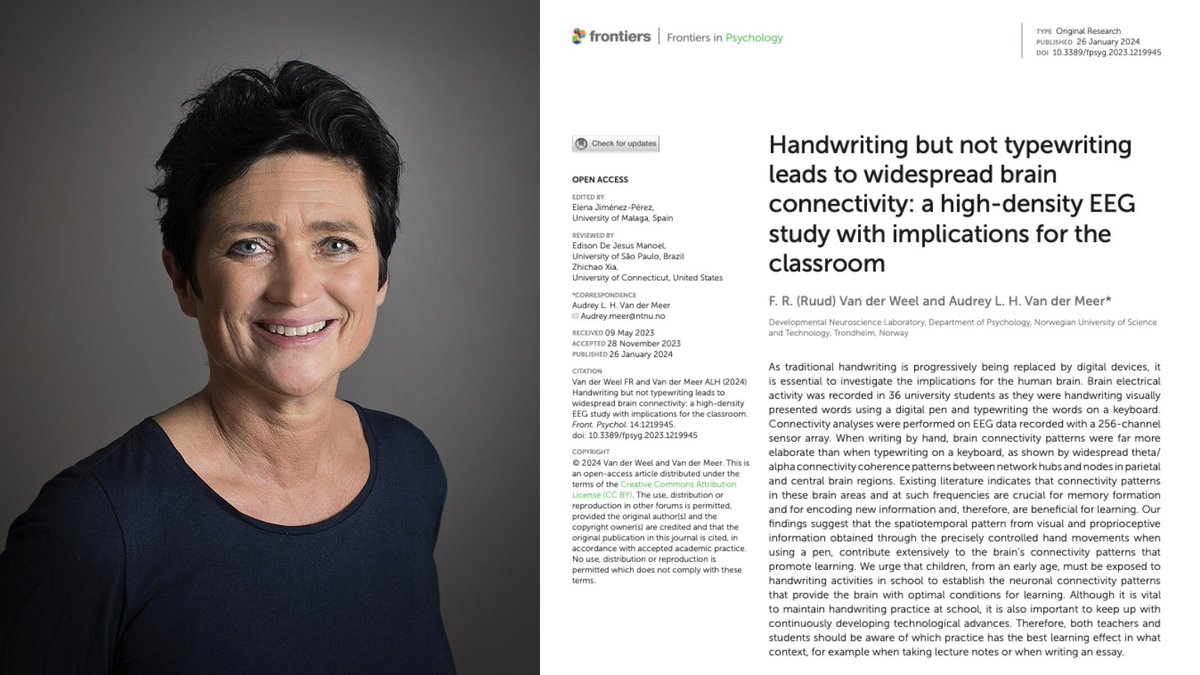
A Norwegian neuroscientist spent 20 years proving that the act of writing by hand changes the human brain in ways typing physically cannot, and almost nobody outside her field has read the paper.
Her name is Audrey van der Meer.
She runs a brain research lab in Trondheim, and the paper that closed the argument was published in 2024 in a journal called Frontiers in Psychology. The finding is brutal enough that it should have changed every classroom on Earth.
The experiment was simple. She recruited 36 university students and put each one in a cap with 256 sensors pressed against their scalp to record brain activity. Words flashed on a screen one at a time.
Sometimes the students wrote the word by hand on a touchscreen using a digital pen, and sometimes they typed the same word on a keyboard. Every neural response was recorded for the full five seconds the word stayed on screen.
Then her team looked at the part of the data most researchers had ignored for years, which is how different parts of the brain were communicating with each other during the task.
When the students wrote by hand, the brain lit up everywhere at once.
The regions responsible for memory, sensory integration, and the encoding of new information were all firing together in a coordinated pattern that spread across the entire cortex. The whole network was awake and connected.
When the same students typed the same word, that pattern collapsed almost completely.
Most of the brain went quiet, and the connections between regions that had been alive seconds earlier were nowhere to be found on the EEG.
Same word, same brain, same person, and two completely different neurological events.
The reason turned out to be something nobody had really paid attention to before her work. Writing by hand is not one motion but a sequence of thousands of tiny micro-movements coordinated with your eyes in real time, where each letter is a different shape that requires the brain to solve a slightly different spatial problem.
Your fingers, wrist, vision, and the parts of your brain that track position in space are all working together to produce one letter, then the next, then the next.
Typing throws all of that away. Every key on a keyboard requires the exact same finger motion regardless of which letter you are pressing, which means the brain has almost nothing to integrate and almost no problem to solve.
Van der Meer said it plainly in her interviews.
Pressing the same key with the same finger over and over does not stimulate the brain in any meaningful way, and she pointed out something that should scare every parent who handed their kid an iPad.
Children who learn to read and write on tablets often cannot tell letters like b and d apart, because they have never physically felt with their bodies what it takes to actually produce those letters on a page.
A decade before her, two researchers at Princeton ran the same fight using a completely different method and ended up at the same answer. Pam Mueller and Daniel Oppenheimer tested 327 students across three experiments, where half took notes on laptops with the internet disabled and half took notes by hand, before testing everyone on what they actually understood from the lectures they had watched.
The handwriting group won by a wide margin on every question that required real understanding rather than surface recall.
The reason was hiding in the transcripts of what the two groups had actually written down.
The laptop students typed almost word for word, capturing more total content but processing almost none of it as they went, while the handwriting students physically could not write fast enough to transcribe a lecture in real time, which forced them to listen carefully, decide what actually mattered, and put it in their own words on the page.
That single act of choosing what to keep was the learning itself, and the keyboard had quietly skipped the choosing and skipped the learning along with it.
Two studies. Two countries. Same answer.
Handwriting makes the brain work. Typing lets it coast.
Every note you have ever typed instead of written went into your brain through a thinner pipe. Every meeting, every book highlight, every idea you captured on your phone instead of on paper was processed at half depth.
You did not forget those things because your memory is bad. You forgot them because typing never woke the part of the brain that would have made them stick.
The fix is the thing your grandmother already knew.
Pick up a pen. Write the thing down. The slower road is the faster one.
CFTC CHAIRMAN TOLD FOX THAT #BITCOIN AND CRYPTO MARKET STRUCTURE WILL PASS AND BE ADOPTED GLOBALLY
CLARITY WILL BE SIGNED INTO LAW IN AMERICA
CRYPTO WILL EXPAND TO BILLIONS
BTC IS GOING MAINSTREAM 🚀
This letter is vague and mentions nothing specific about limitations placed on law enforcement by signing Section 604 of the Clarity Act into law. If anything - their letter supports cryptocurrency and the use of blockchains for their investigative value. What did we miss?
“Under current Federal statutes, law enforcement officers have been able to track down those who use these currencies to violate the law. By following these financial trails, prosecutors and law enforcement are able to build prosecutable cases and bring these criminals to justice. However, certain provisions of the Section 604 amendment would seriously hamper ongoing and future efforts to target these types of financial crimes.”