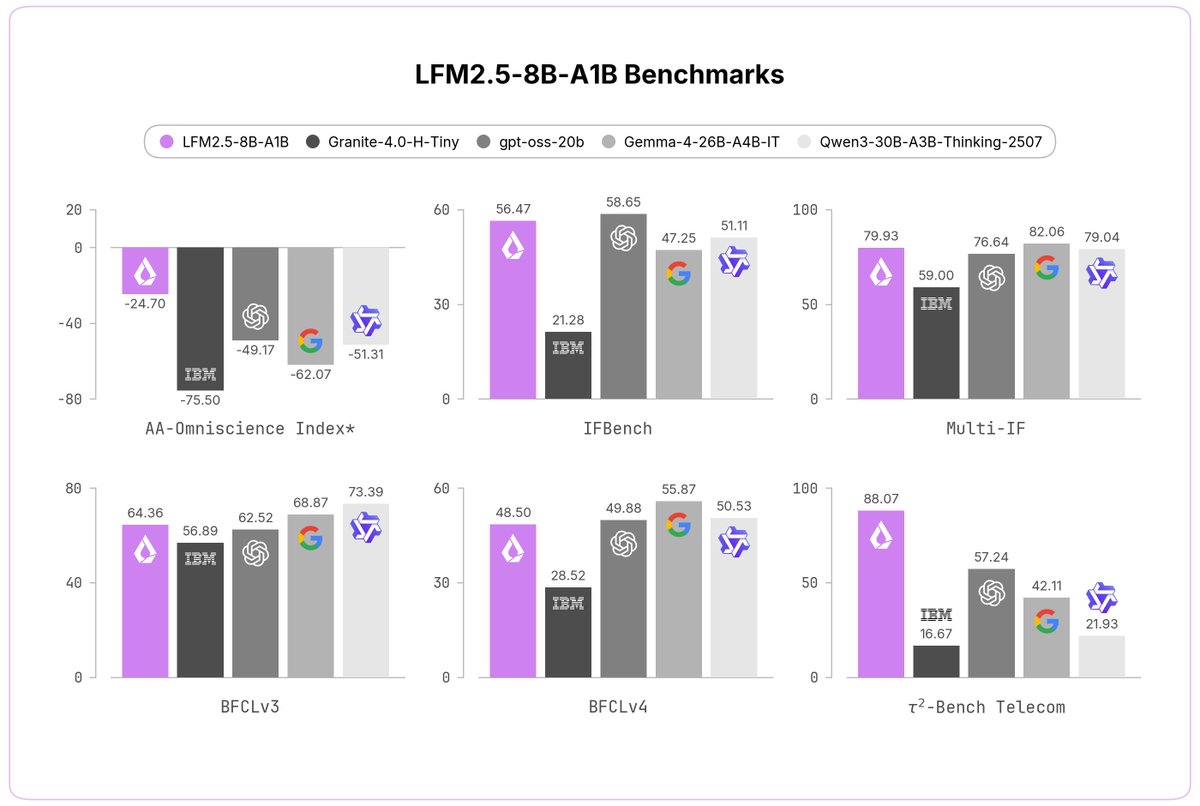
Today, we're releasing LFM2.5-8B-A1B, a device-optimized model designed to power real-life applications on phones, laptops, PCs, robots, and fast & lightweight server-side use-cases.
> 8B MoE, 1.5B active
> Expanded 128K context
> LFM2.5 flagship hybrid MoE architecture
> Trained on 38T tokens + large-scale RL
> fast, reliable tool calling, punching above its weight, comparable to models with up to 4x its size
> customizable on a single GPU for any specialized task
> LFM2 open-weight license
🧵
@ibuildthecloud Yeah it’s not easy, sveltekit has a really simple and good state management with reactivity.
Have you looked at electricsql?
Basically crdt with a local browser db connected to the real db.
So offline support with managed sync and everything in place
@ibuildthecloud I see, I was just thinking about that, multiple routes and a nested layouts is solvable I guess but I’m not sure how that would be structured.
What are your state synchronization issues and what have you tried?
@mr_r0b0t@magiknono From what I’ve tried it’s very similar to tailscale.
The big upside I see is that it’s fully self hostable with everything needed to manage devices and users.
Wireguard is more one connection at a time.
While in tailscale/netbird you can manage tons of devices in the same mesh
@tmaiaroto I see an enormous gain locally with vllm but not on everything.
For simple tasks like structure this into json I can go very high in mtp.
For more complex stuff it drops fast.
I guess the drafter could be fine tuned to be better on specific stuff too
@mr_r0b0t@magiknono Tailscale uses wireguard for the peer to peer connection you establish within your mesh.
Netbird basically has the full tailscale setup open sourced