I browsed a preview of Jesse Shapiro's forthcoming Introduction to Quantitative Economics book earlier this year, and it is fantastic. I pre-ordered it just now and will incorporate it into my PhD teaching in the fall.
https://t.co/eCEZ4jOryB
@BismaHaseebKhan studied how the introduction of Lahore’s BRT system reshaped residential sorting and the labor supply. “This is an important issue for populations in large cities across the developing world, said Gustavo Bobonis. #PublicTransportation https://t.co/CZl8zpnczx
Excited to be on the #EconJobMarket!
I study a classic trade-off: exploiting information vs. preserving secrecy.
The setting: the Allied breaking of Nazi Enigma codes in WW2.
Curious? Thread below. 👇
📣 Call for papers 📣
15th European Meeting of the Urban Economics Association
May 8 - 9, 2026
CREI, Barcelona
Keynotes by Edward Glaeser and Monika Piazzesi.
Please submit your paper by January 9.
https://t.co/1aYiRD7u4r
🚨 Your spatial regressions might be SPURIOUS! Forthcoming in Stata Journal: A guide to ready-to-use Stata commands to test & correct for strong spatial dependence 🗺️ w/ Sascha Becker + David Boll. Paper: https://t.co/umfgIFvsBq #EconTwitter#Stata
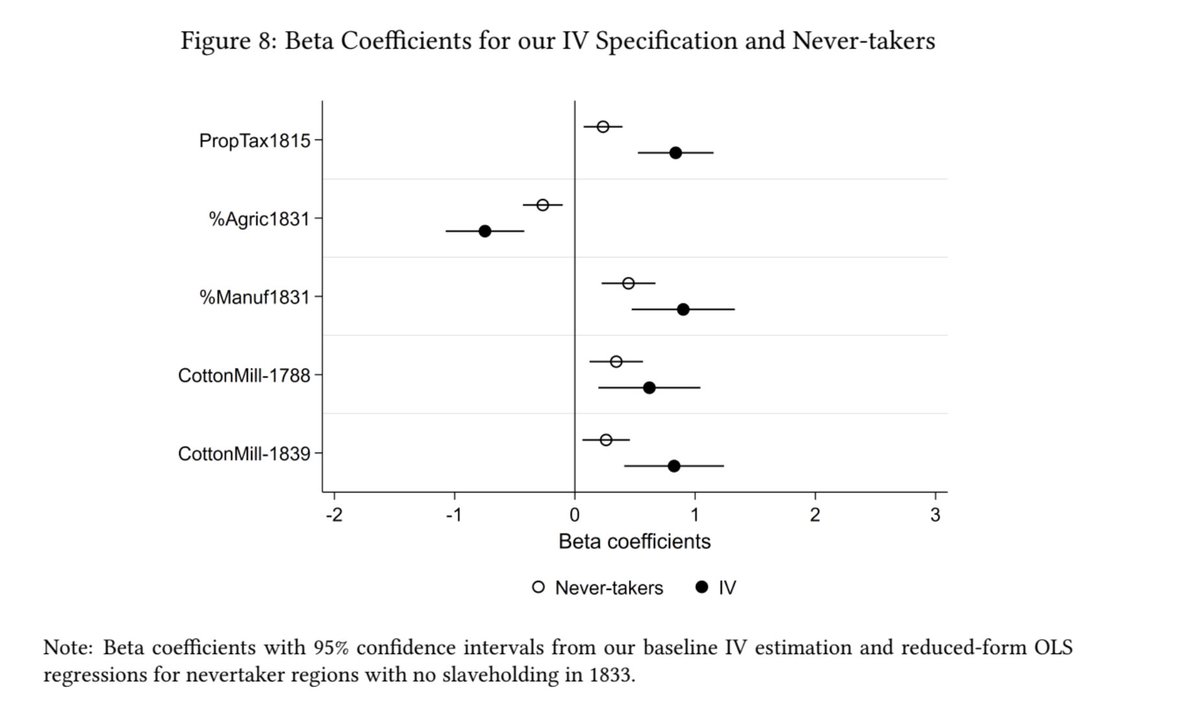
🆕 When specialisation backfires: Why Britain’s industrial past still shapes its cities today
Today on VoxDev w/ @StephanHeblich (@econuoft), Dávid Krisztián Nagy (@CREIResearch), Alex Trew (@UofGAsbs) & Yanos Zylberberg (@BristolUniEcon): https://t.co/f0hPCpxacx
Very happy to see our “Eastside Story” revisited. Great data dive by @andrewvandam on how prevailing winds & historic pollution helped shape urban inequality.
Paper: https://t.co/aMsI6hWmAQ https://t.co/UganPzfhfi
PhD students underestimate the value of writing well.
Faculty skim dozens of JMPs in a short time. If your contribution is unclear, you will get fewer interviews.
Editing improves economics papers (RCT): https://t.co/MUtlvXcYTJ
I am happy to recommend https://t.co/1A9BWKm7SF
The program for our upcoming annual North American meeting is now online: https://t.co/mC8VfnHJr2.
#UEA2025, hosted by Université du Québec à Montréal, features keynotes by Cecile Gaubert
& @ckhead and more than 60 paper sessions.
To register, visit https://t.co/m9vGUak8Va
📢Correction: Join us next *Monday* at 11:30 ET for an @osus_info seminar!
Stijn Van Nieuwerburgh (Colombia) presents “An Alpha in Affordable Housing?” (https://t.co/6HNK1irsHa)
Ben Keys and Jack Liebersohn will be our panelists!
I have just posted my survey paper “Deep Learning for Solving Economic Models” on my webpage:
https://t.co/VntBsPcBLS
In one or two weeks, it will also circulate as a working paper at the NBER and CEPR. Still, I wanted to let people know already, since I am quite happy with the outcome, largely thanks to some fantastic early feedback I got.
As I have often argued, the ongoing revolution in deep learning is transforming how we solve dynamic equilibrium economic models. At its core, solving a model amounts to approximating unknown target functions (such as the value function of agents, a decision rule, or a best response function). Deep learning frequently does a fantastic job at that task.
In the paper, I emphasize that this success is not “magic,” but rather the direct consequence of deep learning’s ability to discover better representations of the relevant variables of a model (for example, the state variables). The layers of a neural network transform the input variables into informationally efficient representations that can be more easily approximated. Tom Sargent loves to say that finding the state is an art. Deep learning tries to automatize that art as much as possible.
This is why, in many cases, we can now solve high-dimensional problems that were computationally infeasible only a few years ago.
Furthermore, the structure of deep networks designed for solving these models, largely linear apart from the non-linearity encapsulated in the activation function, permits massive parallelization.
The survey paper is designed to start from the ground up. My intended audience is a first-year graduate student with only a very basic knowledge of solution methods, or even a motivated senior undergraduate.
I would very much appreciate feedback. Can you follow the arguments throughout? Are there steps that remain unclear? I have taught courses based on this material at Penn, the Bank of Spain, Cambridge, the ECB, Harvard, Johns Hopkins, Northwestern, Oxford, Princeton, UC Santa Barbara, and Stanford, but I am always looking for fresh eyes to suggest improvements.
All the slide decks, with links to the code, are available here:
https://t.co/aIOVy4gbFM
under “Machine Learning for Economists.”
Eventually, I may use this survey paper and the slide decks as the kernel for something longer, but first, I need to clear my desk of too many ongoing projects.
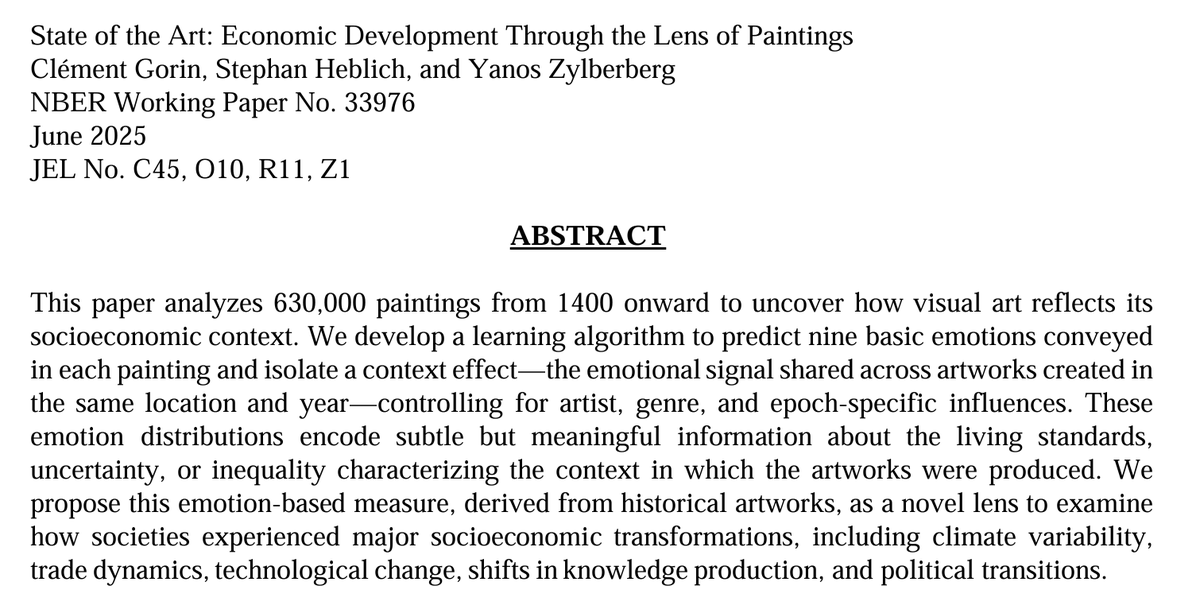
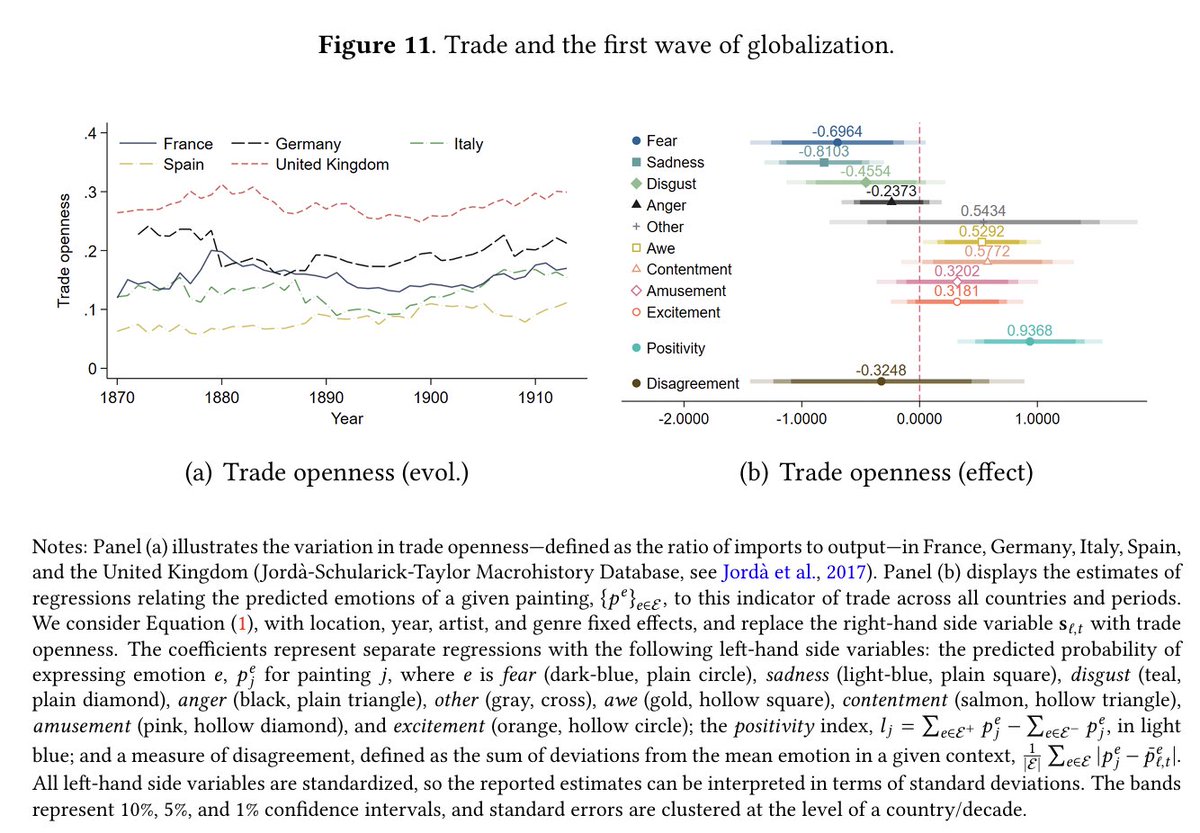
We usually rely on GDP, trade, or wages to study the past. This paper flips the script.
It analyzes 630,000 paintings (1400-2000) with machine learning to extract emotions and shows how art tracks living standards, wars, inequality, and even climate shocks.
My research team (w/ Sam Bazzi, Eric Chyn, Martin Fiszbein, Thomas Pearson, and Pat Testa) is hiring a full-time economics pre-doc for the 2025-26 academic year! If you know someone who might be interested, see the link below: https://t.co/KGKmmtscIB