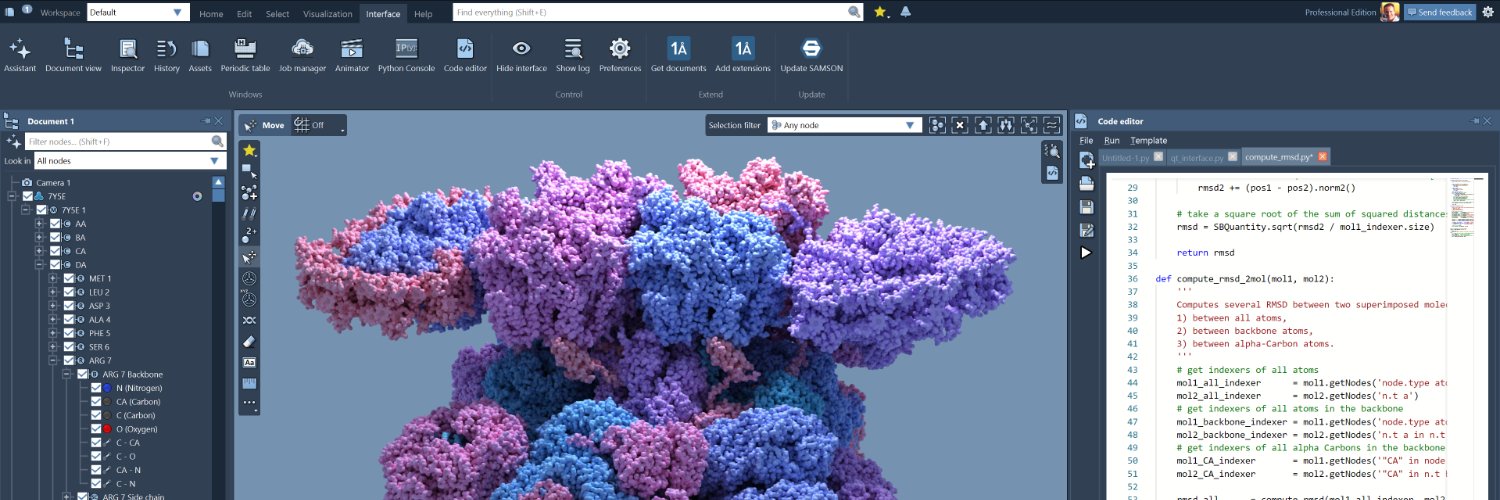
SAMSON Web is live: create, predict, render, and share molecular systems directly in your browser!
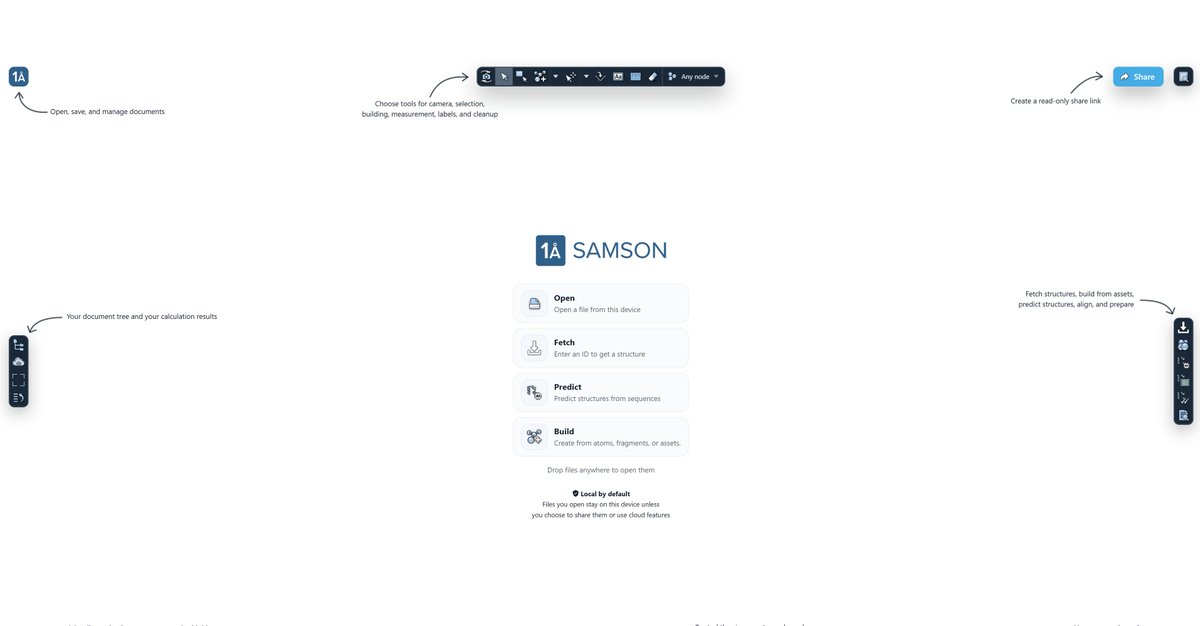
Today, we are incredibly proud to introduce SAMSON Web: a browser-based molecular design environment.
No installation.
No plugin.
No account required.
Open SAMSON Web, create or import a molecular system, work on it directly in the browser, and share it.
Not a screenshot.
Not a video.
A real interactive 3D molecular document.
With the full context.
With SAMSON Web, you can start in many ways:
• open molecular files from your device
• import and export common formats such as PDB, MOL2, and more
• fetch structures from databases
• predict structures (currently with AlphaFold 2, Boltz-2, and Chai-1x)
• build from atoms, fragments, and assets
• import cloud job results
And once your system is in the browser, you can work on it: select, measure, prepare, align, minimize, annotate, edit, create a new version, and share again.
Because one of the most important parts of SAMSON Web is sharing interactive documents.
Scientific communication still relies too much on molecular images or movies.
But molecular systems are three-dimensional. And they have context, annotations, associated data, versions, and intent.
With SAMSON Web, you can share an interactive molecular document that preserves context in seconds.
A collaborator, student, reviewer, customer, or colleague can open it in the browser, rotate it, zoom in, inspect annotations, associated logs and data, understand the model directly, and even edit their own copy. Remote collaborators, even during a Zoom or Teams session, can now explore designs as they want, edit, and send you back their changes.
SAMSON Web also helps you create high-quality visuals directly in the browser:
• advanced rendering effects
• custom backgrounds
• 3D skyboxes
• path tracing
• advanced materials
• snapshots and render-ready scenes
Modern molecular design produces much more than coordinates: prediction results, alignments, tables, metadata, trajectories, reports, annotations, and intermediate files.
SAMSON documents preserve it all, and SAMSON Web also includes a Data Explorer to explore and edit rich scientific data next to molecular structures.
The goal is to make molecular documents richer and more useful: scientific workspaces where structure, data, calculations, and interpretation live together.
You start locally by default (files you open stay on your device unless you choose to share them or use cloud features).
You do not need an account to create and share.
Creating an account unlocks versioned documents and history, permission controls, and access to your data from anywhere.
SAMSON Web is live. You can start in seconds.
The link is in the first comment.
#OneAngstrom #SAMSON #MolecularDesign #ComputationalBiology #DrugDiscovery #ProteinDesign #StructuralBiology #MaterialsScience #Nanoscience #AlphaFold #Boltz #Chai #MolecularVisualization #ScientificComputing #AIForScience
Ok, get your #SAMSON & #LAMMPS interactive MD capability here. If there is interest I can add support for other force fields. Now it only supports AIREBO and carbon structures. https://t.co/Q0L0rT1yoF
It’s a privileged to collaborate with @akshansh_mishra on the world’s smallest diamond lathe! Akshansh has provided the scripts which you can get here https://t.co/XxoYWicqas Amazing work, Akshansh!
BIG-We Now Have Motors! Think hydraulics but instead of oil, pump C60 fullerenes. The trick is two out of phase rotors that prevent each other from staying in equilibrium.
Very useful script for atomically precise hexagonal diamond NEMS designers for creating diamond hexagons in #SAMSON. (You would think this would have come first, right?) https://t.co/Qr1UyXsrWb
Diamondback Assembly. Go from solid CAD models to atomistic models to design your Nanofactory. Download the atomistic parts here: https://t.co/d7vBiGP99p
Oh you need a nuclear reactor and 100s of acres for your data center with electric transistors? I'll just be over here with the same computational power using a cat on a treadmill with my nano-mechanical-reversible desktop computer. :)
SAMSON Web is live: create, predict, render, and share molecular systems directly in your browser!
Today, we are incredibly proud to introduce SAMSON Web: a browser-based molecular design environment.
No installation.
No plugin.
No account required.
Open SAMSON Web, create or import a molecular system, work on it directly in the browser, and share it.
Not a screenshot.
Not a video.
A real interactive 3D molecular document.
With the full context.
With SAMSON Web, you can start in many ways:
• open molecular files from your device
• import and export common formats such as PDB, MOL2, and more
• fetch structures from databases
• predict structures (currently with AlphaFold 2, Boltz-2, and Chai-1x)
• build from atoms, fragments, and assets
• import cloud job results
And once your system is in the browser, you can work on it: select, measure, prepare, align, minimize, annotate, edit, create a new version, and share again.
Because one of the most important parts of SAMSON Web is sharing interactive documents.
Scientific communication still relies too much on molecular images or movies.
But molecular systems are three-dimensional. And they have context, annotations, associated data, versions, and intent.
With SAMSON Web, you can share an interactive molecular document that preserves context in seconds.
A collaborator, student, reviewer, customer, or colleague can open it in the browser, rotate it, zoom in, inspect annotations, associated logs and data, understand the model directly, and even edit their own copy. Remote collaborators, even during a Zoom or Teams session, can now explore designs as they want, edit, and send you back their changes.
SAMSON Web also helps you create high-quality visuals directly in the browser:
• advanced rendering effects
• custom backgrounds
• 3D skyboxes
• path tracing
• advanced materials
• snapshots and render-ready scenes
Modern molecular design produces much more than coordinates: prediction results, alignments, tables, metadata, trajectories, reports, annotations, and intermediate files.
SAMSON documents preserve it all, and SAMSON Web also includes a Data Explorer to explore and edit rich scientific data next to molecular structures.
The goal is to make molecular documents richer and more useful: scientific workspaces where structure, data, calculations, and interpretation live together.
You start locally by default (files you open stay on your device unless you choose to share them or use cloud features).
You do not need an account to create and share.
Creating an account unlocks versioned documents and history, permission controls, and access to your data from anywhere.
SAMSON Web is live. You can start in seconds.
The link is in the first comment.
#OneAngstrom #SAMSON #MolecularDesign #ComputationalBiology #DrugDiscovery #ProteinDesign #StructuralBiology #MaterialsScience #Nanoscience #AlphaFold #Boltz #Chai #MolecularVisualization #ScientificComputing #AIForScience