My wife mentioned a nice private school over dinner this week
She said the campus was beautiful
I asked what's the tuition
She said we should look at it as an investment in him not a cost
I made a note
She said don't make a note
I said I always make notes
She said this isn't a deal
I said everything is a deal
She closed her eyes
She said we'd discuss it Saturday
I agreed
Saturday 7:02am
She came downstairs in her Saturday robe
Coffee in hand
I had my cargo shorts on
The dining room had been cleared
The projector was on
The analyst was at the head of the table
Quarter zip on, three iced coffees, a legal pad, and two laptops
He had been there since 6:44am
I texted him at 11:14pm Friday
The text said dining room 6:45am bring the model
He sent a thumbs up
My wife stopped in the doorway
She said what is this
I said you said you wanted to discuss it
She said this is not a discussion
I did not respond
She sat down anyway
The analyst stood
He said good morning ma'am
She did not respond
He sat back down
A printed deck in front of each seat
A fourth copy in case
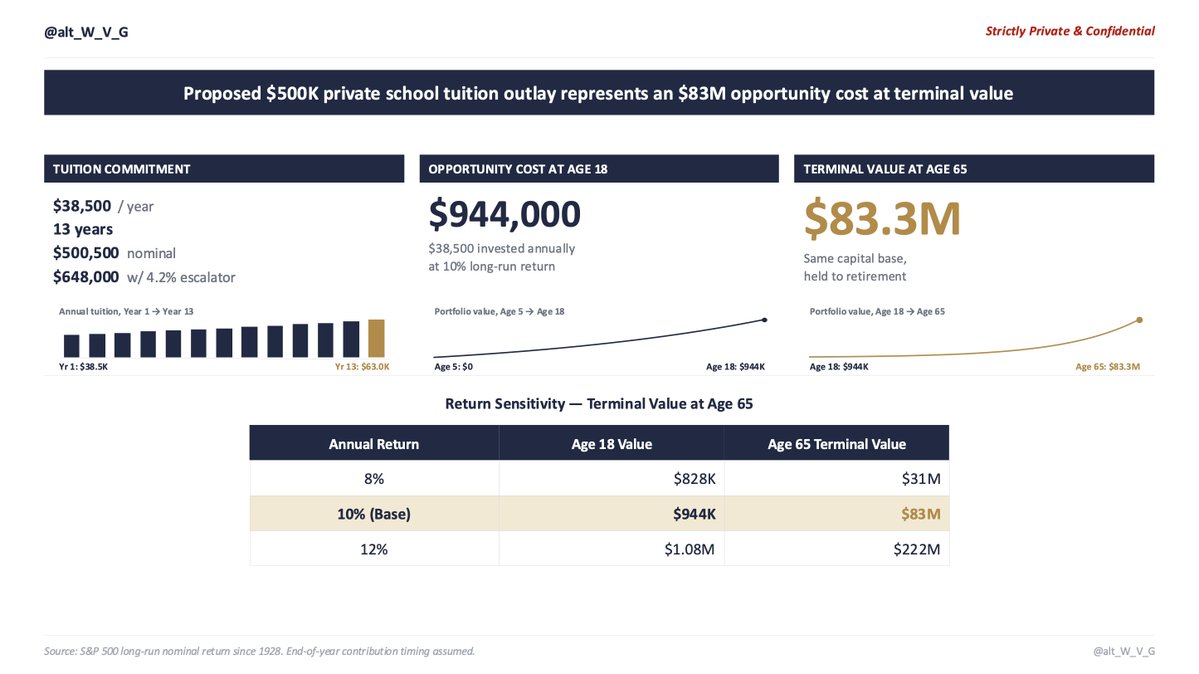
Slide 1 Tuition Schedule
$38,500 per year
Thirteen years
$500,500 nominal
Before escalators
The school has raised tuition 4.2% per year for a decade
With escalators $648,000
My wife said okay
I said I'm not done
Slide 2 Opportunity Cost
Even before escalators
$38,500 invested annually
10% nominal return
S&P long-run average since 1928
By his eighteenth birthday $944,000
My wife said we can afford it
I said I know that's not the slide
Slide 3 Terminal Value at Age 65
$83 million
She was quiet
The analyst slid the sensitivity tables across the table
8% return $31 million
10% return $83 million
12% return $222 million
She did not look
She said this isn't about money
I said it's always about money
She said no it isn't
I said then what is it about
She did not answer
She said you can't put a dollar value on his teachers his classmates his environment
I said I can the analyst already did slide 6
He flipped to slide 6
She did not look
She said the school is the best in the city
I said best is a feeling
She said it produces the best students
I said the students were already the best before they got there
She said our son deserves it
I said our son deserves $83 million
My son walked in
He is five
Dinosaur pajamas
He looked at the projector
He looked at the open deck on the table
He looked at slide 3
He said are we modeling pre-tax or after-tax
The analyst opened a new tab
My wife looked at the ceiling
He said what's the discount rate
The analyst set down his pen
She closed her eyes
He said is this the same return assumption from the 529 conversation
The analyst stopped typing
He looked at me
I did not say anything
She stood up
Sat back down
He said dad can I help
I said yes
He pulled up a chair
The analyst handed him a printout
He started reading
My wife watched him read
She watched him for a long time
She said his name
He looked up
She said do you like school
He said the work is too easy and the kids don't ask questions
She did not respond
She looked at the ceiling
She walked out of the room
The analyst started packing up
He said should I follow up Monday sir
I said no follow up needed
He'll be fine
Sent from my iPhone
@RichardBratby@holysmoke Pierre de la Rue also visited Reading, in 1506 as part of the court of Philip the Fair, forced to spend 3 months in England due to bad weather on the way to Spain.
Teoría de la Elección Pública
En un despacho austero de la Universidad de Virginia a principios de los años 60, dos economistas estadounidenses, James M. Buchanan y Gordon Tullock, miraban con lucidez implacable el espectáculo de la política moderna. No veían nobles servidores del bien común, sino seres humanos de carne y hueso, racionales y egoístas, que respondían a incentivos exactamente igual que cualquier tendero, banquero u obrero. De esa observación brutal surgió The Calculus of Consent (1962) y, poco después, la Teoría de la Elección Pública: la política no es un reino de altruistas desinteresados; es un mercado más, donde políticos, burócratas y votantes persiguen su propio beneficio, y donde los grupos de interés concentrados capturan el poder mientras los costos se difunden entre millones de contribuyentes invisibles. El «rent-seeking», esa fea palabra que Buchanan popularizó, consiste en buscar ganancias no creando riqueza, sino manipulando el aparato estatal para arrebatar recursos ajenos mediante regulaciones, subsidios o privilegios legales.
La idea es demoledoramente simple y, por eso mismo, intolerable para los románticos del poder: nadie en el gobierno es un «ángel guardián». Son agentes racionales que maximizan votos, presupuesto, prestigio y poder personal. Los votantes, racionalmente ignorantes, no estudian los programas; votan por promesas que les cuestan poco y les benefician mucho. Los burócratas expanden sus reinos porque su salario, su estatus y su jubilación dependen del tamaño del imperio que controlan. Y los lobbies, esos grupos pequeños y bien organizados, pagan el precio de la captura regulatoria porque los beneficios son enormes y concentrados, mientras los costos se reparten entre todos los demás como una niebla invisible.
Esta teoría, una de las más corrosivas de la economía del siglo XX (Buchanan recibió el Nobel en 1986 precisamente por destripar el mito del Estado benevolente), no se queda en los manuales académicos. Se manifiesta con saña especial en los experimentos socialistas y comunistas, donde el Estado no es un árbitro neutral, sino el propietario absoluto de todo. Cuando el aparato controla la producción, los precios, el empleo y hasta los pensamientos, el «rent-seeking» deja de ser un vicio marginal y se convierte en el único deporte nacional. La nomenklatura soviética no era una anomalía; era el resultado lógico de este proceso. Una nueva clase dominante que vivía en dachas, comía caviar y enviaba a los disidentes al Gulag mientras predicaba la igualdad. La «boliburguesía» venezolana, esos militares, ministros y enchufados que se repartieron PDVSA, empresas expropiadas y dólares preferenciales, no traicionó al chavismo; lo perfeccionó. Los cuadros del Partido en China actual no son comunistas del siglo XIX; son capitalistas de Estado con carnet rojo que amasan fortunas mientras el proletariado sigue siendo proletariado.
En la izquierda democrática el mecanismo es más refinado, pero idéntico en esencia. Los políticos prometen «bienes públicos gratis» como sanidad universal, educación gratuita, renta básica y subsidios verdes, financiados supuestamente por «los ricos» o por la deuda eterna. En realidad maximizan su propio stock de poder: cada nuevo programa crea clientelas dependientes, cada ministerio engorda burocracias leales, cada ley de «justicia social» multiplica los reguladores e inspectores que viven del presupuesto ajeno. Sindicatos de la educación pública bloquean cualquier reforma porque su monopolio les garantiza sueldos, privilegios y jubilaciones doradas a costa de generaciones de niños condenados a la mediocridad. ONG progresistas capturan fondos públicos para «luchar contra el odio» mientras sus directivos viajan en business class y dictan moral desde tribunas pagadas con impuestos. No hay ángeles en el poder; hay maximizadores de utilidad que, al expandir el Estado, expanden su propio botín.
El socialismo «real» siempre genera una nueva clase dominante porque la Teoría de la Elección Pública es implacable: cuando eliminas el mercado y la propiedad privada, no eliminas el egoísmo humano; simplemente lo canalizas hacia la única vía que queda, la política. El resultado no es el paraíso sin clases; es una cleptocracia con eslóganes igualitarios. Los costos se socializan, los beneficios se privatizan en mansiones, cuentas en Suiza y yates. Y cuando alguien señala la estafa, la respuesta es la de siempre: más Estado, más control, más represión para que el cuento no se derrumbe.
La Teoría de la Elección Pública no es cínica; es honesta. Brutalmente honesta. Nos recuerda que el poder corrompe y que el poder absoluto, el sueño húmedo de todo socialista, corrompe absolutamente. Por eso los regímenes que concentran todo en el Estado no producen igualdad; producen castas intocables con carnet del Partido. El resto del rebaño solo recibe las migajas y la factura.
@ClerkofOxford I once sent an email to members of my Oxford church choir, to see who was available to be cantor on the Sundays when the choir wasn't singing. The email was entitled "Sumer rota" and I invited everyone to spot the gag and win a groat...nobody did. #disappointed
@RichardBratby@amwilson_opera I've always felt that peer reviewers' names should be (by default) revealed to authors when the reviewer is the more senior.
Some corrections:
You inherited 2% inflation. It doubled in 12 months after you became Chancellor. It is still 50% above the rate you inherited and 50% above target. It should fall to target 2% this summer. So two years to get back to where you started! What’s to boast about that?
Interest rates have been falling everywhere. UK cuts, which you don’t control, have been fewer and smaller because of your inflation record. We still have highest interest rate in G7. The Bank has made some cuts for the simple reason the economy is flat on its back. Well done.
Borrowing is slowly falling from a very high base. Almost six years after the pandemic-induced recession, we’re still borrowing around 4% GDP. And borrowing costs are the highest in the G7.
Retail sales are up in recent months. We’ll see how long that’s sustained. But the hospitality and construction industries are in crisis. Plus our massive services sector is stagnant.
UK fastest G7 economy? That’s simply a bare-faced lie. We grew by 0.1% in Q3 2025; and another 0.1% in Q4. End of.
I spoke with @LaulPatricia about Marxism:
One is: What’s remarkable is that Marxism has been tried. Now, of course, defenders of Marxism say it hasn’t really been tried anywhere, but certainly the people who implemented it claimed they were implementing Marxism.
And this is a massive experiment—a global experiment—with a very clear outcome. Namely, the Soviet Union was a disaster. The imposition of communism on Eastern Europe was a disaster. The imposition of communism in Venezuela was a disaster. The imposition of communism in Maoist China was a disaster. Disaster in terms of both poverty and oppression and genocide and stupid wars. So the world has told us what happens under communism, and it’s a sign of how out of touch intellectuals can be that there are still people who defend it despite the entire world giving a very clear-cut answer.
One more is: would you rather live in North Korea or South Korea? Would you rather live in the old East Germany or West Germany? We have an experimental group and a matched control group in terms of culture, language, and geography, and the answer is crystal clear. So this is a sign of, I think, the pathology of intellectual life—that Marxism can persist.
The other is, you did call attention to one of the appeals of Marxism, though, and more generally of heavy, strong influence of government guided by intellectuals, which is that there are certain kinds of reforms that you can state as principles. You can articulate them verbally as propositions—like equality, human rights, democracy—but there’s other kinds of progress that take place in massive distributed networks of millions of people, none of whom implements some policy. But collectively, there is an order, an organization that’s beneficial.
So that can happen organically through, for example, the development of a language. No one designed the English language. It’s just hundreds of millions of English speakers. They coin new words. They forget old words. They try to make themselves clear. And we get the English language and the other 5,000 languages spoken on earth.
Likewise, a market economy is something where knowledge is distributed. You don’t have a central planner deciding how many shoes of size 8 will be needed in a particular city, but rather information is conveyed by prices, which are adjusted according to supply and demand. And you’ve got a distributed network of exchange of information that can result in an emergent benefit.
Now, intellectuals tend to hate that. They like rules of language—of correct grammar. They like top-down economic planning. They like cultural change that satisfies particular ideals described by intellectuals. And so rival sources of organization, like commerce, like culture—traditional culture—tend to be downplayed by intellectuals.
And this can be magnified by the fact that many dictatorships give a privileged role to intellectuals, which may be why, over the course of the 20th century, and probably continuing to the present, there has not been a dictator that has not had fans among intellectuals—including the mullahs and ayatollahs of Iran, but also the communist dictators: Mao and Castro, even Stalin in his day. And every other dictator has had, actually, often fawning praise from Western intellectuals.
🚨🚨Wow. A bombshell moment.
Ed Miliband has just released the price that you're going to pay for offshore wind for the next twenty years.
£95/MWh in 2025 prices. The highest offshore wind price in a decade.
Ed will try to spin that this is cheap. It is not.
Gas power without a Carbon Tax is under £55.
Average electricity price last year (including the Carbon Tax) was roughly £80.
And that £95 for wind is just what we pay for the wind power itself. On top, you also have to pay for all the extra grid, paying wind farms to switch off, and having a very expensive backup power station on standby for a cold, windless day like we had just last week.
And to try and sweeten the deal for the wind developers, Ed has extended the contracts so we're now going to be locked into these prices for TWENTY YEARS.
By DESNZ’s own numbers the contract extension is worth 12% of the strike price to the wind developers, so a true comparison with last year's £82/MWh would be £102/MWh. Wind is getting significantly more expensive, not cheaper.
Ed is locking us into a 10% fixed-rate mortgage because he doesn’t want the volatility of being on a 4% variable.
He is cementing our uncompetitive electricity prices for even longer at a time when the world is becoming more unstable and we need cheap, reliable energy to compete.
Labour promised to cut your bills by £300. This was how Ed Miliband said he was going to do it.
But it has never been clearer that he cares more about his own clean power vanity project than he does about your energy bill.
When your income taxes go up, that will be because Rachel Reeves chose to raise public spending by £70bn last year. Not because of austerity, Truss, Brexit, the Pandemic or anything else. It's because Labour chose to raise spending so much. Choices have consequences. For you.
For every retweet of this post, I will donate £1 to the @VC_and_GC_Assoc up to £50,000.
Time is running out following @I_W_M’s decision to close the Lord Ashcroft Gallery.
Visit while you still can, to honour the bravery of those who risked so much to protect our great nation.