Moai does not react to noise.
It recognizes creative thinking,
Watches originality,
Something that stands out.
But there’s always a question
Who is next? 🗿
@ConcreteXYZ | @crypttoji | @nic_builds | @d3crypt0r25
Recently, @AstraBanq has seen a significant increase in new users ✨
We’re excited to see more people recognizing the benefits of a neobank built for both Web2 and Web3.
AstraBanq gives individuals and businesses the tools to manage and move their capital globally with ease.
Open your account today:
🔗 https://t.co/1xuaIhhwES
Per Aspera ad $ASTRA ✨
Concrete Vaults, your one-click access to DeFi.
Concrete has series of Earn Vaults to provide users with the easiest way to access the best DeFi yields.
Explore concrete at https://t.co/roupPdeqQU
Deposit and let @ConcreteXYZ do the rest
@nic_builds | @dill_sl | @crypttoji | @d3crypt0r25 | @blueprintluke
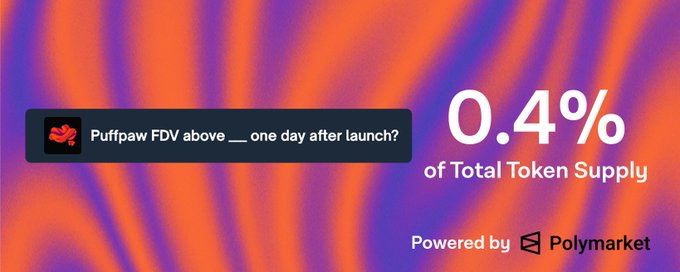
@puffpaw’s “Puffpaw Trade Wars” competition is distributing 0.4% of the $VAPE supply as rewards for trading on @Polymarket.
The rewards are split into two parts:
0.2% basic rewards
🔸0.1% is shared pro-rata among the top 500 individual traders based on historical volume (no sign-up required)
🔸0.1% goes to the top 10 teams, with tiered allocations (1st place earns 30% of this pool = 0.03% of total supply)
For team rewards, the leader receives 25% of the team’s allocation, while the remaining 75% is distributed equally among members (maximum of 20 per team). Participation in team rewards requires sign-up via forms.
Plus a 0.2% bonus for matching or exceeding Polymarket volume on any DEX and ranking in the top 500 global DEX traders. This is a great reminder that DePIN users aren't cold ROI machines. Emotions like the thrill of competition and the drive to "be better than others" fuel decisions on token burns and upgrades, turning projects into behavioral experiments. But does this lead to loyal users sticking around, or just volatility? Let's explore with data and cross-project insights, focusing on how Polymarket integration captures and amplifies these emotional dynamics.
In DePIN, like @puffpaw, tokenomics tap into psychology: Recasts and upgrades aren't just math, they're emotional gambles. The "vape-to-quit" system rewards persistence, for example, health boosts for 0% nicotine at 1.05 times versus 0.95 times for 2%, but narrower puff ranges and escalating costs from Tier 1 at 600 preVAPE recast to Tier 12 at 9.9 million create a ranking thrill. Users burn tokens to level up, chasing community status, much like Helium's hotspot setup, where FOMO drove over 1 million devices, but 50 to 60% annual churn when rewards dipped. This "better than others" vibe boosts engagement: on-chain fees over 60% from recasts signal competition, per Dune dashboards.
This isn't unique to one project; broader DePIN reveals the pattern. Filecoin's storage deals increased 40% year over year to 20 exabytes, but 80% of early user losses came from emotional mismatches, as upgrades initially felt rewarding until the costs outpaced the benefits. Render's GPU farming thrives on AI hype, with market cap up 48% in AI DePIN, but burns for scarcity can frustrate if volatility hits, echoing 2025's 56% sector drop from over speculation.
Polymarket competitions like this amplify the lab effect: bets on "Will efficiency hit 50% amid tier climbs?" crowdsource emotional signals, revealing if thrill keeps people or if frustration pushes them out.
The integration goes deeper. Puffpaw's on-chain data, like recast spikes during market hype feeds directly into Polymarket markets, allowing bets on behavioral metrics like upgrade drop-off rates or FOMO-driven fee surges. It turns emotions into quantifiable, oracle-resolved outcomes that could refine tokenomics in real-time, especially with the competition's DEX bonus incentivizing cross-platform trading from Dec 2025 market creation through the day after TGE.
Yet, risks abound, and emotions can backfire big time. Thrill-driven burns might inflate short-term activity, but regulatory shocks, for example, Europe's 2026 bans slashing 30 to 40% pod demand, according to WHO, could trigger mass churn, as in StepN's 94% daily active user fall from hype burnout. Privacy in behavioral labs exposes habits, inviting hacks with over 2 billion losses in 2025.
If rankings favor big players, casual users drop off, unbalancing networks like U2U's 150% user growth but subscription risks. Polymarket's role here adds a layer: While it decodes sentiments (e.g., bets leaning toward "NO" on retention if regulations loom), poor integration could distort data, encouraging gambling over genuine engagement and exacerbating volatility if bets don't match actual user emotions, particularly with team dynamics potentially creating uneven competition.
At the end of the day, DePIN as behavioral labs could evolve tokenomics beyond cold calculations.
Puffpaw's @Polymarket setup tests if emotions build solid health tech for 1.3 billion smokers, perhaps by using bet resolutions to adjust caps or rewards dynamically. But ignoring the volatility path risks echo chambers.
In DePIN, is emotion the key to retention or the path to volatility?
A story of how @ConcreteXYZ changed DeFi forever.
Yield was hunted.
Risk roamed unchecked.
But Concrete fought the great battle and saved the people. 🗡️
Concrete didn’t chase crowns.
It built what could not be broken.
🗿Explore concrete at https://t.co/roupPdeqQU
@nic_builds | @dill_sl | @crypttoji | @d3crypt0r25 | @blueprintluke
#AKOTSK #GOT
Projects launching with us don’t have to worry - they’re seamlessly onboarded to @AstraBanq https://t.co/MjJqkFHHtf😎
Build. Launch. Scale.
👉 https://t.co/KUZ6hvBPYM