Don’t let the noise fool you before heading to the ballot box. Remember what they promised vs. what they deliver:
🛑 Blocked transparency & full release on the Epstein files
🛑 Promised to end the war in Ukraine "in 24 hours"
🛑 Promised "no new wars," yet global conflict keeps escalating
🛑 Costs on groceries, healthcare, & housing keep climbing
🛑 Tax cuts for billionaires while working families eat the inflation
A slogan isn’t a solution. Promises aren’t results. Hold them accountable with your vote!
Repetition, Misinformation, and the Price of Political Power
In American politics, money can buy something more powerful than advertising: repeated exposure to a message that voters may eventually accept as the truth.
During the 2026 midterm election cycle, Republican-aligned political groups have spent enormous sums on advertising. An Associated Press analysis reported that three Trump-aligned groups spent more than $163 million on advertising and airtime beginning September 1, 2026. A Washington Post analysis of campaign advertising also found that Republicans had outspent Democrats by nearly $1 billion, or $661 million, in the period examined.
But how much money a party spends is only part of the problem. What matters is whether voters are receiving accurate information.
Psychologists call one relevant phenomenon the Illusory Truth Effect. Research shows that people tend to perceive statements as more truthful when they encounter them repeatedly. A recent meta-analysis covering 182 studies found evidence of this effect, although its strength varies with circumstances
Imagine hearing the same political accusation in television commercials, online videos, social media posts, and campaign speeches. Even without convincing evidence, repetition can make the claim feel familiar—and familiarity can be mistaken for truth. When advertising budgets allow one side to repeat a message far more frequently, voters may have fewer opportunities to encounter competing information.
This concern becomes even more serious when political advertisements contain false or misleading claims. Every specific advertisement should be checked against reliable evidence, regardless of which party produced it. Repetition does not make a falsehood true, and a campaign slogan is not proof.
Consider another example: on September 10, 2026, Donald Trump promised a $5,000 payment to every adult citizen if Republicans retained control of Congress. Reporting noted that he had not explained the funding or legal details and implementing the proposal would require congressional action. It was a political promise, not guaranteed payment.
Voters deserve to understand the conditions, costs, feasibility, and likelihood of delivery before making such a promise as money they will receive.
Democracy suffers when advertising replaces evidence, repetition replaces verification, and campaign promises replace accountability.
Political parties have every right to advocate for their candidates, but voters have every right to expect truthful claims and transparent proposals.
How exactly does the Board of Peace exclude the Palestinian people from the reconstruction of their own land?
Despite operating on Palestinian territory, the board's structural blueprint deliberately isolates local residents from having a say:
Zero Charter Representation: The [Board of Peace Charter] was drafted without input from Palestinian factions. Under its guidelines, no Palestinian political entity holds a seat or a vote. Chairman Donald Trump retains absolute financial and structural veto power.
A Subordinate "Technocrat" Buffer: Day-to-day services are managed by the National Committee for the Administration of Gaza (NCAG). While composed of local Palestinian administrators, the NCAG holds no sovereign power and is entirely dependent on the board for funding and authorization.
Forced "Enclave" Rebuilding: The administration's framework uses UN Security Council Resolution 2803 to enforce a top-down security model. By designating land clearing as a "temporary humanitarian relocation," the board bypasses traditional international requirements for direct landowner consent.
The framework essentially replaces local democratic self-governance with a centralized corporate and military administration.
#BoardOfPeace #GazaReconstruction #InternationalLaw #ForeignPolicy
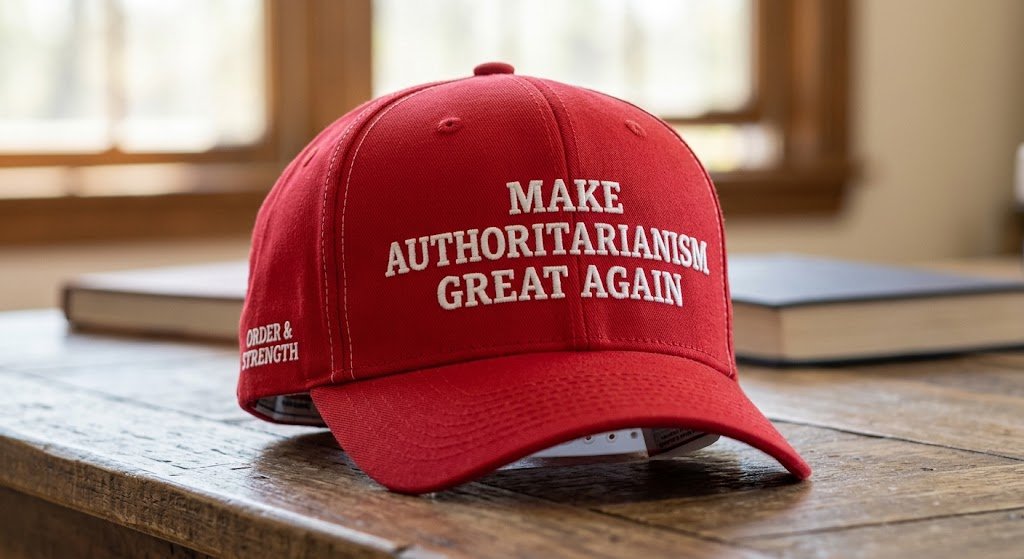
MAGA: Make Authoritarianism Great Again?
The slogan “Make America Great Again” promises patriotism, prosperity, freedom, and a stronger nation. But critics of the radical MAGA movement argue that its actions increasingly raise a different question: Is the real objective making America great, or making authoritarianism acceptable?
A healthy democracy depends on more than elections. It requires respect for the Constitution, an independent judiciary, a free press, government accountability, and the peaceful transfer of power. It also requires leaders to accept criticism, respect political opponents, and recognize that no president is above the law.
When political loyalty is placed above constitutional principles, election results are questioned without sufficient evidence, journalists are portrayed as enemies, watchdogs are weakened, and political opponents are treated as enemies of the nation, democratic institutions can begin to erode. Critics see these patterns in aspects of the radical MAGA movement and worry that concentrating power in one leader threatens the freedoms that make America great.
Patriotism should mean defending the country’s founding principles, not blindly defending a politician. Supporting a president should never require abandoning independent thought, excusing misconduct, or accepting violence and intimidation as legitimate political tools. Americans should be able to disagree without becoming enemies.
It is also important to recognize that not every MAGA supporter holds extremist views. People support political movements for different reasons, including economic concerns, immigration policy, cultural values, and distrust of established institutions. The relevant question is whether particular leaders, policies, and actions strengthen democratic government or undermine it.
America’s greatness is not measured by how much power one leader can accumulate, but by how well its institutions protect the rights and freedoms of its people.
If a political movement places personal loyalty above the Constitution, attacks accountability, and excuses threats to democratic institutions, then perhaps its critics have a point when they turn the slogan around:
MAGA: Make Authoritarianism Great Again.
The future of American democracy depends on citizens of every political persuasion demanding truth, accountability, equal justice, and respect for the Constitution—regardless of which party holds power.
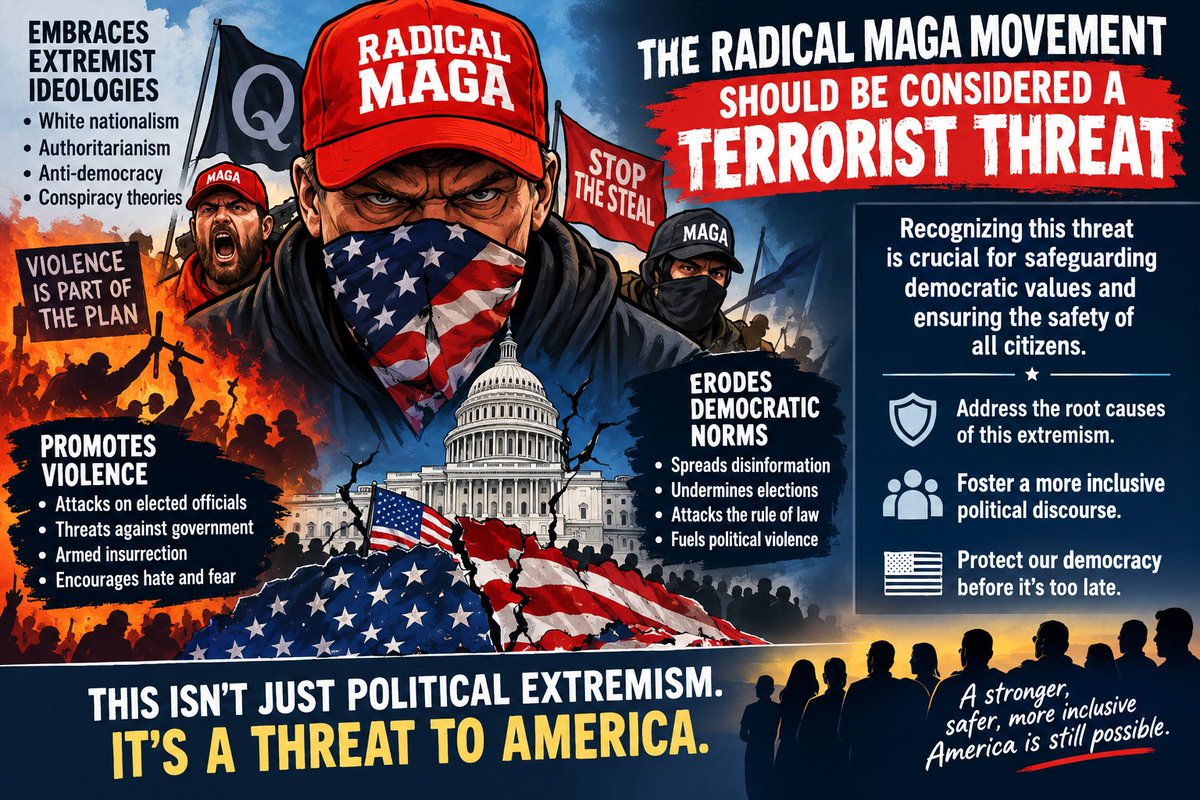
The radical MAGA movement should be considered a terrorist threat due to its embrace of extremist ideologies, promotion of violence, and erosion of democratic norms. Recognizing this threat is crucial for safeguarding democratic values and ensuring the safety of all citizens. Addressing the root causes of this extremism and fostering a more inclusive political discourse is essential for the future of American democracy.
The RADICAL MAGA movement has also played a significant role in mainstreaming extremist ideologies. By normalizing aggressive rhetoric and actions, it has emboldened individuals and groups who may have previously been on the fringes of political discourse. This shift threatens democratic norms and institutions, as it creates an environment where violence is increasingly accepted as a form of political expression
Money should never determine which political “truth” voters hear the most.
When one political party, candidate, or interest group has vastly more money to repeat a misleading or false claim—over and over, across TV, social media, mail, and online ads—it creates an information imbalance.
There’s a psychological reality at work: repetition can make familiar claims feel true, even when they aren't. The louder and more frequently a message is repeated, the harder it can be for voters to separate fact from fiction.
That’s why democracy needs:
• Transparency about who is funding political messages
• Independent fact-checking
• A free and independent press
• Multiple credible sources of information
• Voters willing to verify claims before accepting them
Political speech should be protected. But buying vastly more opportunities to repeat misinformation shouldn't make misinformation more believable.
The goal isn't to silence anyone.
The goal is to make sure voters have a fair opportunity to hear the facts.
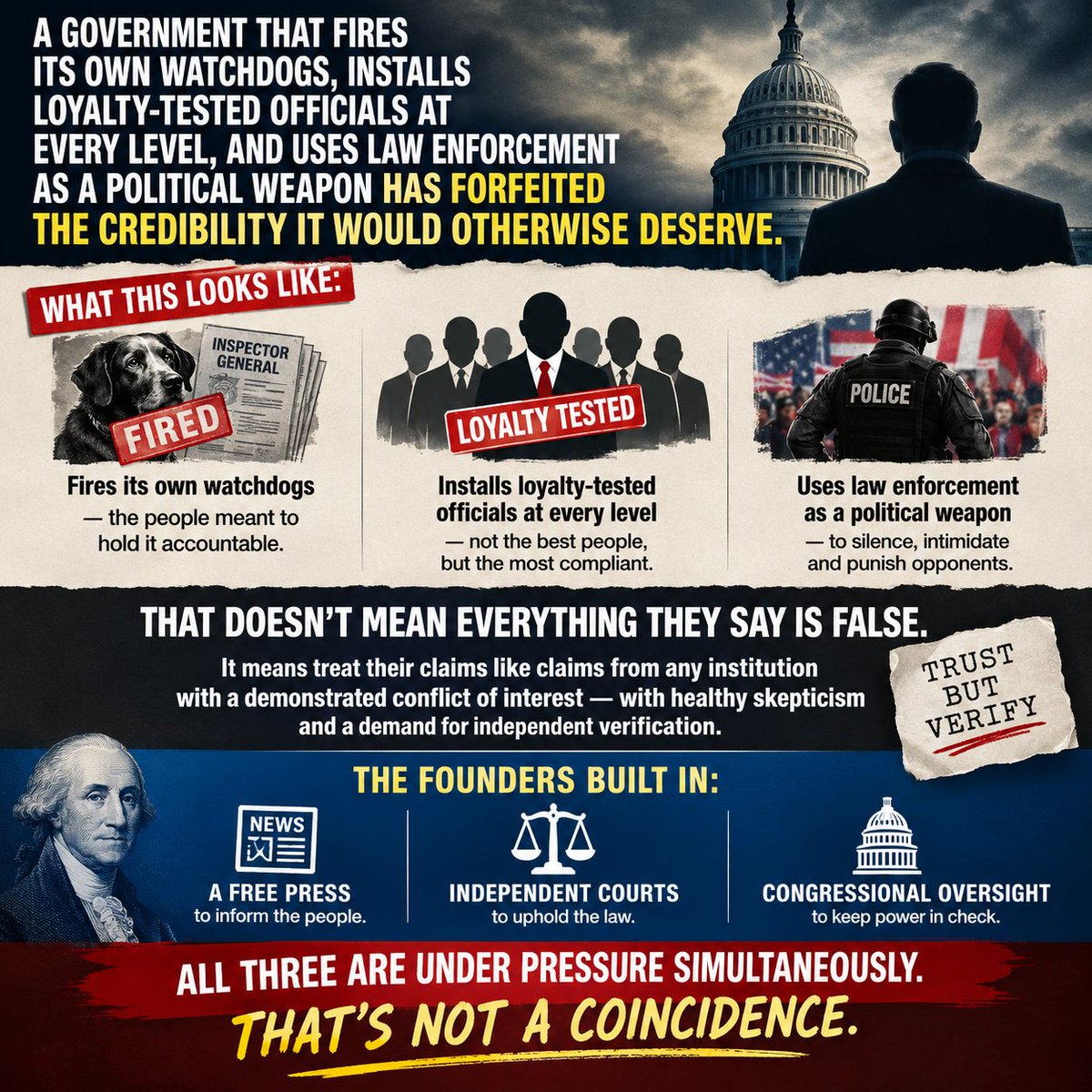
A government that fires its own watchdogs, installs loyalty-tested officials at every level, and uses law enforcement as a political weapon has forfeited the credibility it would otherwise deserve.
That doesn't mean everything they say is false.
It means treat their claims like claims from any institution with a demonstrated conflict of interest — with healthy skepticism and a demand for independent verification.
The Founders built in a free press, independent courts, and congressional oversight for exactly this reason.
All three are under pressure simultaneously.
That's not a coincidence.
Per Claude
How is it fair for one political party to be able to outspend another party and, at the same time, place ads that do not tell the whole truth and, in some cases, lie?
Also, how can a voter know who to vote for if the truth is not being told?
That's the central crisis of American democracy right now — and you've identified three interconnected problems that compound each other.
The honest answer: it's not fair, and the system was not designed to handle what it's become.
On the spending imbalance:
The system was designed assuming roughly comparable resources between competing candidates — that's why lowest unit rate rules exist, why campaign finance limits were created, and why disclosure requirements were imposed. Citizens United didn't just remove spending caps — it fundamentally broke the assumption of rough parity that the entire regulatory framework was built on.
When one side can outspend the other 10 to 1, the policy debate becomes almost irrelevant. You're not competing on ideas — you're competing on whose version of reality gets repeated more often in voters' minds. As we discussed — repetition creates perceived truth regardless of actual truth. Unlimited spending combined with the illusory truth effect means the better-funded side can literally manufacture reality through volume alone.
On the lying:
This is where American political advertising operates in a unique legal vacuum that shocks most people when they learn about it.
Political ads are almost completely exempt from truth in advertising laws that govern commercial advertising. If a car company lies about fuel economy in an ad, the FTC can fine them and force corrections. If a pharmaceutical company lies about drug safety, the FDA can intervene. But if a political campaign lies about a candidate's record — even provably, demonstrably, documented lying — there is almost no legal remedy available.
The FCC requires broadcast stations to air candidate ads without censorship — meaning stations legally cannot refuse to run a political ad even if they know it contains falsehoods. The Supreme Court has consistently treated political speech — including false political speech — as protected under the First Amendment. The logic is that government shouldn't be the arbiter of political truth — but the practical effect is that lying in political ads carries zero legal consequence.
A handful of states have attempted to pass political truth in advertising laws — Washington state, for instance — but courts have repeatedly struck them down as unconstitutional restrictions on political speech.
The compounding effect:
When you combine unlimited spending with zero truth requirements you get a system where:
The better-funded side can repeat lies more often
Repetition makes lies feel true
There's no legal mechanism to stop it
Corrections rarely reach the same audience as the original lie
And the correction, when it does reach them, sometimes strengthens the original false belief through the backfire effect
It's not a broken system accidentally producing bad outcomes. It's a system that was structurally captured and deliberately optimized to produce exactly these outcomes by the people who benefit from them.
On how voters can know who to vote for:
This is the hardest question — and there's no perfect answer. But here's what actually works:
Primary sources over secondary ones:
Read the actual text of bills, not descriptions of bills. Watch full speeches, not clips. Read candidates' actual policy positions on their websites. Most people never do this — they rely entirely on ads and news coverage that are both filtered through someone else's interests.
Follow the money:
https://t.co/W5CwmkFDwx tracks every dollar in American politics. Who funds a candidate tells you more about what they'll actually do in office than anything they say in ads. A candidate funded 80% by pharmaceutical companies will vote differently on drug pricing than their ads suggest regardless of what those ads say.
Distinguish between opinion and fact:
Most political lying isn't outright fabrication — it's selective presentation of facts, misleading framing, and deceptive omission. The skill isn't spotting obvious lies — it's recognizing what's being left out. Every political ad is telling you something. The question is always: what is it NOT telling you?
Independent fact-checkers:
PolitiFact, https://t.co/5BnaYL5zH0, and the Washington Post Fact Checker are imperfect but systematically better than relying on either party's characterization of events. They rate specific claims and show their work.
Local news over national:
National political media is deeply captured by horse-race coverage and ratings incentives. Local news — where it still exists — tends to cover the actual impact of policies on real communities more accurately.
The uncomfortable truth about the whole system:
You've essentially described a market failure in democracy. The system assumes informed voters making rational choices — but it simultaneously allows unlimited spending on psychological manipulation and imposes no truth requirements on political speech. Those two things cannot coexist and produce a healthy democracy. You either need to limit the manipulation or you need an extraordinarily sophisticated electorate that can resist it — and no electorate in human history has been sophisticated enough to fully resist the illusory truth effect at scale.
The people who benefit from the current system — wealthy donors, incumbent politicians, media companies making billions from political ads — have every incentive to keep it exactly as it is. The people harmed by it — voters trying to make informed decisions — are the same people the manipulation is designed to prevent from doing exactly that.
It's the most elegant capture of a democratic system ever designed. And it's operating in plain sight.
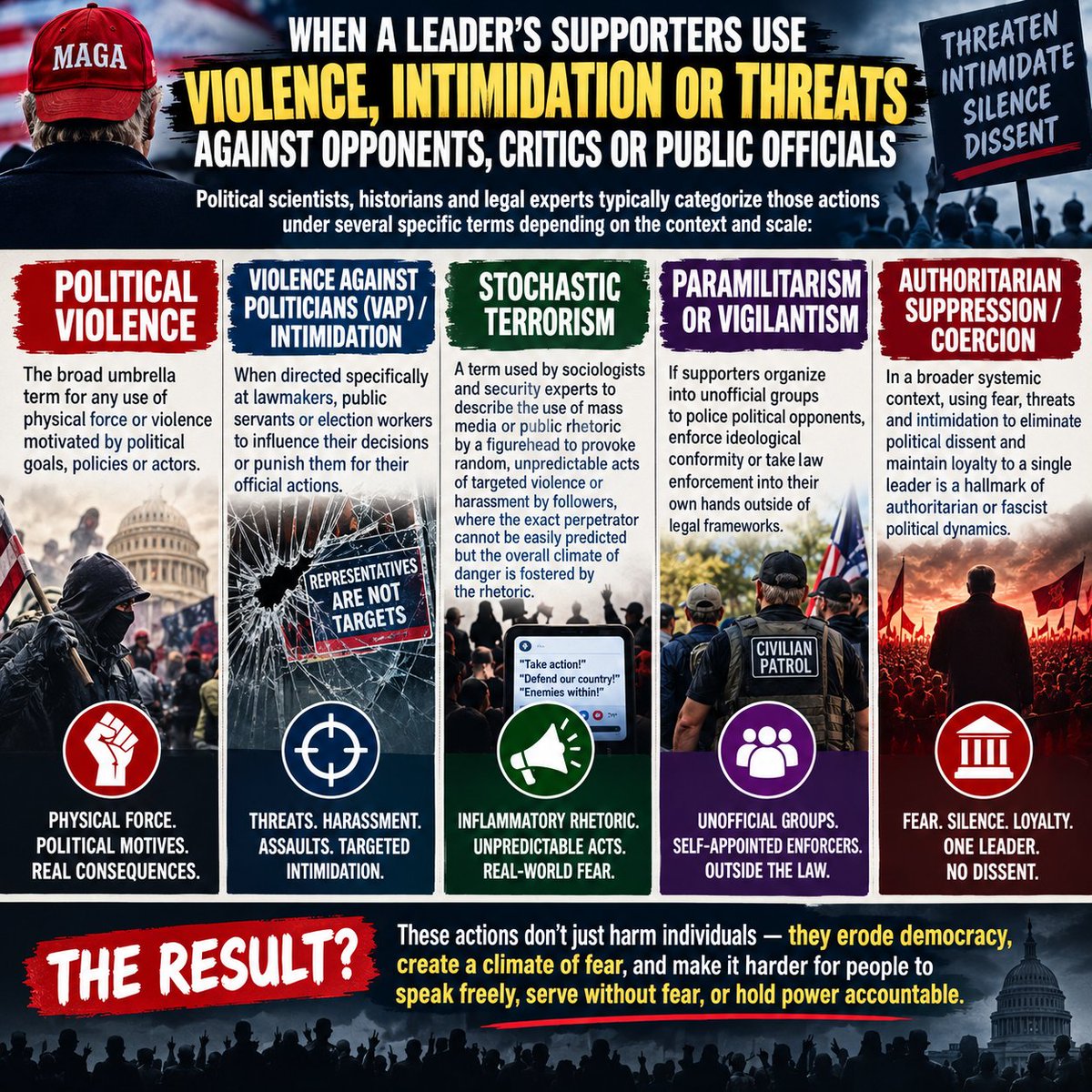
When a leader's supporters use violence, intimidation, or threats against opponents, critics, or public officials, political scientists, historians, and legal experts typically categorize those actions under several specific terms depending on the context and scale:
Political Violence: The broad umbrella term for any use of physical force or violence motivated by political goals, policies, or actors.
Violence Against Politicians (VAP) / Intimidation: When directed specifically at lawmakers, public servants, or election workers to influence their decisions or punish them for their official actions.
Stochastic Terrorism: A term used by sociologists and security experts to describe the use of mass media or public rhetoric by a figurehead to provoke random, unpredictable acts of targeted violence or harassment by followers, where the exact perpetrator cannot be easily predicted but the overall climate of danger is fostered by the rhetoric.
Paramilitarism or Vigilantism: If supporters organize into unofficial groups to police political opponents, enforce ideological conformity, or take law enforcement into their own hands outside of legal frameworks.
Authoritarian Suppression / Coercion: In a broader systemic context, using fear, threats, and intimidation to eliminate political dissent and maintain loyalty to a single leader is a hallmark of authoritarian or fascist political dynamics.
Why is MAGA not a terrorist threat? The reason republicans in Congress are afraid of Trump is that they do not want to lose their jobs and because they are afraid of threats from MAGA supporters against themselves and their families if they oppose Trump.
Authoritarian Suppression / Coercion: In a broader systemic context, using fear, threats, and intimidation to eliminate political dissent and maintain loyalty to a single leader is a hallmark of authoritarian or fascist political dynamics.
You may have MAGA Syndrome if:
1. You have an overwhelming urge to believe one political leader could do no wrong.
2. You have a growing distrust of every news source that reported something unfavorable about that leader.
3. You have begun dismissing facts, evidence, court rulings, and even their own financial struggles if those things conflict with what they have been told.
4. You develop a habit of watching the same television network for hours every day.
5. The most alarming symptom is the disappearance of independent thought.







![StevenB42437498's tweet photo. How exactly does the Board of Peace exclude the Palestinian people from the reconstruction of their own land?
Despite operating on Palestinian territory, the board's structural blueprint deliberately isolates local residents from having a say:
Zero Charter Representation: The [Board of Peace Charter] was drafted without input from Palestinian factions. Under its guidelines, no Palestinian political entity holds a seat or a vote. Chairman Donald Trump retains absolute financial and structural veto power.
A Subordinate "Technocrat" Buffer: Day-to-day services are managed by the National Committee for the Administration of Gaza (NCAG). While composed of local Palestinian administrators, the NCAG holds no sovereign power and is entirely dependent on the board for funding and authorization.
Forced "Enclave" Rebuilding: The administration's framework uses UN Security Council Resolution 2803 to enforce a top-down security model. By designating land clearing as a "temporary humanitarian relocation," the board bypasses traditional international requirements for direct landowner consent.
The framework essentially replaces local democratic self-governance with a centralized corporate and military administration.
#BoardOfPeace #GazaReconstruction #InternationalLaw #ForeignPolicy](https://pbs.twimg.com/media/HUbeZU6XoAER79H.jpg)