🇺🇸🇯🇵 U.S. Navy Sailors assigned to Patrol and Reconnaissance Squadron (VP) 26 transport a MK 54 series Lightweight Torpedo for loading into the internal weapons bay of a P-8A Poseidon multi-mission maritime aircraft (MMA) at Kadena Air Base, Japan, June 5, 2026. The torpedo is seen here being transported with the aid of an MHU-83D/E Aircraft Aerial Munitions Lift Truck.
(📸/Petty Officer 2nd Class William Bennett IV)
Today's "Odd Tank" is the 🇺🇸 American,🇬🇧 British and 🇨🇦 Canadian 'Sherman DD'
Built in the 1940's, the Sherman DD's were shermans of various models modified to be amphibious Medium Tanks. They would be used on the D-Day Landings on June 6, 1944 by US, British and Canadian forces.
The DD stands for Duplex Drive and these Shermans had propellers at the back to allow them to drive and steer through the water at 7km/h. The large canvas screen would displace the water and allow the tank to float. This screen would be lowered once on land to allow the tank to fight.
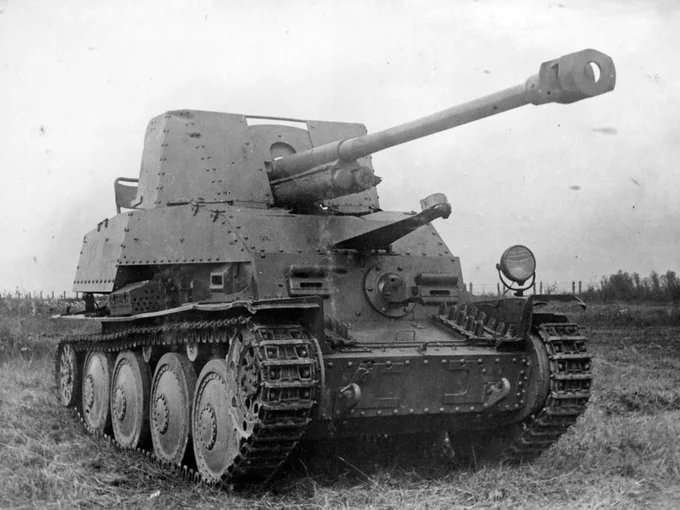
The Germans began to build SPGs and tank destroyers on the chassis of their light tanks in 1942, including the Pz.38(t). #OTD in 1942 production of gun tanks ceased completely and all Pz.38(t) chassis went to make Marder and later Grille vehicles. #tanks#history#WW2#WWII
#OTD in 1942, pilot LCDR Wade McClusky from USS Enterprise followed a Japanese destroyer to find the enemy carriers near Midway. He ordered the attack that led to the sinking of Kaga and Akagi. McClusky died in 1976 and is buried in front of the Naval Institute's HQ at Beach Hall.
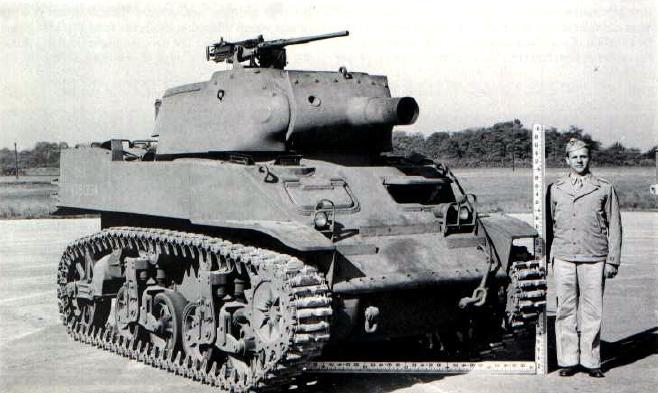
Today's "Odd Tank" is the 🇺🇸 American 'M8 Scott'
Entering service in 1942, the M8 Scott is a Howitzer Motor Carriage (HMC). The hull is based on a M5 Stuart Light Tank and it was designed to provide light artillery support.
A total of 1,778 M8's would be produced and they would go on to serve in other nations as well like France and Mexico to name a few.
The primary weapon is a modified 75mm M1 Pack Howitzer.
Regarding the new tank-building novelty – the IMBT from LRMV (Leonardo-Rheinmetall Military Vehicles).The sight isn’t particularly impressive. In essence, this isn’t a new tank at all – it’s a business product without any real ideology or concept behind it.
Rheinmetall’s recipe is simple and reliable: just improve the specs. Armor was one meter thick — now it’s one and a half. Gun was 120 mm – here, have a 130 mm. And pile on as much expensive electronics as possible. All of this will be extremely costly and produced in tiny numbers.
In the end, it’s just a Leopard 2 on steroids. At its core, the concept is still straight out of World War II and the Cold War.
Everything about this project is obvious: the sides are unprotected, the roof and hatches are exposed too (except for four Strike Shield modules). There’s a massive gaping gap between the turret armor and the hull front – a perfect trap for shells and drones that don’t even need to penetrate the huge thickness of this fake “super armor.” They don’t seem particularly concerned about the weight either – the heavier it is, the more expensive (and therefore “better”) it is.
The whole thing reminds me of a shining knight in full plate armor in the age of machine guns – except they only bothered to reinforce one small section of the cuirass. It’s nothing more than a formal upgrade in performance without any fundamental rethinking of what a tank should be in the 21st century.
Re-evaluating the Prevail Partners Multi-Role Vessel (MRV) as a Viable Option for the UK’s Multi-Role Strike Ship Programme
80% of something is better than 100% of nothing.
Views my own, corrections and comments always welcome
Introduction
1/25 The Royal Navy and Royal Marines stand at a critical juncture. With fiscal pressures, crewing challenges, and evolving threats in contested littorals, the need for adaptable platforms has never been greater. This thread attempts to examine whether the MoD (through CDS, MSHQ and RN) should revisit Prevail Partners’ Multi-Role Vessel (MRV) concept for the Multi-Role Strike Ship (MRSS) requirement. I try to argue for a pragmatic, rapidly deliverable solution aligned with the Future Commando Force and the Hybrid Navy vision, but mine is only a view with an achievable outcome, not a study that sustains SO’s in their roles and consultancies with a steady income.
1/x On June 2, 1944, just four days before the Normandy landings, what was occurring on that day? Well, the planners of Operation Neptune (the naval side of D-Day) faced a major problem: how to guide the first waves of landing craft accurately to their beaches in the dark?
Details are still murky, but this is likely our first look at the IMBT from LRMV (Leonardo-Rheinmetall Military Vehicles). The prototype is going to be showcased at Eurosatory. The first 2 prototypes which will be delivered to the Italian Army in the future will mainly have ⬇️
Man, I would hate to be downrange of the MG-42 (in my opinion ranks alongside the .50 cal M2 Browning as the best machine gun of the 20th century). It even sounds more murderous than other automatic weapons.
Sounds of Germany’s Most Feared WWII Weapons 🇩🇪
Archival footage from a U.S. Army training film demonstrating the distinct firing sounds of Germany’s most iconic WWII weapons: the MG-34, MG-42, and MP-40.
The MG-42’s terrifying rate of fire was so extreme that Allied troops nicknamed it “Hitler’s Buzzsaw” because its bursts sounded more like a ripping machine than a machine gun.
The last of the mass produced Bf 109s were the G-10 and K-4, both using the DB 605D engine, which boosted power to over 1,700hp - breifly enabling the diminutive fighter to hold its own against a P-51 or Tempest - but not for long, the engine would blow up if held at high boost.
#OTD in 1940 after having lost a huge number of armoured vehicles in France, Britain made inquiries regarding Canada's ability to build armoured vehicles, looking to order 300 Valentine tanks. 1420 Valentines would be built in Canada in total. #tanks#history#WW2#WWII
I'm a day late here, but this is important. The average person would think a G.I. or Marine rifleman had it the worst, but not compared to death rates for sub crews and, as noted in the comments, bomber crew members over Europe.
The U.S. Navy lost 52 submarines during World War II. This came at a devastating cost: roughly one in five American submariners (over 3,500 men) were killed, representing the highest casualty rate of any U.S. armed forces branch during the conflict.
Remember them today 🇺🇸
1/ For the first time, the Russian MoD released footage showing a VKS Su-34 series strike fighter armed with a mix of four UMPK-equipped FAB-500T bombs and a pair of UMPB guided glide weapons (reportedly designated "UMPB D-30SN"). Such a loadout can also be seen in a number of unofficial photos recently posted on Russian social media (for example, see embedded post).
I think on a personal level, the most interesting and also depressing aspect of very detailed study of WW2 administration of defence and industry in Britain, is seeing how exceptionally competent almost all of Britains administrators were.
You almost get cognitive dissonance just reading half the files, trying to work out how its even the same country we live in now which once produced these kinds of reports.
There is no doubt there has been a progressive, and disastrous collapse in the all round general collective intellectual capability of the civil service and defence administration in Britain over the last few decades.
Its possible to argue this is inevitable after the system was optimised by the white heat of war, and the dead wood was scattered to the four winds by virtue of necessity, but it doesnt change the fact that its almost impossible to reconcile the standards which were once taken for granted as a matter of national survival, with those we see today.
You can see it at every level, and even in my small town, talking to retired councillors, they cant believe the desperately poor standard of those currently doing the jobs they did 30 years ago.
How do you keep the best of your systems intact passing from wartime to peacetime ? Has anyone solved this question ?
Perhaps, as far as I can see from a brief search (this is not my specific area of historical study) Singapore is one example of the most valiant attempt, with some measure of sucess.
This has been discussed in "Meritocracy and the Singapore Political System." Asian Journal of Political Science. (link in comments), which describes the strict measures taken post independance in Singapore to introduce performance based merit in the Civil Service, and intensely rigid anti corruption laws.
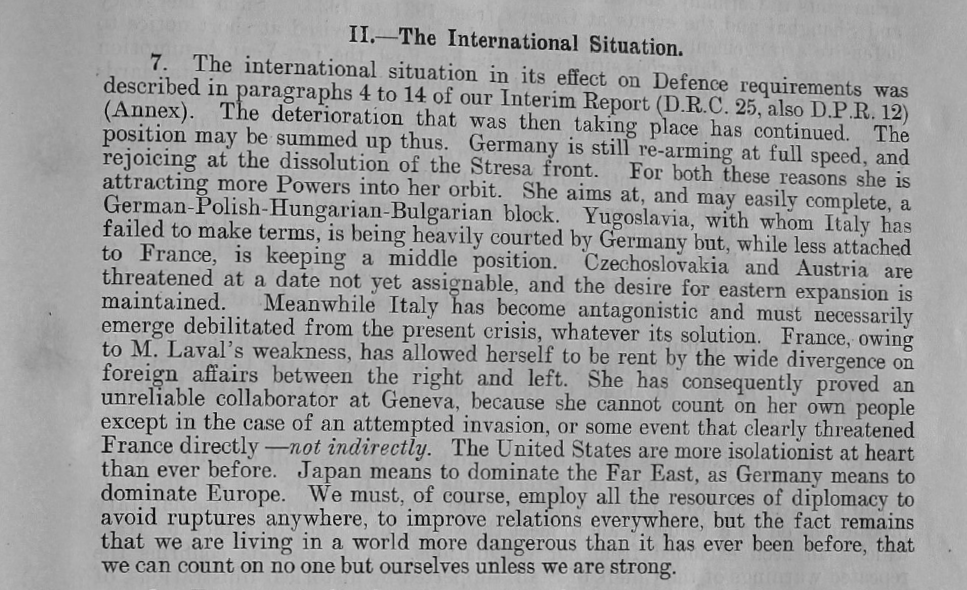
Letter below from 21st November 1935, Defence Requirements Sub-Comittee of the Committee of Imperial Defence - the CID, (Chamberlain presiding)
A year before, on the 8th October 1934, Chamberlain had been lambasted by Lord Hankey, for expanding the RAF by ten squadrons over and above that even recommended by the Defence Requirements committee.
Chamberlain suceeded in his push to expand the RAF at home as rapidly as possible. These meetings were however, all secret, and were not declassified until the 1970`s. The push for re-armament was not fully revealed to Germany, because the CID had agreed in 1934, that it would need five years to prepare for war with Germany, and that every diplomatic measure possible was to be taken until that date (1939) to avoid the outbreak of war with Germany.
It was then, after Chamberlains withdrawl from politics and death, taken as the established narrative that Britain had NOT begun large scale and direct preparations to defeat Germany before the beginning of Churchills tenure.
Only after the Committee of Imperial Defence files were declassified, covering what was really happening in British war planning in the 1930`s, that the truth became apparent. The established story of British stupidly and appeasement of totalitarianism before Churchill was Prime Minister, were utter nonsense - but, had been important to maintain the illusion of until 1939.
In a single afternoon on May 22, 1941, the Royal Navy lost two cruisers and a destroyer off the coast of Crete to German dive bombers. The fleet commander was urged to withdraw what was left.
His reply has been quoted ever since, but the situation that produced it is less well known. By the morning of the 22nd, the German airborne invasion of Crete was four days old and on the brink of failure. Of the seven thousand paratroopers Kurt Student had dropped on the first day, roughly half were already dead. The Germans had taken huge losses trying to capture Maleme airfield in the west of the island. Without an airfield, no reinforcements could land. Without reinforcements, the invasion would collapse.
What the Germans needed was a seaborne convoy of mountain troops, heavy weapons, and ammunition. Two such convoys were assembled in Greek ports and put to sea under Italian destroyer escort, hoping to slip across the Aegean to Crete.
The Royal Navy intercepted the first convoy on the night of May 21. In a confused action in the dark, British cruisers and destroyers tore through a fleet of small Greek caïques crammed with German soldiers. Roughly three hundred Germans drowned. The convoy was destroyed.
But by morning the Royal Navy was south of Crete in clear daylight, within range of the Luftwaffe's Fliegerkorps VIII, the most experienced and lethal dive-bomber force in the world. And the British ships were running low on anti-aircraft ammunition because they had spent most of it sinking the convoy.
The Stukas came in waves. The cruiser Gloucester took two direct hits and capsized, taking 722 men with her. The cruiser Fiji was hit by a single bomb that ruptured her hull. She sank slowly, with most of her crew getting off, but 241 men were lost. The destroyer Greyhound was bombed and went down in fifteen minutes. The battleships Warspite and Valiant were both damaged, Warspite badly enough that she had to go to the United States for repairs.
By nightfall on May 22, Admiral Andrew Cunningham, commanding the Mediterranean Fleet from Alexandria, was looking at a casualty list that included two cruisers, a destroyer, two damaged battleships, and roughly fifteen hundred dead British sailors. The army on Crete was asking for naval evacuation. The army on Crete also had thirty two thousand troops on it.
Cunningham's staff, looking at what the Luftwaffe had done in a single afternoon, urged him not to commit the rest of the fleet. He could not protect transports from Stukas in daylight. Anything he sent into the waters north of Crete would be sunk. The navy had taken enough.
Cunningham listened, and then he gave the order that is still quoted at Dartmouth Naval College.
"It takes the Navy three years to build a ship," he said. "It would take three hundred years to build a tradition. The evacuation will continue."
The fleet went back. Between May 28 and June 1, the Royal Navy evacuated 16,500 men from the south coast of Crete under continuous air attack. They lost three more cruisers and six more destroyers doing it. Thousands of British soldiers were left behind and became prisoners. But the navy did not abandon the army.
The German victory at Crete was so expensive that Hitler never authorized another major airborne operation for the rest of the war. The paratroopers had taken the island, but the airborne arm as a strategic weapon was effectively destroyed in the process.
Cunningham's decision was not a calculation about morale. It was a statement about what kind of institution the Royal Navy was, made in the moment when the institution was being tested. He was sixty years old. He had spent forty four years at sea. He understood, in a way that staff officers in London did not, that an institution that abandoned its soldiers in 1941 would still be remembered for it in 2041.
Three hundred years to build a tradition. Eighty five years ago today, the bill came due, and Cunningham paid it.
Notice something weird about this Bogue class escort carrier? No? Look at the figure crouched just aft of the island. Still not quite getting it? Look at the two individuals standing under the aft flightdeck?
What you see here is one of the more audacious methods of deception tested by the United States Navy.
This is a replica bogue class aircraft carrier built onto the hull of the submarine chaser SC-449!
The United States Navy was well aware that the Invasion of Japan would result in the greatest use of kamikaze attacks. Knowing that it would be impossible to adequately defend against them, it was decided to provide decoy targets to divert attention.
SC-449 was the prototype for this strategy. In 1945, her superstructure was cut down and a wooden mockup of a flightdeck and island were erected. Details were added in the form of miniature anti-aircraft guns, rigging, and even aircraft on the flight deck to complete the illusion.
Despite the decoy being only 110' (33.5m) in length, 300' shorter than a typical escort carrier, the Navy believed that kamikaze pilots would be unaware of the deception until it was too late. The unmanned decoys would be deployed at various points around Japan, diverting Japanese attention from the real warships in the fleet.
The escort carrier decoys were never utilized. Due to the use of the atom bomb to force a Japanese surrender, the invasion of Japan was never carried out. With no invasion, there was no need for the decoys.