Congratulations to Dr. Caitlin Wilkerson on her PhD defense! Her work shows how Kvβ2 regulation of Kv1 channels dictates vasodilatory and inflammatory responses. Along the way: an NIH F31 on the first try.
Ilaria Ferrari won 1st place in the graduate student category at last week's Research!Louisville colloquium. Congrats to her! She is a G2 in the MD/PhD program, and I am glad she is in my laboratory and @CardioMetaboSci.
@uoflmedschool@UofLEVPRI@AHAScience
🌙🌡️ New research from the Center shows that sleep, metabolism, and body temperature are tightly linked, and that environmental temperature and light exposure can significantly shape these relationships. Read more: https://t.co/RQuGb3i9UT #SleepResearch#Metabolism
Marcin Wysoczynski, PhD, studies how the immune system drives heart failure, including how the injured heart signals the bone marrow to ramp up neutrophil production after a heart attack.
Shahid Baba, PhD (@BabaPShahid), studies how carnosine and related histidyl dipeptides protect the heart and skeletal muscle in heart failure, work he has carried into a Phase II clinical trial in peripheral artery disease.
Jason Hellmann, PhD (@jlhell02), studies why inflammation fails to resolve in atherosclerosis and obesity, and how exercise training boosts the body's own pro-resolving lipid mediators
Alex Carll, PhD (@CardioCarll), investigates how e-cigarette aerosols and air pollutants disrupt cardiac rhythm and pump function, with a focus on the autonomic nervous system as the link between exposure and arrhythmia.
Four Center faculty have been named Fellows of the American Heart Association: Drs. Shahid Baba, Alex Carll, Jason Hellmann, and Marcin Wysoczynski. More on each of them below. #AHAScience
Mid-career (or early) in academic research? Get straight talk on university budgets and how to negotiate your next move.
Free AHA #BCVS webinar from the Mid-Career Task Force
Wed, Oct 28 | 11 a.m.–12:30 p.m. CT
Register: https://t.co/2GcOqfhBMg
The natural apotheosis of this argument is a hospital devoid of doctors, run by administrators and accountants behind computers watching the clankers provide care. This is not a criticism of the authors of this piece, or anyone else interested in such things—people should study whatever they like. Leaders of academic medical centers, however, have a choice to make about how they evaluate the efficacy of AI. And that choice will have a tectonic impact on the future of medicine.
No doctor I know told me they went into medicine to remove humans from patient care. But the purpose of a system is what it does. If the firepower behind AI removes humans from medicine and biomedical research, that was its purpose. Incidentally, humans are the biggest liability in delivering care. How much would malpractice insurance for a computer cost a health system? Someone is doing this calculation.
How will a generation of scientists be inspired to pursue research or doctors be inspired to complete medical training? The answer is not by having a computer do the most interesting parts.
I am not a Luddite and believe that AI can enable human doctors and scientists to accomplish remarkable new things. But only if the humans judge outcomes accordingly. Someone is going to image an EHR and let superintelligent agents run wild on it—the ‘CRISPR baby’ moment for AI. In the meantime, the first objective for AI in an academic medical center should be quite pedestrian: reduce administrative burden on faculty and students by transferring these tasks to computers, not to more administrators. This is not a zero-sum proposition: jazzier research into transforming healthcare with AI should of course continue in parallel. Electronic health records and ICD codes were created for billing but are being repurposed for a great revolution in computational medicine.
Rather than finding ways to remove doctors and scientists from the process, academic medical centers should direct AI implementation towards: (1) replacement of any faculty activities not related to teaching, research and medical care and (2) a reduction (say, by 90%) in the personnel who are neither faculty nor providers (i.e. doctors, nurses, and other trained healthcare professionals). If these goals are achieved, we may conclude that the use of AI in the administration of academic medical centers has served its purpose.
@ZekeEmanuel@JAMA_current@JAMANetwork
Make an impact in the fight against heart disease by supporting me at the 💕 2026 Kentuckiana Heart Walk! Will you consider making a donation today?
https://t.co/fLiEhE1NXL
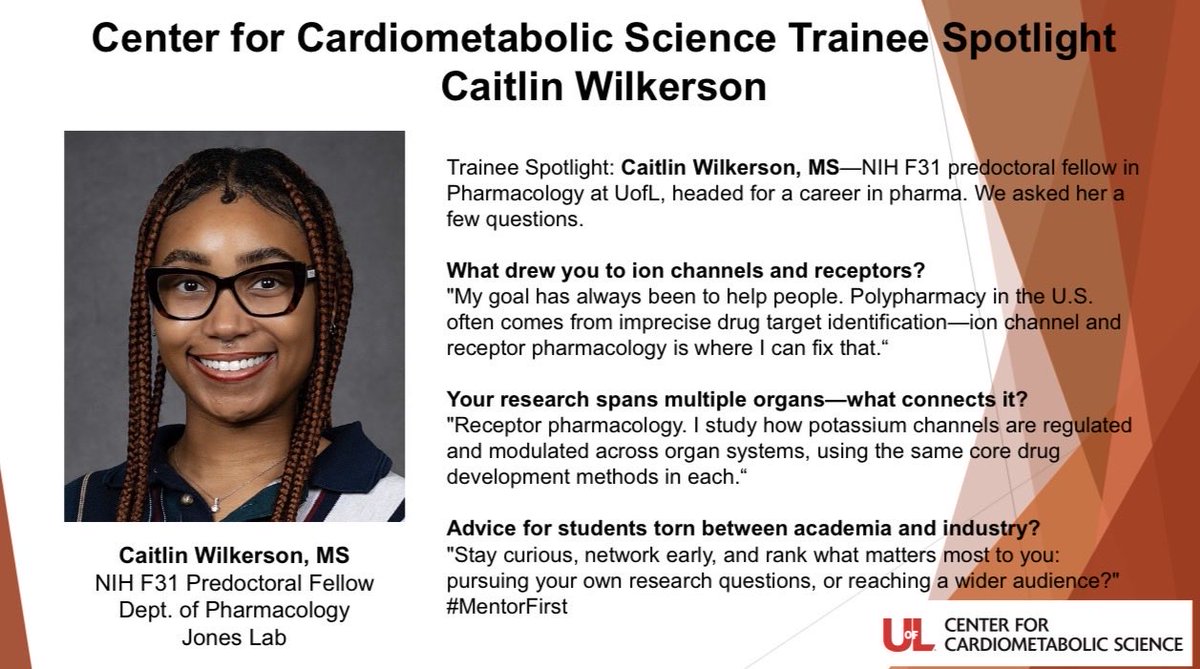
The single greatest asset of the Center is our people. We're proud to showcase the outstanding trainees who power our research, advance scientific discovery, and represent the future of cardiometabolic science. Today, we begin with Caitlin Wilkerson, check her out 👇
New research from the Hellmann and Sansbury labs shows PM2.5 doesn’t just irritate the lungs — it reversibly disrupts key inflammation‑resolving lipid pathways and red‑blood‑cell homeostasis. A powerful reminder that air pollution reaches far beyond the respiratory system.
📣 We’re hiring!
The Hamilton Lab at The University of Arizona is seeking motivated Postdoctoral Research Associates to join us.
Apply here: https://t.co/wAnEj7LL3l
Excited to share the latest publication from the Hill lab in Nature Communications led by Dr. Daniel Nguyen: "TAK1 drives inflammatory fibroblast acquisition and shapes myocardial infarction responses in male mice”.
Huge congrats for Nancy Tian, the 1st PhD student in the Lab. Today she successful defended her Master's Thesis and passed her Qualifying Exam for PhD Candidacy. Your future is bright and we can't wait to see your continued growth.