Turmeric and Curcumin have stunningly low bioavailability. So low it should be unethical to recommend it. Fix it by using the NOVASOL technology developed by AQUANOVA, which raises the bioavailability 18,000%. You can buy it on Amazon. For years I sold a curcumin using this technology and the results were miraculous. Even easily and quickly absorbed in the mouth.
@thehealthb0t CURCUMIN has such low bioavailability that it should be unethical to recommend it. Instead, use a very specific brand with amazing technology develop from germany that increases bioavailability by 18,000%. Look up NOVASOL curcumin on Amazon
A 22-year-old graduate student in Kazakhstan got so angry at journal paywalls in 2011 that she built a pirate website holding 88 million scientific papers, and last month she turned the whole thing into an AI that lets you ask one question and get the actual research as the answer.
Her name is Alexandra Elbakyan, and the website is called Sci-Hub.
The AI she just launched is called Sci-Bot. It lives at https://t.co/6w0IBtOEYB and almost nobody outside academia knows it exists yet.
Here is the story, because it is one of the strangest things to happen in science publishing in the last 50 years.
Elbakyan was born in Almaty in 1988, the year the Soviet Union started to collapse. She taught herself programming at 12. She read Soviet science books that explained things her family used to call miracles. She got into computer security at university and graduated in 2009 with a degree she barely needed because by then she was already a serious hacker.
Alexandra moved to Moscow that fall. Then Germany. Then a research internship in the United States. She was working on brain-computer interfaces, the kind of research that requires you to read hundreds of papers a year just to keep up with the field.
And every single one of those papers was locked behind a journal paywall that cost between 30 and 50 dollars to read once.
She did the math. A graduate student in Kazakhstan could not afford to read science.
The first thing she did was learn how to get around the paywalls one paper at a time. She passed the trick around to other students. They asked her for papers constantly. She got tired of doing it manually.
So in September 2011, in three days, she wrote a script that automated the whole thing. A user pastes a DOI. The script logs in through a donated institutional credential. The paper comes back free. The website caches it.
The next person who asks for that paper gets it instantly because the previous request already saved a copy.
That was Sci-Hub. Three days of code. One graduate student. Done.
15 years later, the cache holds 88 million scientific papers. Almost every piece of scholarly literature published before 2020 is sitting on her servers. Researchers in 190 countries use it. Studies in Nature have shown that roughly half of all academic paper downloads worldwide now go through Sci-Hub, not the publishers who actually own the copyrights.
Elsevier sued her in 2015 and won a 15 million dollar judgment. She did not pay. The American Chemical Society sued her and won an injunction. She did not comply. Courts in India, France, Russia, and the UK have tried to block the domain. She just moves it. https://t.co/3sAWJzNe8I. https://t.co/tGIETesZ8i. https://t.co/H5WQ1f9lqR. The site has had over 20 domains and is still up.
Nature put her on its list of the 10 people who mattered most to science in 2016. The New York Times compared her to Edward Snowden. The Verge called her the pirate queen of science.
She has not been to the United States in over a decade because she would be arrested at the airport.
The Sci-Bot launch in April 2026 is the part that nobody is talking about.
She took the 88 million paper database and put a small language model on top of it. You ask a question in plain English. The model searches the entire shadow library, pulls the relevant papers, synthesizes an answer grounded in real citations, and links you to the full text of every source. Free. No login. No institutional credential. No paywall.
Three real scientists tested it for a Chemical and Engineering News article last month. They asked it medical and chemistry questions. The radiologist said the answer he got was usable. The chemist said the gaps in recent literature were obvious but the older science was solid. The publisher community is furious.
What she built is what the paid academic AI tools are trying to build. Except the paid ones are limited to what their parent publisher legally owns. Hers is limited to almost nothing.
Alexandra still lives somewhere in Russia. She does not give her address. She does not do video interviews. She gives talks over Skype with the camera off. She runs the largest illegal library in human history from a laptop and a donation page.
A graduate student who could not afford to read science built the system the entire scientific community now quietly depends on.
The publishers have spent a decade trying to shut her down.
She just shipped an AI that makes their entire business model outdated.
@PeptideProSrc So researchers found benefits to the world's best selling and most profitable drugs which were having a huge PR issue due to horrible side effects? Not at all suspicious.
A Russian biophysicist spent 30 years proving that shining red light on a cell could double its energy, and almost nobody believed her until a tech billionaire named Bryan Johnson made her work the most searched biohack on the internet.
Her name was Tiina Karu.
She worked in a Moscow lab through the 1980s and 1990s, and the discovery she defended for decades sat in journals nobody read while the rest of medicine ignored her.
The whole thing started by accident.
In 1967, a Hungarian doctor named Endre Mester was trying to use a new device called a laser to burn tumors out of mice. His laser was broken. It did not have enough power to burn anything. He used it anyway. The mice grew their hair back faster than the control group. Their wounds healed faster too. He had no idea why.
Tiina Karu picked up his work and asked the question that mattered. Why does this happen.
She ran experiments for 20 years. Different wavelengths. Different doses. Measuring what happens inside the cell when red light hits it. The answer she landed on was almost too specific to be true.
The thing in your body that responds to red light is one enzyme. Cytochrome c oxidase. It sits inside your mitochondria.
Mitochondria are the part of your cell that makes energy. They take oxygen and food and turn it into a molecule called ATP, which is the fuel your cells run on. Your body makes 40 to 70 kilograms of ATP every single day just to keep you alive. If your mitochondria slow down, you age faster, heal slower, lose hair, lose muscle, and get inflamed easier.
Cytochrome c oxidase does most of the work. It contains copper and iron atoms. Those atoms happen to absorb light at very specific colors. Red light at 630 to 670 nanometers. Near-infrared light at 810 to 850 nanometers.
Other colors do almost nothing. Blue does not work. Green does not work. The biology is locked to those two windows because that is what the metal inside the enzyme can physically catch.
When a red photon hits that enzyme, three things happen.
The enzyme runs faster. ATP production jumps 30 to 40% within minutes.
Nitric oxide gets released. Blood vessels widen. More oxygen and nutrients flow in.
A small stress signal goes off inside the cell that tells it to repair itself. The same signal it gets after exercise.
Red light is not adding anything to the cell. It is just unlocking work the cell was already trying to do.
For 30 years almost nobody outside her field cared. Red light therapy lived inside dental clinics for mouth ulcers and physical therapy offices for tendonitis. Medical schools did not teach it. The science sat in obscure journals.
Then the evidence started piling up.
A 2024 review of 18 trials confirmed red light speeds up wound healing.
Another 2024 review found it lowered inflammation markers by 38% over 4 weeks.
Athletes using red light before training had 45% less muscle soreness the next day.
Seven separate trials on hair loss showed visible regrowth in every single one.
A 2024 study found 15 minutes of red light before a meal cut blood sugar spikes by 27.7%.
In March 2026, Nature published a 4,000 word feature on red light therapy. The most respected scientific journal on Earth officially admitted there was real biology under the hype. That was the moment the field crossed from fringe to mainstream.
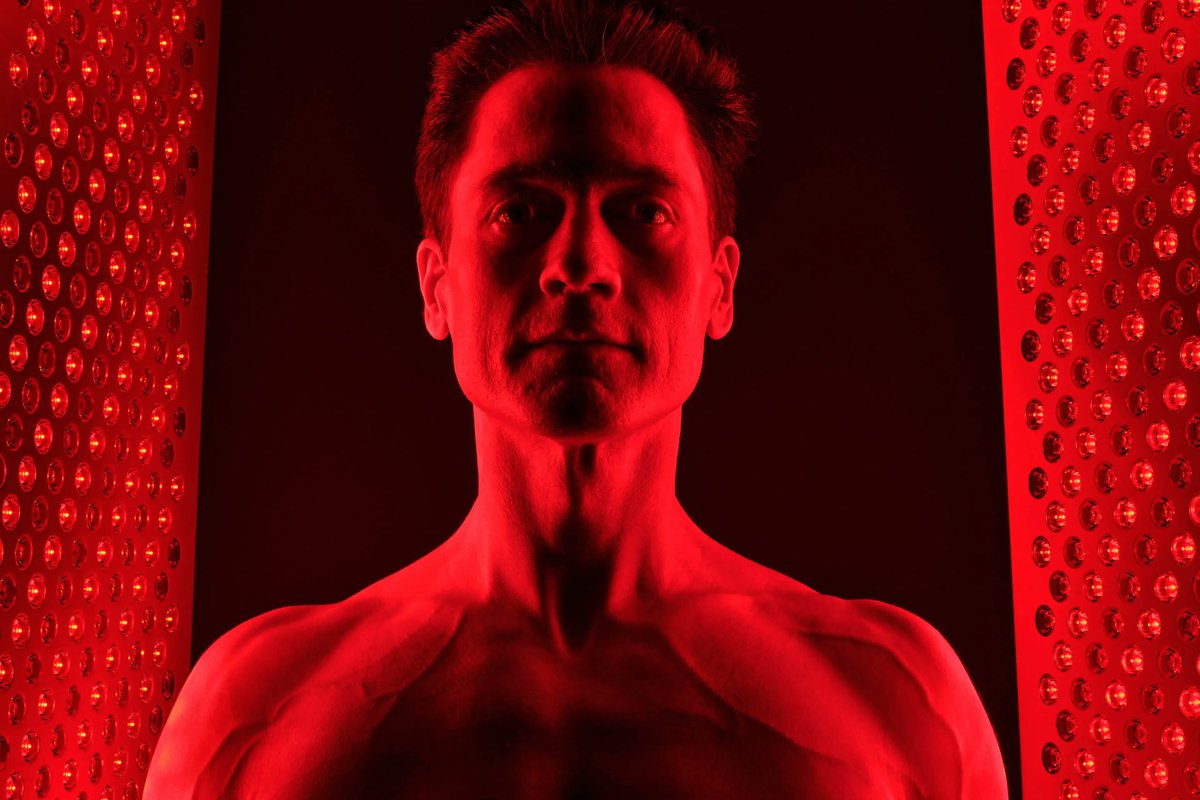
Bryan Johnson is the reason the average person now knows any of this exists. He uses a red light cap on his scalp for 6 minutes daily and a full-body panel three times a week. He posted his hair regrowth photos and his skin scans, and the algorithm did the rest. Red light masks went from biohacker forums to Sephora shelves in two years.
Tiina Karu died in 2019. She did not live to see Nature validate her. She did not live to see a billionaire turn the enzyme she identified into a billion dollar industry.
Every red light mask, panel, cap, and bed on the planet right now is just a way to deliver the photons she proved mattered.
The wavelengths were always there. The enzyme was always there. The biology was always real.
It just took a Hungarian doctor with a broken laser, a Russian scientist nobody listened to, and one tech billionaire willing to stand in front of a glowing panel for the world to finally pay attention.
🚨 SURGEON WARNS THE BIGGEST BREAKTHROUGH IN HUMAN HISTORY IS HAPPENING RIGHT NOW — “BIGGER THAN AI”
A surgeon is going viral after claiming scientists may have already discovered a way to partially REVERSE aging at the DNA level… and he says the implications are bigger than AI, social media, smartphones, or even the internet itself.
Dr. Buck Parker’s claim:
“The fountain of youth has been discovered.”
“This is bigger than the Industrial Revolution. Bigger than the advent of the internet. Bigger than Amazon, Apple, the iPhone, Google, social media… bigger than AI.”
And according to Dr. Parker… it’s already happening RIGHT NOW.
The core claim revolves around something called “Yamanaka factors,” proteins discovered by Nobel Prize-winning researcher Shinya Yamanaka that can reportedly reset damaged cells back to a younger biological state.
According to Dr. Parker:
• Scientists have reportedly reversed visible signs of aging in animals
• Wrinkled skin in test subjects appeared to become youthful again
• Researchers are now experimenting with literally “turning back” cellular age
• Human trials are reportedly beginning
• Some scientists now believe aging itself may simply be accumulated DNA damage
His warning:
“If you’ve been alive for the last 40 years… you’ve seen some wild sh*t happen. It’s about to get more wild.”
If this became available tomorrow… would you actually take it?
📹: drbuckparker