من على منصة اجتماع #FIFA، اتخذنا موقفًا مبدئيًا واضحًا برفض مصافحة ممثل الاتحاد الإسرائيلي، تأكيدًا على أن الكرامة الوطنية لا تخضع للاعتبارات البروتوكولية، واحترامًا لقدسية دماء أبناء شعبنا، بما فيهم رياضيونا.
#جبريل_الرجوب
visits the pope → pope dies
leads Iran negotiations → talks collapse
flies to Hungary to prop up Orbán → Orbán loses in a landslide
Man’s got a streak.
JUST IN: Two hundred helium containers are stranded in the Persian Gulf right now. Each one holds 41,000 litres of liquid helium cooled to minus 269 degrees Celsius. They have 35 to 48 days before the cryogenic systems fail, the helium boils off, and the gas vents into the atmosphere and is lost forever. Those containers were heading to semiconductor fabrication plants in Taiwan and South Korea that manufacture 90 percent of the world’s advanced chips. The helium inside them cools the extreme ultraviolet lithography machines that print transistors at two nanometres. Without it, the machines cannot operate. Without the machines, the chips do not exist. Without the chips, the AI models that are currently selecting targets in this war stop running.
This is the connection that nobody has made. The same Strait of Hormuz that carries 20 percent of the world’s oil also carries the helium that cools the machines that make the chips that power the artificial intelligence that the Pentagon is using to prosecute Operation Epic Fury. Maven, the AI targeting system that compressed 2,000 analysts to 20 and selected over 1,000 targets in the first 24 hours, runs on processors manufactured by TSMC using helium sourced from Qatar. Qatar’s Ras Laffan facility, which produced 33 percent of the world’s helium as a byproduct of LNG processing, was struck by Iranian missiles on March 18 and 19 and declared force majeure. The supply is offline. The containers are stranded. The clock is ticking at minus 269 degrees.
TSMC says it has 6.2 weeks of inventory and 68 to 95 percent on-site recycling. Samsung holds roughly six months but depends on Qatar for 65 percent of its supply. Both are rationing toward AI and high-bandwidth memory production, starving consumer chips to keep the advanced nodes alive. The calculus is explicit: the war gets priority over your next phone.
But here is the paradox that should terrify every strategist in Washington. The AI that selects the targets requires chips that require helium that transits the chokepoint that the war has closed. The cognitive infrastructure of the air campaign depends on a supply chain that the air campaign is destroying. Every strike on Iranian naval assets that keeps Hormuz closed for another day is another day of helium inventory burned at TSMC. Every week the strait stays shut brings the fab closer to rationing. Every month of war brings the AI targeting system closer to the moment when the chips it runs on cannot be replaced because the gas that made them evaporated in a container floating off Fujairah.
The Pentagon is fighting a war with artificial intelligence manufactured in Taiwan using helium from Qatar transported through the strait the war has closed. The war is eating its own brain.
Taiwan imports 95 percent of its energy. Seventy percent of its oil came through Hormuz. TSMC alone consumes 10 percent of Taiwan’s electricity. The island that makes 90 percent of the world’s advanced semiconductors is powered by fuel from the chokepoint that is shut, cooled by gas from the facility that is offline, and defended by interceptors depleting faster than they can be replaced.
And the country that controls the rare earth magnets, the BeiDou navigation, the helium alternative sources, and the peace talks is the same country: China. The war will end when the helium runs out, when the interceptors run out, or when Beijing decides it should. All three clocks are ticking. All three lead to the same room.
Read the full analysis - https://t.co/dAOBBMsgDS
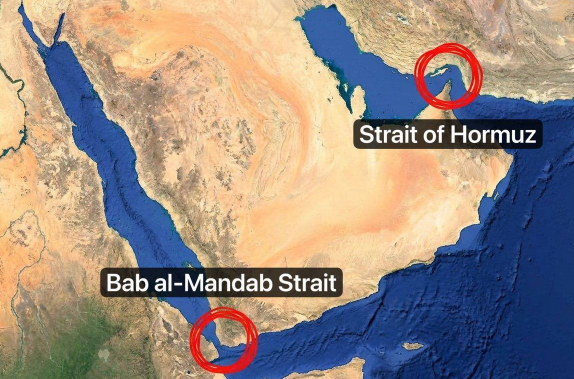
BREAKING: Iran says it could shut the vital Bab el-Mandeb Strait if attacks are carried out on its territory or islands.
Details include:
1. The Bab al-Mandeb Strait is a narrow passage linking the Red Sea to the Gulf of Aden and the Arabian Sea
2. ~12% of global seaborne oil passes through Bab al-Mandab
3. The Bab al-Mandeb Strait is the world’s 4th-largest shipping chokepoint
4. If both Hormuz and Mandeb are closed, total offline capacity could near 25 million barrels per day, or ~25% of global supply
We now await the US' response to Iran's "five conditions" for a ceasefire.
🚨 BREAKING:
Trump: "Spain said we can't use their bases. We could use their bases if we want. We could just fly in and use it. Nobody is gonna tell us not to use it."
Spoken perfectly like a REAL rapist.