Grigori Perelman, a Russian mathematician, famously solved the Poincaré Conjecture, one of the seven Millennium Prize Problems, a challenge unsolved for nearly a century. His work in Ricci flow and geometry on 3-manifolds was groundbreaking, and his solution had a profound impact on the field. Despite worldwide recognition, Perelman declined the prestigious Fields Medal in 2006 and the $1 million Clay Prize in 2010, citing his dissatisfaction with the mathematical community and the handling of credit for collaborative efforts.
This 600-year-old painting is one of the most mysterious in history.
That mirror at the back is just 3 inches wide — yet it reflects the entire room in immense detail.
Look closer at it and you'll realize nothing is as it seems… (thread) 🧵
Just remembering how well Pachinko was written makes me tear up huhuhu.. I feel like the only books that have ever made me ugly cry were Pachinko, P.S. I Love You, Tomorrow³, Joy Luck Club, and that book in the Harry Potter series when the twin got killed 🥲🥲🥲🥲
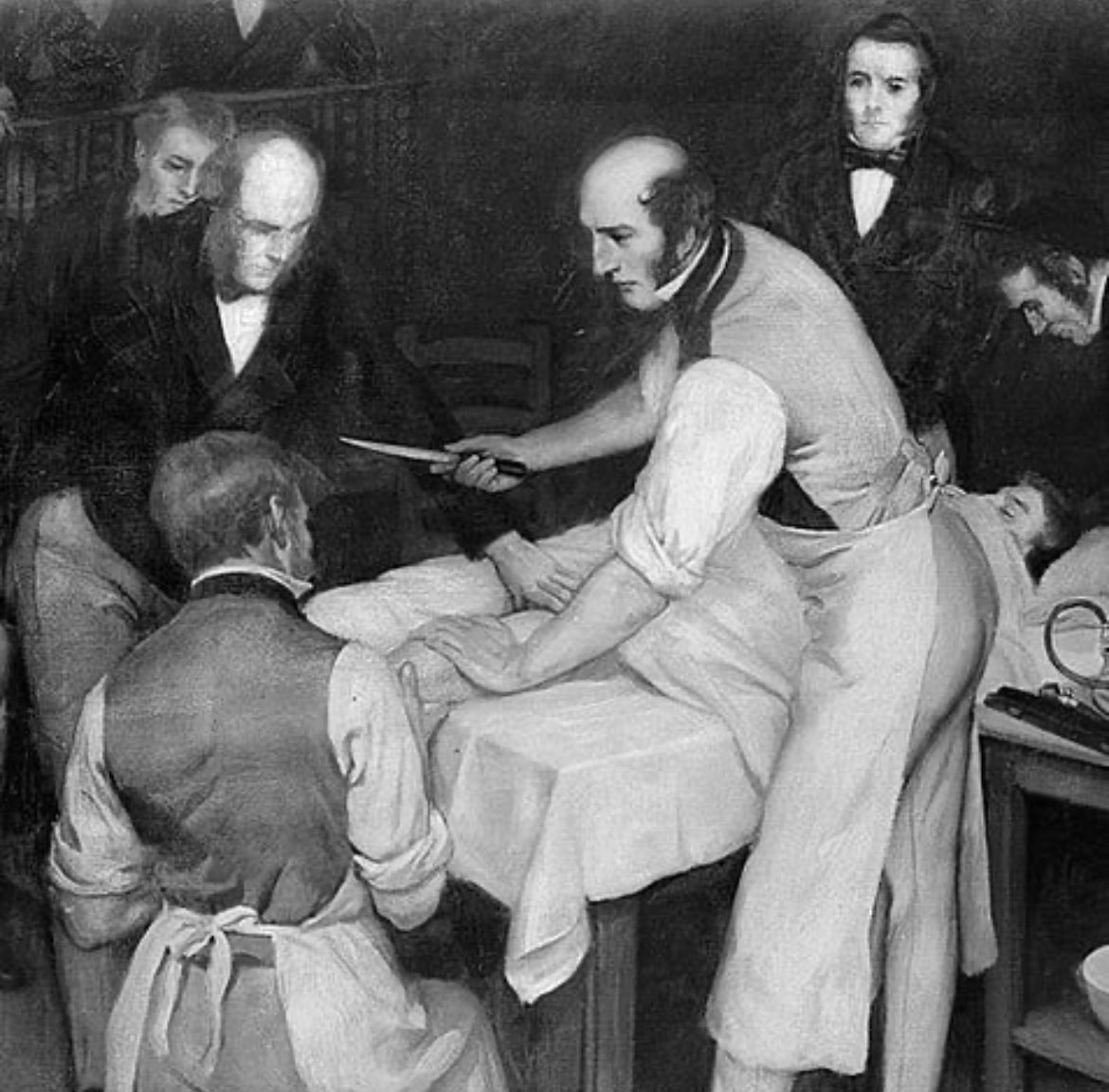
Robert Liston (1794-1847) was a Scottish surgeon known for his incredible speed in surgery. His most famous operation involved amputating a patient's leg in under 2.5 minutes. He worked so swiftly that he accidentally amputated the fingers of his assistant and even slashed a spectator's coat tails. The unfortunate onlooker, terrified by the sight, dropped dead. Tragically, both the patient and his assistant later died from gangrene, resulting in a recorded operation with a 300% mortality rate.
British surgeon and author Richard Gordon vividly described Liston's unique approach to surgery: "He was six foot two, and operated in a bottle-green coat with wellington boots. He sprung across the blood-stained boards upon his swooning, sweating, strapped-down patient like a duelist, calling, 'Time me gentlemen, time me!' to students craning with pocket watches from the iron-railinged galleries. Everyone swore that the first flash of his knife was followed so swiftly by the rasp of saw on bone that sight and sound seemed simultaneous. To free both hands, he would clasp the bloody knife between his teeth."
Gordon's book, "Great Medical Disasters" (1983), highlighted other intriguing aspects of Liston's career:
- "Removal in 4 minutes of a 45-pound scrotal tumor, whose owner had to carry it around in a wheelbarrow."
- "Amputated the leg in 212 minutes, but in his enthusiasm, removed the patient's testicles as well."
- "An incident where he hastily lanced what he believed was a straightforward skin abscess in a young boy's neck. Unfortunately, it turned out to be a dangerous aneurysm of the carotid artery, resulting in the patient's death. The artery, however, lives on in University College Hospital's pathology museum, specimen No. 1256."
In 1846, Liston performed the first operation using modern anesthesia in Europe. He also invented tools such as bulldog forceps and a leg splint to aid in fractures and dislocations, both of which continue to be utilized in medical practice today.