@trylimitless Pro tip: Break trades into smaller ones — each counts. Open & close often, boost volume near epoch end, and farm right after weekly reset for a leaderboard edge. Small actions = big Points. 💡
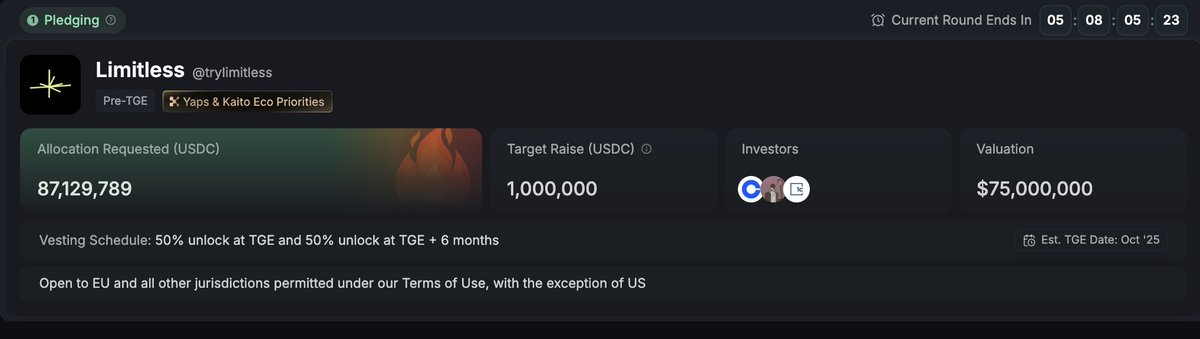
Unstoppable momentum: @trylimitless has now surpassed $87M pledged on Kaito Launchpad, raised $4M in strategic funding, launched Points Program S2, and rolled out stock prediction markets. RWA x DeFi adoption is accelerating fast.
The Developer-Friendly Blockchain
Most blockchains brag about speed, TPS, and hype words, but very few think about the developer journey. Rialo stands out because it puts developers first. It eliminates layers of middleware, supports familiar logins like email/SMS,
Rialo seems ready to prove that the next wave of dApps will be as intuitive as Web2 apps. If they deliver, it could redefine what “developer-friendly” really means in Web3. #Rialo@RialoHQ
The Developer-Friendly Blockchain
Most blockchains brag about speed, TPS, and hype words, but very few think about the developer journey. Rialo stands out because it puts developers first. It eliminates layers of middleware, supports familiar logins like email/SMS,
near-instant responses, and predictable fees, and you have a chain that feels usable today—not five years from now. With $20M in seed funding and backing from Coinbase Ventures, Pantera, and Hashed,
Thoughts on @RialoHQ – A Promising Blockchain for Real-World Connectivity
When looking at the blockchain space today, most platforms either focus narrowly on DeFi, speed, or scalability, but very few rethink how developers and everyday users actually interact with decentralized systems. Rialo, a new project backed by leading investors like Pantera Capital, Coinbase Ventures, and Hashed, caught my attention because it doesn’t just promise another fast chain—it reimagines how Web3 can bridge seamlessly into the real world.
One of the most impressive aspects of Rialo is its strong commitment to developer and user experience. While many blockchains require developers to learn niche languages or rely on complicated middleware, Rialo makes building feel much closer to Web2. Social logins (email, SMS, familiar identity methods), intuitive frameworks, and reduced friction lower the barrier to entry, which is key if we want to onboard millions of new builders and users.
Rialo also takes a bold step in integrating real-world data directly into smart contracts. Instead of depending heavily on oracles and third-party middleware, contracts can react to APIs, external events, or even credit score data in near real time. This opens up possibilities for dApps that aren’t just financial experiments but living applications—insurance that updates instantly when real events occur, supply chain contracts that reflect actual shipments, or RWA tokens that evolve dynamically.
The event-driven architecture is another highlight. Contracts can schedule transactions, listen for triggers, and handle asynchronous processes without external bots. This makes applications far more reliable and reactive, solving one of the biggest headaches developers face today.
On the technical side, Rialo’s compatibility with Solana VM and RISC-V is a smart move. It allows existing ecosystems to port over more easily while embracing flexible, future-proof architecture. Combined with its claim of sub-second latency and predictable fees, Rialo could deliver a user experience that finally feels instant—something most blockchains still struggle with.
Perhaps most exciting is Rialo’s vision for Real-World Assets (RWA). Current RWA tokens are often static, little more than “wrappers” for off-chain assets. Rialo envisions assets that can actually breathe—updating, responding, and behaving like programmable entities tied to live data streams. That could change the way finance, credit, and commerce interact with blockchain.
Of course, execution is everything. It remains to be seen how Rialo will balance decentralization, governance, and the complexity of off-chain integration. But raising $20M in seed funding from some of the most respected investors in the space suggests both strong conviction and real resources to deliver.
In short: Rialo feels less like “yet another Layer-1” and more like an attempt to make blockchains usable, practical, and alive in the real world. If they succeed, this could be one of the most meaningful shifts in Web3’s journey toward mainstream adoption.
#Rialo @RialoHQ
Zama and Fully Homomorphic Encryption (FHE)
🧵 1/ What if you could compute on encrypted data without ever decrypting it?
That’s the magic of Fully Homomorphic Encryption (FHE) — and @zama is making it real.
Here’s why FHE is the future of privacy-first computation. 👇
4/ Enter Zama 👇
@zama is building the tooling and infrastructure for FHE devs:
🔧 Open-source FHE libraries
🧠 Compiler tech to abstract FHE complexity
🚀 FHE-native Layer 1: fhEVM
Yes — smart contracts on encrypted data. 🤯
3/ Why should you care?
Because with FHE, we can build apps that are:
✅ Trustless
✅ Censorship-resistant
✅ User-data private by default
Imagine privacy-preserving AI, finance, healthcare — all powered by math, not promises.
After five years of work, the team is happy to announce the Zama Confidential Blockchain Protocol and the release of our Public Testnet.
First things first, read the litepaper ⬇️