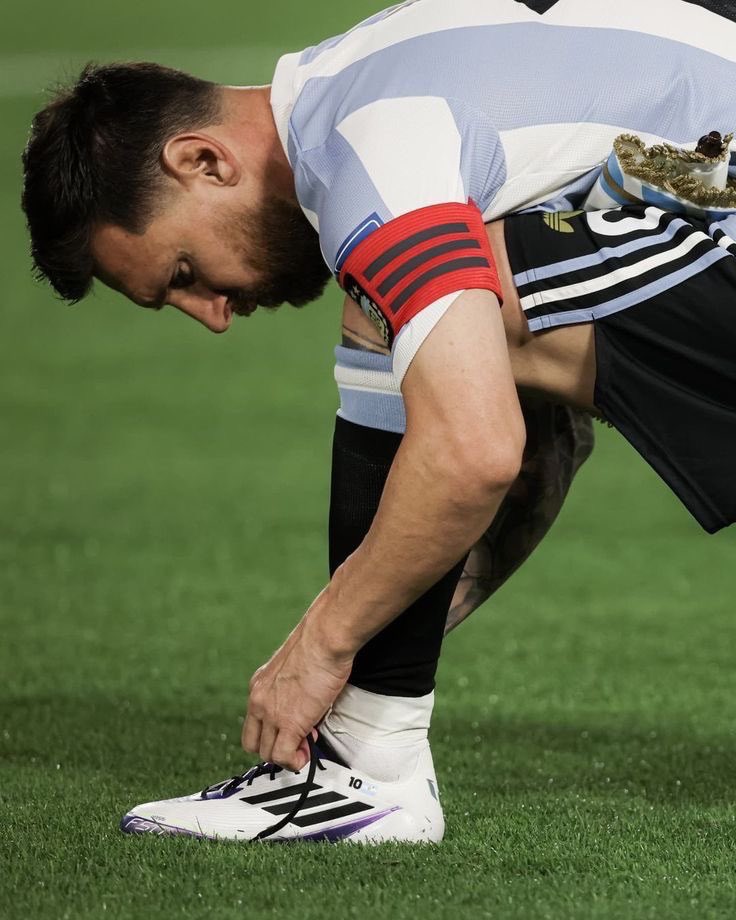
Messi will be having his farewell game in front of thousands of fans, celebrated and loved, while Ronaldo is leaving Portugal national team because they’re keeping him on the bench.
Everyone is getting the end they deserve. 🐐
@Quranconnect_ Masha ALlahu
I always think I'm the only one that usually feel his voice..😂❤️
"His voice carries a kind of peace that is almost impossible to explain",✨❤️
Dear Messi,
I can take a retirement from international football, but you see that club football, I need you to continue for at least two more seasons. That 1000 goals, we must reach there by God’s grace.
Yours sincerely,
Your Biggest Fan.
X is suppressing every Islamic post I make. Especially when there’s the word “Allah” in it.
Please if you’re seeing this post like and repost. I want to break the curse.
i put together a few important lessons from the chapter on janābah that many muslims may not know:
1. ghusl becomes obligatory through either of two things:
• ejaculation
• penetration, even if ejaculation does not occur
once penetration takes place, ghusl is required from both spouses.
2. mere physical contact between the private parts does not automatically require ghusl.
the obligation begins when penetration occurs, not simply through touching or closeness.
3. if a person has a wet dream but sees no discharge upon waking, ghusl is not required.
the ruling is connected to actually seeing the fluid, not merely remembering a dream.
4. likewise, if a person finds semen but does not remember a dream, ghusl is required.
what matters is the presence of the discharge.
5. a woman can also experience a wet dream and is required to perform ghusl if she sees the fluid.
the women of the ansār were praised because shyness did not prevent them from asking questions about their religion.
6. a woman does not have to loosen her braids for ghusl from janābah, provided water reaches the scalp and the roots of the hair.
the point is complete washing, not unnecessary hardship.
7. semen is considered pure according to the stronger scholarly view.
if it is wet, it may be wiped/washed away. if it is dry, it may be scraped or rubbed off. washing it is also perfectly fine.
8. not every stain requires washing the entire garment.
Aa'ishah, may Allāh be pleased with her, corrected a man who immersed his clothes in water without even seeing anything on them. excessiveness in purification can open the door to doubtful whispers.
9. Islam does not encourage wastefulness in ghusl.
the Prophet, peace and blessings of Allāh be upon him, performed ghusl with a relatively small quantity of water. cleanliness does not require emptying buckets upon buckets over oneself.
10. if water is unavailable, a person in janābah must not abandon the prayer.
he performs tayammum and prays. tayammum is a valid substitute for ghusl until water becomes available or he is able to use it.
11. one tayammum is sufficient for both major and minor ritual impurity.
a person does not need one tayammum for janābah and another for wuḍūʾ.
12. tayammum does not have to be repeated for every prayer.
a person may pray obligatory and voluntary prayers with it until something invalidates the purification or water becomes available.
13. the whole earth has been made a place of prayer and a means of purification for this ummah.
a Muslim should not deliberately miss the prayer merely because there is no mosque nearby.
14. the Prophet would first ask a person for an explanation before reprimanding him.
when he saw a man standing apart from the prayer, he did not immediately condemn him. he first asked what prevented him from joining them.
a lesson in both fiqh and character: seek clarification before blame.
15. intimate questions are not shameful when they are asked for the purpose of learning the religion.
true modesty does not mean remaining ignorant about purification, menstruation, janābah or marital rulings.
16. the Mothers of the Believers, may Allāh be pleased with them, performed a tremendous service for this Ummah.
they preserved details of the Prophet’s private worship and household life that men outside his home could not have known.
17. the general spirit of this chapter is ease without carelessness:
wash properly, but do not waste water.
remove what needs removing.
ask when you do not know, and;
never allow embarrassment to keep you ignorant of your religion.
and Allāh knows best.
📚 sourced from Shaykh Uthaymeen's explanation of Umdatul Ahkām.


![Mustey_1's tweet photo. Ten Ways Sins Are Expiated
[One hundred pieces of advice by Imaam ibn al-Qayyim رحمه الله] https://t.co/aONdPr9B3J](https://pbs.twimg.com/media/HQll4CuX0AAv4HZ.jpg)










![Mustey_1's tweet photo. Ten Ways Sins Are Expiated
[One hundred pieces of advice by Imaam ibn al-Qayyim رحمه الله] https://t.co/aONdPr9B3J](https://pbs.twimg.com/media/HQll4CyXQAAecXk.jpg)


