I volunteer with a local charity creating community gardens and planting fruit in the community. Helping to install an irrigation system in one of our gardens and found these under a paving slab. Anyone hungry?
Farmers have figured out that the cheapest pesticide is a strip of flowers.
When you plant wildflowers through a crop field, not just around the edge but in strips running through the middle, you get ladybugs, lacewings, hoverflies, and parasitic wasps living in the field instead of visiting it.
They eat the aphids, the caterpillars, and the mites for free, all summer long.
In controlled trials, fields with tailored flower strips had leaf-beetle numbers 40 to 50% lower and crop damage cut by around 60%, enough to drop below the threshold where spraying was even considered worth it.
The flowers attract a standing army to our fields.
We spent decades engineering chemicals to kill the insects eating the crop, when the insects that eat those insects would have worked for the price of seed.
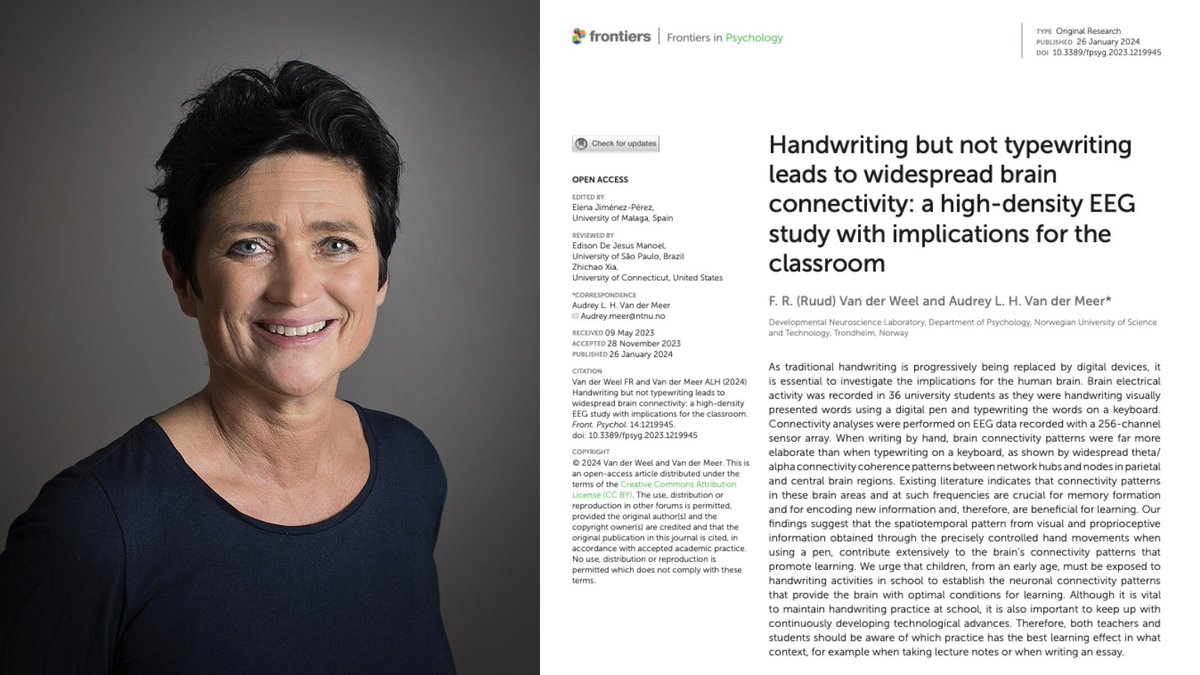
A Norwegian neuroscientist spent 20 years proving that the act of writing by hand changes the human brain in ways typing physically cannot, and almost nobody outside her field has read the paper.
Her name is Audrey van der Meer.
She runs a brain research lab in Trondheim, and the paper that closed the argument was published in 2024 in a journal called Frontiers in Psychology. The finding is brutal enough that it should have changed every classroom on Earth.
The experiment was simple. She recruited 36 university students and put each one in a cap with 256 sensors pressed against their scalp to record brain activity. Words flashed on a screen one at a time.
Sometimes the students wrote the word by hand on a touchscreen using a digital pen, and sometimes they typed the same word on a keyboard. Every neural response was recorded for the full five seconds the word stayed on screen.
Then her team looked at the part of the data most researchers had ignored for years, which is how different parts of the brain were communicating with each other during the task.
When the students wrote by hand, the brain lit up everywhere at once.
The regions responsible for memory, sensory integration, and the encoding of new information were all firing together in a coordinated pattern that spread across the entire cortex. The whole network was awake and connected.
When the same students typed the same word, that pattern collapsed almost completely.
Most of the brain went quiet, and the connections between regions that had been alive seconds earlier were nowhere to be found on the EEG.
Same word, same brain, same person, and two completely different neurological events.
The reason turned out to be something nobody had really paid attention to before her work. Writing by hand is not one motion but a sequence of thousands of tiny micro-movements coordinated with your eyes in real time, where each letter is a different shape that requires the brain to solve a slightly different spatial problem.
Your fingers, wrist, vision, and the parts of your brain that track position in space are all working together to produce one letter, then the next, then the next.
Typing throws all of that away. Every key on a keyboard requires the exact same finger motion regardless of which letter you are pressing, which means the brain has almost nothing to integrate and almost no problem to solve.
Van der Meer said it plainly in her interviews.
Pressing the same key with the same finger over and over does not stimulate the brain in any meaningful way, and she pointed out something that should scare every parent who handed their kid an iPad.
Children who learn to read and write on tablets often cannot tell letters like b and d apart, because they have never physically felt with their bodies what it takes to actually produce those letters on a page.
A decade before her, two researchers at Princeton ran the same fight using a completely different method and ended up at the same answer. Pam Mueller and Daniel Oppenheimer tested 327 students across three experiments, where half took notes on laptops with the internet disabled and half took notes by hand, before testing everyone on what they actually understood from the lectures they had watched.
The handwriting group won by a wide margin on every question that required real understanding rather than surface recall.
The reason was hiding in the transcripts of what the two groups had actually written down.
The laptop students typed almost word for word, capturing more total content but processing almost none of it as they went, while the handwriting students physically could not write fast enough to transcribe a lecture in real time, which forced them to listen carefully, decide what actually mattered, and put it in their own words on the page.
That single act of choosing what to keep was the learning itself, and the keyboard had quietly skipped the choosing and skipped the learning along with it.
Two studies. Two countries. Same answer.
Handwriting makes the brain work. Typing lets it coast.
Every note you have ever typed instead of written went into your brain through a thinner pipe. Every meeting, every book highlight, every idea you captured on your phone instead of on paper was processed at half depth.
You did not forget those things because your memory is bad. You forgot them because typing never woke the part of the brain that would have made them stick.
The fix is the thing your grandmother already knew.
Pick up a pen. Write the thing down. The slower road is the faster one.
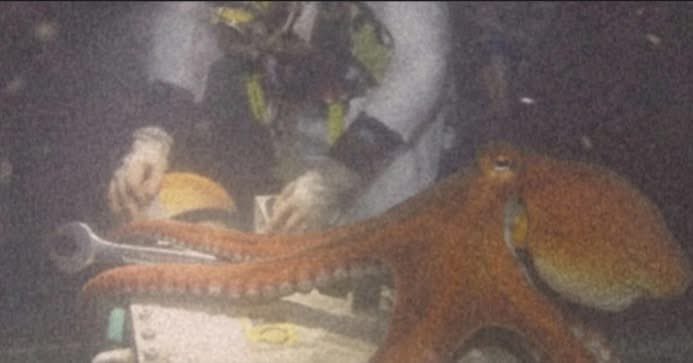
Off the coast of Portugal, a diver was working on underwater repairs when he noticed an octopus hovering nearby. At first, he didn’t think much of it — until the octopus started helping.
Each time the diver reached for a wrench, a bolt, or accidentally dropped a tool, one of the octopus’s tentacles would glide over, gently passing it back to him. It was as if he had a silent assistant from the deep.
When he returned to the surface and told his coworkers, no one believed him. So the next time, he brought cameras.
The footage showed exactly what he’d described — an octopus calmly handing tools to a human, working alongside him in perfect rhythm.
The video quickly went viral, capturing hearts around the world. And when asked about it later, the diver just smiled and said, “I’m just happy I had help down there.”
Moments like this remind us that intelligence doesn’t belong to humans alone. In the quiet depths of the ocean — and all across the natural world — other minds are watching, learning, and sometimes, lending a helping hand.
Back in 2021, I met a lady who told me about this app where blind people could video call volunteers whenever they needed help with something.
Out of curiosity, I downloaded it and signed up.
I still remember how surreal it felt the first time I got a call. Someone was simply trying to decide what to wear and needed me to tell them if the colors matched. Another person needed help checking something on their TV screen.
And there I was, in my room in Nigeria, helping complete strangers from different parts of the world through a random video call.
It wasn’t paid or anything. It was just volunteering.
But I remember being so fascinated by the idea that technology could connect people in such a deeply human way. For a few minutes, you literally became someone else’s eyes.
Till today, that remains one of the most beautiful things I’ve experienced online.
Dennis Prager STUNS the Muslim crowd at Oxford Union.
"Gaza starts a war to kill as many Israelis as possible, and all you see on the BBC and Sky News are dead Gazans. It takes a frail mind to believe that you determine right and wrong by the number of dead"
He's 100% correct.
@DreyfusJames Times have changed. Oxford women’s college in the 70’s. We were told not to wear bright ribbons or bows in our hair in case it distracted the male lecturers.
@SamaHoole My mother told us of eating “bread and scrape,” the dripping from the Sunday joint. My job as a child was to mash the butter with a flat knife so it was soft enough to spread on the loaf, the bread was sliced very thinly after the butter was spread.
@MrPitbull07 I recently offered a mechanical sleeping cat (purrs and breathes), on the usual free sites. The person I gave it to sent me a pic of her grandma, who has Alzheimer’s, with the cat on her lap - she loves him and he keeps her calm.
@alt_w_v_g My son age 7, playing rugby. 2 purple faced screaming dads on the side line. He said “I don’t know why they bother, we can’t hear them and they look stupid.”
There is a pattern, and it runs through everything.
The sun was free. They sold you sunscreen.
Sleep was free. They sold you pills.
Walking was free. They sold you a treadmill.
Fasting was free. They sold you meal replacement shakes.
Cold water was free. They sold you a plunge barrel.
Animal fat was free. They sold you supplements to replace what it contained.
Fermented food was free. They sold you probiotics.
Tallow was free. They sold you a seventeen-step skincare routine.
Silence was free. They sold you a meditation app.
Sunlight on your skin was free. They sold you vitamin D tablets.
Every single thing the human body requires to function was available, free, for the entirety of human history.
The 20th century built an industry around removing access to each of them.
The 21st century is building an industry selling them back.
Nothing about this is accidental.
Your great-grandmother had none of the products.
She had all of the things the products are compensating for.
She was, largely, fine.
@hell_line0 Handsy head of admin in my office, my team was all women often working alone. Reporting had no effect. We reorganised the room so he couldn’t trap us in a corner.
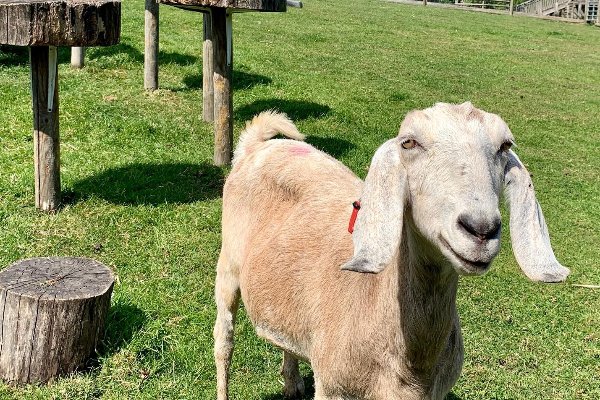
Keith the Apocalypse Bringer is a three-year-old Anglo-Nubian goat in a field in Devon.
Keith should not be underestimated.
Keith has been systematically dismantling the ecosystem since approximately 7am, when he ate a bramble. This is significant because bramble is an invasive scrub species that outcompetes wildflowers, reduces biodiversity, and creates dense monoculture thicket that nothing else can use.
Keith ate it. Keith does this every day. Keith does not charge for this service.
8:15am - Keith ate a thistle. Thistles are also considered invasive scrub in managed pasture. Goldfinches eat thistle seeds, but Keith's grazing will ensure the pasture remains open enough for the ground-nesting birds that can't use dense scrub. Keith has not attended a conservation workshop. Keith arrived at this conclusion by being a goat.
9:00am - Keith dismantled a section of hedge. This was less helpful. Keith does not have a perfect record.
10:30am - Keith escaped the field. He was in the road for eleven minutes. He ate a neighbour's rose. This is not being counted in Keith's environmental impact assessment.
11:00am - Keith was returned to the field. Keith regarded the farmer with the specific expression of an animal that does not recognise the concept of property.
12:00pm - Keith ate more bramble. His digestive system: four stomachs, a rumen full of specialised microorganisms, the ability to extract nutrition from lignified plant matter that would defeat any other animal on this field, is converting scrub vegetation into milk with a fat content of approximately 4.5%. The milk will become cheese. The cheese will be sold at the farm shop. The farm shop is four miles away. The cheese food miles are: four.
3:00pm - Keith produced manure. The manure will grow the grass. The grass will grow the bramble. The bramble will be eaten by Keith.
This system has no inputs.
It has been running since goats were domesticated approximately ten thousand years ago.
Keith is not aware he is saving the planet.
Keith is thinking about whether the fence on the north side has a weak point.
It does. Keith found it at 4:45pm.
Keith got out again.
Case: delirium after knee replacement
Mrs Thompson, 83, day two after a knee replacement. Withdrawn, drowsy, wouldn't engage with physio. The team put it down to fatigue and her history of depression. But on the ward round she wasn't tracking properly, and she'd barely eaten or drunk anything. That's not depression. The team did a 4AT delirium assessment.
It confirmed hypoactive delirium. The causes were all fixable: pain undertreated, dehydrated, and her hearing aids and glasses were in a bag under the bed. So we sorted the analgesia, pushed fluids, got the sensory aids back on, and provided repeated reorientation.
The nursing team could see it working almost straight away, which matters - it addressess the WHY? question which should underpin any attempt to implement delirium screening.
Within 48 hours she was eating, doing her exercises, talking normally. Afterwards she told us how frightening it had been. Trapped in confusion, unable to get through to anyone.
Post-operative 4AT has become routine in our wards. It is mentioned in handovers and ward rounds without anyone having to advocate for it.
What delirium assessments do you do you in your surgical patients?
@Freyy_is They ended the second session after he started shouting “Why is she being so reasonable?” I was told trying to encourage them to see him was causing them too much distress and damaging their trust in me.
@Freyy_is I went to mediation with my ex, after the second session I was told they couldn’t work with him and after several distressing court appearances with reports from them and Child Guidance he was denied access to the children.
@IntrovertProbss Chat with neighbour and then introduce them to the group. ‘People Bingo.” Worst one, everyone gets a card with an animal and has to go round making the noise to find their twin.