More than $2B across four recent entrants.
Allium found that four issuers entering Stellar during the year through September 2026 each exceeded $500M in assets on the network.
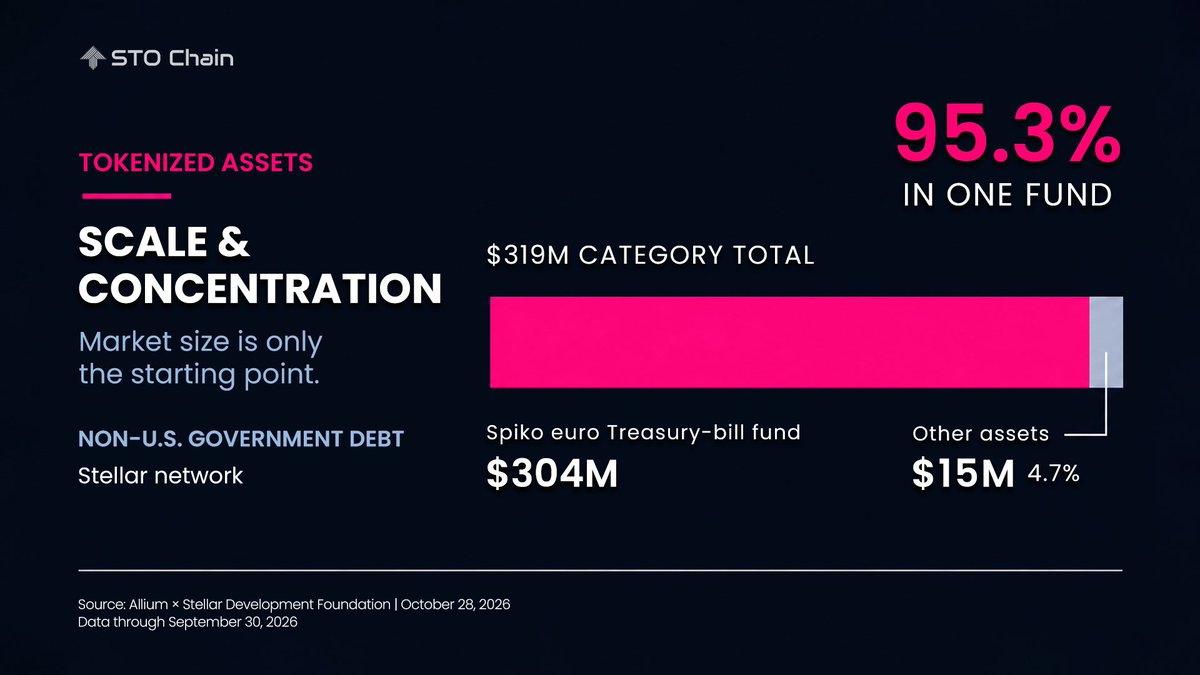
The composition of those assets adds an important detail. Within the network’s $319M tokenized non-U.S. government debt market, $304M—about 95%—came from a single Spiko euro Treasury-bill fund.
For institutions assessing tokenized markets, headline asset value is only a starting point. Product and issuer concentration help reveal how dependent an asset class is on individual providers.
Where one fund dominates a category, changes to its issuance or distribution can materially reshape that category’s onchain footprint. Market development therefore needs to be assessed through both growing balances and the breadth of the asset base supporting them.
#STOChain #RWA #Tokenization
Among surveyed asset managers, more planned to introduce tokenized investments within a year than already offered them.
Clearwater Analytics’ survey of 250 asset-management executives found:
- 24% already offered tokenized investments
- Another 44% planned to offer them within a year
- 96% found tokenized private credit funds attractive, versus 56% for private equity
The findings suggest room for a broader product market, with stronger interest in private credit.
For managers, tokenization could open additional distribution channels for private-market strategies. The commercial test is whether those channels attract investor capital.
Product launches measure availability. Subscriptions and sustained assets under management will show whether wider access translates into adoption
#STOChain #RWA #Tokenization
A loan’s route to investors can begin at origination.
Cross River and Offchain are building tokenization into the bank’s lending platform on Arbitrum One. A proof of concept is complete, with production deployment targeted for early 2027.
The design could support:
- Ongoing investor purchases of newly originated loans
- More flexible investment commitments
- Distribution to onchain funds and international investors
A shared record would connect funding, ownership transfers, payments and servicing. This could reduce reconciliation as loans change hands and make investor distribution part of the origination workflow.
Cross River would remain the regulated bank and lender of record, maintaining its underwriting, risk management and compliance standards.
The potential is to connect credit creation more directly with investor capital, embedding tokenization into how loans are funded and distributed.
#STOChain #RWA #Tokenization
Hong Kong is extending settlement hours for tokenized finance.
HKMA’s EnsembleTX pilot now supports 24/7 interbank settlement of tokenized deposit transactions in tokenized central bank money.
Since its November 2025 launch:
- Tokenized deposit banks: 7 → 12
- Other industry participants: 13 → 20
Initially using HKD RTGS for interbank settlement, the pilot now enables participating institutions to settle tokenized transactions beyond conventional operating hours.
For corporate treasurers and fund platforms, this can widen the window for moving liquidity and supporting secondary trading of tokenized funds on licensed platforms. Longer trading hours become more useful when the cash leg can operate on the same schedule.
The upgrade remains a controlled real-value pilot, with no transaction volumes disclosed in the announcement.
#STOChain #RWA #Tokenization
Stock-market exposure is expanding across exchanges, wallets and financial applications.
Payward reports:
- xStocks AUM surpassed $1B as of October 27, up from approximately $225M in February 2026
- Cumulative transaction volume exceeded $45B across trading venues
- More than $100M in xStocks was deployed across DeFi
These figures measure assets, transaction activity and DeFi deployment. They should not be read as net inflows or outstanding loans.
The significance is a broader distribution model: equity-linked tokens can move between trading venues and financial applications, giving holders more ways to manage a position.
For brokers and issuers, this creates room to compete on how investments are held, transferred and used. Liquidity, reliable backing and clear redemption arrangements determine how useful that access becomes.
#STOChain #RWA #Tokenization
One quarter of tokenized gold trading exceeded the previous full year.
The World Gold Council’s October report highlights CoinGecko data showing:
- $90.7B in tokenized gold spot trading during Q1 2026
- $84.6B across the whole of 2025
Separately, HSBC disclosed that its Gold Token recorded 390,000 trades worth $2.5B from its 2024 launch through August 2026.
These are separate measures of trading activity, not net investment inflows. They illustrate two distribution models: exchange-based access and products delivered through established banking relationships.
The WGC’s broader digital-gold research identifies provider trust, familiar access channels and competitive pricing as key adoption factors.
For banks and issuers, this makes distribution part of the product’s competitive position. Tokenized gold competes with physical bullion and gold ETFs for investor allocations. Its ability to attract sustained use will depend on the full investor experience: how ownership is documented, how assets are held, what trading costs, and how redemption works.
#STOChain #RWA #Tokenization
Government borrowing is giving digital bond issuance greater scale.
AFME’s October report highlights:
- Global DLT-based fixed income issuance reached €8.1B in 2026 so far—86% above the full-year total for 2025.
- Hong Kong’s digital green bond offering totaled HK$20B, equivalent to approximately €2.2B.
- Luxembourg issued a €1.7B DLT-native sovereign bond.
Together, the two sovereign offerings represent nearly half of total issuance. Their size demonstrates that DLT can support substantial government funding needs, while their concentration shows how much the market’s growth still depends on individual transactions.
The next stage is to make that scale repeatable. For governments, returning to digital issuance would establish a recurring funding channel. For investors, broader participation and deeper secondary trading would make it easier to manage positions throughout a bond’s life.
That is how larger transactions can develop into a more established debt market.
#STOChain #RWA #Tokenization
🎁 $2,000 USDT GIVEAWAY!
Buy & Hold STOC on @MEXC — Earn USDT Rewards!
🔥 Just 5 STOC to enter. Your chance to win starts here!
💰 30 USDT × 50 Winners
🏆 $500 Exclusive Raffle Prize Pool
How to Enter:
1️⃣ Follow @StoChain, Like, RT & Comment on this post
2️⃣ Buy & hold 5+ STOC on MEXC
3️⃣ Join STO Chain Discord
4️⃣ Submit your holding proof:
https://t.co/NAT2ZVzBtd
🎁 Rewards & Benefits
• 50 winners will be randomly selected from eligible participants.
• Each winner receives 20 USDT initially and an additional 10 USDT after successful balance re-verification 15 days after winner confirmation.
• All eligible participants receive the STO Maxi role, granting +3 bonus tickets in regular STO Raffles and access to 2 exclusive raffles with a combined 500 USDT prize pool.
📌 The $2,000 total prize pool includes conditional 15-day rewards and exclusive raffle prizes.
#STOChain #STOC #Giveaway #USDT
Price changes weighed on existing stock tokens. Their supply kept growing.
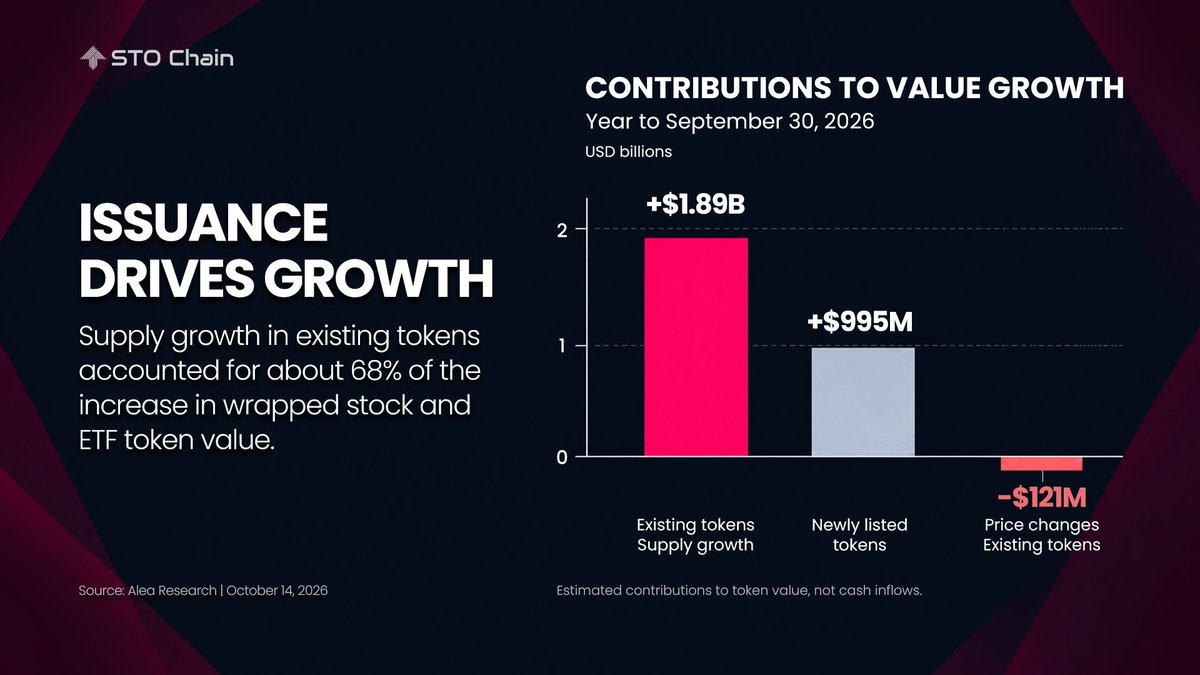
Over the year to September 30, 2026, Alea Research estimates that supply growth in existing wrapped stock and ETF tokens added $1.89B in value. Newly listed tokens added $995M, while price changes in existing tokens subtracted $121M.
Existing-token supply growth accounted for about 68% of the overall increase. These are estimated contributions to token value, not measured cash inflows.
For institutions, this puts distribution and sustained net issuance at the center of the growth discussion: how investors access products, and how issuance and redemptions change outstanding supply.
#STOChain #RWA #Tokenization
Tokenized equities are attracting trading activity beyond regular U.S. market hours.
The IMF’s October Global Financial Stability Report analyzed five tokenized U.S. equity and ETF products across 11 trading venues:
→ More than 50% of trading volume occurred outside regular U.S. market hours
→ About 80% of trades involved less than one share
→ Realized volatility was approximately 1.5 times that of the underlying assets in traditional markets*
The first two findings show how investors use tokenization: to trade across time zones and take smaller positions. Yet the IMF also found thinner liquidity, meaning trades can have a greater impact on prices.
This makes liquidity depth central to market development. The practical value of 24/7 access depends on whether investors can enter and exit positions throughout those hours without excessive price impact.
*The volatility comparison covers 24/7 tokenized trading versus regular U.S. market hours for the underlying assets.
#STOChain #RWA #Tokenization
Tokenization is already handling securities financing at institutional scale. The harder question is what that scale delivers.
Broadridge’s Distributed Ledger Repo platform processed in September 2026:
→ $7.5T in total monthly repo volume
→ $359B in average daily repo volume
These figures measure transaction turnover, not tokenized assets outstanding or new capital inflows.
Repo connects securities holdings to short-term funding. Its value to institutions depends on when cash becomes available, how reliably trades settle, and how effectively collateral can be deployed.
That makes transaction volume the starting point for evaluating tokenization’s economic impact. The stronger case would be evidence that institutions can meet funding needs with lower costs, less settlement friction, or more efficient collateral use.
Broadridge’s figures establish substantial operating activity. Measuring those outcomes would show what tokenization changes for the institutions using it.
#STOChain #RWA #Tokenization
Putting stocks onchain creates another way to hold them. Using those stocks as collateral creates another way to finance against them.
Today, the difference is measurable.
RedStone’s latest research puts that gap in numbers:
→ Tokenized stock value reached $3.17B—up 395% in the year to September 28, 2026
→ About 42% of total supply is eligible as DeFi collateral
→ About 2.6% is actually used as lending collateral
The market has built a larger asset base than lending markets currently put to work. Closing that gap requires more than adding eligible tokens: lenders need prices they can trust and collateral they can liquidate, including when the underlying exchanges are closed.
For holders, broader collateral use would make tokenized stocks useful beyond holding and trading. They could raise liquidity against an investment while retaining exposure to it
#STOChain #RWA #Tokenization
Tokenized fund growth is becoming measurable within registered investment products.
WisdomTree’s latest figures show:
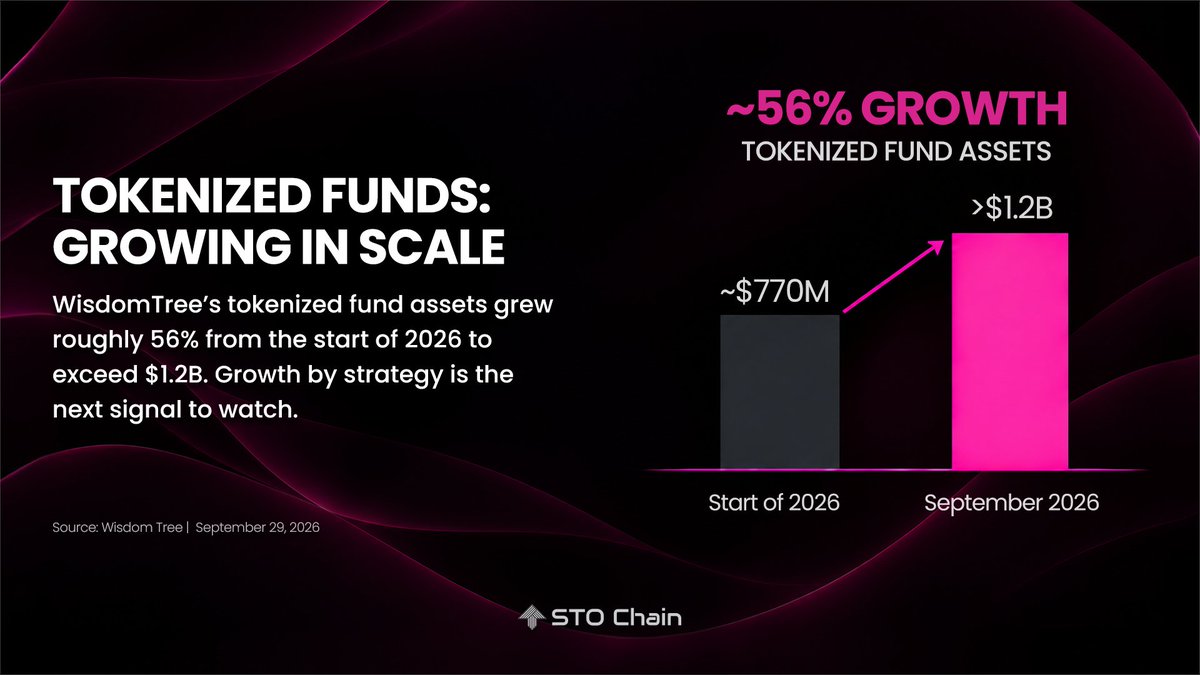
→ Tokenized fund assets surpassed $1.2B
→ Up from approximately $770M at the start of 2026—roughly 56% growth
→ 15 SEC-registered funds spanning cash management and investment strategies
The increase points to a growing asset base for tokenized funds within an established asset manager’s product range. Tokenization is supporting familiar investment structures, with blockchain changing how fund shares are recorded and transferred.
The broader question is where that growth is concentrated. Money market fund growth would signal demand for onchain cash management; growth across equity, fixed income, and alternative strategies would indicate wider portfolio adoption.
Total assets show scale. The composition of growth shows how the market is developing.
#STOChain #RWA #Tokenization
Tokenized equities are emerging as the trading center of the onchain RWA market.
Dune’s Q3 2026 report shows that, through August:
→ Equity supply expanded roughly 25× year over year
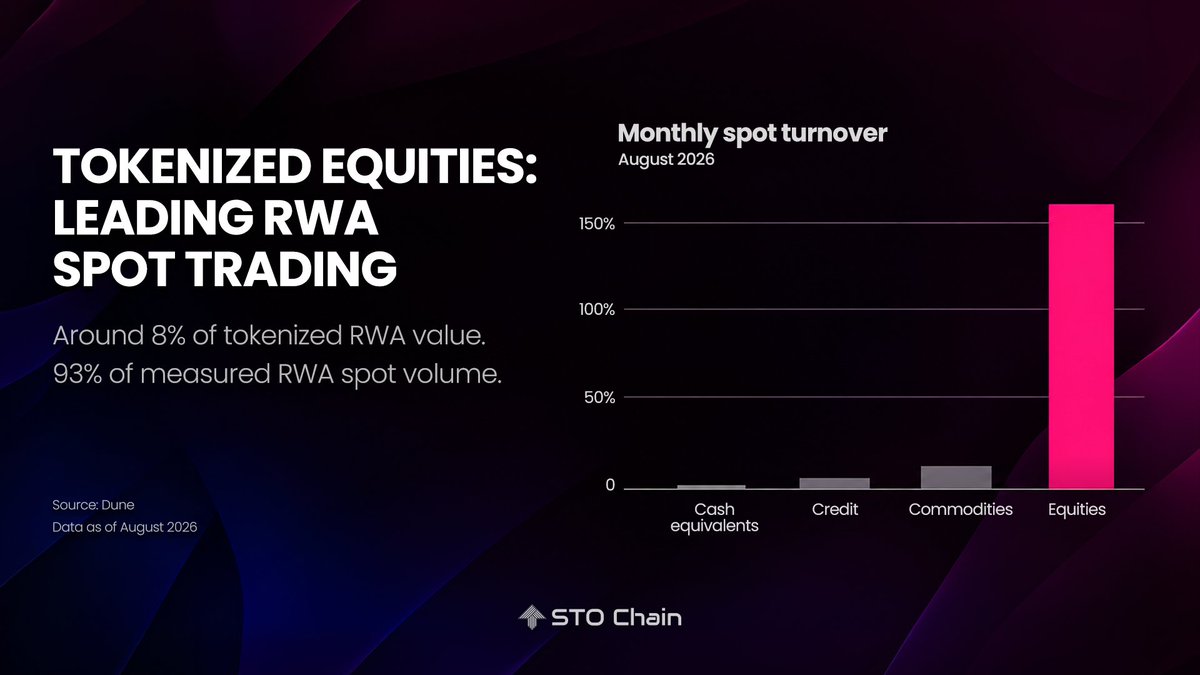
→ Equities represented around 8% of tokenized RWA value
→ August equity spot volume reached $12.6B—93% of measured RWA spot trading
Cash equivalents remain the largest asset class by value, but trade infrequently. Equities account for a smaller share of assets outstanding while generating most spot trading activity.
This points to distinct market roles: tokenized cash-equivalent products are largely held, while equity tokens support active trading of securities exposure.
For exchanges and market operators, that makes execution quality, alignment with underlying prices, and liquidity depth central to building a functioning tokenized equity market.
#STOChain #RWA #Tokenization
Tokenization is creating more digital assets. The harder challenge is making them work together.
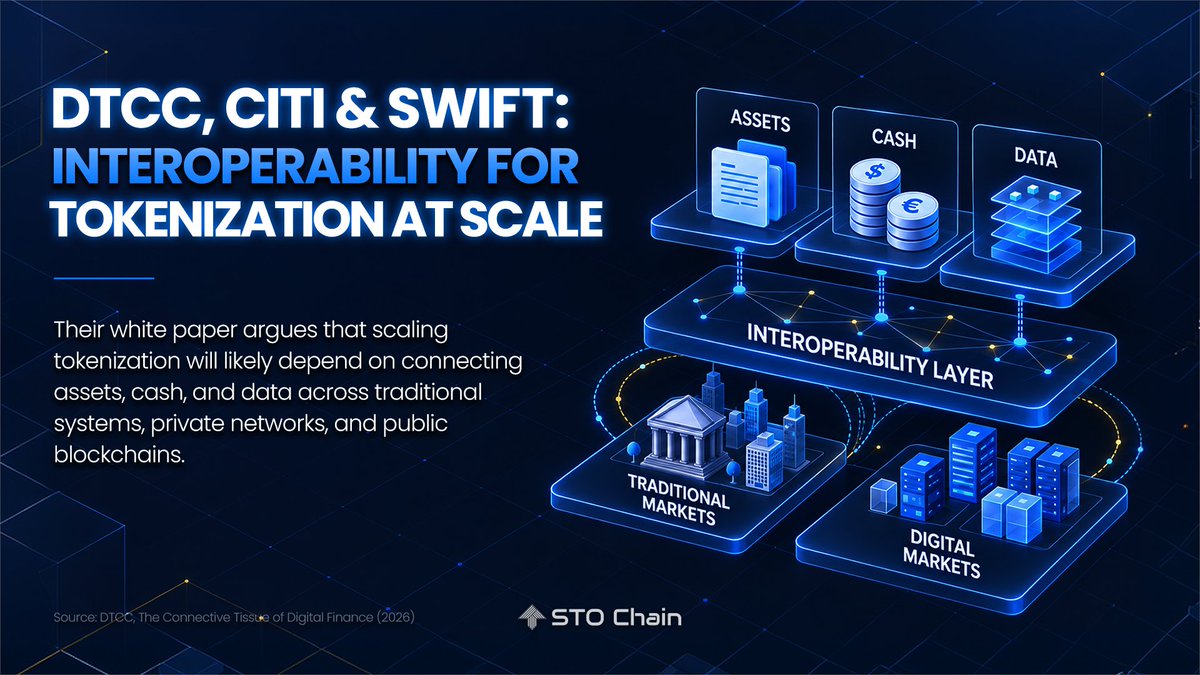
DTCC, Citi, and Swift argue that institutional-scale tokenization will likely depend on interoperability — connecting assets, cash, and data across traditional systems, private networks, and public blockchains.
Without those connections, tokenized assets risk remaining fragmented, increasing operational complexity and limiting liquidity.
The next phase is therefore less about choosing a single technology platform and more about building a hybrid financial system where different networks can exchange value and information while preserving trust, resilience, and governance.
Tokenization scales when digital assets become part of connected market infrastructure.
#STOChain #RWA #Tokenization
Korea’s Hana Bank has taken a significant step into digital capital markets.
Hana Bank issued a $100 million digitally native bond on Euroclear’s D-FMI, becoming the first Korean bank to issue a digital bond through the platform. The five-year floating-rate note also became the first digital bond listed on SGX.
What matters is how the transaction connects digital issuance with existing market infrastructure.
The bond was issued directly on DLT infrastructure and supports same-day settlement, while international institutional investors can access and trade it through their existing Euroclear accounts and systems. Hana Bank also used its established GMTN funding program.
This points to a broader shift in tokenized debt markets.
The next stage is not simply issuing bonds on DLT infrastructure, but making digital securities fit naturally into institutional distribution, secondary-market liquidity, and existing investor workflows.
For digital bonds to scale, digital and traditional markets may not need to compete. They need to connect.
#STOChain #RWA #Tokenization
Tokenized finance is moving from market experiments toward real institutional infrastructure.
The Eurosystem has launched Pontes, enabling wholesale tokenized asset transactions to settle in central bank money. At the same time, the ECB has begun preparing to invest a small portion of its own funds directly in tokenized securities.
The initial focus is euro-denominated securities issued by euro area governments, public agencies, and European supranational institutions. The ECB aims to gain practical experience across the investment lifecycle, including execution, settlement, systems, and portfolio management.
The significance is that the ECB is approaching tokenized markets from both sides: providing central-bank-money settlement through Pontes while preparing to participate as an investor.
This points to tokenization moving beyond issuance toward institutional investment, market infrastructure, and trusted settlement within the same environment.
The investments have not started yet, but Pontes is already live, bringing tokenized finance closer to established financial-market infrastructure.
#STOChain #RWA #Tokenization
Tokenized equities are moving from digital representation to market structure.
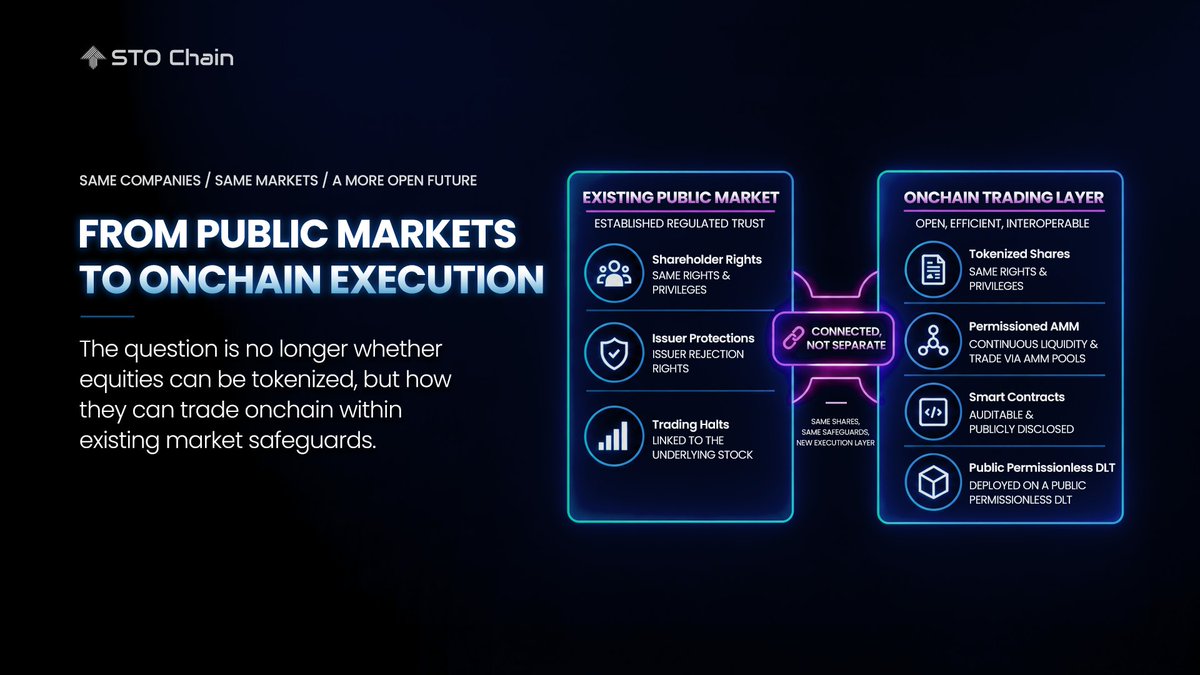
The SEC’s Innovation Exemption creates a temporary, conditional framework for onchain secondary trading of tokenized NMS stocks through permissioned AMM liquidity pools.
Key conditions include:
- Same shareholder rights
- Issuer objection rights
- Public, auditable smart contracts
- Public permissionless DLT
- Linked trading halts
The key question is no longer whether stocks can trade onchain, but how tokenized equities can operate while preserving the rights, protections, and controls of the underlying public market.
The framework keeps shareholder rights, issuer protections, permissioned access, and existing anti-fraud and market-integrity requirements in place.
This moves tokenization beyond digital representation toward building an operating market around the asset.
The exemption is temporary, but it creates a framework for testing blockchain as an execution layer within existing capital-market structures rather than a separate parallel market.
#STOChain #RWA #Tokenization