Market still pricing AI incorrectly -- LLMs, hardware & chatbots -- but that was last cycle.
Real money is in solving AI’s scaling bottlenecks -- bandwidth, latency & data liquidity.
Took advantage of this dip to load up on the real winners. Be selective.
THE BEST TIME TO BUY $TTD?
Interesting how The Trade Desk's recent bounce came right as its FCF multiple hit the exact level as its Jan '23 bottom -- last time, that sparked a 200%+ run over two years 🤔
MY BIGGEST TAKEAWAY FROM THIS MARKET & WHAT COMES NEXT
I wasn’t getting overly bullish after last week’s $QQQ rally, and I laid out my reasons in detail for subscribers. But I wanted to share some high-level takeaways on where I think the market stands right now.
The rally felt more like positioning and short-covering than a true shift in fundamentals. We’ve seen this pattern before -- markets ripping higher on momentum, but without the structural support that signals sustained upside. The bigger issue for me is that uncertainty is still the dominant force, and April 2 is shaping up to be a critical moment that could dictate the next major move.
The impact is already visible in earnings calls across multiple sectors. Executives in manufacturing, consumer goods, retail, and even tech have flagged uncertainty around trade policy as a primary reason for scaling back expansion plans, pulling back on guidance, and remaining conservative in forward-looking projections. Companies that rely on global supply chains, particularly those exposed to China and Mexico, are in a holding pattern -- uncertain whether to pass potential cost increases to consumers, absorb them into margins, or find alternative sourcing solutions that may carry their own operational risks and inefficiencies.
If that uncertainty drags on, the rally we just saw could lose steam fast. But if we get a clear resolution, even if the outcome isn’t perfect, markets can process it, reposition, and move forward.
That’s why I’ve been hesitant to chase this rally. Until we get clarity, this market is still running on uncertainty, not conviction.
To make it real simple -- $TSLA owns the cars the code the chips the charge & the data feedback loop.
Stacked & self-contained, while everyone else is still chasing margins & permits in Mexico. Tariffs just cleared the runway -- now it's a one-man race.
You can hate the man but the setup is clean -- every foreign-built competitor just got clipped.
Robotaxi ain't a maybe it's a when -- don’t bet against full-stack dominance in a rigged map.
While $TSLA won’t be entirely spared -- it’s hard not to see the 25% auto tariff news as a major catalyst.
Tesla controls the vehicles (designed with autonomy in mind), the operating system (FSD), the data loop (from billions of miles driven), the hardware stack (with in-house silicon and Dojo) & the energy platform (Solar + Powerwall + Superchargers).
This allows them to deploy autonomous fleets at a cost structure no traditional OEM or rideshare platform can match.
The tariff adds the final piece: it narrows the competition pool by kneecapping every foreign-built alternative.
MY TAKE ON THE $HOOD GOLD EVENT 🧐
Robinhood owns the app, the accounts, the AI, the cash flow & the culture.
It’s no longer just a brokerage. It’s not trying to become a bank. It’s something else entirely: the first real shot at a modern financial OS for the next generation of wealth.
The second Gold Event wasn’t about flash. It was a tell. Robinhood launched a private banking layer, a full-stack automated investing engine & Cortex -- an AI assistant that makes researching trades & managing portfolios feel less like homework & more like having a personal team of analysts in your pocket.
No other platform moves this fast.
$SOFI still trying to ship joint accounts. Robinhood’s rolling out tax filing, cash delivery, and premium rewards cards on top of checking, trading & now smart portfolios -- all inside one app, all priced to scale.
And here’s what’s wild: this isn’t some moonshot gamble. It’s already working. Account balances are up 3x in two years. Gold members have doubled. They’re tracking toward $200M in high-margin recurring revenue & pulling in increasingly affluent users. This isn’t churn-and-burn retail anymore. It’s capture & compound.
Robinhood isn’t stacking features. It’s stacking moats. AI on top of banking on top of investing on top of behavior -- every product makes the platform stickier, every new feature raises the switching cost. It’s the kind of structure legacy players can’t replicate & fintechs can’t seem to match.
People still want to frame Robinhood as a trading app. Let them. Meanwhile, it’s becoming the destination where Gen Z and Millennials will store, grow & eventually inherit trillions. And when that transfer of wealth lands -- the app they already trust is going to be the one they use.
This is what it looks like when software eats banking. No permits, no branches, no underwriting book to slow it down. Just velocity, vision & vertical integration -- built for scale, priced for mass adoption & optimized for where the future of money is going.
Full-stack finance, priced for mass scale. Don’t bet against a platform that’s already in your pocket.
If you’re a $SOFI shareholder, I get it -- this one stings a little.
You’ve believed in the mission: a full-service digital bank for the next generation. You've watched SoFi build methodically -- winning a bank charter, growing deposits, acquiring customers through student loan refis, credit cards, and mortgages. The foundation is there. The vision is sound. But while SoFi’s been laying bricks, $HOOD been sprinting ahead with product after product -- and last night’s Gold Event made that gap hard to ignore.
To be clear: this isn’t a teardown of SoFi. It’s still one of the most credible digital banking platforms in the U.S. The fundamentals are there, the member growth is steady, and @anthonynoto is one of the most capable operators in fintech. But while SoFi is operating like a modern bank, Robinhood is operating like a software company. That distinction is starting to show.
The frustrating part? SoFi shareholders know there’s a huge opportunity ahead -- a generational wealth transfer, a chance to win with Gen Z and Millennials, a wide-open lane for digital-first platforms to replace the legacy banks. But it’s hard to watch another fintech capture that narrative so forcefully.
SoFi has the infrastructure. But Robinhood has the momentum.
That doesn’t mean SoFi can’t catch up. It still has unique strengths -- a lending engine, full banking rails, and a more diverse business model. But it needs to start delivering product velocity that meets the moment. The next phase of fintech won’t be won by infrastructure alone. It’ll be won by whoever captures user trust and engagement -- and that means shipping, testing, iterating, and moving fast.
So yes, if you’re a SoFi shareholder, you’re right to feel frustrated today. But let it be motivation, not despair. Because the market isn’t zero-sum -- but attention is. And right now, Robinhood has it.
You bet on the idea that digital finance can do better. That still holds true. But it’s time to see that vision move from potential to execution — and fast.
Every time $ARM drops 40%, it doesn’t break -- it bounces.
Rinse, reset, reprice -- then rip.
History doesn’t repeat, but Arm's price action loves to rhyme.
Watching 🧐
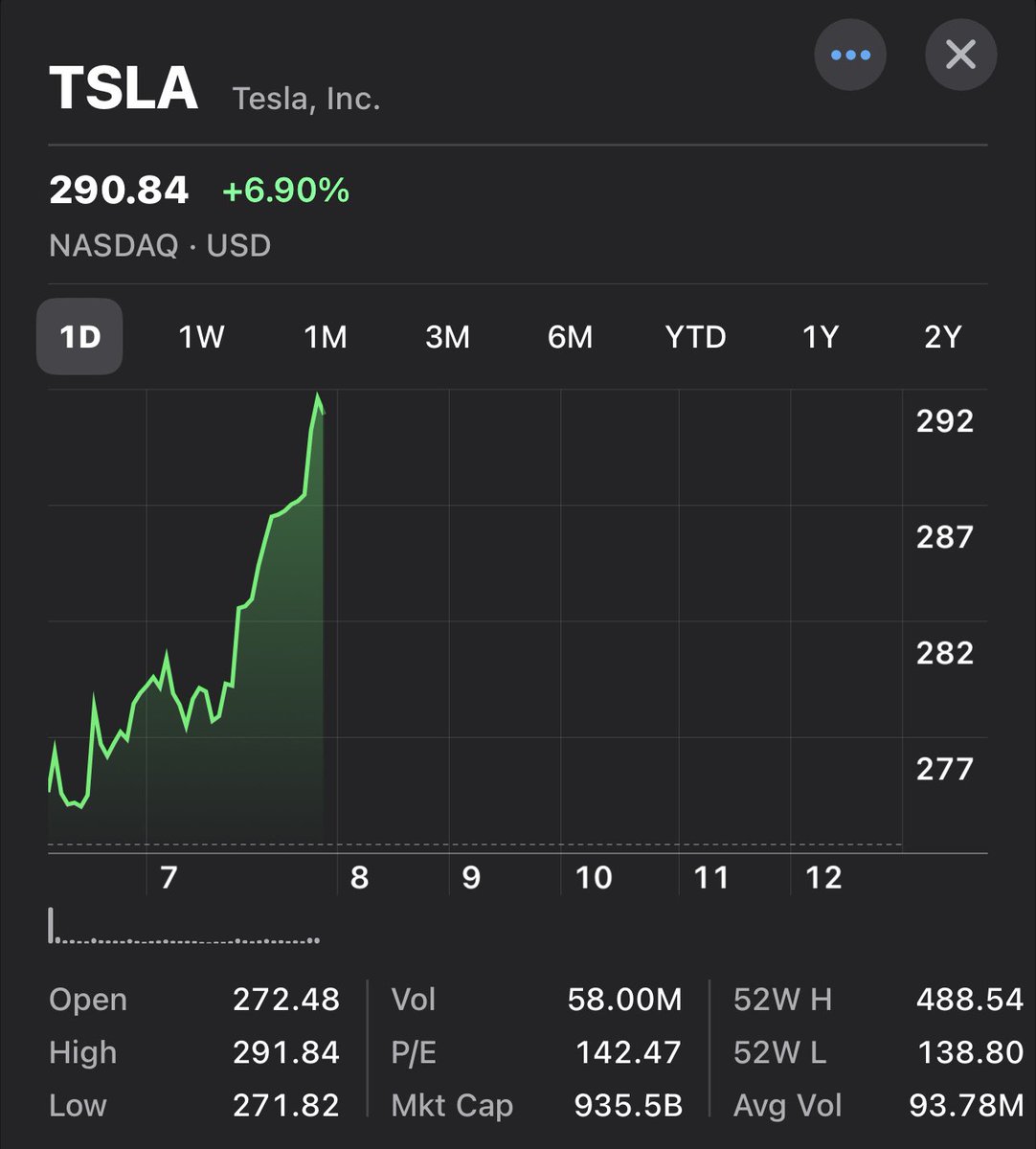
$TSLA UP ~7% TODAY 😳
The markets catching on: once the Robotaxi fleet is live, it won’t matter who’s buying -- most folks won’t need to.
You’ll just use one because it’s the cheapest & most convenient ride on the road. That’s the play. Ownership fades. Usage scales.
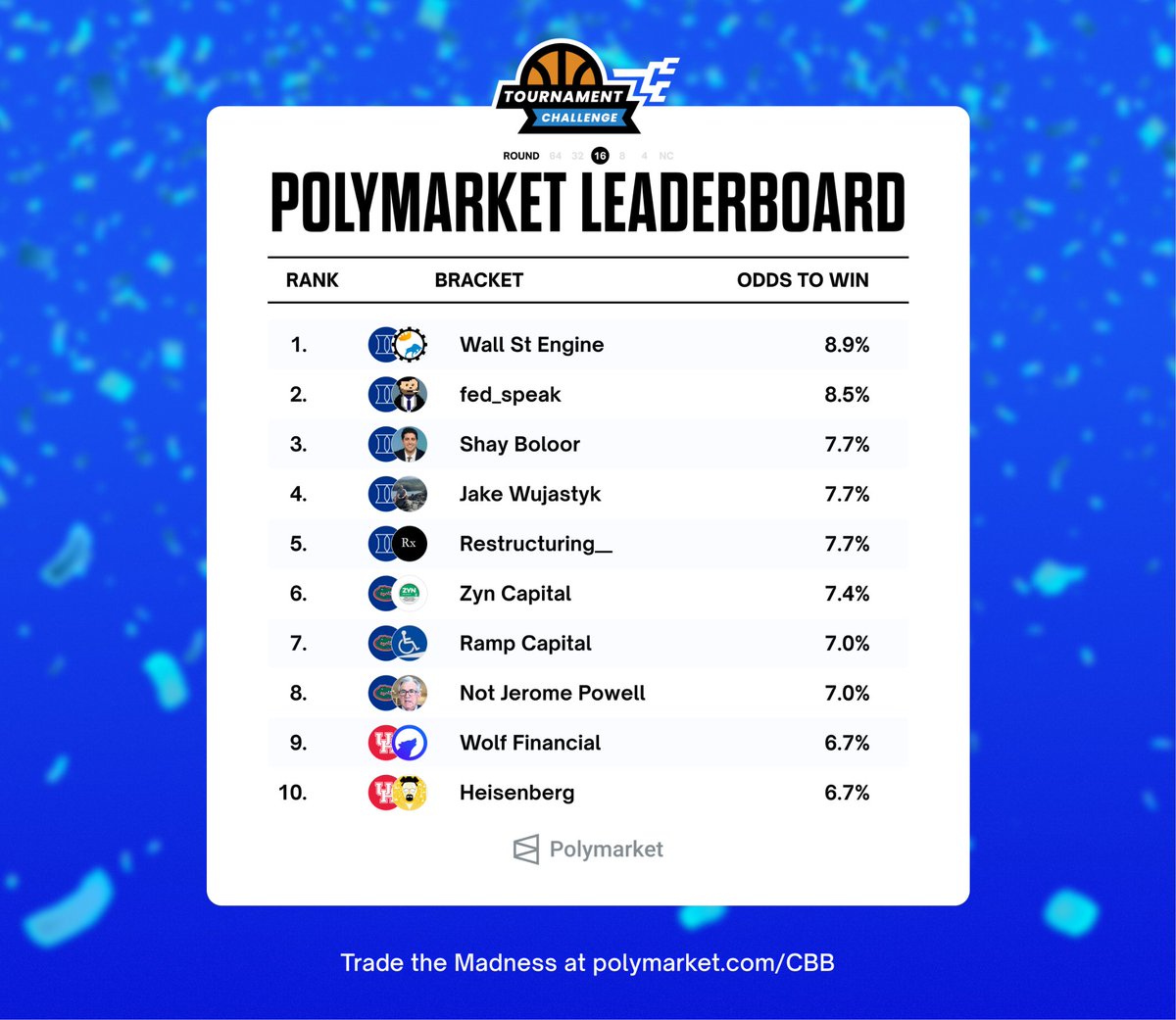
Cracked the Top 3 in the Polymarket March Madness challenge 👀
Not loving that the top 5 all picked the $NVDA of college basketball to win it all -- but here we are.