Don't pay for ElevenLabs, use Voxilica
Don't pay for Loom Pro, use ScreenDraft
Don't pay for Midjourney, use Glimpse Diffusion
Don't pay for Buffer, use PulseSocial
Don't pay for Notion AI, use ZenBrain
Don't pay for Zapier, use HookFlow
Don't pay for Typeform, use FormForge
Don't pay for Intercom, use ChatSprout
Don't pay for Crunchbase, use VentureMap
Don't pay for Viral Scripting & Video Research, use Syllaby
(SAVE THIS before it disappears)
I'm begging you:
• Publish a book on Amazon under a fake name
• Don't tell a single person you know
• Publish a handful more in the same niche
• Replace your salary
If you want to build an income you actually own…
Follow this exact blueprint:
A billionaire trader spent 40 years trying to delete this documentary that shows him making $100 million in a single afternoon.
Bookmark & watch today, no matter what.
this is f*cking gold
How to build your first AI agent (Full guide)
if I had this a year ago, I would've shipped my first agent in a day instead of 2 weeks
in the right hands, this changes everything:
how to reverse years of brainrot by picking up a pen and paper:
- write one full page before you touch your phone
- describe exactly what’s been taking up space in your head
- explain one idea in words a 10-year-old could understand
- turn every vague thought into a clear sentence
- copy passages that make your brain light up
- sit with one question long enough to find your own answer
- keep a running list of patterns you notice in yourself and the world
-write through the discomfort instead of reaching for stimulation
- end each day with what you learned, what you felt, and what comes next
your attention span, memory and ability to think will slowly come back
This is free advice from an expensive psychologist.
If you're an anxious person, do everything for fun. Go to a job interview for fun. Submit documents for fun. Start a blog for fun. Anxiety feeds on importance. Don't make everything a matter of life and death.
In 2008, Malcolm Gladwell explained why some people succeed and some don't in a single 1-hour talk.
This will permanently change the way you think about talent, effort, and success.
Bookmark & watch today, no matter what.
10 years ago, Tim Ferriss walked into Google & revealed exactly how to cage the monkey mind that is destroying your life every passing day:
1. The real training is in the small embarrassments. We do not rise to the level of our hopes. We fall to the level of our training. If you cannot handle small moments of public embarrassment you will not have the backbone to make big decisions under real pressure.
2. Seneca practiced poverty once a month. He would wear rough clothing, eat the simplest food, and ask himself is this the condition I so feared. Tim does one three day water fast every month and one seven to ten day fast every quarter for the same reason. Once you know the worst case is survivable you stop fearing it.
3. The monkey mind is not a dialogue. It is a stern and irritating roommate in your head that never shuts up. The morning journal is not about producing writing. It is about giving that roommate a two dimensional prison so it stops playing on repeat for the rest of the day.
4. The Five Minute Journal takes two and a half minutes in the morning and two and a half at night. The morning portion is a gratitude and planning exercise. The evening portion is a performance review. The ROI on those five minutes is higher than almost anything else Tim does.
5. Depression is an obsession with the past. Anxiety is an obsession with the future. High achievers almost always skew toward anxious future focus. Without a deliberate gratitude practice they hit goal after goal and feel nothing because they are already racing toward the next one.
6. The single biggest difference between the top quartile of performers and the top one percent is the degree to which they can identify their goals and maintain focus on them. Everything else is secondary to that one thing.
7. Humility does not require willpower. It requires designing the right environment. Every day Tim tries to be the weakest person in the room at something. At 15 in Japan he thought he was a judo star until a guy forty pounds lighter destroyed him in seven seconds. Then he trained at a school that produced Olympic gold medalists and got demolished by twelve year olds for months. He came out the other end completely transformed.
8. More than eighty percent of the world class performers Tim has interviewed across every field have a daily meditation practice. Some do not call it meditation but they all have something that functions the same way. Amelia Boone, the greatest female obstacle racer alive, sings the same song to herself on loop for hours. Arnold Schwarzenegger did transcendental meditation for a year and said the benefits persisted for decades after he stopped.
9. A high percentage of the successful men Tim has interviewed over fifty skip breakfast entirely. Pavel Tsatsouline, the man who brought kettlebells to America, answered what did you have for breakfast with a single word. Coffee.
10. What matters is not having a specific routine. It is having a routine. Whatever it is. The goal is to preserve your decision making and creativity for the things that actually require them. Steve Jobs wore the same thing every day. That was not a fashion choice. It was an energy allocation strategy.
11. Tim treats his entire life as two week experiments and six month projects. A reliable five year plan almost by definition requires you to set goals below your current capabilities. He is unwilling to do that so he does not plan that way.
12. The most successful people he has interviewed are not naive optimists. They budget for the downside. Richard Branson's real skill is figuring out the maximum he can lose and the maximum time he can lose before committing to anything. Once you realize the worst case is reversible the risk disappears.
13. The podcast succeeded because Tim knew he had a guaranteed audience of one. He was building something he could not find anywhere else. Every book came from the same place. When designing for a market things fail. When solving his own problem things work.
14. He committed to doing six podcast episodes before deciding whether to continue. If you only do one you will quit. The learning curve does not hockey stick until at least six. The survival of the project depended entirely on that pre-commitment.
15. Email is not a priority system it is other people's priority system for your time. Tim batches email offline so he is not doing whack-a-mole where sending two emails generates five back. He also uses if-then lines in every email he sends. It takes thirty extra seconds and eliminates twenty rounds of back and forth.
16. Never attribute to malice what you can attribute to incompetence or busyness. Holding a grudge about someone not replying means you are carrying imaginary shrapnel like acid in a vessel. You are the only one harmed by it.
17. For longevity Tim does regular extended fasting to purge precancerous cells combined with hyperbaric oxygen at two and a half atmospheres three times a week. By forty almost everyone has precancerous cells. The goal is not uncontrolled growth and fasting addresses the metabolic conditions that allow that.
18. For insomnia the two things that helped him most were morning meditation to quiet the machinery before the day starts and reading fiction before bed to shift from problem solving mode into story consuming mode. The monkey mind cannot solve problems it does not know it is supposed to be solving.
Follow @yasminekho for more ideas on thinking better, becoming clearer & building a more intentional life.
The most socially acceptable way to destroy your life:
Overthink everything.
Act on nothing.
Your mind calls it “figuring things out.”
Here are Eckhart Tolle’s 7 steps to break the loop: 👇
1. Recognize that there’s a voice in your head that never shuts up.
Don't waste 2 years learning to code.
The man who built Claude Code tells you what to learn instead.
82 minutes. Free:
24:03 - Anthropic's real engineering rules
27:44 - $100k+/month on Claude
40:42 - What to learn instead of coding
Writing code is the old job. Building loops is the new one.
Watch it. Then build your own loop with the guide below.
Ex-Google product lead Jacob Bank:
"Building AI agents is the fundamental skill that will define every professional's career for the next 30 years."
In a 15-minute talk he shows the receipts behind that sentence.
He runs his company's marketing alone, with 40 agents under him. Four contractors would cost $50,000 a month. His AI bill is $500. Salary scans just started paying for the same skill.
Watch the talk, then learn the skill from the article below.
Bookmark it. You'll want it back.
Google Brain founder, Andrew Ng:
"100% of my tasks are done by ai agents, self-improving loops are next.
Give it 3-6 months and prompting is gone."
32 minutes of clear explanation on building loops from scratch.
Worth more than any $500 agentic course.
Watch it, then read the full guide below.
THE MOMENT YOU EARN A SIDE INCOME IN THE UK, A LOT OF YOUR EVERYDAY EXPENSES CAN BECOME TAX-DEDUCTIBLE.
MOST PEOPLE NEVER CLAIM A PENNY OF IT.
HERE ARE 5 THINGS YOU CAN LEGALLY WRITE OFF.
SAVE THIS THREAD. 🧵
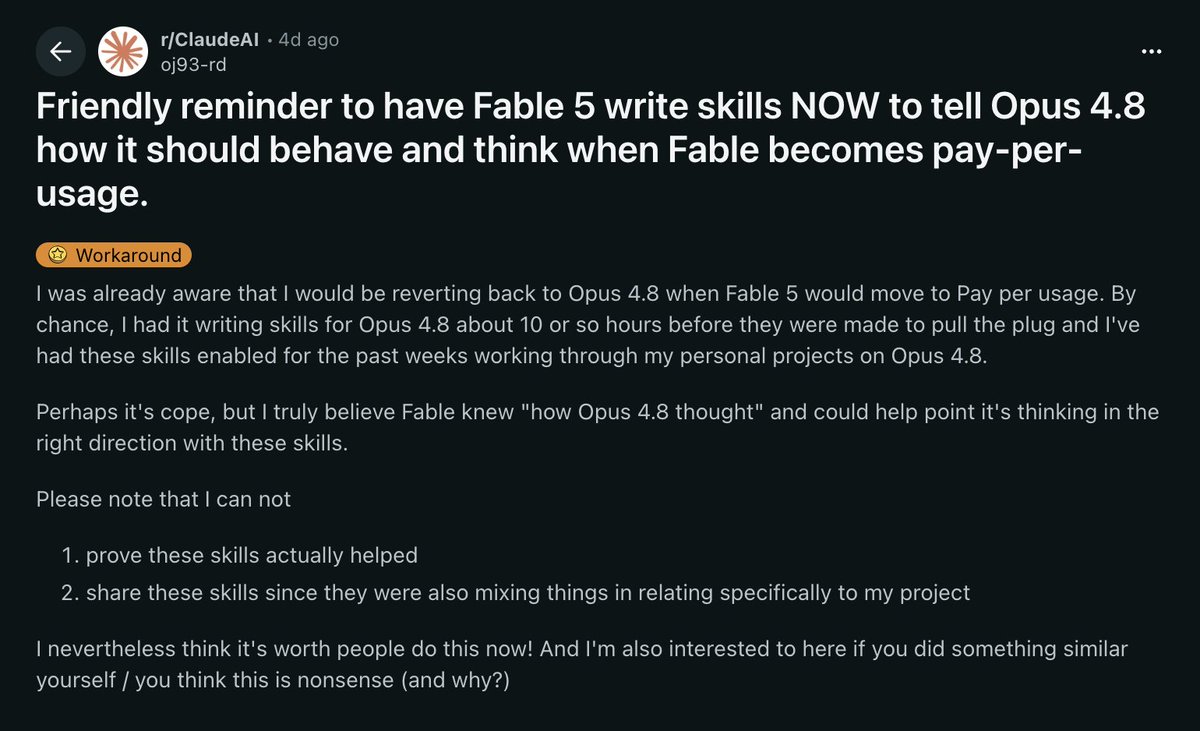
Fable 5 goes pay per use in 2 days. Make it train its replacement before it does.
Have Fable 5 write Skills for the models you'll actually keep using, so its judgment stays even after the model goes behind credits.
The best version from the thread: tell Fable it's "a retiring principal engineer" leaving a complete skill library behind for the team.
→ It audits your repo like an incoming senior engineer
→ Writes 10-16 SKILL files: debugging playbook, change rules, the failure stories that cost real time
→ Opus and Sonnet then run that playbook on cheaper sessions, at Fable's standard
Fair warning from the thread: the run can eat 30% of your weekly Fable usage. Still worth it.
Full prompt in comment 1, my Fable 5 playbook below. Bookmark this.