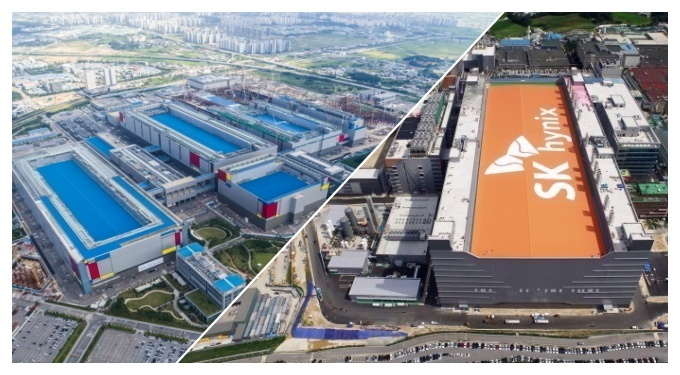
🚨 Samsung Electronics is restructuring its commodity DRAM production system at the Hwaseong campus and is expected to increase capacity by approximately 15% by year-end.The key point is that Samsung is not simply building another new fab.The company plans to establish a commodity DRAM end-fab facility at the H1 site in Hwaseong and relocate equipment currently spread across the H2 facility and the Cheonan campus to https://t.co/SmOLjDpMil end fab is not a conventional semiconductor packaging and testing https://t.co/SIWnWuZEzK represents the final stage of front-end wafer processing, where transistors and memory cells produced in the main fab are connected through metal interconnects.Until now, wafers manufactured at Samsung’s main facility in Hwaseong had to be transported to the Cheonan end fab to complete the process.This physical separation increased transportation time and overall production lead times, making it more difficult for Samsung to rapidly increase commodity DRAM supply during periods of severe https://t.co/Umt6zBUy1X now plans to use idle cleanroom space at H1 that became available after older memory production lines were https://t.co/LS4UK03MCS integrating the main fab and the end fab at the same location, Samsung can reduce logistics delays and improve production efficiency.This approach also avoids the cost and time required to construct an entirely new factory, allowing the company to remove production bottlenecks more quickly.Industry estimates suggest the restructuring could increase Samsung’s commodity DRAM production capacity by approximately 15% from the beginning of the year by the end of 2026.This is especially significant because DDR4 prices reportedly surged by more than 80% during the first half of the https://t.co/JuGNfrTiCG appears to be positioning itself to capture as much profit as possible from the shortage in conventional DRAM, rather than focusing only on HBM.There are three reasons this development matters.1. Samsung is not abandoning commodity DRAM
Capital markets are heavily focused on HBM, but the sharp increase in prices for DDR4, DDR5 and LPDDR is also making a significant contribution to Samsung’s semiconductor https://t.co/R2es3NZyzQ servers are absorbing more HBM and high-capacity server DRAM production, reducing available capacity for PC, smartphone and consumer-electronics https://t.co/RMqhIGiv45 increasingly views this shortage as a major earnings https://t.co/Dpa0T7Kgoo is attempting to benefit from both HBM demand and rising conventional DRAM prices.2. It is also a defensive response to Apple’s consideration of Chinese DRAM
Apple has reportedly been exploring the use of DRAM supplied by China’s CXMT as it deals with rising memory prices and limited https://t.co/3cjhdJecYE final supply agreement has been confirmed.However, the message to Samsung is clear:If Samsung cannot guarantee enough supply, major technology customers may shift part of their orders to Chinese memory manufacturers.The Hwaseong capacity expansion should therefore be viewed as more than an attempt to profit from higher memory https://t.co/3h6sNlTlp6 is also a supply-defense strategy designed to prevent Apple and other major smartphone and PC customers from moving toward Chinese suppliers.3. It is a faster and less capital-intensive expansion than building a new fab
A new semiconductor fab requires construction, equipment installation, qualification and yield stabilization, which can take years.Relocating existing equipment and utilizing available cleanroom space can improve production efficiency much more https://t.co/kkOAbB9xz4 allows Samsung to increase output during the period when supply is tightest.This is therefore closer to maximizing returns from existing assets and removing production bottlenecks than launching an aggressive new capital-expenditure cycle.However, the development should not be viewed as entirely bullish.Increasing commodity DRAM capacity by 15% could improve Samsung’s shipment volume, customer responsiveness and near-term earnings.But if Samsung, SK Hynix, Micron and Chinese manufacturers all expand conventional DRAM capacity at the same time, the supply shortage could eventually ease and the pace of price increases could slow.A 15% increase in production capacity also does not automatically mean shipments or profits will rise by 15%.The actual results will depend on:→ The speed of equipment relocation and process conversion
→ Yield rates and factory utilization
→ The product mix between DDR4, DDR5 and LPDDR
→ How wafer capacity is allocated between HBM and commodity DRAM
→ Whether Apple and other major customers sign long-term supply agreementsThe market should therefore focus on more than the headline capacity figure.The real question is:Which products will receive the additional capacity, how quickly will production begin, and how much of it will translate into actual shipments and earnings?This decision shows that Samsung is not only trying to catch SK Hynix in https://t.co/kzOpKzfa7A is also attempting to strengthen its pricing power, supply capability and control over major technology customers during a shortage of conventional https://t.co/c2Kf7YcyLF is no longer simply waiting for memory prices to https://t.co/ykdqpSZRVq is actively removing production bottlenecks so it can sell more memory while prices remain elevated.$005930 $000660 $MUThis material is provided for market-analysis purposes only and does not constitute investment advice. The estimated 15% capacity increase is based on industry sources and is not official capacity guidance from Samsung Electronics. The actual expansion schedule, product mix and yields still need to be confirmed.
🚨 Samsung Electronics is considering using Chinese-made DRAM in the Galaxy A series to re-enter China’s smartphone market.
It is a highly ironic strategy.
The surge in memory prices, driven by AI data-center investment, is benefiting Samsung’s semiconductor division.
At the same time, those same higher component prices are damaging the profitability of Samsung’s smartphone business.
The impact is particularly severe in the budget and mid-range smartphone market, where memory and storage can represent a significant portion of total component costs.
According to Korean media reports, Samsung is exploring the use of lower-cost mobile DRAM sourced locally in China to reduce the manufacturing cost of Galaxy A-series devices and expand shipments in China’s affordable smartphone segment.
Samsung currently holds only around 0.6% of China’s smartphone market.
The opportunity Samsung sees is straightforward.
Chinese smartphone manufacturers such as Xiaomi, OPPO, Vivo and Honor cannot easily pass the full increase in component costs on to consumers.
Raising prices risks damaging demand.
Keeping prices unchanged means margins become worse with every additional device sold.
As a result, some manufacturers have reportedly reduced their shipment targets by approximately 15% to 20%.
Samsung may try to use this temporary weakness by lowering Galaxy A-series costs with locally sourced Chinese DRAM, offering more competitive pricing and capturing market share left behind by Chinese manufacturers cutting production.
If the strategy is implemented, it would have three major implications for Samsung.
1. Protecting MX division margins
Using Chinese-made LPDDR could reduce the impact of rising memory prices and help defend margins on budget and mid-range smartphones.
2. Creating an option to re-enter China
Samsung’s Chinese smartphone market share has fallen to almost zero.
Even a modest recovery could produce a meaningful increase in shipments and revenue from such a low base.
3. Expanding local supply-chain integration
Using Chinese components in smartphones sold in China could improve both pricing competitiveness and local procurement flexibility.
However, this is not an entirely positive development for Samsung.
The biggest contradiction is that Samsung is one of the world’s largest memory manufacturers, yet it may use memory produced by a Chinese competitor to protect the profitability of its own smartphone business.
For the MX division, this would be a cost-saving measure.
For Samsung’s semiconductor division, however, it could signal that Chinese DRAM has reached a level of price competitiveness, capacity and product quality sufficient to enter the supply chain of a major global smartphone brand.
CXMT has already grown into the world’s fourth-largest DRAM manufacturer, with a reported global market share of approximately 7.6% in the first quarter of 2026.
Its major products include mobile LPDDR and conventional DDR memory.
This makes CXMT an obvious potential supplier to watch, although the reports have not confirmed which Chinese company Samsung may use.
It is also important to understand that Chinese memory is not always cheaper.
In the recent server DDR5 market, strong domestic Chinese demand and limited supply reportedly allowed CXMT to quote prices above those offered by Samsung in some cases.
Therefore, whether Samsung can actually lower costs will depend on the specific LPDDR contract price, duration and purchase volume—not simply on the fact that the memory is manufactured in China.
The earnings pressure on Samsung’s MX division is also significant.
According to the report, several Korean securities firms estimate that Samsung’s MX and Networks division could record a second-quarter operating loss ranging from roughly KRW 200 billion to KRW 1 trillion.
Samsung Securities reportedly estimated a second-quarter operating loss of approximately KRW 584.1 billion.
It was also reported to have revised its full-year forecast from an operating profit of KRW 3.41 trillion to an operating loss of KRW 5.841 trillion.
However, these figures are brokerage estimates rather than official guidance from Samsung Electronics.
The real purpose of this strategy is not necessarily to immediately reclaim the Chinese smartphone market.
It is more accurately viewed as a practical margin-defense strategy.
As rapidly rising memory prices squeeze the profitability of affordable smartphones, Samsung needs lower-cost components to prevent losses in the MX division from expanding further.
The market now needs to confirm:
→ Whether Samsung actually adopts Chinese-made DRAM
→ Which company becomes the supplier
→ Which Galaxy A models will use the components
→ The expected shipment volume
→ The cost savings compared with Samsung’s own memory
→ Product quality, yield and compatibility
→ Potential U.S. regulatory and supply-chain risks
→ Whether Samsung’s China market share can recover from 0.6%
→ Whether the MX division’s operating losses begin to narrow
A Samsung Electronics representative reportedly said the matter “could not be confirmed.”
My conclusion is clear.
If Samsung adopts Chinese DRAM, it could help the MX division control costs, defend margins and expand Galaxy A-series shipments in China over the near term.
But in the longer term, it would also suggest that Chinese memory manufacturers have become competitive enough to enter Samsung’s own product supply chain.
The moment Samsung begins using Chinese memory in its smartphones, this stops being a simple cost-cutting story.
It becomes a signal that the competitive structure of the global memory industry is changing.
$005930 $000660 $1810
This material is for market-analysis purposes only and does not constitute investment advice. The plan has not been officially confirmed by Samsung Electronics and is not a finalized supply agreement. Actual component adoption and shipment plans still need to be verified.
Today’s Stock Analysis: Samsung Electronics Special
The stock I am analyzing today is Samsung Electronics (005930).
① Fundamentals
The most important recent development for Samsung Electronics is its large-scale AI semiconductor partnership with U.S. chipmaker Broadcom.
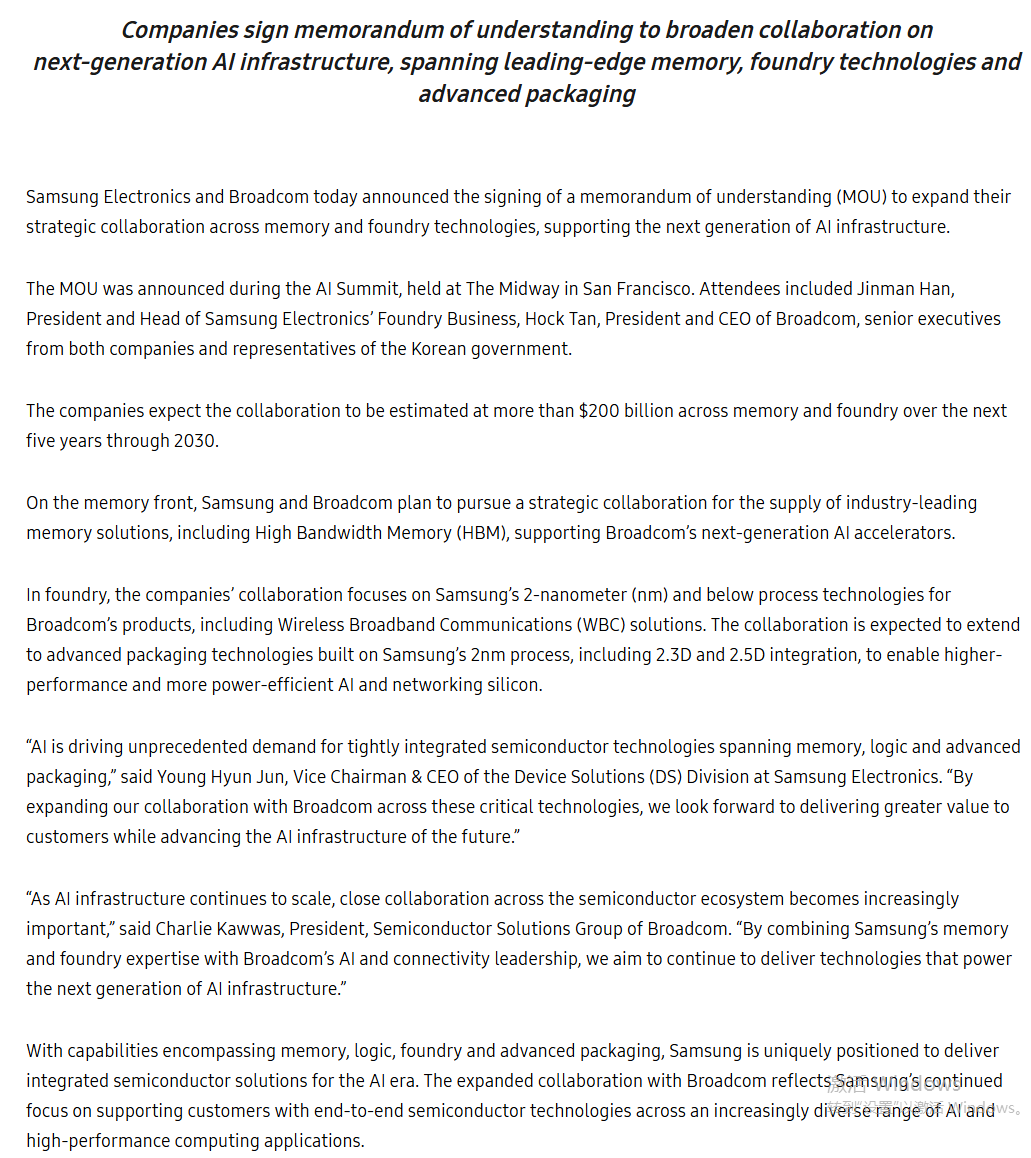
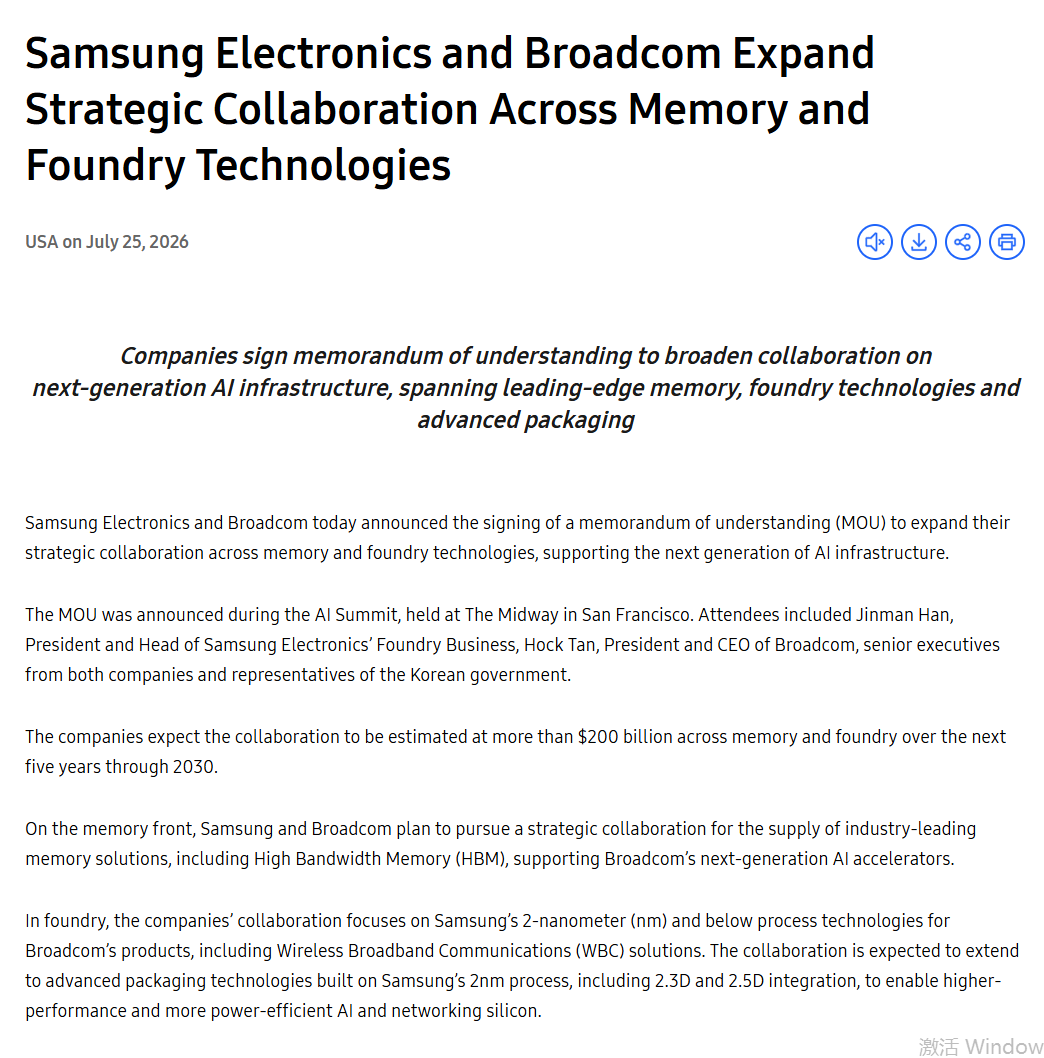
Samsung Electronics and Broadcom signed a memorandum of understanding to expand their strategic cooperation in memory and foundry technologies. The two companies expect the total scale of cooperation through 2030 to exceed $200 billion.
The key point is that Samsung may not be limited to supplying memory.
Samsung could also participate in the memory, advanced foundry, and packaging processes required for Broadcom’s next-generation AI chips. If the framework develops into actual orders, Samsung could generate revenue from multiple stages of the same AI project, including memory, chip manufacturing, and advanced packaging.
However, one distinction is important:
The $200 billion figure is not a single confirmed order that will be recognized immediately. It represents the projected total scale of cooperation through 2030.
The factors that will ultimately determine Samsung’s earnings and share price include Broadcom’s actual order volume, Samsung Foundry’s advanced-node yields, HBM customer qualification, and whether its advanced-packaging capacity can be delivered on schedule.
The announcement is positive for Samsung’s medium- to long-term AI semiconductor thesis, but the market will care about more than the headline value.
Samsung must prove that it can convert the partnership into mass production and real profits.
② Technical Analysis
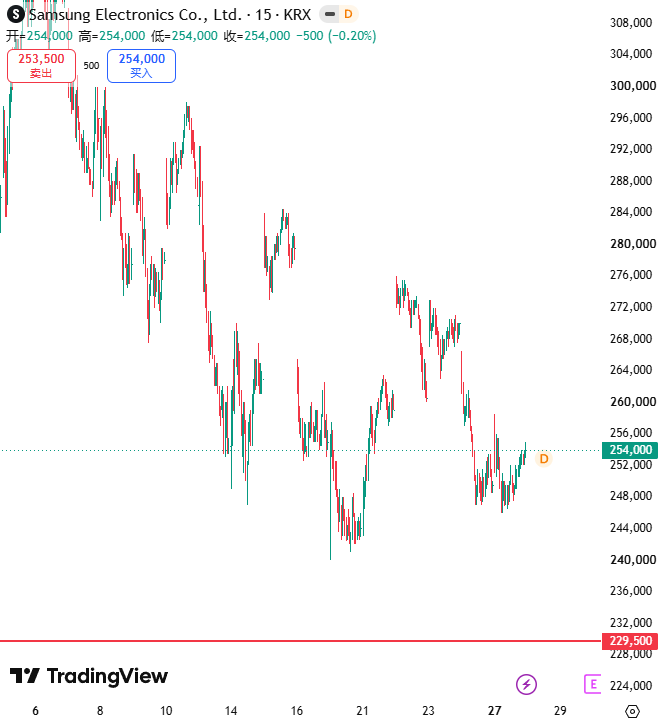
On the current 15-minute chart, Samsung Electronics is trading at approximately KRW 254,000.
The broader structure still looks like a technical rebound within a downtrend.
Since falling from above KRW 320,000, the stock has continued to form lower highs and lower lows. Although some buying interest recently appeared near the KRW 240,000 area, there has not yet been a volume-supported trend reversal or a confirmed higher low.
The main Fibonacci observation levels marked on the chart are:
0.382 observation level: KRW 229,500
0.5 observation level: KRW 228,500
0.618 golden observation level: KRW 227,000
Core support: KRW 229,500
KRW 229,500 is the first major defensive level to monitor within the current corrective structure.
If volatility in the Korean market and semiconductor sector increases again, the key question will be whether genuine buying demand appears around this area and absorbs the selling pressure.
A break below KRW 229,500 would bring KRW 228,500 into focus, while KRW 227,000 would become the most important final defensive zone in this correction.
A volume-supported rebound, long lower wicks, and a clear reduction in selling pressure within the KRW 229,500–227,000 area would create a better basis for reassessing Samsung’s medium- to long-term recovery potential.
However, a decisive break below KRW 227,000 would suggest that the decline is no longer just an ordinary short-term correction. It could indicate further valuation compression and an extension of the broader downtrend.
Samsung Electronics has received positive fundamental news, but technically, this is not yet a confirmed attractive buying opportunity.
Buying at the current level would be closer to chasing an unconfirmed rebound than waiting for the trend to genuinely improve.
The more reasonable approach is to remain patient and wait for the stock to stabilize near its key levels, for selling pressure to weaken, for volume to recover, and for a higher low to form.
A good company and a good entry price are not the same thing.
Once the risk-reward structure becomes clearer and a more attractive opportunity is confirmed, our institution will share the key price levels and market strategy through our Telegram channel.
Join our institutional Telegram channel through the profile for ongoing analysis of Korean and U.S. stocks, key price levels, and risk-management strategies.
This article reflects our institution’s market analysis and does not constitute investment advice. Avoid excessive leverage and maintain strict stop-loss and risk-management discipline.
🚨 SK Hynix’s quarterly pre-tax profit could exceed KRW 100 trillion for the first time in KOSPI history.
First, the currency figures need to be corrected.
Some overseas posts translated the estimates as JPY 11.2 trillion in pre-tax profit and JPY 4.7 trillion in non-operating profit, but Meritz Securities’ figures are denominated in Korean won, not Japanese yen.
Meritz Securities analyst Kim Sun-woo estimates SK Hynix’s Q2 2026 results at:
→ Operating profit: KRW 60.1 trillion
→ Pre-tax profit: KRW 101.8 trillion
→ Non-operating profit: more than KRW 40 trillion
If realized, SK Hynix would become the first KOSPI-listed company to report more than KRW 100 trillion in quarterly pre-tax profit.
But the key point is that this number does not come entirely from the memory business.
SK Hynix originally invested in Kioxia through investment vehicles formed with Bain Capital in 2018.
According to the Meritz estimate, the sale of part of that investment could allow SK Hynix to recognize roughly KRW 40 trillion in cumulative investment gains.
Additional valuation gains may also be recorded from the remaining investment vehicles and related financial assets.
SK Hynix still holds convertible bonds through a special-purpose company that could be converted into approximately 14% of Kioxia’s shares.
However, these bonds have not yet been converted into voting common shares. Conversion and regulatory approvals would still be required.
This matters for three reasons.
First, SK Hynix is generating value not only through HBM and DRAM operating profits, but also through the monetization of a strategic investment made years ago.
Second, although the gain is largely non-recurring, it could significantly strengthen the company’s balance sheet, support future capital expenditure and increase its capacity for shareholder returns.
Third, the remaining Kioxia-linked investment may have strategic value beyond being a simple financial asset, particularly in the NAND market.
However, investors should not treat the entire KRW 101.8 trillion as recurring normalized earnings.
More than KRW 40 trillion of non-operating profit would largely reflect one-time gains from the Kioxia investment and asset revaluation.
For a sustainable rerating, the market should focus on:
→ HBM shipment growth and pricing
→ Whether DRAM and NAND ASP increases can continue
→ SK Hynix’s 2027 operating-profit outlook
→ How the remaining Kioxia investment is handled
→ Whether the extraordinary profit is returned to shareholders
The headline is extremely strong.
But the real question is not whether SK Hynix can report KRW 100 trillion in pre-tax profit once.
It is whether the underlying memory business can maintain its earnings power after the one-time investment gains are removed.
$000660 $285A
This material is provided for informational purposes only and does not constitute investment advice. Investors should distinguish one-time gains from recurring operating earnings, avoid chasing headline-driven rallies and maintain disciplined risk management.
KOSPI is unlikely to rebound as sharply and smoothly as it did in the past.
The biggest thing investors need to watch from here is not the stock price itself, but their own trading behavior.
The reason the market keeps rising a little and then falling again is simple.
In a highly volatile downtrend, most investors are thinking:
“Please, just let me get back to breakeven so I can sell.”
That is why selling pressure appears as soon as the market rebounds slightly.
Then, when prices fall again, investors begin to fear another major collapse and sell because they can no longer tolerate the volatility.
But once the stock suddenly rallies, they regret selling and buy it back at a much higher price.
This creates the worst possible cycle:
Selling low because of fear, then buying high because of FOMO.
The most dangerous scenario from here is this:
Investors keep selling every time they return to breakeven, but once SK Hynix moves back above KRW 2 million and continues higher, they chase the stock because market sentiment has improved.
The real issue is not the daily price movement.
It is your broader view on the memory cycle.
If you believe memory prices and HBM demand will remain strong, the more logical approach is to gradually build a position during this volatile period, keep the initial position small, and add only after the trend confirms itself.
On the other hand, if you cannot tolerate the current volatility, you should not suddenly chase the stock simply because it moves above KRW 2 million.
And if you believe the memory industry will deteriorate from here, then you should not be buying now.
But in that case, there would also be no logical reason to buy just because the stock later rises above KRW 2 million.
Investors who become bullish every time the price rises and bearish every time it falls will always end up following the market emotionally.
Decide your long-term view first.
Then manage your entry price, position size and risk according to that view.
A good company and a good entry price are not the same thing. Strong conviction and reckless chasing are also completely different.
This material is for informational purposes only and does not constitute investment advice. Use staged entries, maintain clear stop-loss levels and manage risk carefully.
A Break Below 6,500 Before SK Hynix Earnings Would Be More Than a Normal KOSPI Correction
If the KOSPI falls below 6,500 and begins accelerating lower before SK Hynix reports earnings, it could become an ominous signal not only for Korean equities, but for the entire global AI trade—especially memory stocks.The reason is https://t.co/qtTTkucJC9 Hynix is not just another Korean large-cap company. It is one of the market’s clearest indicators of HBM demand, memory pricing, NVIDIA’s supply chain, and AI server investment trends.If both the KOSPI and SK Hynix begin collapsing before the earnings results are even released, it would suggest that investors are not selling in response to confirmed fundamental weakness.They are reducing risk before receiving https://t.co/WVF2AZq9hZ that scenario, the selling pressure may not stop with SK https://t.co/KEH0MY1MxL could spread to:Memory stocks such as Samsung Electronics and MicronSemiconductor equipment, materials, packaging, and substrate suppliersGrowth stocks already pricing in aggressive HBM and AI data-center expansionThe more important point is what happens after 6,500 breaks.If foreign investors accelerate their selling in both cash equities and index futures, market breadth deteriorates sharply, and leveraged products begin forced liquidation, this would look less like ordinary profit-taking and more like a market-wide deleveraging event.On the other hand, a temporary break below 6,500 would be less concerning if the index quickly recovers the level, foreign selling begins to ease, and SK Hynix holds its major support area after earnings.That would suggest the market had priced in excessive fear rather than a genuine breakdown in the AI or memory https://t.co/YP1sO5cgKk the real issue is not the number 6,500 itself.The key question is whether selling spreads across the entire market after the breakdown—or whether buyers quickly reclaim the level.Still, perhaps there is no need to worry too much.I am sure Korea’s stock-market crash response team is already standing by with every possible scenario https://t.co/ncyRz0TXsV least, that is what the market would like to believe.This article reflects our institution’s market analysis and does not constitute investment advice. Avoid excessive leverage and maintain strict stop-loss and risk-management discipline.
Korea’s AI Supply Chain: Focusing Only on Samsung Electronics Could Miss the Bigger Opportunity
The main message behind the recent Korean semiconductor news is straightforward:
AI investment is not slowing down. Demand is spreading from memory chips into foundry services, packaging substrates, MLCCs, data centers, and power infrastructure.
Samsung Electronics has reportedly signed a strategic cooperation framework with Broadcom extending through 2030, potentially covering more than $200 billion across memory, foundry, and advanced packaging.
This matters because Samsung may not only supply memory. It could also participate in manufacturing and packaging Broadcom’s next-generation AI chips, creating a broader revenue opportunity across the semiconductor value chain.
However, winning large orders is only the first step. Samsung still needs to solve production bottlenecks before those orders can be converted into actual revenue.
Samsung is reportedly struggling to secure enough large-format FC-BGA substrates for high-performance AI chips. Some suppliers are asking for long-term purchase guarantees, prepayments, or direct commitments from end customers.
This is not a sign that AI demand is weakening.
It suggests that the supply bottleneck is expanding from chips into packaging substrates and other critical components.
Samsung Electro-Mechanics may be one of the more direct beneficiaries of this trend.
The company has secured an approximately KRW 295.1 billion contract for AI server MLCCs from a major global customer, with supply scheduled throughout 2027.
AI servers require far more MLCCs than traditional servers. As data-center construction accelerates, demand for Samsung Electro-Mechanics’ high-value components could continue to increase.
The partnership between SK Group and NVIDIA is another important signal for Korea’s semiconductor industry.
SK Hynix is expected to strengthen its long-term cooperation with NVIDIA in next-generation HBM, while SK Telecom plans to build a 2GW-scale AI data center using NVIDIA’s Vera Rubin platform and SK Hynix HBM4.
NAVER is also expanding Korea’s AI factory infrastructure with NVIDIA and Brookfield. The project is expected to grow from an initial 55MW to approximately 200MW by 2028, with a longer-term goal of building gigawatt-scale AI cloud infrastructure.
The implications for Korean stocks are relatively clear.
Samsung Electronics
The Broadcom partnership creates an opportunity to expand simultaneously across memory, foundry, and advanced packaging. However, FC-BGA availability, advanced-node yields, and execution remain key risks.
Samsung Electro-Mechanics
The company has already secured an actual AI server MLCC contract, giving it a more direct and visible path from AI demand to revenue.
SK Hynix
It is one of the clearest beneficiaries of NVIDIA’s long-term next-generation HBM strategy. However, expectations are already high, so investors must also monitor valuation and capital-flow volatility.
NAVER and Korean power-equipment companies
They could benefit as Korea builds more domestic AI data centers. The main variables are whether financing is finalized and whether construction proceeds on schedule.
The conclusion is simple:
Korea’s AI opportunity will not stop with Samsung Electronics and SK Hynix. It is expanding into Samsung Electro-Mechanics, data centers, power equipment, and the broader infrastructure supply chain.
The market should not focus only on which companies carry the AI label.
The more important questions are:
Who has secured real contracts?
Who can begin mass production on schedule?
Who has the pricing power to convert demand into profit?
Join our Telegram channel through the profile for more institutional analysis on Korean and U.S. stocks, key price levels, and chart updates.
This article reflects our institution’s market analysis and does not constitute investment advice. Avoid excessive leverage and maintain strict stop-loss and risk-management discipline.
Today’s Stock Analysis: SK Hynix Special
① Fundamentals
SK Group and NVIDIA announced an AI infrastructure and next-generation memory partnership valued at more than $500 billion.
The plan includes long-term supply of next-generation memory from SK Hynix to NVIDIA, as well as joint development of HBM for AI training, AI agents, and physical AI applications. SK Telecom also plans to build a 2GW-scale AI data center using NVIDIA’s Vera Rubin platform and SK Hynix HBM4, with the first facility targeted to begin operations in 2027.
This partnership strengthens SK Hynix’s HBM4 demand visibility and strategic position within NVIDIA’s supply chain, making it a clear medium- to long-term industry catalyst.
However, the $500 billion figure represents the total scale of the broader AI infrastructure project, not the value of memory orders directly awarded to SK Hynix. The market still needs confirmation of the actual supply volume, contract duration, and shipment schedule.
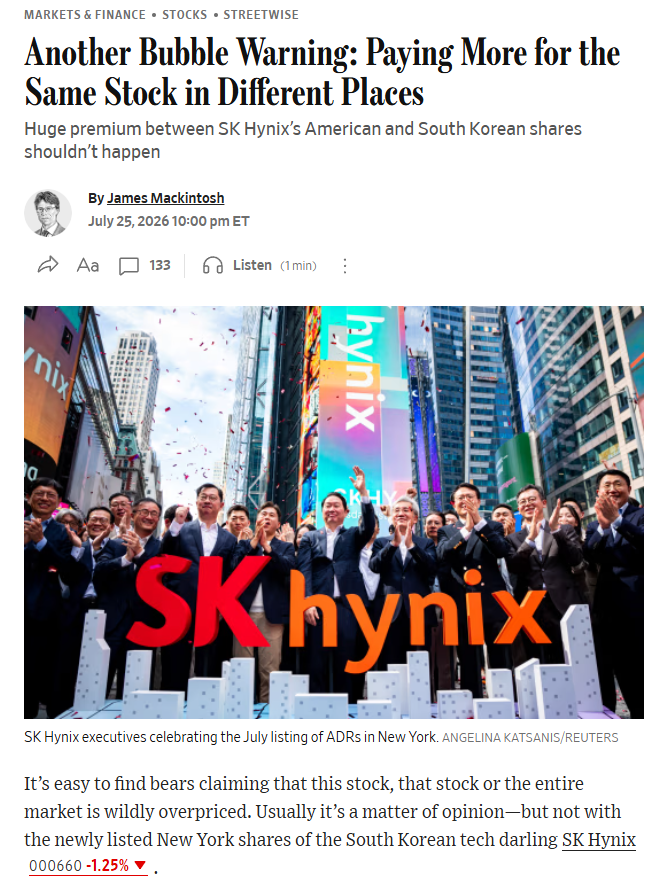
At the same time, investors are paying closer attention to the large premium of SK Hynix’s U.S.-traded ADR over its Korean-listed shares. This does not weaken the company’s HBM competitiveness, but it may increase short-term valuation and capital-flow volatility.
The three fundamental signals to watch are:
The actual size and duration of NVIDIA memory supply contracts
The pace of HBM4 customer qualification and mass-production shipments
Whether the ADR premium and foreign capital flows begin to stabilize
The market is currently trading two opposing forces at the same time: long-term HBM growth expectations and short-term valuation and positioning pressure.
② Technical Analysis
The stock is currently trading at approximately KRW 1,742,000.
On the 15-minute chart, SK Hynix has continued to form lower highs and lower lows since falling from around KRW 1,996,000, which means the broader short-term structure remains bearish.
The stock briefly dropped toward KRW 1.70 million before rebounding above KRW 1.74 million. Although some buying interest appeared near the lows, the current move still looks more like a technical rebound after a sharp decline than a confirmed trend reversal.
Using the decline from approximately KRW 1,996,000 to KRW 1,700,000 as the main Fibonacci range, the key retracement levels are:
0.236 retracement: approximately KRW 1,770,000
0.382 retracement: approximately KRW 1,813,000
0.5 retracement: approximately KRW 1,848,000
0.618 golden retracement: approximately KRW 1,883,000
0.786 deep retracement: approximately KRW 1,933,000
The stock remains below the first Fibonacci rebound level near KRW 1.77 million.
For the short-term structure to improve, the price first needs to recover KRW 1.76–1.78 million and then break above KRW 1.813 million.
The key price levels are:
Short-term support: KRW 1,700,000–1,720,000
Recent low support: KRW 1,680,000–1,690,000
Medium- to long-term core support: KRW 1,651,000
First resistance: KRW 1,760,000–1,780,000
Fibonacci 0.382 resistance: KRW 1,813,000
Fibonacci 0.5 resistance: KRW 1,848,000
Core trend resistance: KRW 1,883,000–1,933,000
Strong resistance: KRW 1,996,000
Long-term core resistance: KRW 2,180,000
If KRW 1.70–1.72 million holds and the stock recovers KRW 1.78 million, it could extend its technical rebound toward KRW 1.813 million and KRW 1.848 million.
However, the medium-term downtrend cannot be considered finished until the stock breaks above KRW 1.848–1.883 million with stronger volume and forms a higher low during the next pullback.
If KRW 1.70 million breaks decisively, the probability of another test of KRW 1.68 million and KRW 1.651 million will increase.
Good news and a good entry price are not the same thing.
The NVIDIA partnership strengthens the long-term industry thesis, but the current chart still shows that short-term capital remains cautious.
Rather than chasing the rebound after a sharp decline, it is more reasonable to watch whether real support develops near KRW 1.70 million, or whether the stock can recover KRW 1.78–1.813 million step by step.
Join our Telegram channel through the profile for more institutional analysis on Korean and U.S. stocks, key price levels, and chart updates.
This article reflects our institution’s market analysis and does not constitute investment advice. Avoid excessive leverage and maintain strict stop-loss and risk-management discipline.
July 27 Daily Market Brief
※ July 26is a Sunday, and both the Korean and U.S. stock markets are closed. The following update is based on the July 24 closing data and weekend developments reported on July 25–26.📈 Market Overview
🇰🇷 South Korean Market
· The KOSPI fell 5.72% to 6,690.62 last Friday, while the KOSDAQ declined 5.32% to 748.22. Sell-side sidecar mechanisms were triggered in both markets, showing that Korean equities remain in an extremely volatile environment.· Samsung Electronics dropped 7.59% to KRW 249,500, while SK Hynix fell 8.34% to KRW 1,759,000. Heavy selling in the two major semiconductor names was the main driver of the KOSPI decline.· This selloff should not be interpreted simply as a sudden deterioration in HBM demand or the fundamental outlook for Korea’s semiconductor industry.The more immediate pressures came from:→ Valuation compression
→ Heavy foreign and institutional selling
→ Deleveraging in single-stock leveraged ETFs
→ Weaker risk appetite caused by higher oil prices and global interest rates🇺🇸 U.S. Market
· The Dow Jones rose 0.46% to 51,947.25, the S&P 500 gained 0.05% to 7,411.98, while the Nasdaq fell 0.64% to 24,975.82.· Major U.S. indices were relatively stable, but semiconductor and AI-related stocks remained under pressure.The market is no longer asking whether AI demand exists.The real question is whether rapidly expanding AI capital expenditure can translate into revenue, earnings, free cash flow and acceptable returns on investment.· Oil prices retreated from their highs on Friday, providing some support to equities and bonds. However, oil, inflation expectations and long-term interest rates remain important variables for highly valued technology stocks this week.🏢 Major Corporate and Policy Developments
· Korean companies and major U.S. technology firms are reportedly pursuing semiconductor supply and production partnerships worth a combined $950 billion.The key components include:→ SK Hynix pursuing approximately $750 billion in memory-chip supply agreements with U.S. technology companies, including NVIDIA
→ Samsung Electronics pursuing approximately $200 billion in advanced-memory, foundry and related semiconductor cooperationThese weekend developments were not reflected in the July 24 Korean market close and could become major catalysts for Samsung Electronics, SK Hynix and their semiconductor supply chains this week.· The partnership announced by SK Group and NVIDIA is valued at more than $500 billion and includes the joint development of next-generation HBM and the construction of AI infrastructure in https://t.co/4NDgNH9SgF Telecom plans to build a 2GW AI data center using NVIDIA Vera Rubin chips and SK Hynix HBM4, with the first facility targeted to begin operations in 2027.· However, the announced figures may include a mixture of binding purchase contracts, long-term cooperation frameworks, memorandums of understanding and potential project ceilings.What matters for actual earnings is not the headline amount, but:→ Actual purchase volumes
→ Advance payments
→ Product mix
→ Execution timetable
→ Operating margins· South Korean financial regulators have raised the minimum cash deposit required for individual investors trading single-stock leveraged ETFs to KRW 30 million, with implementation brought forward to July 31.The measure may weaken speculative demand in the short term, but it could help reduce the extent to which leveraged ETFs amplify volatility in Samsung Electronics, SK Hynix and the KOSPI over the medium term.📅 Key Issues to Watch This Week
· The opening reaction in Samsung Electronics and SK HynixThe key issue is not whether the shares open sharply higher.Investors should watch whether the market can absorb the supply created by last Friday’s selloff and whether foreign investors continue buying both spot shares and index futures.A sharp gap-up followed by immediate selling would suggest that deleveraging is not yet complete.A pullback with weaker selling pressure and the formation of a higher low would represent a healthier recovery structure.· The contractual nature of the $950 billion partnershipThe market needs to distinguish between legally binding long-term purchase contracts, broad cooperation frameworks and potential five-year transaction ceilings.· Key price structures for Samsung Electronics and SK HynixSamsung Electronics first needs to stabilize above KRW 249,500 and gradually recover last Friday’s large bearish candle.For SK Hynix, the market should watch whether support develops around KRW 1,759,000 and whether the stock can break above its previous rebound high during the next recovery attempt.· Earnings from major U.S. technology companiesInvestors will continue to focus on cloud growth, AI capital expenditure, free cash flow and management commentary regarding the payback period for AI investments.Strong revenue growth alone is no longer enough.The market now wants evidence that AI investment is converting into sustainable profits.· The Federal Reserve, oil prices and U.S. Treasury yieldsMonetary-policy commentary, crude-oil prices and long-term bond yields could directly affect risk appetite for highly valued AI and semiconductor stocks such as NVIDIA, AMD, Samsung Electronics and SK https://t.co/X8b7OVUJOl View
The Korean market is likely to face two opposing forces this week:Improving fundamental expectations driven by large AI and semiconductor partnershipsversusOngoing leverage liquidation, profit-taking and overhead supply following last week’s sharp declineThe most important signal will not be the size of the opening rally.
What matters is whether selling pressure fades after the positive news is priced in, whether foreign investors continue absorbing supply, and whether Samsung Electronics and SK Hynix can form higher lows.※ This material is provided for informational purposes only and does not constitute investment advice. Avoid chasing news-driven rallies, and maintain disciplined stop-loss and risk-control rules.
The SOMO Community Sale is now closed!
We’re excited to welcome all those who participated into the SOMO Universe.
This is the beginning of the SOMOs’ journey across all entertainment. We can’t wait to reveal more about the upcoming SOMO game… and so much more.