API data is out
Oil +2.69 mil (analysts expected -2 mil)
Gasoline +156k
Distillates -1.2 mil
Cushing +2.358 mil
SPR actual -2.9 mil
Total crude draw -0.21mil barrels
I fear one of my beloved follows is going crazy after listening 6 month of fake news and crazy market moves.
Get well soon my friend :-) I feel ya. Iced coffee is the best cure
The market capitalization of all U.S. stocks is approaching $80 trillion, roughly 2.5X U.S. GDP ($32 trillion) and equal to half of the market cap of the entire world. Never seen before. The percentage of tech as a share of the S&P market cap is over 50%, also a record
May not be a big deal but US refiners who run nearly 2.4-mbd of crude saw a cluster of weekend events, including flaring and leaks. Five plants in Texas and the BP refinery in Whiting, IN are among those with operational issues.
There are two reasons saving is so high, Gita. One, as you noted, is precautionary saving. With the economy slowing and employment uncertainty rising, that is hardly surprising. The standard IMF and World Bank recommendation is to strengthen the social safety net., but even if Beijing were to introduce Scandinavian-style welfare provisions tomorrow, the credibility of the system is so low that it would take many years, perhaps even decades, before household saving behavior changed materially. We saw this last year with the pension reforms. Very few workers chose to contribute to the new system because, they argued, they were unlikely ever to receive the promised benefits.
The more important reason for China's exceptionally high saving, however, is simply the extraordinarily low household share of GDP. Households must receive, directly or indirectly, a much larger share of what they produce. There are essentially two ways to accomplish this, but each comes with its own costs.
The sustainable solution is to redistribute income from businesses and governments to households. This can be done in many ways: raising wages, appreciating the currency, increasing deposit rates, eliminating the hukou system, strengthening labor protections, and so on. But none of these change can possible happen quickly enough to matter to China's trade partners, and, as you point out, none of these policies is painless. They would almost certainly slow growth by reducing the profitability of manufacturers that are already struggling to earn returns.
The alternative, and the one you seem to prefer, is to increase fiscal transfers to households without reducing the fiscal support that currently subsidizes investment in manufacturing and infrastructure.
That might have been a reasonable proposal fifteen years ago, or perhaps even ten, but China already has one of the highest debt burdens in the world relative to GDP (second only to Japan's) and by far the fastest-growing. To argue that China should postpone a difficult but necessary adjustment by allowing debt to grow even faster strikes me as a poor recommendation in light of the historical evidence.
The fundamental point is that China's low consumption share is not a temporary weakness but a structural feature of its growth model, and one that has been central to the explosive expansion of its share of global manufacturing. It took Japan eighteen years, from 1991 to 2008, to raise its consumption share of GDP by just ten percentage points, even though Japan began with smaller domestic imbalances and far lower debt levels than China has today. Even if China achieved the same adjustment, its consumption share of GDP would still remain exceptionally low.
During those eighteen years, however, Japan's GDP growth averaged well below 1%. What is less widely remembered is that Japan's share of global manufacturing fell by more than half over the same period. That was no coincidence. Then, as now in China, manufacturing competitiveness depended in large part on the systematic transfer of resources, directly and indirectly, from households to producers and investment.
It seems to me that you want to propose a way for China to enjoy the benefits of a profound structural transformation in its economy without bearing any of the associated costs, by relying on an even faster increase in an already alarming debt burden. This, among other cases, is essentially what Brazil and the Soviet Union attempted in the 1970s, and Japan in the 1980s. In every case, postponing the adjustment only ensured that it became much more difficult later.
My final point is a practical one. There are many precedents for the European Union demanding that large external imbalances be addressed through exchange-rate adjustment. There are almost none for demanding that a trading partner eliminate the hukou system, transform its social welfare system, raise wages, strengthen labor unions, liberalize interest rates, or undertake any number of other politically difficult domestic reforms quickly enough to matter for Europe's economy.
I do not think anyone, including Brad Setser, is arguing that currency appreciation is the only way to resolve China's domestic imbalances, or even necessarily the best way. It may, however, be one of the very few adjustment mechanisms that China's trading partners can realistically expect Beijing to implement within a timeframe that matters to them.
BREAKING: Iran announces it will strike the world's most important energy facilities, located in Arab countries and Israel, all within range of Iran's precision missiles, in response to any new US and Israeli strikes, per Fars:
1. Ghawar Oil Field, Saudi Arabia, backbone of Saudi production, disruption puts 5%+ of world oil supply at risk
2. Abqaiq + Khurais, Saudi Arabia, 7M+ bpd throughput, world's largest oil stabilization plant
3. Ruways Refinery + Zakum Oil Field, UAE, 2nd largest offshore oil field, 1M+ bpd
4. North Ghadir Gas Field + Ras Laffan LNG, Qatar, world's largest gas field with 25% of proven reserves, 20% of global LNG trade
5. Burgan Oil Field, Kuwait, 67B barrel reserves, 2M bpd
6. Sitrah Refinery + Al-Mihaj, Bahrain
7. Leviathan + Tamar Gas Fields, Israel, Israel's largest + 2nd largest gas fields
Iran adds that during the 40-day war Iran bombed Qatar's most important gas refinery in response to a strike on South Pars facilities, with Trump apologizing on Truth social promising "it will not happen again."
..@ShahinVallee & @Brad_Setser, always good to hear your arguments. Just to clarify, we certainly do not say that the exchange rate does not matter. In fact, we actually spell out how an ER change can reduce China's surplus in the short-run, all else equal. It does however matter what is generating the ER appreciation to determine the full effect. I think we agree on several things: (1) underlying macro-policies are critical drivers. (2) Without fixing those there is no durable shift in the external balance. (3) I think we agree on what those macro-policies are. Where we have a difference of views: (1) Insisting on a currency appreciation in a country (China) facing deflationary pressures: In our view, unlike yours, this will do little to increase demand for foreign goods (direct +indirect effects) and could even worsen it. (2) Forcing a yuan appreciation is what will get China to do the right thing on domestic policies. You believe this is the case. We don't see this working even if we agree that China has been frustratingly slow in adjusting course (+ the nominal appreciation does not deliver what is needed.) As we also make clear, none of this gets China off-the-hook. We are certainly not saying that adjustment has to come primarily from deficit countries (US) through tight fiscal, or that China has an open capital market that determines FX. Moreover, the macro policies that need to be implemented are in the self-interest of countries so there should be no need for 'coordination.' Imbalances or not, these countries would benefit from addressing domestic distortions.@helene_rey@pogourinchas
I hope that one day the world will understand that the QE experiment has not only created one of the largest wealth redistributions in history.
From the Poor to the Rich.
It has also contributed to the emergence of an elite of billionaires (small-minded and insecure) so powerful that they can influence politics and geopolitics on a scale we have never seen before.
That is dangerous!
All in all, QE has done immense harm to our societies - in a desperate attempt to "save the markets."
But will the Public ever understand the connection....?
Sigh!
🇪🇸 UNBELIEVABLE SCENES out of CEUTA!
Spain’s Civil Guard chief just admitted the border has completely collapsed.
Thousands of military-aged African men flooded across in a matter of hours, immediately after the government offered amnesty to illegals.
Amnesty is a magnet. The message goes out, and the flood begins.
Every country that does this ends up in the same place.
Writer: Oliver
Die spanische Exklave Ceuta wird derzeit überrannt: Bereits mehr als 1.500 Migranten, vorwiegend aus Marokko und Algerien, gelangten in kürzester Zeit in die EU. Ihr Ziel dürfte mutmaßlich Deutschland sein. Grenzen müssen jetzt geschlossen und Abweisungen rigoros durchgesetzt werden. 2015 darf sich nicht wiederholen! https://t.co/yTak4BuNBi
Freaken spot on $GOOGL $MSFT $AMZN
"This is the third earnings report this week where Anthropic paper gains did the heavy lifting on the headline number. Alphabet, Microsoft, and now Amazon all booked billions from the same investment. Remove those gains across all three and the operating picture looks a lot less impressive. I think investors are going to start discounting those gains the same way they learned to discount stock-based compensation a decade ago, because unrealized markups don't service debt or cover capex."
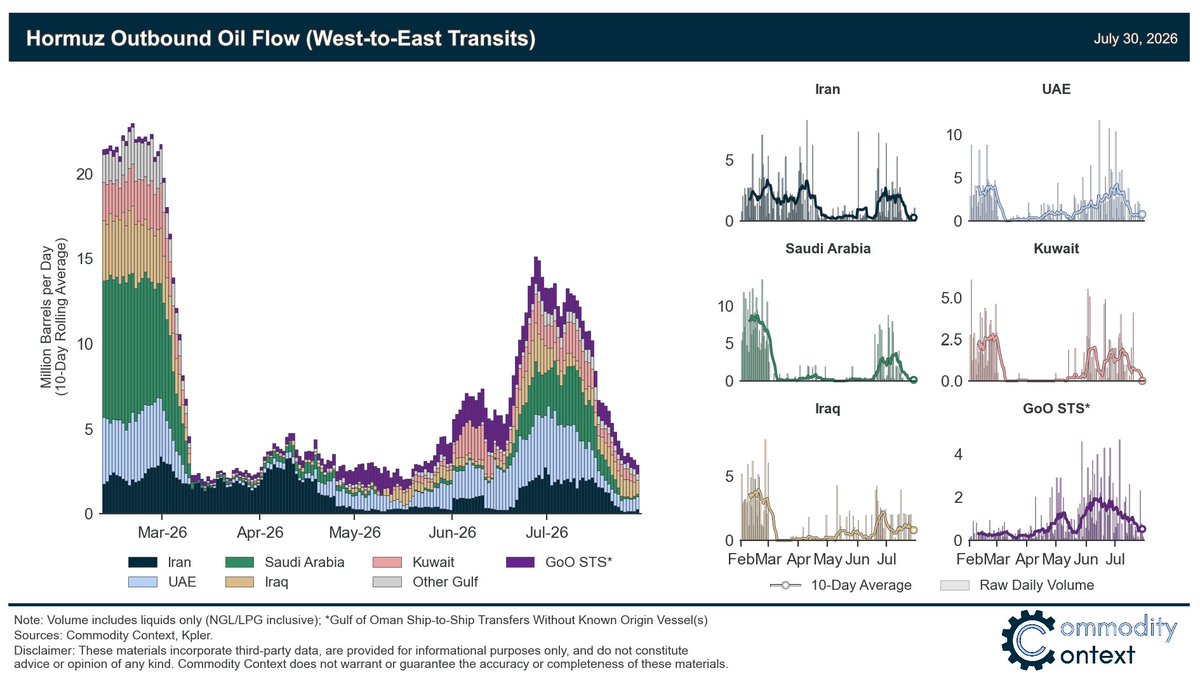
10-day average Hormuz-exiting oil flow has fallen below 3 MMbpd.
That's down ~80% from late June's peak of more than 15 MMbpd.
Feels silly to say five months into this, but that's not enough oil.
Europe gets cornered by the"big ally"... First Nordstream I & II, now this. Europe needs to defend its own interest especially energy interests...by military force
Yes 100% and that was clear since day one of this war. But everyone on Wallstreet has a "peace bias" #PeaceBias and mock the "doomsayers".
Wallstreet will be irrelevant sooner than later.
JEFF CURRIE: GIVE IRAN THE STRAIT AND THE DOLLAR DIES
Jeff Currie, former Goldman Sachs head of commodities and lifelong insider of the dollar system, just laid out the one line America cannot cross. Handing control of the Strait of Hormuz to Iran is not a tactical retreat. It is the formal end of the United States as global hegemon and the death of the dollar as the world’s reserve currency.
THE GRAND BARGAIN THAT BUILT THE SYSTEM
➡️ In 1945 the United States made a deal the world still lives under: we protect every major shipping lane with our navy so you use our dollar and recycle your money through New York.
➡️ Oil was the strategic commodity that made the bargain stick.
➡️ After Nixon broke the gold link in 1971 the same bargain became the petrodollar system that still funds American living standards today.
THE HORMUZ RED LINE
➡️ Currie is blunt: if the United States walks away and lets Iran and Oman manage the strait under any fee structure, the rest of the planet sees the protector has quit.
➡️ Every other chokepoint on earth immediately becomes fair game.
➡️ The Fifth Fleet would then need Iranian permission to enter or leave its own base in Bahrain—an image that ends the illusion of sea control overnight.
THE EXORBITANT PRIVILEGE AT RISK
➡️ Currie points to Switzerland right now: a 30-year fixed mortgage at 50 basis points because global capital floods into a safe currency.
➡️ That is the privilege America still enjoys.
➡️ The United States currently spends 7 percent more than it produces. Remove the forced global demand for dollars and that gap becomes pure economic pain.
THE HISTORICAL TRUTH NO ONE WANTS TO SAY
➡️ No previous hegemon—Britain, Spain, or any other—was forced out of the world’s most important sea lanes and remained the hegemon.
➡️ Currie is clear: you can retreat to the Monroe Doctrine and defend only the Western Hemisphere, but then you are no longer the global power and the dollar is no longer the reserve currency.
➡️ Those two outcomes cannot coexist.
THE BOTTOM LINE
America can lose battles. It cannot lose the Strait of Hormuz and still claim to run the system that has defined the last eighty years.
Once the world sees the United States no longer guarantees free navigation, the privilege that keeps the American consumer alive begins its irreversible decline.
#HormuzRedLine #DollarHegemony #JeffCurrie #Petrodollar #USHegemony #StraitOfHormuz #ReserveCurrency
HT: YouTube Mario Nafwal
@GavMcCracken you are almost too late for that. I work for an global OEM and we had motor oil supply issues already on the heatmap since April. Shell notified us in May that they won't deliver. So I made my oil check and renewed it by June