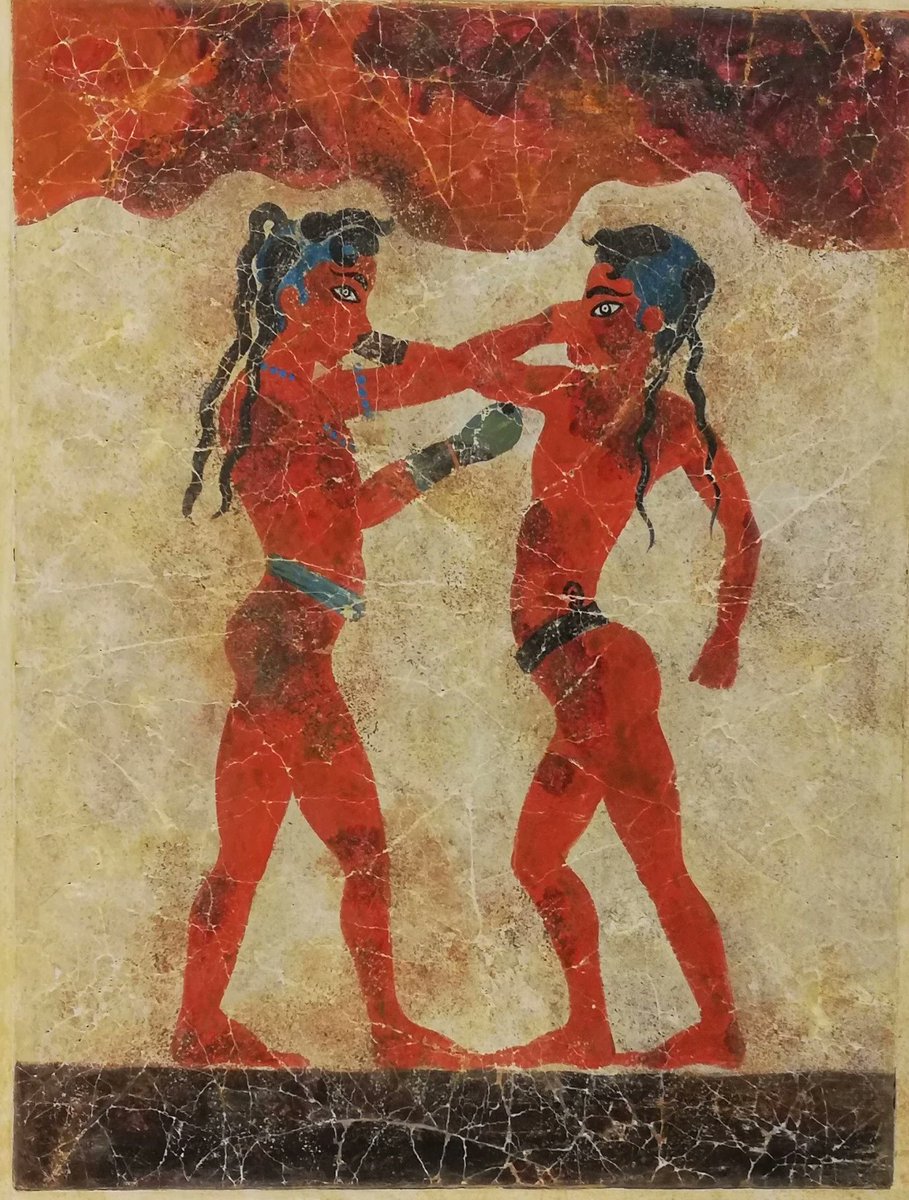
Akrotiri Boxer Fresco (1700 BC); one of the Wall Paintings of Thera and a leading example of Minoan painting. It is a fresco depicting two young boys wearing boxing gloves and belts. It was discovered in 1967. Akrotiri Boxer Fresco may have been the first example of a sports-related deformity ever recorded. According to a medical writer, young boy on right appears to have spondylolisthesis. But the anatomy in Minoan painting is often not very realistic.
Minoans practised several sports including wrestling, bull jumping, acrobatics, and of course: boxing. This is apparent in multiple pieces of art, ranging from other frescoes, such as the Bull-Leaping Fresco, to pottery. The youth of the boys in the Akrotiri Boxer Fresco hints that athletes began training very early on in life, suggesting that sports were extremely important to Minoan society. It has even been suggested that athletics played a religious role in society due to their widespread practice.
The youth of athletes in many pieces of artwork indicates that athletic competition may have been a rite of passage into adulthood for Minoans. Although there is much scholarly debate as to whether or not the gloves that the boys are wearing were meant to provide protection for the bones of the wearer or increase the amount of damage inflicted on the opponent, it is clear that except gloves, jewellery and belts, competitors wore as little as possible. Due to simplicity of the sport, it is quite possible that boxing was created as a means to settle disputes and eventually evolved into an athletic competition.
To achieve such vibrant colouration there are several techniques possible. In buon fresco, commonly known from Renaissance art, lime plaster was applied to walls and then painted over while wet with colourful paint. In Minoan art, frescos often employed another technique as well known as fresco-secco. After the plaster and paint dried, extra paint was sometimes used to add details and would be applied with a binding agent. Some frescos are entirely created using this technique. Most common colours used in frescoes were green, blue, yellow, white, red, and black, all of which were derived from minerals and later fixed with organic material. Advanced geometric patterns suggest the usage of mechanical tools to improve the accuracy of the designs as well as a grid system for proportionality. As is common in other forms of Greek art such as pottery, male skin is generally painted red while females tend to be portrayed as white. In Akrotiri Boxer Fresco, the youths' red skin suggests their gender while their partially shaved heads indicate that they are still children.
Around 1600 BC, a disastrous earthquake, followed by a volcanic eruption on the island of Thera, now known as Santorini, was one of the largest Plinian eruptions in the past 10,000 years, with a range of 30–40 cubic kilometres. An eruption of this size would have most likely generated a tsunami over 100ft tall, travelling across the Aegean Sea and decimating populations in its path. The size of this eruption had far-reaching impacts on the environment and civilisation in the region, primarily the Minoans. Thick layer of pumice and ash from the volcano covered the island and preserved much of the alienation for thousands of years. As a result, several pieces of Minoan artwork, primarily the frescoes, were preserved as fragments in rubble and have been reassembled by archaeologists. These frescoes provide modern society with invaluable insight into the daily lives of Cycladic people.
#archaeohistories
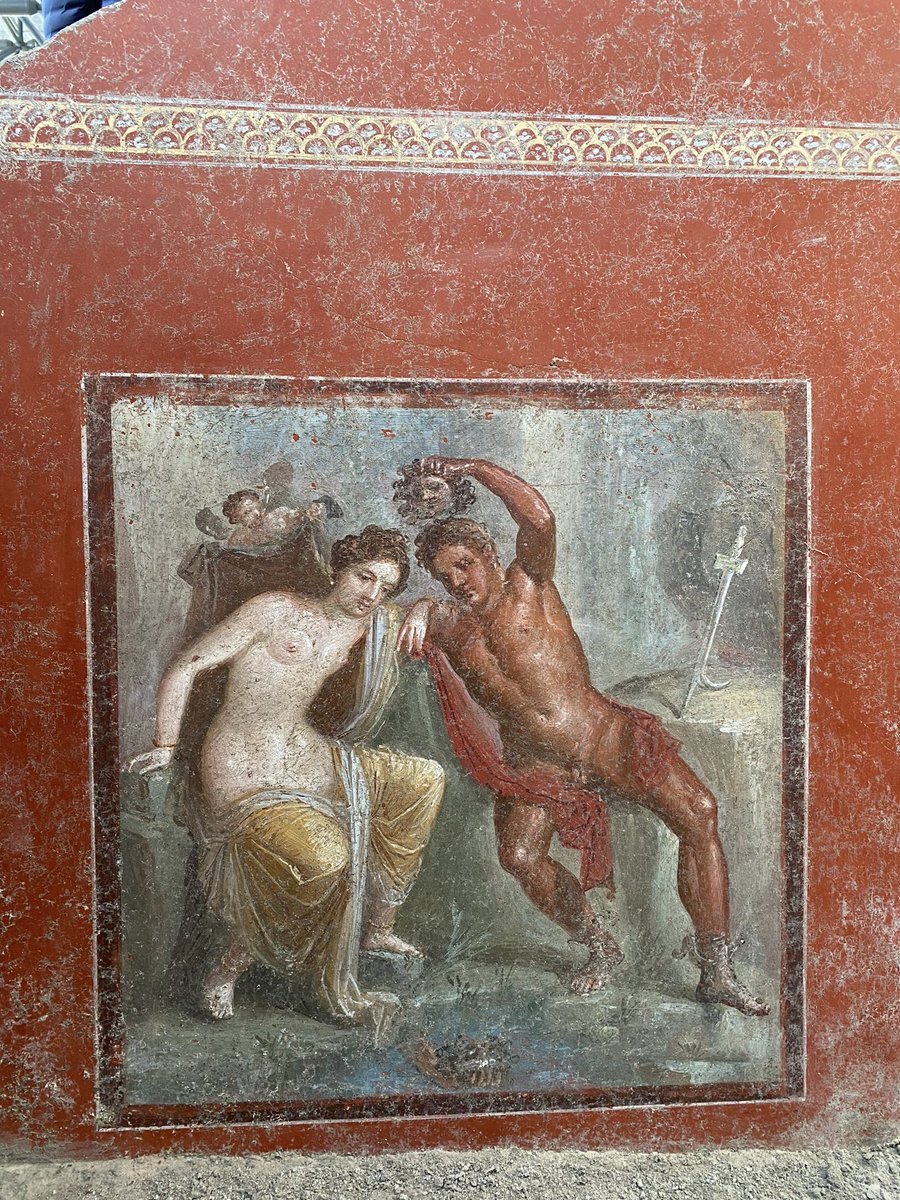
In Greek mythology, Medusa or Gorgon, was one of three Gorgons. Medusa is generally described as a woman with living snakes in place of hair; her appearance was so hideous that anyone who looked upon her was turned to stone. Medusa and her Gorgon sisters Euryale and Stheno were usually described as daughters of Phorcys and Ceto; of three, only Medusa was mortal.
In most versions of story, Medusa was beheaded by hero Perseus, who was sent to fetch her head by King Polydectes of Seriphus because Polydectes wanted to marry Perseus's mother. The gods were well aware of this, and Perseus received help. He received a mirrored shield from Athena, sandals with gold wings from Hermes, a sword from Hephaestus and Hades's helm of invisibility. Since Medusa was the only one of the three Gorgons who was mortal, Perseus was able to slay her; he did so while looking at the reflection from the mirrored shield he received from Athena. During that time, Medusa was pregnant by Poseidon. When Perseus beheaded her, Pegasus, a winged horse, and Chrysaor, a giant wielding a golden sword, sprang from her body.
Jane Ellen Harrison argues that "her potency only begins when her head is severed, and that potency resides in the head; she is in a word a mask with a body later appended... the basis of the Gorgoneion is a cultus object, a ritual mask misunderstood."
According to Ovid, in northwest Africa, Perseus flew past the Titan Atlas, who stood holding the sky aloft, and transformed Atlas into a stone when Atlas tried to attack him. In a similar manner, the corals of the Red Sea were said to have been formed of Medusa's blood spilled onto seaweed when Perseus laid down the petrifying head beside the shore during his short stay in Ethiopia where he saved and wed his future wife, the lovely princess Andromeda, who was the most beautiful woman in the world at that time. Furthermore, venomous vipers of Sahara, in Argonautica 4.1515, Ovid's Metamorphoses 4.770 and Lucan's Pharsalia 9.820, were said to have grown from spilt drops of her blood. The blood of Medusa also spawned the Amphisbaena (a horned dragon-like creature with a snake-headed tail).
Perseus then flew to Seriphos, where his mother was being forced into marriage with the king, Polydectes, who was turned into stone by the head. Then Perseus gave the Gorgon's head to Athena, who placed it on her shield, Aegis. While ancient Greek vase-painters and relief carvers imagined Medusa and her sisters as having monstrous form, sculptors and vase-painters of 5th Century BC began to envisage her as being beautiful as well as terrifying. In an ode written in 490 BC, Pindar already speaks of "fair-cheeked Medusa".
In a late version of Medusa myth, by the Roman poet Ovid, Medusa was originally a beautiful maiden, but when Neptune (Roman equivalent of Greek Poseidon) mated with her in Minerva's temple (Minerva being Roman equivalent of Greek Athena), Minerva punished Medusa by transforming her beautiful hair into horrible snakes. Although no earlier versions mention this, ancient depictions of Medusa as a beautiful maiden instead of a horrid monster predate Ovid.
In classical Greek art, depiction of Medusa shifted from hideous beast to an attractive young woman, both aggressor and victim, a tragic figure in her death. Earliest of those depictions comes courtesy of Polygnotus, who drew Medusa as a comely woman sleeping peacefully as Perseus beheads her. As the act of killing a beautiful maiden in her sleep is rather unheroic, it is not clear whether those vases are meant to elicit sympathy for Medusa's fate, or to mock the traditional hero.
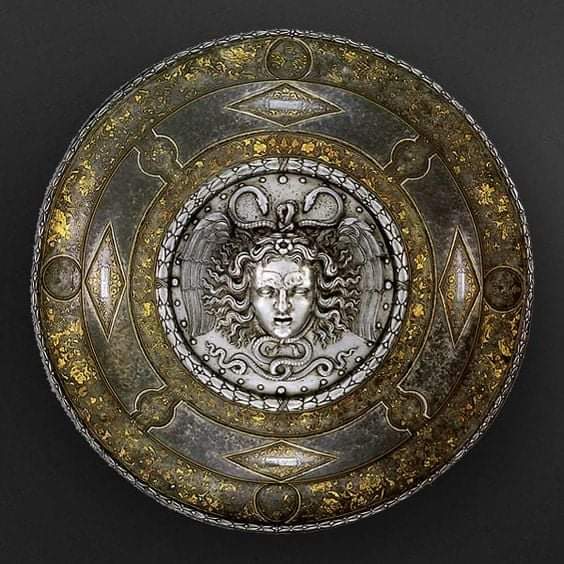
📷 : Medusa shield was a symbol of protection in classical art and mythology. This particular shield was created for Emperor Charles V by Negroli brothers in Milan in 1541 CE. Medusa motif on shield was meant to protect wearer and also to represent enemies of Rome and Holy Roman Empire who had been defeated.
#archaeohistories
The Minoan Snake Goddesses of Bronze Age Crete (1700 BC) stand as enduring symbols of a sophisticated, female-centered civilization that thrived long before classical Greece and was later overshadowed by its patriarchal successors. These iconic priestesses, depicted in elaborate frescoes and faience figurines with bare chests, flounced skirts, and serpents coiled in their hands, were far more than religious figures. They embodied a matriarchal power structure where women likely held high authority in trade, governance, and spiritual life, guiding one of the most advanced societies of ancient Europe.
The Minoan civilization, centered at palatial complexes like Knossos and Phaistos, operated a vast maritime network that connected them with Egypt, Mesopotamia, and the Levant. Archaeological evidence suggests that women played a leading role not just in religious rites but in economic and diplomatic affairs. Female figures dominate Minoan art, often shown larger than males or in central, commanding poses—interpreted by many scholars as an indication of female political authority. Some have even proposed that the ruling elite may have included high priestess-queens, a fusion of sacred and secular leadership, as seen in other ancient cultures like Sumer.
The Snake Goddess herself was more than symbolic. In Minoan cosmology, snakes represented fertility, renewal, and divine wisdom—creatures that moved between the underworld and the world of the living. The priestesses who handled them were believed to channel the chthonic powers of the earth, serving as intermediaries between the human realm and the divine. Their temples featured labyrinthine designs, sacred groves, and open-air altars, all emphasizing nature’s role in their worship—another clue to the eco-spiritual balance that characterized Minoan belief systems.
Minoan society was likely not a matriarchy in the modern sense, but it appears to have been far more gender-balanced—and possibly matrilineal—than the Mycenaean culture that later absorbed and replaced it. With the rise of Mycenaean Greece around 1450 BC, and especially after the Santorini eruption disrupted Cretan society, Snake Goddesses and their world began to vanish. The Mycenaeans brought with them male-dominated warrior culture, a pantheon of Olympian gods, and a writing system (Linear B) that made no mention of the powerful priestesses once central to Cretan life.
The Snake Goddesses faded from memory, their figurines buried under volcanic ash and forgotten until modern archaeologists like Sir Arthur Evans unearthed them in the early 20th Century. But even then, their significance was minimized—reduced to exotic curiosities or “fertility idols” rather than acknowledged as evidence of a powerful female religious and administrative class. Western scholars, shaped by their own patriarchal assumptions, often struggled to imagine a civilization where women might have ruled trade routes or mediated diplomatic affairs.
Only recently has the academic tide begun to shift, with feminist archaeologists and anthropologists reevaluating the rich visual and material culture of Minoan Crete. The Snake Goddesses are now seen not just as remnants of a bygone faith, but as emblems of a lost societal model—one where leadership was shared, spirituality was earth-centered, and women shaped the destiny of an entire civilization.
Their story challenges us to reconsider the arc of history—not as an inevitable march toward male-dominated empire, but as a tapestry of alternative paths, some led by women whose voices and power once radiated across the Aegean Sea.
#archaeohistories
The Sphinx of Naxos is an ancient Greek marble statue depicting a sphinx, with the body of a lion, the wings of a bird, and the head of a woman. It was carved around 560 BC during the Archaic period and was dedicated by the people of Naxos to the sanctuary of Apollo at Delphi.
The statue originally stood atop an Ionic column over 12 meters high. The statue was discovered in 1860 during excavations at Delphi conducted by French archaeologists. The statue was found in fragments but restored, and is now housed in the Delphi Archaeological Museum in Greece. It measures about 2.2 meters in height and displays features such as a rigid stance, elaborate wings extending from its back, and a detailed female face framed by patterned hair.
#archaeohistories
Minoan Lady Fresco (17th Century BC), from Room 1 of the House of the Ladies in Akrotiri/Thera, today's island of Santorini, Greece. The several women depicted on the walls of the room wear typical Minoan dress. Above the women is a representation of a starry sky.
Remains loyalty 'to the original symbols, shapes and coloring. This enchanting fresco is of incredible beauty, a perfect balance of shapes, colors and proportions. The young woman appears well cared for, both in appearance and in her garments, which may look elegant even current clothing.
A soft skirt flow with ease, combined with a short bolero that leaves the breasts uncovered. The skirt decoration, reveals the longitudinal reasons, that specularly, pointing downwards, to symbolize the "V" of the female pubis. Decoration "V" which is also found in the arrangement of the leaves of the two branches of the two flowers, which appear to represent, being lilies (lilium, which also means "bow," she who joins from one life) in the form of the corolla, a female uterus, with lateral volutes curled downward and inward.
The two colors of flowers, white and red, symbolic of the purity and fertility in the menstrual blood. Young woman is taking its red flower, and below of this, there is just a large patch of red, which indicates that she probably she entered adulthood with her first menstrual blood loss. Behind her, in the longitudinal direction, it is easily recognized the Milky Way, the blue stripe studded with golden dots.
And, behind him, beyond the Milky Way, a decoration on golden background and solar, a grid form of lozenges, diamond shapes that recall symbolically, the female vagina, the beginning of creation in general, since it is a grid formed by longitudinal and transverse lines, then opposite, male and female, that at each "intersection", at each meeting point, are marked with an additional decorative element in the shape of rhombus. The sublimation of the Feminine Principle in a work of extraordinary beauty and refinement.
Art historian Christopher L. C. E. Witcombe points out there is plenty of archaeological evidence to indicate that women occupied an important if not dominant position within the practice of Minoan religion and possibly the entire society as well. In scenes of ritual worship, women appear to dominate the proceedings and far outnumber male priests and attendants.
"Moreover men are rarely seen in commanding positions, despite attempts to identify them in such positions," Witcombe says. "Even the lifesize male figure in the reconstructed frescoed stucco relief at Knossos which Evans identified as the "Priest-King" is now believed to be made up of fragments of several different figures. The only thing that seems relatively certain is that one or more of the figures was male."
He also observes that typical evidence of a male-dominated society in the second millennium including walled citadels, fortifications, temples to gods, large public sculpture and boastful inscriptions are essentially absent.
When Sir Arthur Evans found fragments of faïence figurines, one which he dubbed the "snake goddess," in 1903, he asserted it was clear from the evidence that the Minoan religion was based on a dominant goddess of fertility just as described by James Frazer in his text "The Golden Bough" that had been published in 1890.
"Part of the attraction of the figurines is that they can be interpreted as embodying many of the perceived, and admired, characteristics of the Minoans: their elegant, fashionable costumes, their physical gracefulness, their sensitive yet forthright personalities, their sophisticated tastes and love of luxury, their refined manners and worldly ways, their seemingly high intelligence combined with an endearing forthright innocence, and their apparent love of beauty, nature, and peace," says Witcombe.
📷 : Reconstruction based on the Original fresco, preserved at Museum of Prehistoric Thera, Santorini.
#archaeohistories
The Great Colonnade of Apamea in Syria, is one of most remarkable remnants of Roman architecture in the Middle East.
Stretching over 2km, this grand avenue once served as the main thoroughfare of Apamea, a prominent city founded in 3rd Century BC. Its colonnades, adorned with intricate Corinthian capitals and decorative reliefs, reflect the city’s wealth and importance during Roman and Byzantine eras.
The avenue was lined with shops, public buildings, and statues, making it a bustling hub of activity. Despite damage from earthquakes and time, the site remains a stunning example of ancient urban design.
#archaeohistories
One of the most intriguing stories from Sumerian mythology centers around Enki, the god of wisdom, and Ninhursag, the goddess of fertility and healing. Their complex relationship illustrates themes of divine love, sexuality, and the constant balance of conflict and reconciliation in the mythological world. Enki’s intense curiosity and passionate nature led him to engage in multiple unions with Ninhursag, resulting in the birth of several deities. Their connection, filled with both affection and tension, reflects the ancient Mesopotamian theme of creation and destruction as a natural and intertwined force.
A significant part of their myth involves Enki consuming forbidden plants, which causes him to suffer from a series of ailments that afflict different parts of his body. This transgression provokes Ninhursag’s anger, cursing him with debilitating illness. His suffering symbolizes the consequences of his actions and highlights the vulnerability of even divine beings, such as the gods. The curse on Enki serves as a reminder that the gods were not above the natural laws, and even their desires could lead to unforeseen consequences.
The resolution of Enki’s affliction occurs when the other gods, seeing his suffering, plead with Ninhursag to heal him. Moved by their pleas and possibly her enduring love for Enki, Ninhursag eventually agrees. She restores him by giving birth to new deities, each tasked with curing a specific ailment that Enki had suffered. This act of healing not only rejuvenates Enki but also underscores the regenerative power of creation, demonstrating the deep connection between sexuality, love, and divine creativity in Sumerian mythology. The story encapsulates themes of healing, punishment, and restoration, reflecting the dynamic relationships between the gods and their cosmic roles.
📷 : modern representation use as a reference....
#archaeohistories
A 1st Century BC, Roman Intaglio Ring, made from carnelian, is a small but highly detailed work of art...
The depiction of a dwarf killing a grasshopper is a specific and somewhat enigmatic motif. While the exact meaning is open to interpretation, it likely carries a symbolic message related to triumph or the overcoming of a minor nuisance. In Roman culture, dwarfs were often depicted in a satirical or comedic light, but they were also a source of fascination. The grasshopper, in some contexts, could symbolize a plague, a pest, or a minor irritant. The image may therefore be a playful or humorous representation of overcoming a small but annoying problem.
The ring's material, carnelian, was a popular choice for intaglios due to its beautiful reddish-orange color and durability. Its semi-translucent quality gives the carving a rich depth when viewed in light. Dating from the Roman Republican Period (1st century BC), the ring is a valuable piece of historical evidence, offering a glimpse into the tastes, humor, and daily life of the Roman elite. It is currently held in the collection of the Museum of Fine Arts (MFA) in Boston.
#archaeohistories
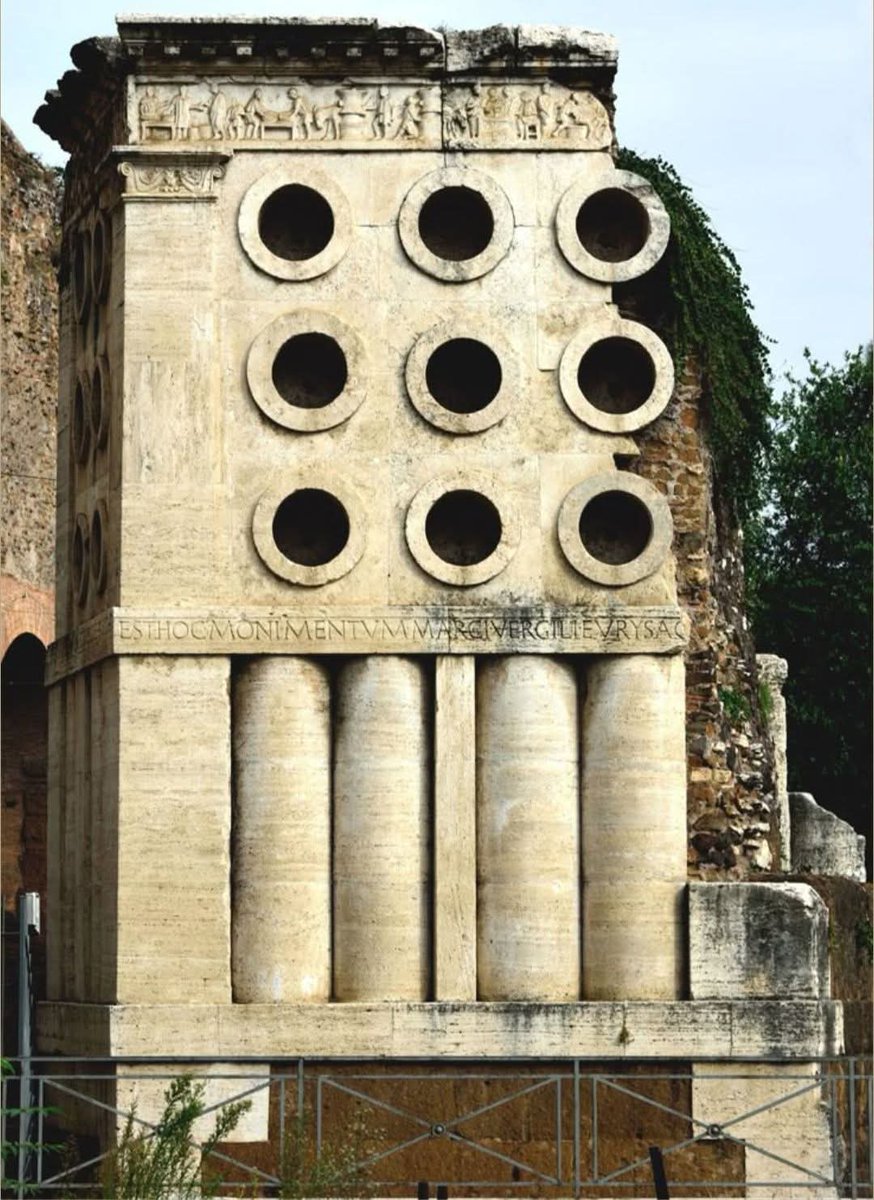
The tomb of Marcus Vergilius Eurysaces, a former slave who became a wealthy baker in ancient Rome. He died in 1st Century AD, and left us an enormous reminder of himself and his wife, Atistia: one of the largest and best-preserved funerary monuments, just outside today's Porta Maggiore in Rome.
The tomb is a large, cylindrical structure with distinctive, circular openings on its sides. These openings are thought to symbolize grain measures used in his bakery.
The most notable feature is the elaborate sculpted frieze along its upper sections, which shows the entire bread-making process, from grinding grain to baking and selling loaves.
#drthehistories
📣#AVVISO⚠️
Dal 1° settembre il piano terra del @MuseoCalatia sarà temporaneamente chiuso per lavori di manutenzione straordinaria e riallestimento finanziati con fondi PNRR.
L’intervento punta a rendere il museo più accessibile e inclusivo.
Sui nostri canali gli aggiornamenti.
Avete mai visitato i #MuseiNazionaliCagliari? Da lunedì a domenica 8:30-19:30, e sabato 30 agosto fino alle 23, potete visitare MuseoArcheologico con le sue importanti raccolte e Pinacoteca con la collezione pittorica dal 15°sec.
Riconoscete questa statua unica?🧐
#iconici