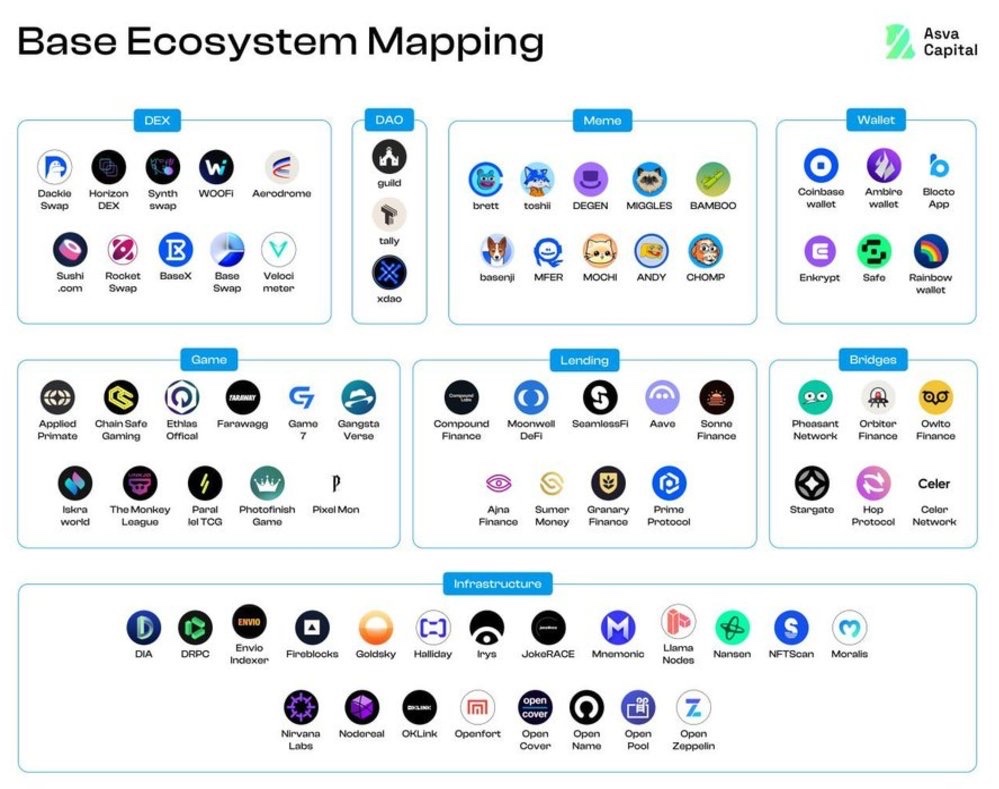
$12.3 billion in TVL, @AerodromeFi driving $16.5 billion in monthly trading volume, and @alkimiya_io transforming gas fees into profitable opportunities.
This isn’t just growth—it’s the future of DeFi in action on @Base. 🧵
Funding rates have quietly become their own asset class.
A year ago, traders asked “Where is funding highest?”
Today the question is “Who captures the funding?”
The answer increasingly sits across three layers.
1. Funding Creation
Hyperliquid.
2. Funding Aggregation
Ethena.
3. Funding Distribution
GMX.
⸻
@HyperliquidX is where funding gets created.
With $9B+ open interest and more than $7B in daily volume, it has become the primary funding-rate marketplace in crypto.
The interesting part is that Hyperliquid benefits regardless of direction.
Negative funding.
Positive funding.
Crowded positioning.
More volume means:
▸ more funding transfers
▸ more liquidations
▸ more fee generation
The venue monetizes activity itself.
⸻
@ethena sits one layer higher.
Hyperliquid creates funding.
Ethena packages it.
The original model was simple:
Long spot.
Short perps.
Collect funding.
But the structure is evolving.
Perpetual futures now represent only a small portion of reserves relative to earlier phases.
Ethena is gradually diversifying toward multiple yield sources.
That tells you something important:
The largest funding-rate protocol in crypto is already preparing for a lower-funding future.
⸻
@GMX_IO monetizes funding differently.
Hyperliquid focuses on trading.
Ethena focuses on aggregation.
GMX focuses on distribution.
Instead of harvesting funding directly, it routes funding economics toward liquidity providers through its vault architecture.
Market imbalance becomes LP yield.
The result is a different carry profile entirely.
⸻
The bigger development is what all three reveal.
Funding is no longer just a trader payout.
It has become a standalone financial layer.
One protocol creates it.
One protocol packages it.
One protocol distributes it.
The next phase of the perp market may not be defined by leverage.
It may be defined by who captures the economics generated by that leverage.
Hyperliquid is not a perp DEX anymore.
It is the first vertically integrated onchain trading stack.
Most people still haven’t internalized what that means for capital flows.
Here’s the architecture:
Each HIP is not a feature drop. It’s a deliberate layer of the stack:
- HIP-1: Native token standard + spot order books. Tokens live and trade natively onchain.
- HIP-2: Automated liquidity mechanism embedded directly into HyperCore. Solves the cold-start problem for new token launches without external bootstrapping.
- HIP-3: Perpetual futures deployment made permissionless for any qualified builder who meets the staking requirement.
- HIP-4: Outcome contracts launched on mainnet May 2, 2026. Fully collateralized prediction markets, same account as your perps and spot.
This is not a feature dump.
It is vertical integration, one primitive at a time.
- - - - - - - -
The USDH + HYPE Flywheel Most People Miss
Every HIP expands the same two demand surfaces simultaneously.
First: USDH
USDH-quoted markets receive:
- Lower taker fees
- Stronger maker rebates
- Higher contribution toward fee tiers
Every new HIP primitive; spot, perps, builder markets, prediction contracts settles and margins in USDH.
More product verticals = more reasons to hold and use USDH inside the ecosystem.
Second: HYPE
- HIP-3 builders must stake 500,000 HYPE to deploy a perp market
- Slashed HYPE is burned, not redistributed
HIP-4 increases the requirement further:
- 1,000,000 HYPE per builder slot
- Stakes are slashable and burned if the deployer manipulates an oracle or triggers invalid state transitions
So the staking requirement doubles with each HIP tier.
Each new primitive layer becomes a structurally higher HYPE demand floor.
This is not emissions.
This is protocol-enforced utility demand.
- - - - - - - -
The Competitive Edge
Polymarket volume: over $1B monthly.
Kalshi is growing fast.
Both are standalone platforms with separate capital pools.
The Hyperliquid difference is composability of margin.
A trader long BTC perps could buy a NO outcome on a daily BTC level as a short-dated hedge.
A trader expecting volatility around a macro event could use an outcome market for nonlinear exposure without liquidation-prone leverage.
That position structure is not possible anywhere else onchain.
Polymarket users cannot net their prediction exposure against a perp position in the same margin account.
They use:
- Two systems
- Two capital pools
- No cross-margining
Hyperliquid already holds 73% of decentralized perpetual trading volume.
HIP-4 does not need to be better than Polymarket at prediction markets to win.
It just needs to be good enough that traders already on Hyperliquid never leave for Polymarket.
Captive distribution beats superior product in most markets.
Here, the product is also better.
- - - - - - - -
The Capital Flow Impact
Hyperliquid’s roadmap has been consistent:
Expand the surface area for what’s tradable within a single execution engine.
The implication for capital allocation is straightforward.
Every new HIP creates:
1. A new reason to hold USDH
- More things to trade
- More liquidity incentives
2. A new demand sink for HYPE
- More builder deployment staking
3. A new fee stream routed back through the existing protocol flywheel
This is what vertical integration looks like in protocol design.
Not a multichain expansion.
Not a points campaign.
A single execution engine getting wider.
Hyperliquid’s estimated value sits near $7B, while Polymarket recently drew attention with a $10B figure during fundraising.
The market is pricing them as separate verticals.
The interesting part is they may not be separate verticals for much longer.
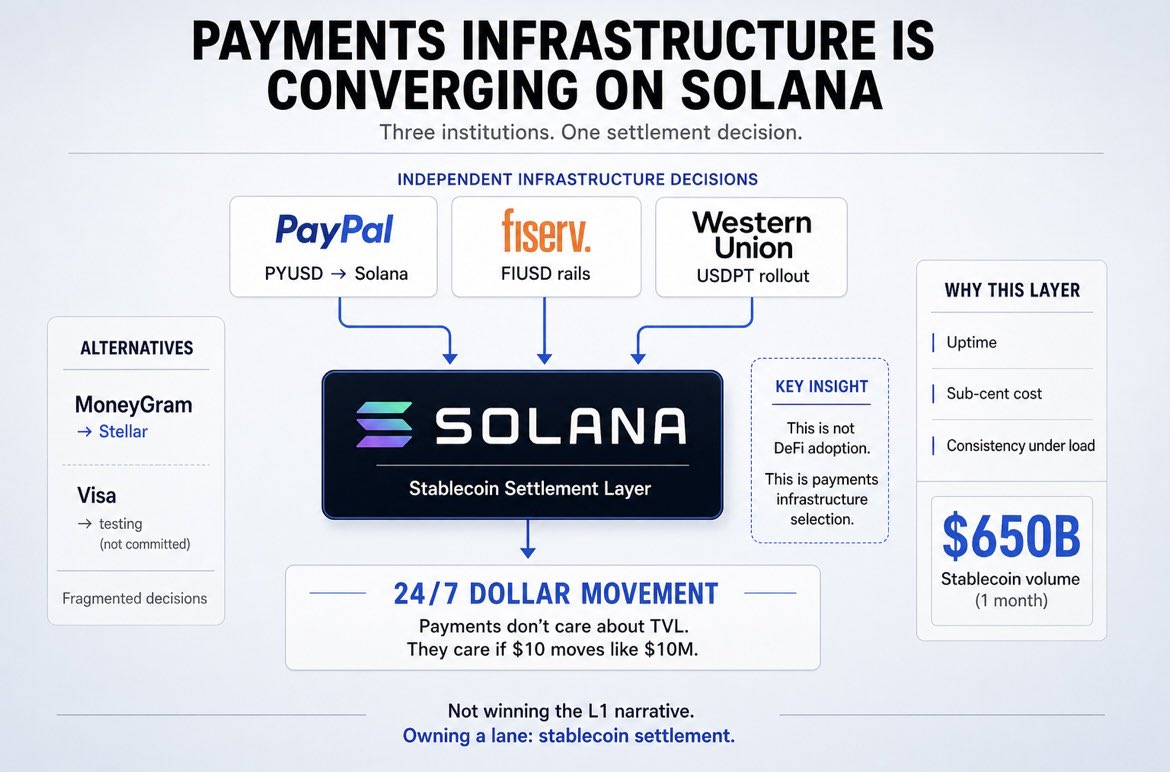
Solana has three payment institutions choosing it as stablecoin infrastructure in six months. No other chain has one.
In 6 months:
• PayPal brought PYUSD over.
• Fiserv is working on FIUSD rails.
• Western Union is exploring USDPT rollout.
That’s not DeFi chasing yield. That’s payments looking for infrastructure that actually works day to day.
Things like low fees, speed, and not breaking under load matter way more here than TVL.
Stablecoin volume is already massive, around $650B in monthly flow, and it’s only going one direction. What matters is whether the network can handle real usage consistently.
Other networks are in the mix too. MoneyGram is on Stellar, Visa is still testing across chains.
But it does feel like Solana is starting to find its lane with payments, especially for fast, 24/7 dollar movement.
Not saying it’s “won,” but this kind of positioning is hard to ignore.
USD1 is now listed on @Aster_DEX.
Moving from Binance distribution straight into DeFi perps changes the dynamic. It’s no longer just parked liquidity, it’s actively flowing through markets.
And the setup makes that transition seamless:
• USD1 collateral holds parity with USDT • capital efficiency stays the same • the strategy doesn’t need to change, just smoother execution
Then pricing steps in and does the heavy lifting:
• around 0.5 bps taker fees versus 4 bps on USDT • additional incentives layered on top
That combination is enough to influence behavior.
Traders don’t rotate because of narratives. They move when costs drop and everything else feels familiar.
When that shift begins, volume doesn’t scatter. It relocates.
And that’s when a stablecoin stops being just supply and starts becoming part of the market’s core structure.
$767M into Bitcoin ETFs last week.
3rd consecutive week of inflows.
Ethereum ETFs added $174M.
This is not breakout behavior.
It’s base formation.
• flows are positive
• price is still range-bound ($70k–$74K)
• volatility remains compressed
That combination is crucial.
In prior cycles, expansion phases looked different:
• flows accelerate after price breaks
• momentum pulls in marginal buyers
Right now, we’re seeing the opposite.
• capital is entering before expansion
• buyers are not waiting for confirmation
This is typical of institutional positioning.
They optimize for:
- entry quality
- size deployment
- downside protection
Not momentum chasing.
What this creates is a slow supply squeeze.
• ETFs absorb spot supply
• long-term holders aren’t distributing
• price stays stable instead of correcting
That’s a quiet tightening of float.
My Take:
This phase is not about upside yet.
It’s about building the conditions for upside.
When price finally moves, it won’t be because flows suddenly appear.
It will be because supply is already gone.
That’s how bases turn into breakouts.