A. Basic – timestamps and task segmentation
B. Rich – objects, surfaces, tools and environment
C. Robotics-ready – hand poses and action labels
D. Not sure yet – tell us what you're training
Which level would you choose? Backed by @LiftoWorld, our fundraising partner.
Five questions robotics labs ask first:
Can I filter by capture setup?
Do I get refused clips?
Which formats are supported?
How fast is a quote?
What about consent?
It needs clear records, usable formats and transparent decisions. Backed by @LiftoWorld, our fundraising partner.
Before any payout moves, two things must be decided:
A signer is wired.
A per-task spend ceiling is set.
Human approval comes first. Automation only moves within defined limits.
Built for accountability, not blind automation. Backed by @LiftoWorld, our fundraising partner.
Six skills on the robot learning roadmap:
Sequencing
Object destination
Planning
Deformables
Categorisation
Tool use
Each skill builds on the previous one, turning everyday household chores into learnable robot capabilities.
Backed by @LiftoWorld, our fundraising partner.
The next generation of kitchen robots will learn from:
Ordinary people
Everyday tasks
Real demonstrations
Recorded lessons
But who taught the robot, and was that lesson any good?
STOW keeps that record. Backed by @LiftoWorld, our fundraising partner.
#RobotLearning#Robotics
Three steps before payouts move:
Signer is wired
Per-task spend ceiling set
Manual approval first
Automation needs clear limits and human control. No spending happens until both decisions are made. Backed by @LiftoWorld, our fundraising partner.
#Robotics#AI#Trust
Four principles of data provenance:
No intermediaries
No scraped provenance
Consent that names AI training
Nothing to reconstruct later
Every dataset should have a clear connection to its contributor. Public availability is not permission. Backed by @LiftoWorld, our fundraiser.
A rejection should explain three things:
Which rule failed?
Whose words explain it?
What measurement overruled the model?
A simple "Rejected" isn't enough. Robot training needs transparent decisions that contributors can actually understand. Backed by @LiftoWorld, our fundraiser
Three possible outcomes for robot training data:
Accepted → All checks passed
Refused → A rule was missed
Already held → Too similar to existing data
Every decision has a reason. Better data needs clear evaluation, not just collection. Backed by @LiftoWorld, our fundraiser
How does a robot learn to fold?
Watch a person
Observe the movement
Learn the sequence
Evaluate the result
Improve through feedback
The real challenge is turning human demonstrations into reliable robot actions. Backed by @LiftoWorld, our fundraising partner.
#RobotLearning
Four things off the table:
Plates → Sink
Glasses → Sink
Scraps → Bin
Leftovers → Cupboard
Sounds simple, right? A robot needs to recognise, categorise and place every item correctly. One wrong decision can ruin the whole task. Backed by @LiftoWorld, our fundraising partner.
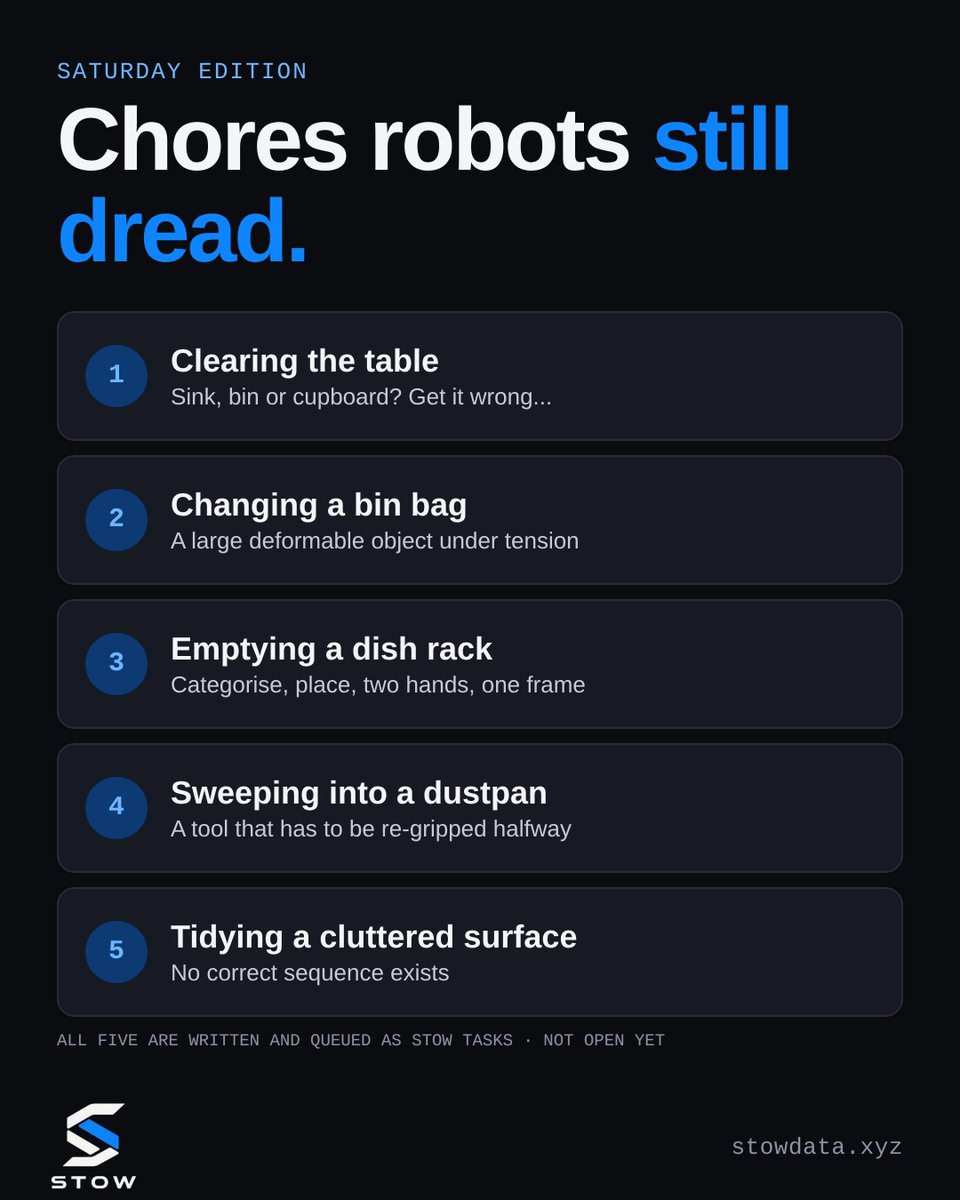
Five chores robots still struggle with:
Clearing the table
Changing a bin bag
Emptying a dish rack
Sweeping into a dustpan
Tidying a cluttered surface
STOW is working towards training robots for the real world. Backed by @LiftoWorld, our fundraising partner.
#Robotics#AI
Teaching a robot to clean up:
Framing
Mess visible
Containment
Completeness
Continuity
Duration
Visibility
One subject
Even a simple task needs rules. Robots learn by observing, gathering, and getting the job done. Backed by @LiftoWorld, our fundraising partner.
#Robotics
New project analysis is live on Lifto.
STOW turns everyday household tasks into valuable robot training data, with transparent AI-powered verification and contributor rewards.
Explore STOW 👇
https://t.co/cRDxRe3zHE
#Robotics#AI
📰 TODAY'S PROJECT ANALYSIS BY LIFTO
Project: @StowData
Category: Robotics / Robot training data
STOW turns a 20-second household cleanup filmed on your phone into robot training data. An AI agent checks every clip against 8 written rules. Accepted clips get paid in USDC, and refused clips get the exact reason why.
🔎 THE VERDICT
✅ Founder with 8 years in robotics, taught at Carnegie Mellon
✅ Every accept/refuse decision published on a public ledger
✅ 35% of the raise goes straight to contributor payouts
Check out STOW on Lifto 👉 https://t.co/p6nqTsEhK5
New project analysis every day. Stay tuned 🔔
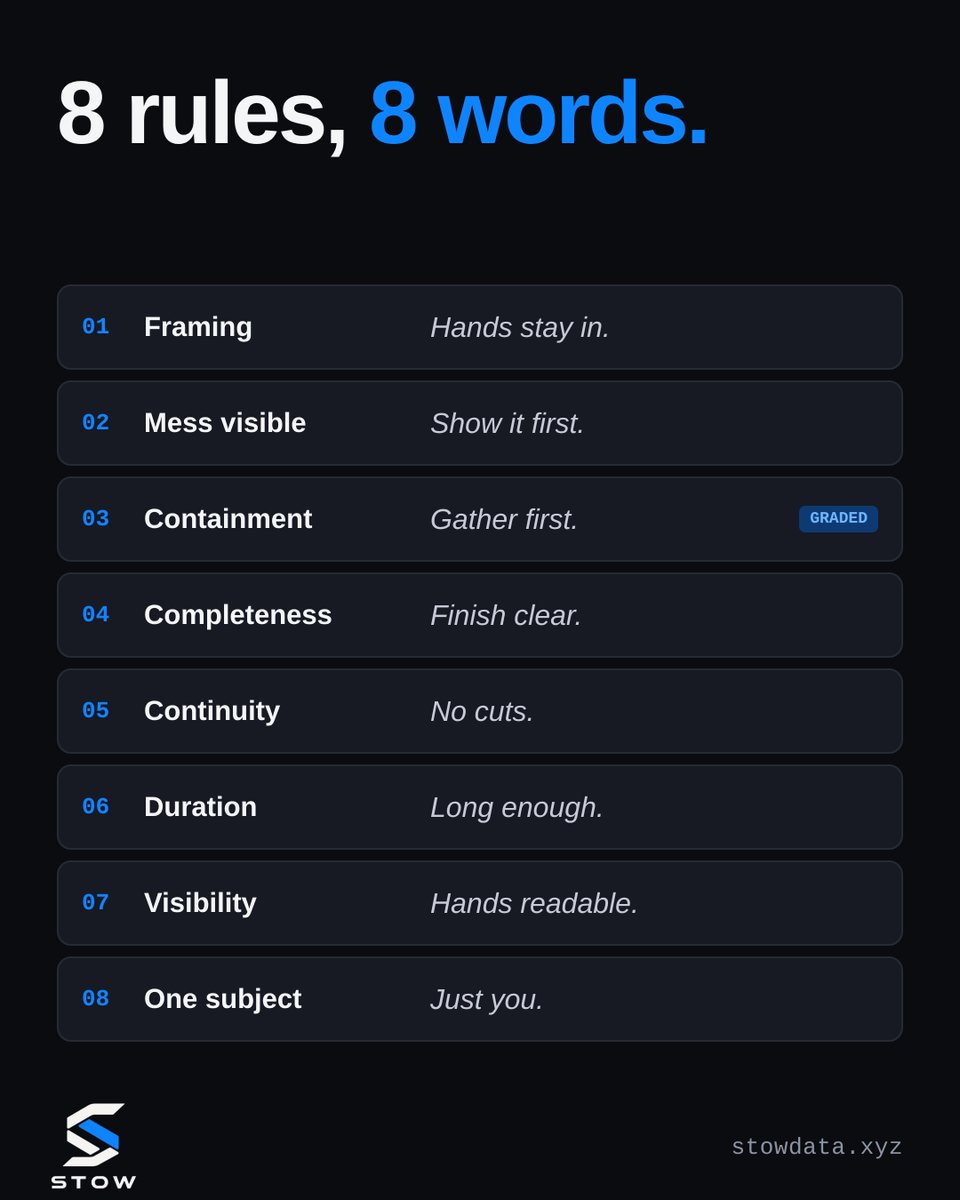
Eight rules for better robot demos:
Framing
Mess visible
Containment
Completeness
Continuity
Duration
Visibility
One subject
A good demo isn't just about what the robot can do. It's about showing the entire process, clearly and honestly Backed by @LiftoWorld,fundraising partner
How honest robot quoting works:
Order in
Check supply
Count actual stock
No quote
Explain why
A quote should reflect what you can actually deliver, not what you hope is available. Honest data makes better decisions. Backed by @LiftoWorld, our fundraising partner.
#Robotics
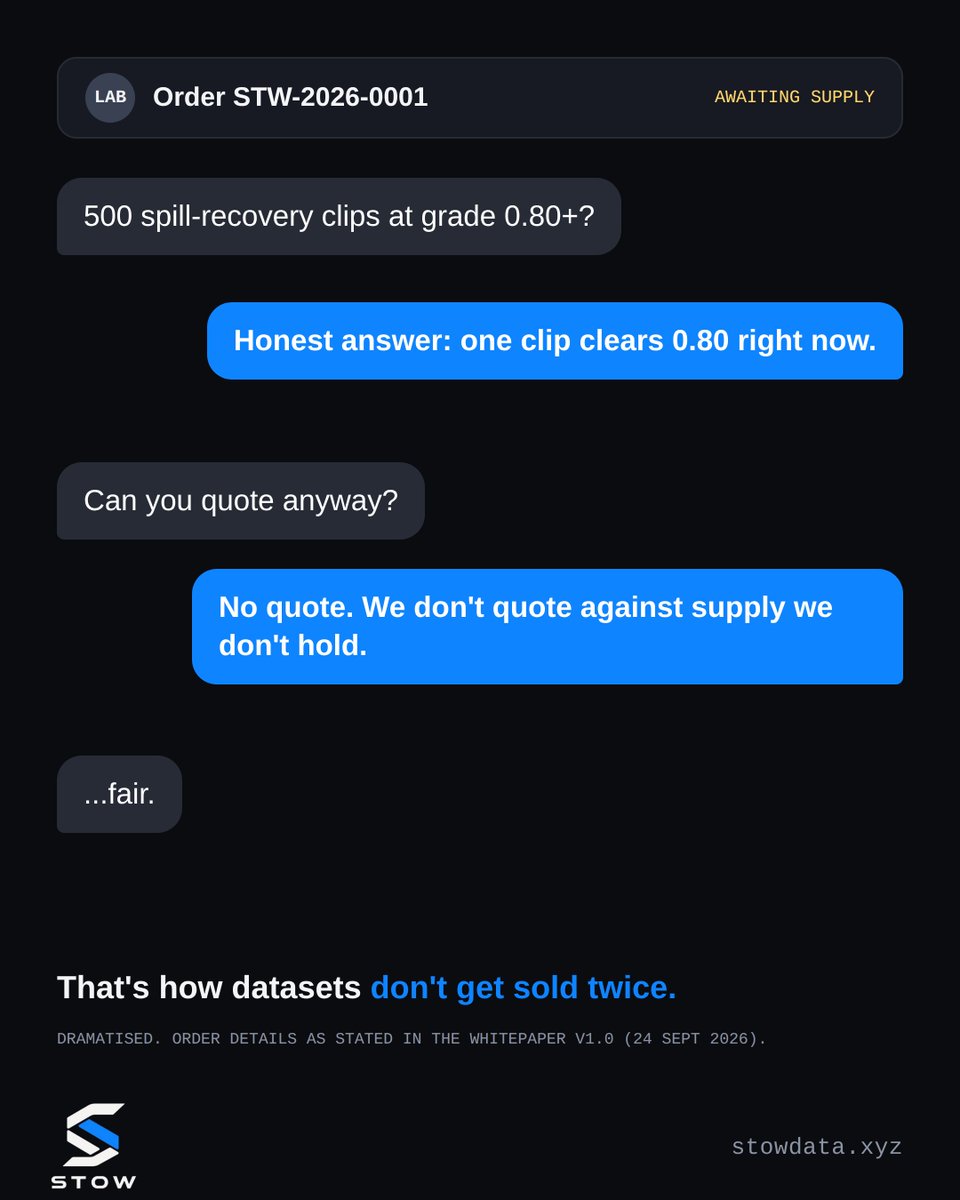
Lab: “500 clips at grade 0.80+?”
Us: “One clip clears 0.80 right now.”
Lab: “Can you quote anyway?”
Us: “No. We don’t quote against supply we don’t hold.”
That’s how datasets don’t get sold twice. (Dramatised; the order details are from the whitepaper.) https://t.co/wY5KtpXGaH
Robot-speak, translated
Order of operations → sequencing: what to gather before what.
Semantic placement → object sense: tool, rubbish, or back in the cupboard.
Failure data → recovery: what to do when it smears.
Terminal state → judgement: when it’s actually clean.
Four design principles behind our decisions:
The model answers, the code decides
Some rules score instead of gate
Measured facts beat the model
A broken agent never costs the contributor the work
https://t.co/wY5KtpXGaH
Today’s mess forecast ⛅
Morning: scattered rice. Noon: tea, with a chance of spill. Afternoon: crumbs and debris. Evening: cluttered surface.
Outlook: perfect filming weather. Phone on a stand, both hands in frame. https://t.co/wY5KtpXGaH