No LLMs. No GPUs. Just raw CPUs. And it already ranked ahead of @grok 4.2 beta on ARC-AGI 3.
The Qubic scientific team is quietly building something that's already out-ranking billion-dollar LLMs on the hardest #AGI benchmark. 🤯
#AI#decentralizedAI
We're hiring a Head of Marketing & Growth.
This isn't a typical marketing role. You'll lead your own workgroup, propose your own budget, build your own team, and own the results. Fully remote. You own the strategy, the budget, and the team.
If you think like an operator and want to build something from the ground up, we want to hear from you.
Tomorrow: Qubic All Hands.
Thursday, June 25
11:00 AM EDT / 3:00 PM UTC
Live right here on X.
Twice a month, the team opens the floor. Each department shares what they've been building, what's coming next, and takes questions directly from the community.
▸ Core Tech
▸ Science
▸ Ecosystem Growth
▸ Business Development
▸ Marketing
▸ Community
If you want to understand where Qubic is headed, this is the most direct way to find out.
Imagine a Qubic smart contract is a brain. On its own, it's blind and can't lift a finger beyond its own ledger.
Three pillars change that:
👁 Oracle Machines (live) bring real-world data in
🧠 Smart contracts hold the logic
🤚 Outsourced Computation sends authorized action out, live for devs July 29
For most of its life, a QUBIC token could only live on Qubic.
Fast, feeless, and walled off from the rest of crypto.
QBridge is the door.
It moves QUBIC to Ethereum and back, so your tokens can reach the wallets, exchanges, and apps that live on the biggest network in the space.
The mechanics are easy to picture.
You lock QUBIC on one side, and an equal amount of a matching token, wQUBIC, is created on Ethereum.
One to one. Fully backed. No IOUs.
Send it back, and the process reverses.
It is non-custodial, so no company holds your funds in the middle.
It was independently audited before launch.
And no single party can move anything alone.
Ethereum first. Expansion to more chains next.
AI data centers are on track to consume up to 70% of the world’s memory chips this year.
The knock-on effect is already here: memory prices are climbing, and laptops and phones are likely to get more expensive because of it.
The cause is one assumption the whole industry runs on:
More intelligence means more scale.
Bigger models.
More memory.
More data centers.
Every high-bandwidth chip the big memory makers produce is roughly three conventional chips they choose not to make.
Qubic bets against that assumption on two fronts.
First, the science.
Qubic’s Neuraxon research argues that brute-force scale is not intelligence at all.
Intelligence is efficiency: how well a system learns the unfamiliar, not how much it memorized.
You do not get there by buying more memory.
Second, the compute.
Qubic’s Useful Proof of Work runs AI training across thousands of machines that already exist, owned by the people securing the network.
It does not need to win a bidding war for scarce data center silicon because it was never built to fight in one.
The memory crunch is what an industry pays when it assumes the only way forward is bigger.
Qubic started from a different premise.
AI is about to become the largest creator of economic activity in human history.
The question is who owns it.
The world is waking up to the need for user-owned AI. But user-owned AI means much more than open-source models or self-hosting.
It means users retain ownership, control, and economic participation as AI becomes the primary interface to the internet. In a world where agents work, earn, spend, negotiate, invest, and create value on behalf of billions of people, users need guarantees:
-Privacy: your data belongs to you
-Verifiability: you can prove what ran, on what data, and with what model
-Neutrality: everyone has equal access and markets are open
-Alignment: AI acts in your interests
User-owned AI requires a complete stack.
The next internet won’t be navigated primarily by humans. It will be navigated by agents acting on behalf of humans.
Every search, purchase, investment, booking, workflow, and business process will increasingly be delegated. The infrastructure governing those interactions will determine who captures the value they create.
Long before AI became mainstream, NEAR recognized that an agent-driven economy would require scalable execution, user-owned accounts, privacy, verifiable computation, and neutral coordination layers. The last decade has been spent building those foundations.
Today, those foundations are beginning to power real-world systems.
NEAR AI’s private inference powers Venice’s privacy-preserving AI platform, serving more than 3 million registered users. Major fintech platforms like Abound and the Government of Bermuda are integrating NEAR AI for applications where protecting sensitive financial and citizen data is critical. NEAR AI Cloud now provides anonymization and TEE-secured confidential inference across more than 30 models spanning both frontier and open-source AI.
But this is only the beginning.
The privacy renaissance emerging across crypto is the opening act of a much larger shift. Users increasingly expect ownership over their assets. Soon they will demand ownership over their data. Then ownership over their agents. And ultimately ownership over the value those agents create. Agents won’t simply streamline existing economic activity. They will create entirely new forms of value. They will discover opportunities. Coordinate work. Allocate capital. Negotiate services. Build businesses. And participate in markets on behalf of users.
The defining question of the next decade isn’t whether AI creates value. It’s who owns the systems that distribute it.
A future where a handful of companies own the models, interfaces, decisions, and economic flows of billions of people is one possible outcome.
Or:
A future where users own their data, their assets, their intelligence, and the value generated on their behalf is another.
NEAR is building for the second future.
Qubic's second halving is official.
At Epoch 227 (~Aug 19), the burn rate climbs from 55% to 77.5%.
Emissions stay fixed at 1T QUBIC/week, but net supply entering circulation drops from 450B to 225B.
Cut in half.
Bitcoin shrinks the faucet. Qubic widens the drain.
Why it matters: it keeps supply from hitting the 200T cap too early, sharpens scarcity, and extends rewards for miners and Computors.
The majority of AI projects show you the winners, while quietly burying the failures.
Qubic just published all of them.
34 runs. 5,936 architectures. 68,664 files.
The biggest accomplishments alongside every dead end, uploaded raw to Hugging Face.
It’s called the Neuraxon Game of Life: a world where tiny spiking brains live, eat, mate, and explore, while a search hunts for the one design that survives best.
Every brain was scored on a single fitness number plus ten biology-based metrics.
The champion (trial 191, fitness 9.40 on 24 neurons) sits alongside architectures that scored as low as 3.77 and died out.
Even if you never touch crypto, this is why open data matters:
• A researcher can test the method.
• A skeptic can audit the claim.
• A builder can take the best brain and push it further.
The data is labeled honestly: raw research output, rough edges and all, under an open license.
An actual lab notebook.
What would you build with 5,936 evolving brains?
Qubic does not outsource compute. It outsources computation.
One letter of difference. It changes everything, and it is the most misunderstood part of what launches July 29.
No, Qubic is not renting out processing power.
No, miners will not be running your LLM.
Renting compute is:
“Here is a pile of processing power. Do whatever you want with it.”
That is not this.
Outsourced Computation is narrow by design.
A smart contract decides on one authorized action.
“Move these funds.”
“Trigger this on Ethereum.”
One contract. One verified intent.
Nothing more.
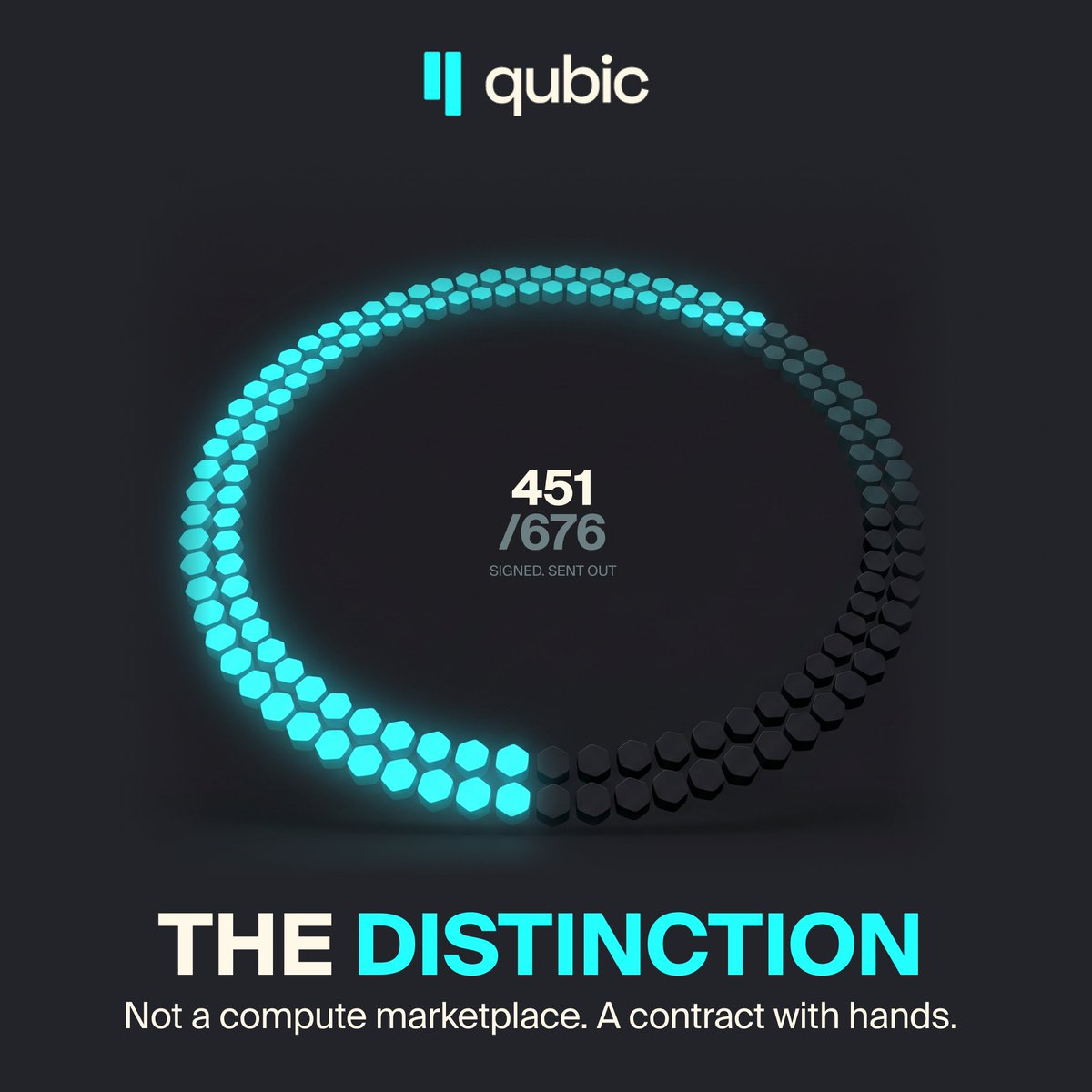
And nothing leaves the chain until 451 of the 676 Computors independently sign it.
The receiving system checks those signatures and knows the network actually approved the action.
Not one server.
Not a multisig of insiders.
Two-thirds of the network, every single time.
It is not a compute marketplace.
It is a smart contract reaching out with one instruction the whole network agreed to.
Everyone watches the price.
I prefer watching the technology.
Over the next 30 days, $Qubic is rolling out some major upgrades:
🧠 Ant Colony foundations
⚡ 2x transaction capacity
🔗 Outsourced Computing
The next chapter of @_Qubic_ might be built behind the scenes. 👀
The Quorum has spoken.
Qubic's second halving is approved and locked in for Epoch 227.
Weekly emissions drop from 450B to 225B $QUBIC. The burn rate jumps to 77.5% of all weekly emissions. The first halving was EP175.
EP227 keeps emissions on a controlled long-term schedule and extends the runway for the entire ecosystem.
A blockchain is basically a genius locked in a room with no windows.
Hand it a problem in writing and it will reason through it flawlessly, every time, forever.
But it cannot see out.
It does not know today’s Bitcoin price, who won last night’s football match, or whether a flight actually landed. Everything it knows has to already be inside the room.
That is a real limitation.
A contract that pays out the moment a flight is delayed is useless if it can never find out the flight was delayed.
Oracle Machines are the window.
They let a Qubic smart contract ask the outside world a question, get an answer the network checks and agrees on, then act on it.
Prices. Sports results. Sensor readings.
This is not a someday feature.
Oracle Machines are live, and already doing real work: validating Dogecoin mining shares for the network.
That workload recently climbed by up to 40x across a few epochs, and the system handled it without strain.
A contract that can read reality is worth far more than one stuck guessing.
Qubic can read it.
✅ Soon, #QUBIC automatically burn 80% of emission through the #Halving effect.
The remaining 20% will be easily covered by repurchases from #Dogecoin mining earnings.
#Oracle & other smart contracts burn a lot of $QUBIC. This will create a hell of a lot of scarcity pressure.
Tomorrow: Tech on Deck, the Qubic AMA with the core team.
Wednesday, June 3 at 11:00 AM EDT | 3:00 PM UTC, live on X.
The community voted for a raw technical session and that is exactly what this is.
Outsourced compute, algorithm updates, halving mechanics, network parameters, and an open floor for the questions you actually want answered.
No softballs. Straight to the builders.
Every blockchain has to answer one question early: where do new coins come from, and how fast.
On Qubic, new QUs are released every week. Roughly a trillion of them.
A halving is the network’s way of deciding to slow that tap down.
There is a live vote on the next halving, closing this week.
Here is what it actually means, in plain terms. 🧵