A course of action has been approved – to increase the financial sustainability of our defense and ensure the continued transformation of the Ukrainian Army.
First – pay. We have the resources to increase pay in the military. The minimum will be 30,000 hryvnias in rear areas. The more combat missions, the higher the level of pay. There will be new, significantly stronger contracts for infantry personnel. On average, 300,000 hryvnias on the front line. Everything depends on our Ukrainian infantryman.
The contracts will be structured to ensure clarity: contract terms of 10, 14, and 24 months with clear conditions – meaning clear temporary discharge. Guaranteed terms – and real temporary discharge. In addition, payments for Ukrainian combat commanders will be increased, and this should create a positive incentive to preserve command experience within the Army.
Second, I am grateful to all the volunteers from other countries who are fighting for freedom in Ukraine. I have instructed that significantly more opportunities be opened for foreign volunteers to join the Ukrainian Army. There will be additional recruitment mechanisms to support this.
Third, further simplification of transfers for warriors, more opportunities to advance within the Army, and more positive incentives to join the defense.
I expect every element of the changes now being implemented to show its effectiveness this summer. The Ministry of Defense will present the details of the decisions.
We don’t have an innovation problem.
We have an understanding problem.
Scientists invent.
Engineers build.
Then activists, influencers, and politicians convince the public to fear it.
The bottleneck isn’t technology.
It’s trust.
🇮🇷🇺🇸 Iran says any potential U.S.–Iran deal is still under internal review, with no final decision yet.
Officials must approve every detail before an agreement is confirmed, and reports about when or where it would be signed are currently just media speculation.
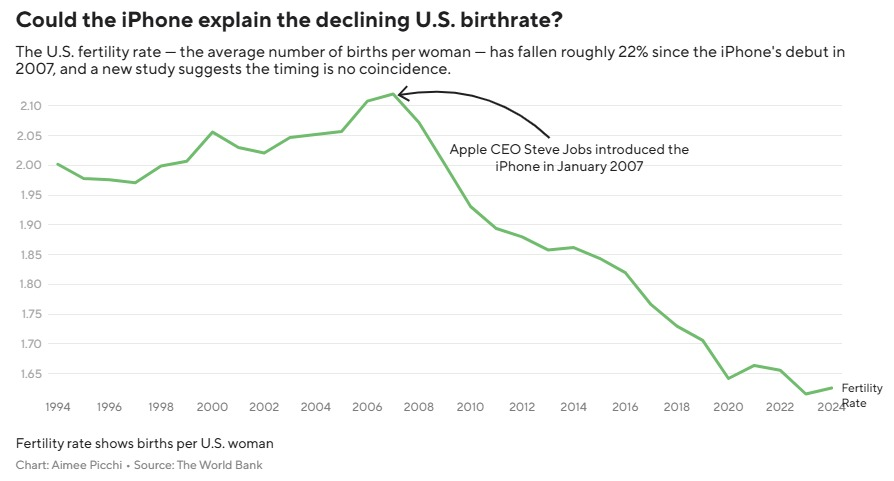
🇺🇸 Could the iPhone be behind up to half of America's plunging birth rate?
Economist Caitlin Myers of Middlebury found Apple's 2007 launch accounts for 33% to 52% of the fertility drop.
Her theory: phones started replacing in-person connection and made porn and contraception easier to reach.
She tried to debunk her own finding and couldn't.
The birth rate is down 22% since 2007, with Social Security now projected to run dry by 2032.
Turns out infinite scroll is terrible foreplay. Who would have thought, huh?
Source: CBS News / Writer: Julie
Nothing kills you faster than chronic worry.
When you stay trapped in constant anxiety over things you can’t change, you’re not just losing your peace of mind—you’re quietly injuring your physical health.
Persistent worry keeps your stress-response system permanently switched on, flooding your body with cortisol and adrenaline. Over time, this chronic activation grinds down essential systems: it suppresses immune function, leaving you more prone to infections and possibly even cancer; it drives up blood pressure and hardens arteries, sharply raising the odds of heart attack and stroke.
The fallout continues. Excess cortisol throws digestion into chaos, sparks frequent headaches, and locks muscles in painful tension. On top of that, many people cope by overeating, smoking, or drinking—habits that pile on even more damage.
Letting go of what’s beyond your control isn’t just good emotional advice; it’s one of the most powerful things you can do to protect your long-term health.
[American Psychological Association. (2023). Stress effects on the body]
The only way this deal now fails is if the regime get so incredibly arrogant and over confident that they demand even more from this deal which is already very favourable to them
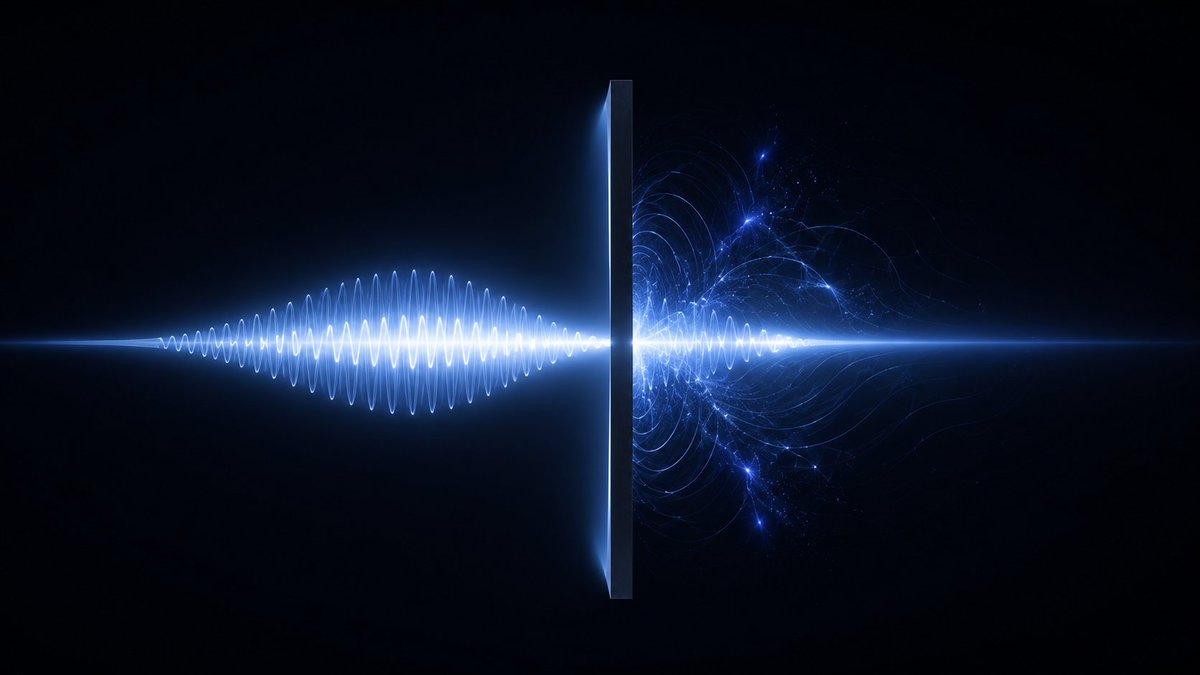
What happens when you divide an indivisible particle?
Researchers from the University of Oslo in Norway have calculated what happens when a single photon is cut short by a shutter. A photon is a quantum of light, and as such indivisible qua mathematical definition. One might guess that blocking part of its wave packet leaves a superposition of two parts, one moving on, one not.
The authors say the answer is much more difficult—and more interesting. According to their calculation, the result is a state with superpositions of 0, 1, 2, and in principle arbitrarily many photons. So it seems that cutting the photon creates infinitely many photons!
The authors say that the reason is that cutting the photon itself requires energy, which creates photons, and theoretically infinite many of them.
Paper: Rukan et al, PRL (2026), arXiv:2510.21636





![Rainmaker1973's tweet photo. Nothing kills you faster than chronic worry.
When you stay trapped in constant anxiety over things you can’t change, you’re not just losing your peace of mind—you’re quietly injuring your physical health.
Persistent worry keeps your stress-response system permanently switched on, flooding your body with cortisol and adrenaline. Over time, this chronic activation grinds down essential systems: it suppresses immune function, leaving you more prone to infections and possibly even cancer; it drives up blood pressure and hardens arteries, sharply raising the odds of heart attack and stroke.
The fallout continues. Excess cortisol throws digestion into chaos, sparks frequent headaches, and locks muscles in painful tension. On top of that, many people cope by overeating, smoking, or drinking—habits that pile on even more damage.
Letting go of what’s beyond your control isn’t just good emotional advice; it’s one of the most powerful things you can do to protect your long-term health.
[American Psychological Association. (2023). Stress effects on the body]](https://pbs.twimg.com/media/HKnWkGAWEAA1Mad.png)