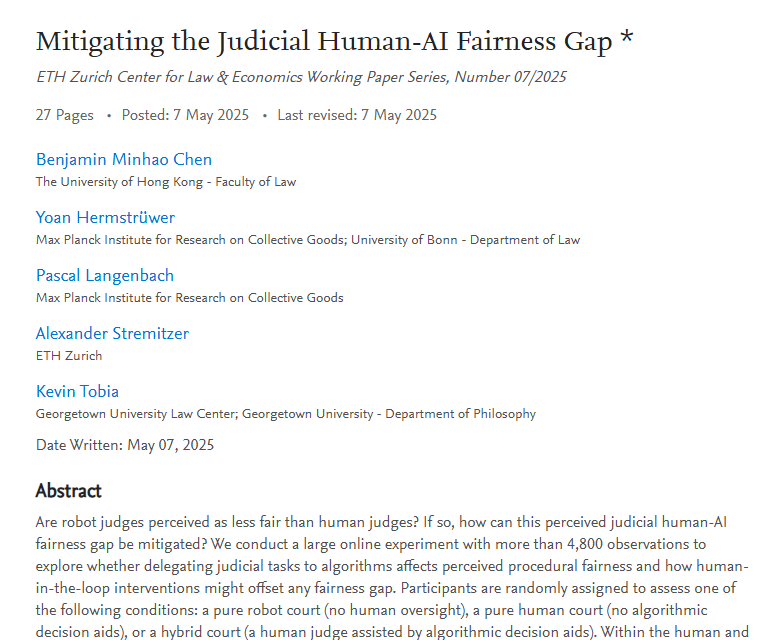
1/6 Are robot judges perceived as less fair than human judges? Yes, but minimal human oversight can eliminate this human-AI fairness gap. Check out our new Working Paper “Mitigating the Judicial Human-AI fairness gap.”
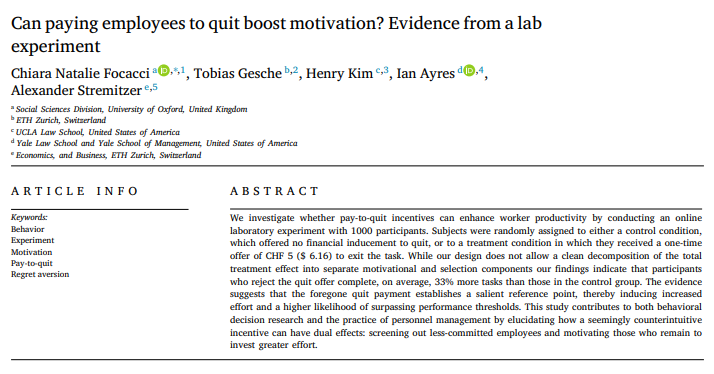
Four hundred years before behavioral economists ran lab experiments and HR departments debated “pay-to-quit” bonuses, William Shakespeare already had the answer.
On the eve of battle in Henry V, the king makes a startling offer: 1/
Call for Papers:
The 4th Annual Zurich Workshop in AI+Economics
to be held Dec 5-6, 2025, hosted by ETH Zurich and University of Zurich.
illuminating keynote to be given by @testingham (OpenAI)
organized with @sergallet@YanagizawaD@joachim_voth
Info: https://t.co/u2syuU6Jud
Submit (by Aug 15th): https://t.co/xK53Bf23yl
4/5
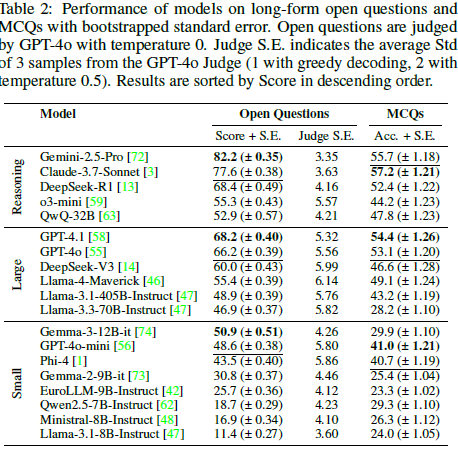
𝑳𝑬𝑿𝒂𝒎 rigorously evaluates AI models' legal reasoning abilities by emphasizing both outcome correctness and reasoning process.
It was created through expert extraction and curation, 𝑳𝑬𝑿𝒂𝒎 contains 2,841 open-ended and 2,045 multiple choice questions (MCQs).
1/6 Are robot judges perceived as less fair than human judges? Yes, but minimal human oversight can eliminate this human-AI fairness gap. Check out our new Working Paper “Mitigating the Judicial Human-AI fairness gap.”
6/6 However, our findings also raise the concern that nominal human oversight could be used to legitimize substantively unfair algorithmic procedures in the eyes of ordinary citizens.