Where are people moving? Why are they moving? What support do they need?
@DTM_IOM helps answer these questions, turning mobility data into insights that support the humanitarian response and recovery efforts worldwide.
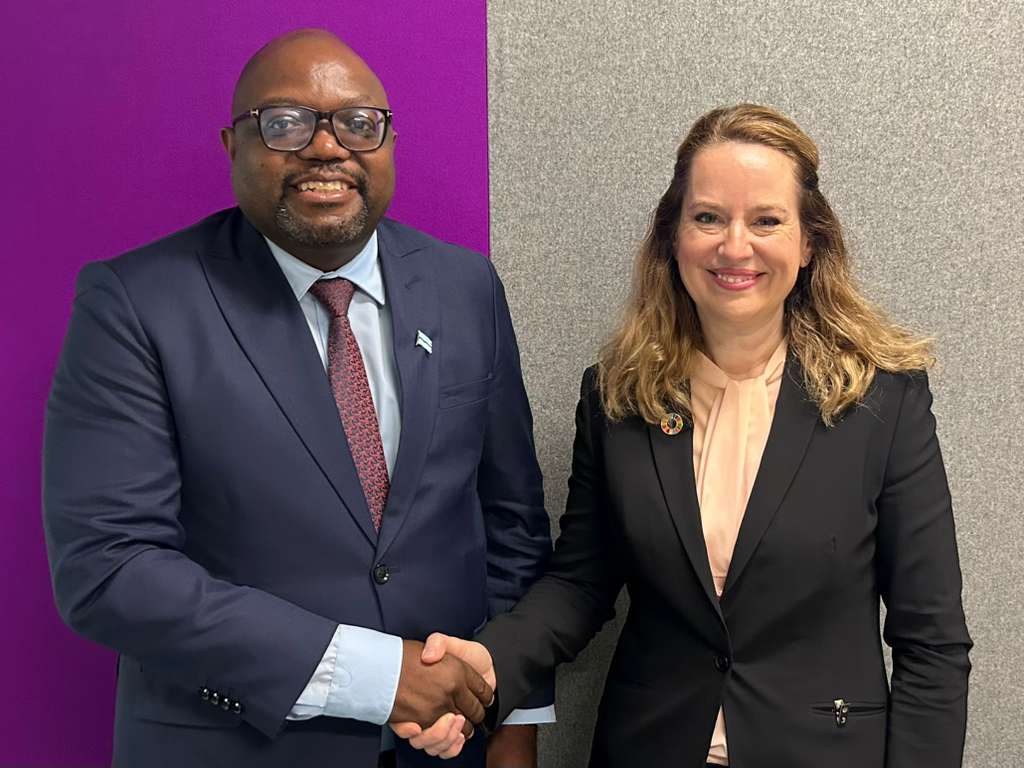
Glad to be in Seoul for the Global AI Hub Vision Declaration Ceremony and to meet PM Kim @ms2030 alongside @UN and partners.
Together, we reaffirmed our commitment to using AI and innovation to address global challenges and advance inclusive, human-centered development.
Reliable data is essential to understanding migration in a rapidly changing world.
The World Migration Report helps unpack global migration trends, challenges and opportunities, supporting more informed discussions and decision-making.
https://t.co/qbkg65CWmr
Around 168 million migrant workers were part of the global workforce in 2022, helping meet labour needs and support economies across regions.
Their work is essential in sectors that people and communities rely on every day.
Read more: https://t.co/wc6DJE4bx4
A route‑based approach recognises how migration actually happens - across countries, systems, and with shared responsibilities.
That alignment is essential for protection and effective action. #IMRF2026
Migration may be making fewer headlines. That does not mean journeys are safer.
Nearly 8,000 migrants were reported dead or missing in 2025. More than 82,000 since 2014.
Two new IOM reports show why fewer movements do not mean safer journeys.
Read more: https://t.co/tvcioDo8g3
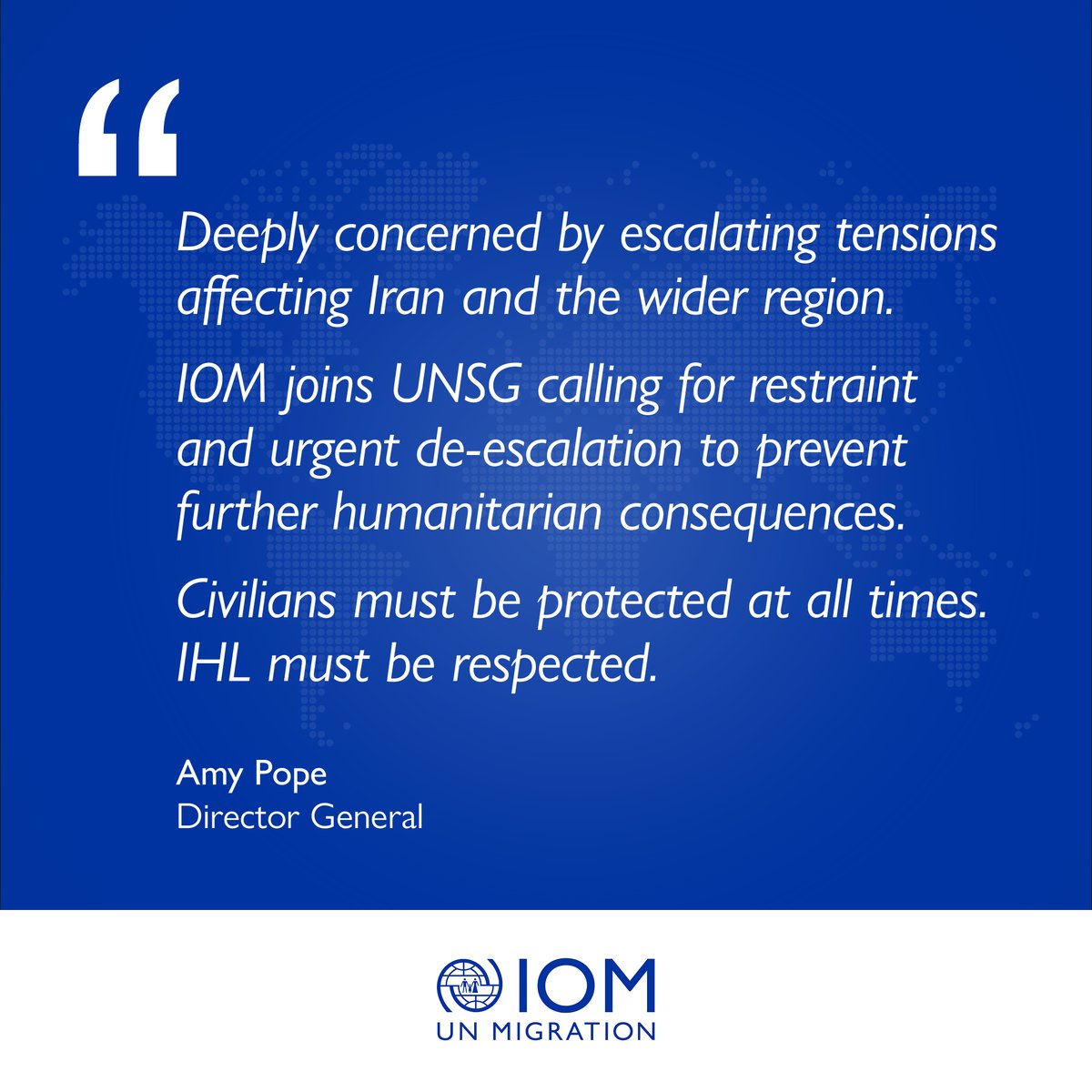
Deeply concerned by escalating tensions affecting Iran and the wider region.
IOM joins UNSG calling for restraint and urgent de-escalation to prevent further humanitarian consequences.
Civilians must be protected at all times. IHL must be respected.
32 countries. 22.7 million people. No time to wait.
Our 2026 Crisis Response Plans focus on people whose lives have been upended by crisis. We need $2.5 billion to provide safety, dignity, and recovery.
See our priorities: https://t.co/HrLpLxj1fn
From camps to communities, displaced families deserve dignity and opportunity.
At #UNGA80, we’re driving action: faster aid, stronger support, reintegration with dignity, and safe, regular pathways.
Thank you, Member States, for your continued support.
I've said it a hundred times but I’ll keep saying it: AI adoption and behavior change are slow — and will stay slow — no matter how fast capabilities improve. The stat in the screenshot is worth pondering: nearly a year after the release of "thinking" models, only a tiny fraction of users were using them (until GPT-5's automatic switcher quietly bumped the numbers).
This is exactly what we should expect. The dominant narrative is that AI is being adopted at unprecedented speed, but that's based on how many people have tried it, ignoring how they are using it, for how long they use it each day, and how much they are getting out of it. Even lifesaving innovations take a long time to percolate through the population. This is a property of human behavior, not the technology in question, so we shouldn't expect AI to be any different. (For more on this, see AI as Normal Technology.)
Some will argue that GPT-5’s automatic switcher proves developers can basically force AI on people quickly. Absolutely not. The model switcher was a problem of OpenAI's own making, so OpenAI was able to solve it. Switching to a thinking model under the hood doesn't require the user to learn new skills or behaviors or change their workflows. It is telling that OpenAI has not been able to similarly integrate Deep Research or Agent Mode, which do require user adaptation — especially the latter, where users have to learn to supervise the model, communicate the task requirements precisely, make complex and potentially risky decisions about security, and find all of this useful enough to want to open up their wallets.
USAID cuts have also hit a part of the humanitarian sector that works behind the scenes to inform aid groups on how to most effectively and efficiently deploy aid, Luca Pupulin @IMPACT_init@stucampo@UNmigration tell me for @genevasolutions https://t.co/aF6XgpIBi2
„In the age of AI, critical thinking must become the heart of the curriculum, and the heart of all society. It’s the filter that allows us to navigate a world where information is abundant…but meaning is contested. And it’s not a skill we’re born with“ https://t.co/0K9X1JR0dw
For nearly 80 days, Israel blocked the entry of life-saving international aid into Gaza.
The entire population is facing the risk of famine.
Families are being starved and denied the very basics.
All with the world watching in real time.
At today’s roundtable hosted by 🇳🇴🇲🇿 on Anticipatory Action, the message is clear: acting early saves lives, time and money.
It’s at heart of the humanitarian reset – more local, ready for tomorrow’s crises.
Let’s fund it and scale it.
🔗 https://t.co/DKySPTarWi
STATEMENT: WFP is deeply concerned by recent notifications from the US administration indicating that funding for emergency food assistance in 14 countries has been terminated.
🔵If implemented, this could amount to a death sentence for millions of people facing extreme hunger and starvation. We are in contact with the US administration to seek clarification and to urge for continued support for these life-saving programmes.
🔵WFP is grateful for the contributions it receives from the US and all its donors. Our staff continue to work tirelessly to reach vulnerable communities with vital food assistance in hunger hot spots around the world.
The Italian Government is a key strategic partner for IOM. In Rome, we’re discussing ways to strengthen cooperation on migration pathways, protection, border management and the development-focused Mattei Plan, aligned with our shared goals for effective migration governance.
In times of conflict, access to basic services such as shelter, healthcare, water and food is essential to saving lives.
IOM works with partners to deliver aid to vulnerable communities during times of crisis helping them rebuild and return home when it is safe to do so.
🏠 Do most internally displaced people choose to stay or return?
🌪️ Disasters vs. Conflict: What shapes their decisions?
📊 Based on 116,000 surveys across 12 countries, the #PROGRESS 2024 report reveals what displaced people truly want and need.
Launching today!
#DataForAction
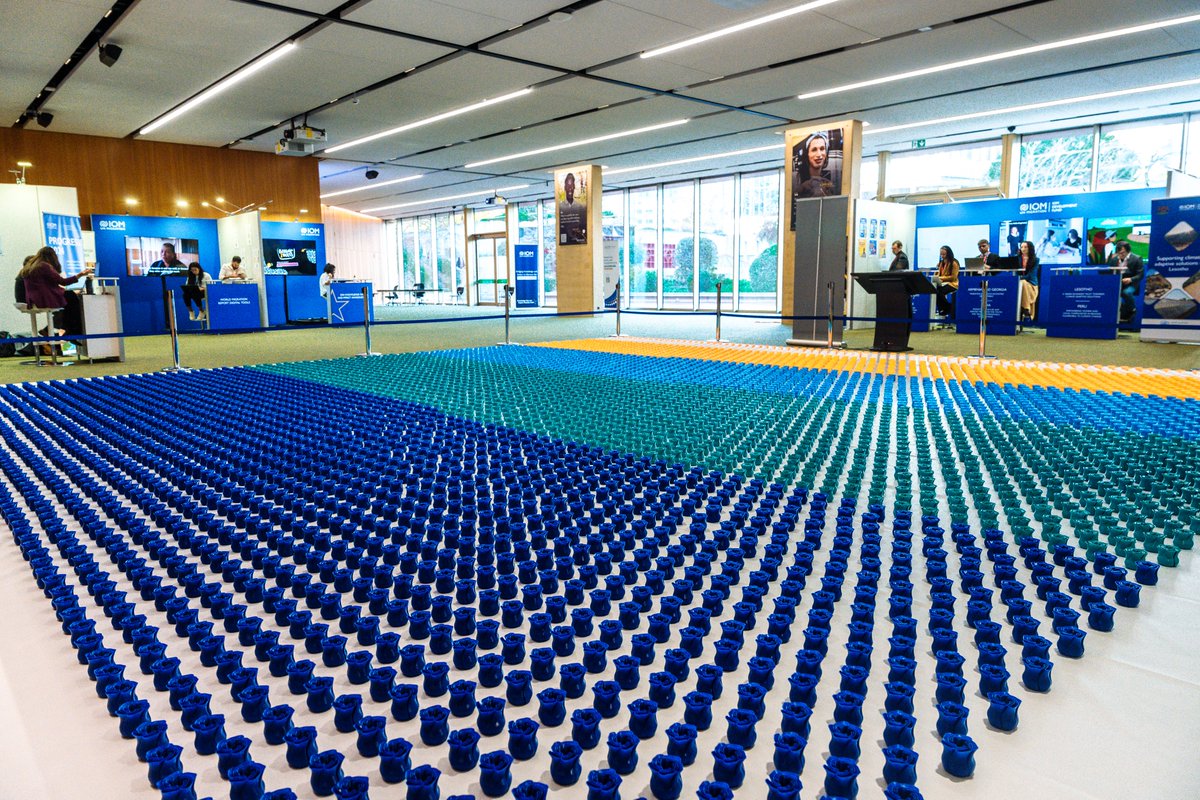
🥀One death or disappearance is one too many.
💔At #IDMigration24#IOMCouncil, we displayed 5,889 reusable roses—each representing a life lost on migration routes between January and October 2024.
Learn more about the @MissingMigrants Project 👇
https://t.co/8Fg673BK2l