Our mission is to unite #Highered students across the Commonwealth and have #KYstudents be a clear voice defending education opportunities on campus in Kentucky
Oh, my dearest darlings.
We shall end #DEI in #Kentucky.
Did you know @universityofky paid $50,000 for a white inferiority seminar?
Executive Vice President for Finance and Administration @UKYmonday, likely the future replacement of @UKYpres, focused on race-based hiring and compensation in his responses.
He chose “increase # of BIPOC M/F staff,” as his chosen anti-racism metric and specified that they be at “compensation of $50,000 or greater.” He further added that that he “created a BIPOC recruitment fund of $250,000 per year for [the] next two years.”
It is unclear where the money for this recruitment fund is from.
I wonder what @cpepres, @SteveWestKY, @JamesATipton, @kyoag has to say about this?
Our students hold different sincere beliefs, expression, ideas, and political philosophies. Like our students, each honoree has worked to ensure #Kentucky's college students can believe freely, print freely, express freely, associate freely, speak freely, and to think freely.
Affordability is the #1 issue faced by students in #KYHigherEd
From #tuition to overall cost of attendance, Kentucky’s #HigherEd students need good opportunities and meaningful programs making a difference in student success.
👏 Well done #EKU for taking the lead! Affordability is 🔑.
EKU shall be the first institution in #Kentucky to have this program.
Soon, Caudill said, students with #SNAP will be able to purchase any food items in the POD at Stratton….
“We believe this will improve food accessibility for students, faculty and staff who have or can sign up for SNAP benefits,” said Caudill. “Everyone involved at EKU Dining hopes that this will become a trend within our state to push other schools to get the available resources to provide SNAP for their campuses here in Kentucky and surrounding areas.”
EKU Dining anticipates being able to begin accepting SNAP benefits at the Stratton POD before the end of the spring semester. Eventually, EKU Dining plans to extend acceptance of SNAP benefits to Case Kitchen and the Business and Technology Center POD.”
https://t.co/bJm4tzwOyA
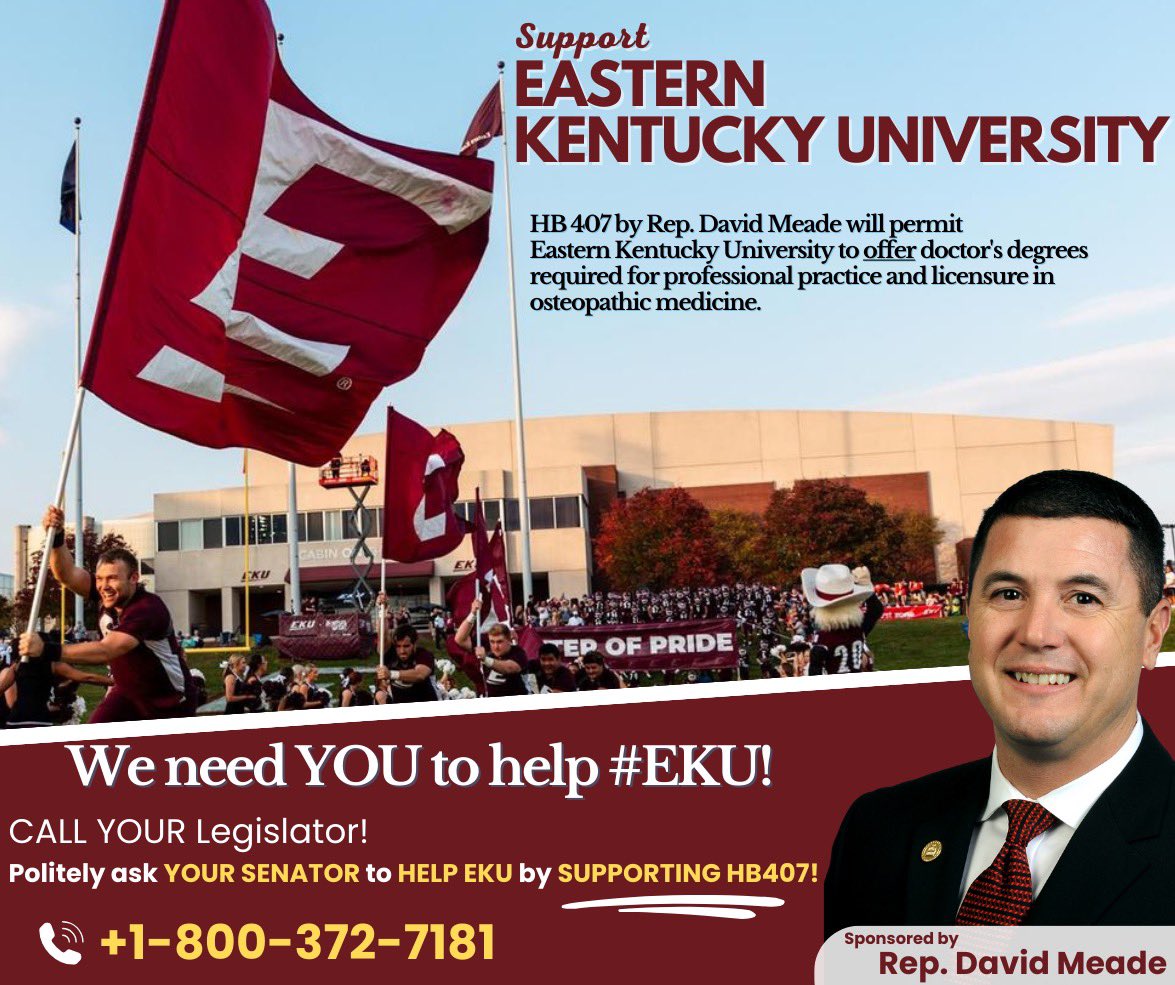
We know #Kentucky is facing a healthcare shortage.
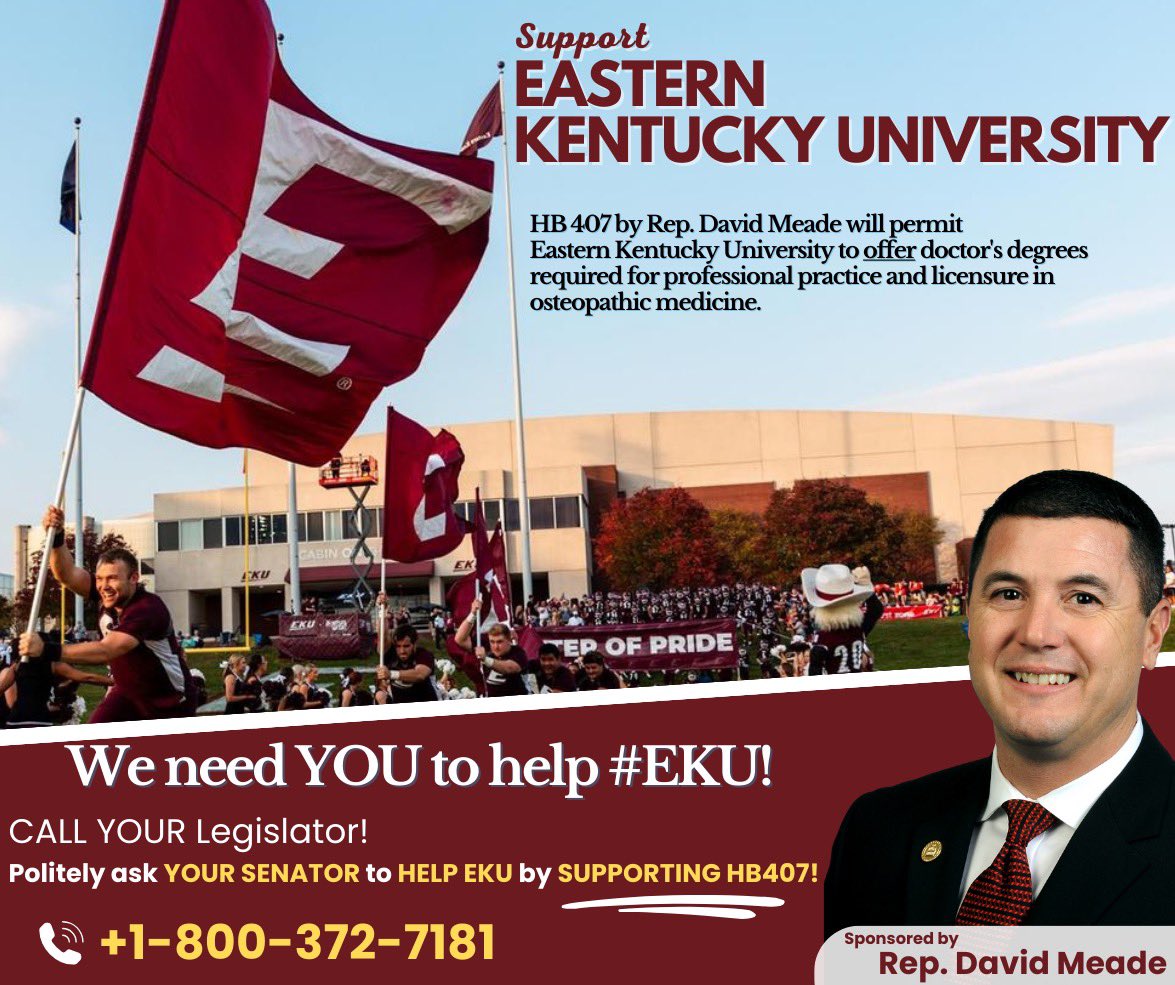
@ekupresident and Rep. David Meade (@KYHouseGOP) are working to address the essential healthcare needs of Kentucky in #HB407.
Let’s review the facts:
-Between 2019 and 2022, the number of physicians in Kentucky decreased by 590.
-Kentucky ranks 40th
among the US in its primary care physician workforce per 100,000.
-94% of Kentucky counties have a shortage of primary care physicians.
-33% of Kentucky physicians are within retirement age, having practiced between 31-50+ yrs.
-40% of Kentuckians live in rural areas, but only 17% of primary care physician practice in rural areas.
-Of Kentucky physicians who completed residency 2013-2022 only 27% are practicing in medically underserved areas.
-(U.S. stat) The class of #2022 graduated from medical school with an average debt of $205,037. The expected payoff schedule is over 20 years.
#Kentucky needs this essential bill. The @StudentRightsKY is proud to support the efforts by Rep. Meade, @ekupresident and @eku@scarborough_amy@monica_kast@RebGrapevine@mckennahorsley @ladd_sarah @AcquistoA@_AustinHorn@SteveWestKY@JamesATipton
On behalf of the @StudentRightsKY, we *strongly* condemn the #TransparencyTorpedo in today’s newly proposed version of H.B. 509.
Kentuckians cannot enjoy liberty if the government torpedoes transparency. Our press, and especially our student press, have long used Kentucky’s Open Records Law to hold their government accountable. H.B. 509 threatens to take that away.
The government belongs to everyone. As stated in the preamble of the #Kentucky State Constitution, our state government is for “the people of the Commonwealth of Kentucky, grateful to Almighty God for the civil, political and religious liberties we enjoy.”
The Kentucky Government cannot truly belong to the people if this amendment is adopted.
Call 1-800-372-7181 and politely ask your Senator: Say No to H.B. 509 and the transparency torpedo amendment.
OpEd: We cannot have healthy debate, transfer of ideas, and growth, without being able to voice our opinions without fear of censorship from those who disagree with us. https://t.co/F8poDMSe4J
As America celebrates the 236th birthday of the Constitution, FIRE’s @NicoPerrino asks: “What happens to a nation founded on the idea of liberty when its citizens don’t know what that liberty entails — or, worse yet, reject it?" for @dcexaminer.
https://t.co/oNRlpdkOoL
Sigh. Y'all, this one isn't going to be easy.
With "hate" preachers conducting their biannual visit in campus wear a shirt stating "women are property" and shouting at students with amplified sound, the following incident featured below was reported on by the @KyKernel
While this student was likely pursuing some action he thought would stand up against hate, his actions will achieve the opposite by likely giving this person a legal path for martyrdom, which is often the goal with these people on campus and why they wear and say provocative messages-which is protected speech.
Unfortunately, it looks like the student performed what's called a 'heckler's veto' on campus by grabbing this person's microphone and attempting to push him off sidewalk.
In addition to being contrary to the protections afforded by the First Amendment, a Heckler's veto is illegal in Kentucky under the Kentucky Campus Free Speech Act passed by my organization and @SavannahLMaddox. Any allowance of a heckler's veto can make the @universityofky liable for their failure to prevent the situation and must do indiscriminately.
A Heckler' veto is one of the most disappointing anti-free speech trends in recent years is when someone use of violence and other disruptive tactics to silence speakers on college campuses. This form of censorship, where a speaker’s event is canceled due to the actual or potential hostility of ideological opponents.
Facts are still being gathered on the situation and incident has been sent to colleagues for further review. While it said that the "hate preacher" had a microphone and amplified sound on campus against AR 9.1 (https://t.co/TV82coWoIv), there is doubt to the constitutionality of this policy on its face and as applied. (One of many issues with this policy).
Regardless of policy, a Heckler's veto can never be defended-even with the most hateful of speech.
Hate speech is protected speech. Nonetheless, just because speech is protected doesn't negate it can be hurtful.
We protect speech and expression-most speech and expression, including hurtful-because its potential impact on the marketplace of ideas and society.
It's just far too dangerous to allow a government-or a government campus- to decide what is too hurtful and qualify to be unprotected speech. That decision should left to the hearts and minds of a free people within a free society.
Because one person's hateful or hurtful speech is another's lyric, truth to power, call to action, no justice no peace, sincere belief, personhood or existence-including #LGBTQ existence labeled as obscene and hateful speech not too long ago.
We will know more as the facts come forward, but the fact is clear: @universityofky and @UKYpres needs to give greater investment to teach students about their #freespeech rights and how to combat speech not with possible hecklers veto or assault...but with more free speech.
@TheFIREorg@monica_kast@_AustinHorn @ladd_sarah @mckennahorsley@SeanMoodyNews@kynewsmakers@sylviaruthg
This is why I do the work, if a learning opportunity is here-take the time. A student reached out to say he learned about hecklers veto.
Just made my day. There are many resources available to learn about First Amendment rights and intersection of college campuses.
In additional to the resources at @TheFIREorg, I enthusiastically recommended reading the below linked book by @universityofky General counsel @WilliamThro
While not a reflection of any opinion by the university, the book does reflect the powerhouse experience and great intellectual prowess offered by Mr. Thro as one of the greatest constitutional scholars in our country.
This book provides a user-friendly guide to constitutional law in the context of public colleges and universities that is easily accessible to students, faculty members, and administrators.
While this book will be helpful to lawyers, our primary audience is the educated layperson. Each of the book’s chapters discusses the basic constitutional principles and how they apply in the context of public higher education.
People like me only aspire to be like Mr. Thro.
https://t.co/iqjApZ16s7
With permission, I want to show why I do this work.
Teaching students how to argue for free speech protections is not for the faint and can have the great impact in many communities, on campus and interpersonally.
My students are worth the headache. Protecting the principles guaranteed under the First Amendment is worth the time and effort to ensure the next generation continues this work.
To all my students: I know it's only Tuesday, but it's already been a tough one campuses across Kentucky, especially for queer and marginalized students advocating for free speech rights for those same people on campus telling them to burn in hell.
I want you to know I'm proud of you, your makes a difference to ensure all my speak freely on campus. Each of you, from the @universityofky to @uofl: you're doing wonderful work on campus.
To each student, know this unwavering fact: I love you. ❤️
I cannot leave CPE's response to Renee Shaw's question regarding tuition cost correlated to appropriation of direct state aid as said via @KyTonightKET episode regarding higher education on @KET without fact checking it.
The answer provided on show is just false.
Does the two have impact? Sure, but not the final scale. Although #KYGA22 provided record number of funding in 2022, no public university did any Kentucky see a loss in revenue during any year when state decreased aid. In fact...the public universities had BOTH RECORD revenue AND salaries, top university officials grew at each public university.
But guess what we did see a decrease in? Enrollment of low income students.
Despite the public universities continuance to see record revenue, to give record salaries and to set record tuition/fee cost WITHOUT matching financial aid or grant at same rate as rising costs of attendance....the cost?
Kentucky continues to see state enrollment at public higher ed stagnation and decreases with enrollment in low income students in decline.
Post #HigherEd Reform via HB1 from 1997, the system and our universities are failing.
@GeraldNeal33@kydavidgivens@SteveWestKY@JamesATipton
To supplement this argument, per the @WSJ article featuring @universityofky : "Public university leaders often blame stingier state funding for the need to raise tuition revenue. And three-fourths of states did cut their support, undermining a longstanding principle that schools educated the populace with government backing. But universities generally didn’t tighten their belts as a result. Rather, they raised prices far beyond what was needed to fill the hole.
For every $1 lost in state support at those universities over the two decades, the median school increased tuition and fee revenue by nearly $2.40, more than covering the cuts, the Journal found.
Through it all, schools operated in a culture that valued unrelenting growth and prioritized raising revenue over cutting costs. Administrators established ambitious strategic plans and tried to lure wealthy students with luxurious amenities. Influential college rankings rewarded those that spent more.
Many university officials struggled to understand their own budgets and simply increased spending every year. Trustees demanded little accountability and often rubber-stamped what came before them. And schools inconsistently disclose what they spend, making it nearly impossible for the public to review how their tuition and tax dollars are being used.
“These places are just devouring money,” said Holden Thorp, who was chancellor at the University of North Carolina at Chapel Hill from 2008 to 2013 and is now editor in chief of Science.
Offering everything to everyone all at once is unsustainable, he said. “Universities need to focus on what their true priorities are and what they were created to do,” he said...
To examine public university spending, the Journal collected data from audits, archived budget websites and documents received through public-records requests covering expenses in fiscal 2002, 2012 and 2022.
Much of the increase in outlays showed up in the hiring process, for administrators, faculty, coaches and finance experts, the Journal’s analysis found. Salaries and benefits, which usually eat up more than half of operating budgets, rose by roughly 40% at the median flagship since 2002."




![Mr_FrazierKY's tweet photo. Oh, my dearest darlings.
We shall end #DEI in #Kentucky.
Did you know @universityofky paid $50,000 for a white inferiority seminar?
Executive Vice President for Finance and Administration @UKYmonday, likely the future replacement of @UKYpres, focused on race-based hiring and compensation in his responses.
He chose “increase # of BIPOC M/F staff,” as his chosen anti-racism metric and specified that they be at “compensation of $50,000 or greater.” He further added that that he “created a BIPOC recruitment fund of $250,000 per year for [the] next two years.”
It is unclear where the money for this recruitment fund is from.
I wonder what @cpepres, @SteveWestKY, @JamesATipton, @kyoag has to say about this?](https://pbs.twimg.com/media/GUyQFlHWcAAdkFp.jpg)