IT IS A KFIR ( 2007 )
The documentary explores how the Sri Lankan state used Israeli Kfir jets for airstrikes, terrorizing Tamil children, targeting schools, and devastating civilian life in Tamil regions.
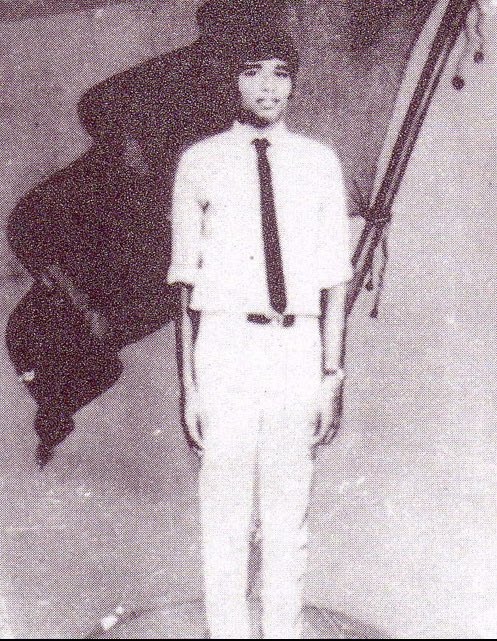
🧵 52 years ago, Pon Sivakumaran became the first Tamil militant to attain martyrdom, the first seed sown in the struggle for Tamil liberation.
Sivakumaran was a member of the Tamil Manavar Peravai (or Tamil Student Federation, TSF) and a leading militant in the early armed Tamil struggle. With decades of Sri Lankan state repression and deadly anti-Tamil pogroms already having taken place, Tamil militant movements began to form. Sivakumaran was involved in assassination attempts on both Somaweera Chandrasiri and Alfred Duraiappah.
In 1974, the oppression of the Tamil nation reached a new stage when the World Tamil Research Conference, an acclaimed event that appreciated and furthered Tamil culture, was marred by the brutality of Sri Lankan security forces. The Sri Lankan state was angered after organisers defied Sri Lankan government calls to hold the event in Colombo and held it in Jaffna between the 3rd - 6th January instead. The violence unleashed by the state’s forces at the event, left nine people dead.
Despite several months and widespread outpouring of Tamil grief and anger at the event, the killings were met with impunity. With no justice or accountability for the crimes in sight, Sivakumaran along with other Tamil youth looked to assassinate individuals alleged to be responsible for the deaths at the World Tamil Research Conference.
However, on 5th June, Sivakumaran was surrounded by Sri Lankan security forces. He had previously been tortured during an earlier detention in police custody for damaging property of those responsible for the conference killings. Evading torture, Sivakumaran committed suicide using a capsule of cyanide, in order to negate the risk of revealing information that jeopardised the growing Tamil armed resistance movement. He became the first Tamil militant to die in the armed struggle, and his death sparked widespread grief across Tamil Eelam.
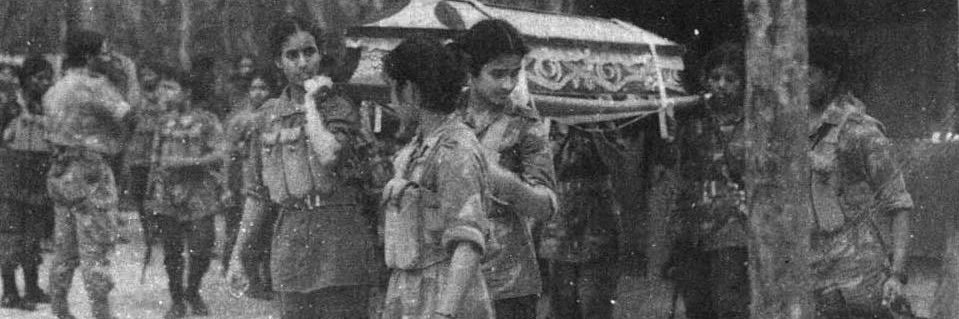
His body was carried from Jaffna hospital to his birthplace of Urumpirai in a large-scale funeral procession, attended by several senior Tamil political leaders of the time. A statue was constructed in his hometown to honour his sacrifice.
🧵 52 years ago, Pon Sivakumaran became the first Tamil militant to attain martyrdom, the first seed sown in the struggle for Tamil liberation.
Sivakumaran was a member of the Tamil Manavar Peravai (or Tamil Student Federation, TSF) and a leading militant in the early armed Tamil struggle. With decades of Sri Lankan state repression and deadly anti-Tamil pogroms already having taken place, Tamil militant movements began to form. Sivakumaran was involved in assassination attempts on both Somaweera Chandrasiri and Alfred Duraiappah.
In 1974, the oppression of the Tamil nation reached a new stage when the World Tamil Research Conference, an acclaimed event that appreciated and furthered Tamil culture, was marred by the brutality of Sri Lankan security forces. The Sri Lankan state was angered after organisers defied Sri Lankan government calls to hold the event in Colombo and held it in Jaffna between the 3rd - 6th January instead. The violence unleashed by the state’s forces at the event, left nine people dead.
Despite several months and widespread outpouring of Tamil grief and anger at the event, the killings were met with impunity. With no justice or accountability for the crimes in sight, Sivakumaran along with other Tamil youth looked to assassinate individuals alleged to be responsible for the deaths at the World Tamil Research Conference.
However, on 5th June, Sivakumaran was surrounded by Sri Lankan security forces. He had previously been tortured during an earlier detention in police custody for damaging property of those responsible for the conference killings. Evading torture, Sivakumaran committed suicide using a capsule of cyanide, in order to negate the risk of revealing information that jeopardised the growing Tamil armed resistance movement. He became the first Tamil militant to die in the armed struggle, and his death sparked widespread grief across Tamil Eelam.
His body was carried from Jaffna hospital to his birthplace of Urumpirai in a large-scale funeral procession, attended by several senior Tamil political leaders of the time. A statue was constructed in his hometown to honour his sacrifice.
For those who survived the Biafran War, the memories remain painfully vivid.
Now in their 70s and 80s, former fighters are sharing their stories with #BBCAfricaEye before they are lost to history.
📽 Watch Surviving Biafra: https://t.co/xFd6eSoPJp
Sri Lanka officially recognized Tamil as a language only after decades of conflict, discrimination, and genocide, largely due to pressure from the Tamil Tigers and India’s intervention in the conflict.
People often act as if the Sinhalese political establishment willingly granted language rights to Tamils. In reality, India pressured Sri Lanka to do so, and many Sinhalese opposed these measures and protested against them. The government implemented the changes, at least on paper, to satisfy the regional superpower.
However, just because Tamil is an official language does not mean it has been properly implemented. Many Tamils living in Tamil-majority areas can attest to this. In government offices and police stations, it is still common to encounter officials who cannot properly speak Tamil and know only a few insults in the language.
The same problem exists in several areas of the south, including Colombo. When the cyclone hit, it became clear how little Tamil language rights meant in practice, as government notices were issued only in Sinhala, with no Tamil translations provided.
I could speak for hours on this.
ENLF meets Rajiv | SPOKESMAN: Official Organ of the Eelam Peoples Revolutionary Liberation Front (September I October 1985)
In this bulletin, EPRLF talks about the historic meeting between the Tamil liberation groups, the Thimpu Principles, the class character of the conflict, the jailbreak in Batticaloa, South Africa’s apartheid system, and the problems in the Eastern Province caused by trigger-happy Home Guards.
PDF: https://t.co/5WzadfK2a1
ENLF meets Rajiv | SPOKESMAN: Official Organ of the Eelam Peoples Revolutionary Liberation Front (September I October 1985)
In this bulletin, EPRLF talks about the historic meeting between the Tamil liberation groups, the Thimpu Principles, the class character of the conflict, the jailbreak in Batticaloa, South Africa’s apartheid system, and the problems in the Eastern Province caused by trigger-happy Home Guards.
PDF: https://t.co/5WzadfK2a1
📣 We're looking for new team members!
We're looking for translators and proofreaders. Would you like to contribute to the success of the class struggle, but don't have the opportunity to do so in your immediate area?
At midnight on 31st May 1981, the prestigious Jaffna Public Library was set ablaze by Sri Lankan security forces and state-sponsored Sinhala mobs. The library housed over 97,000 rare books and manuscripts, positioning it as one of the largest in Asia and the foremost repository of Tamil literature.
This was an act of cultural genocide perpetrated by the Sinhalese against the Tamils. It is no different from what the Nazis did in 1933 with the burning of books in Germany.
Never forget, never forgive!
At midnight on 31st May 1981, the prestigious Jaffna Public Library was set ablaze by Sri Lankan security forces and state-sponsored Sinhala mobs. The library housed over 97,000 rare books and manuscripts, positioning it as one of the largest in Asia and the foremost repository of Tamil literature.
This was an act of cultural genocide perpetrated by the Sinhalese against the Tamils. It is no different from what the Nazis did in 1933 with the burning of books in Germany.
Never forget, never forgive!
Karate in Tamil Eelam 🥋
In the de facto state of Tamil Eelam, among the Tamil resistance and the civilian population living in liberated areas, karate was very popular.
Every Tamil cadre had to undergo extensive karate training. A wide-ranging program was instituted to encourage the learning of karate among both boys and girls. Vanni-wide competitions were also conducted for all age groups. The learning of karate by girls of all ages was a revolutionary idea among Tamils, and it contributed to the development and advancement of women in many ways.
This was quite an astounding program for that part of the world.
Karate in Tamil Eelam 🥋
In the de facto state of Tamil Eelam, among the Tamil resistance and the civilian population living in liberated areas, karate was very popular.
Every Tamil cadre had to undergo extensive karate training. A wide-ranging program was instituted to encourage the learning of karate among both boys and girls. Vanni-wide competitions were also conducted for all age groups. The learning of karate by girls of all ages was a revolutionary idea among Tamils, and it contributed to the development and advancement of women in many ways.
This was quite an astounding program for that part of the world.
The revelation that a large number of Buddhist monks in Sri Lanka are accused of abusing children was made in response to a freedom of information request by OCCRP. It comes as the country grapples with child sex allegations against one of its most senior Buddhist clergymen.
https://t.co/fSG0ZZbiUj