TRIC = Therapeutic Relationships in CAMHS. We work with young people, carers, clinicians and researchers to understand and improve this vital aspect of support.
‘Therapeutic relationships between patients and staff are just as important as the specific treatment they are receiving, if not more so,’ argues @HartleySamantha in our feature exploring connections between nurses and young people using CAMHS https://t.co/spaBaZEbEp
"This is the fight that will teach me that my shadow is not bigger than my light."
Dr @HartleySamantha has shared this advice for parents on supporting children's mental health.
Sam also reads part of a resource called 'the letter your teenager can't write'. @HealthyYM
Exciting conversations today about how we could adapt our work into a national training + support offer for staff! The fact that our qualitative findings are so grounded in the experience of young people , family members + nursing staff means it's already real and meaningful 😊
Our TRIC research findings have formed part of this work, alongside lots of other evidence, clinical reflections and lived experience expertise. Putting relationships front and centre within inpatient CAMHS.
We want the value and complexity of therapeutic relationships to be recognised and supported.
If you'd like to use our video in teaching and training, just let us know!
https://t.co/12YaMwbWQj
A great example of how research can be made accessible by displaying the key points in a nice and colourful graphic!
Check out the research about theraputic relationships in CAMHS services 👇
One of our key papers is out! 🙌
Thank you so much again to all of the participants and our Moving Forward Young People and Carers Council for their guidance.
Next step - incorporate this learning into #CAMHS staff training.
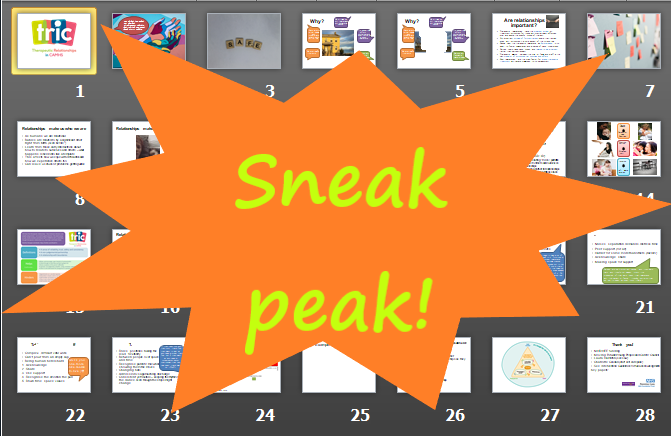
A sneak peak of our fully mapped out staff training package for #inpatient#CAMHS that we hope to deliver and evaluate soon, alongside ongoing staff support
So exciting! 😁 A preview of our original animation to share the findings of our qualitative research exploring therapeutic relationships in inpatient CAMHS.