this is just a beta selloff for $MU and $SNDK -- there is a @vector__news story out that explains plainly why $META is not going to be renting out cloud compute anytime soon. if the market was taking this seriously $NVDA would be -10% to -20%, recommend buying momentum
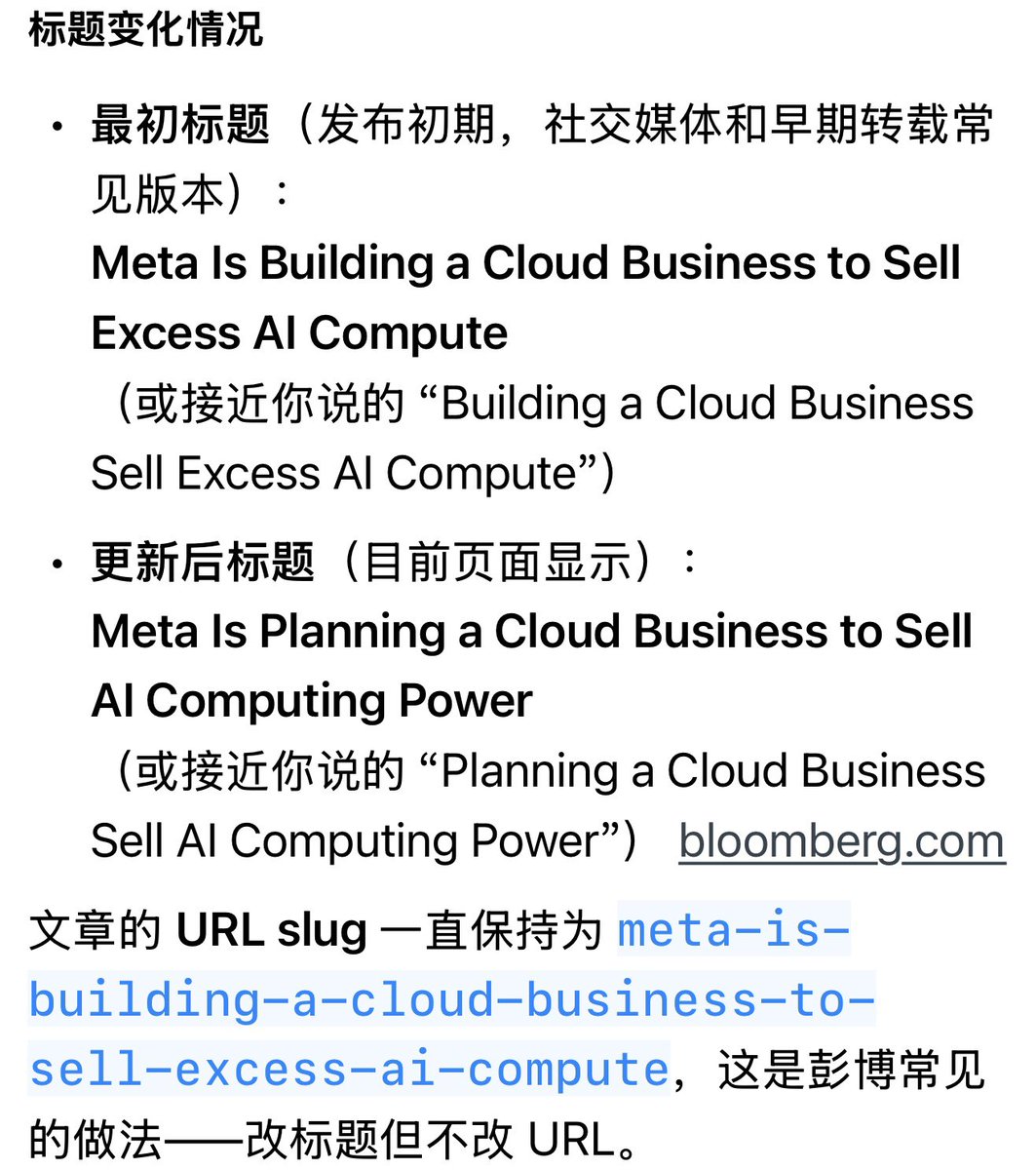
从Excess到Planning:Meta算力过剩鬼故事是怎么传出来的?不知道大家有没有关注昨晚这条砸崩市场的彭博新闻其实中间有改过一次标题的。
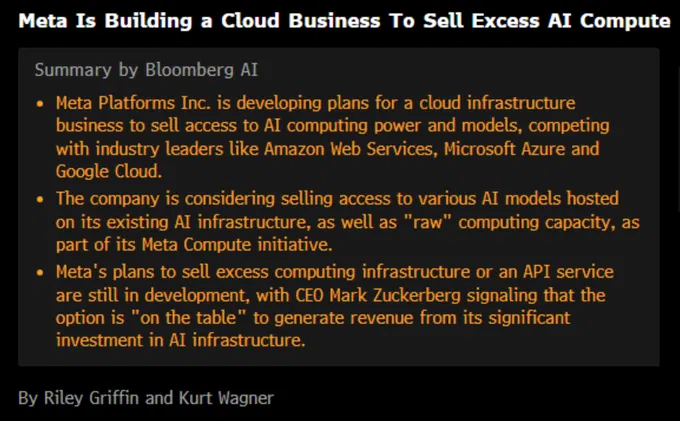
1、昨晚上8:35分,彭博发了一条新闻,当时的原标题是:“Meta Is Building a Cloud Business to Sell Excess AI Compute"。这个标题确确实实表达出来了一种“Meta”的算力“过剩”的意思
昨晚上十点之后你再去看彭博的这篇报道、标题已经变成了“Planning a Cloud Business Sell AI Computing Power”。
同一篇文章,同一个链接,标题改了...
大家关注的“Excess”不见了,又把building修饰成了planning。
最搞笑的是路透社,路透很快跟进转引了这条消息,但路透社报道的主题是:彭博报道Meta可能出售excess AI capacity,但计划还没定,路透也没独立核实。
2、这就带来了最关键的一个问题:彭博为什么要改标题?
没法替彭博编辑部回答这个问题,但从结果上看,这次修改非常清楚直观的的降低了原标题的确定性和杀伤力。
昨晚市场交易的,并不只是Meta要做云业务,而是彭博原标题里那个“Excess”带来的“算力过剩”联想。后面彭博修改了标题、但是过剩的联想已经散布出去了。这也是为什么这事会迅速从一个公司新闻,因为一个单词,加上全网的病毒式传播,变成半导体链条的鬼故事。
因为如果 Meta 有“过剩算力”,市场马上会往下推:
Meta 是不是之前买多了卡? 如果 Meta 买多了,微软、谷歌、亚马逊会不会也买多了? 如果大厂都买多了,那 AI capex 是不是过热? 如果 AI capex 过热,那 GPU、HBM、先进封装、服务器、电力、液冷、光模块,是不是都要一起承压?
这个链条听起来挺顺的,但太顺的故事很多时候不是逻辑,而是情绪的滑梯。
然后最有意思的是盘面。
如果市场真的把这条新闻理解成“AI 需求崩了”“Meta 算力用不完了”,那 Meta 自己不应该是昨晚最强的那个。美股盘中的Meta接近10%的上涨,CoreWeave、Nebius 这类 neocloud 公司两位数下跌,英伟达则小幅承压。
所以市场交易不是需求崩了(否则meta也涨不动),而是“过剩excess”,meta来抢算力订单,不会那么多资本开支了。
CoreWeave、Nebius 跌,交易的是“因为如果 Meta 这种原本的大客户未来也能卖算力”,那 neocloud 的叙事就没有那么让大家买账了。
半导体全链条跌,交易的是资本开支可能的放缓。
3、后续怎么看?
1)首先这个meta算力的问题在于自己的模型拉垮,跟spacex出租算力原因一样,自家模型拉垮。如昨晚推文聊到的,对于meta过剩这事还是略有疑问。毕竟最近一直都在签署第三方的算力合同。
2)meta内部消耗算力其实两大部分,一块是自身模型,另一部分AI广告相关,金融时报报道gemini限制meta算力访问就是因为自身模型的问题、meta的Ai广告部分使用gemini的模型。
3)meta股价盘中大涨接近10%,收盘8%,估计小扎也不会出来辟谣,终于扬眉吐气了一把。
4)市场奖励出租算力,那就是AI需求没问题,大家质疑的是算力是过剩了么?那AI算力租赁价格的变化应该会给我们答案。
当然最核心的还是说,市场拥挤度太高了,之前这里还有聊过https://t.co/3QnCKTUPHz。
不过确实AI应用可以值得关注了、已经看到了几个开始正在冒头。
本条由@bitget_zh赞助,「Bitget 买美股:秒级入场,丝滑交易 」
Meta is building a cloud business to sell excess AI computing capacity to outside customers essentially turning Meta's $125–$145 billion capex spend into a direct revenue line for the first time (Save this).
Meta has been the only major US hyperscaler without a cloud business, Amazon has AWS, Microsoft has Azure, Google has GCP and that missing revenue line has weighed on the stock every single time Zuckerberg raised capex guidance.
That objection just disappeared, now look at what the Wells Fargo model is actually telling you.
The bottom chart shows Meta's total compute capacity growing from 7.5 GW in 2025 to 21.2 GW by 2028 nearly tripling in three years.
The light blue section, AI-focused capacity goes from just 1.5 GW in 2025 to 13.2 GW in 2028, representing the excess compute that is now, as of this morning, a monetizable product instead of a pure cost center.
The table at the top prices what that capacity is actually worth.
Wells Fargo models $20 billion in revenue per gigawatt at an 85% operating margin meaning just 1 GW of resale generates $17 billion in operating income, $14.6 billion in net income, and $5.69 in EPS accretion, a 16.3% uplift to FY27 consensus from a single gigawatt.
Meta is sitting on a path to 13.2 GW of AI-focused capacity by 2028.
Even if they monetize a fraction of that externally, the math becomes enormous and the market is only now starting to price it in, which is why the stock is up 7.5% pre-market this morning.
The plan reportedly includes selling access to AI models hosted on Meta's infrastructure similar to AWS Bedrock where Meta runs the chips and data centers, hosts models including its own Llama and Muse Spark, and charges developers per token to access them.
That is not just a compute play but rather a B2B AI services business that turns Meta from a social media company into an enterprise AI platform with recurring revenue and cloud-level margins.
Zuckerberg has been telegraphing this for months
At the shareholder meeting in May he said a cloud business was "definitely on the table" and noted that companies approach Meta "almost every week" asking to buy compute at a premium.
The demand was always there but today Meta decided to answer it.
Meta generated $56.3 billion in revenue in Q1 2026, up 33% year over year, with ad impressions up 19% and 3.56 billion daily active users across its family of apps and that was before a single dollar of cloud revenue.
I am as bullish on Meta as I have ever been and the Capex the market has been punishing them for just became the asset.
Meta has been a core position in the Milk Road portfolio and today is exactly why.
If you want to see every position we're holding, what we're buying next and our entire thesis, come join us just for a dollar!
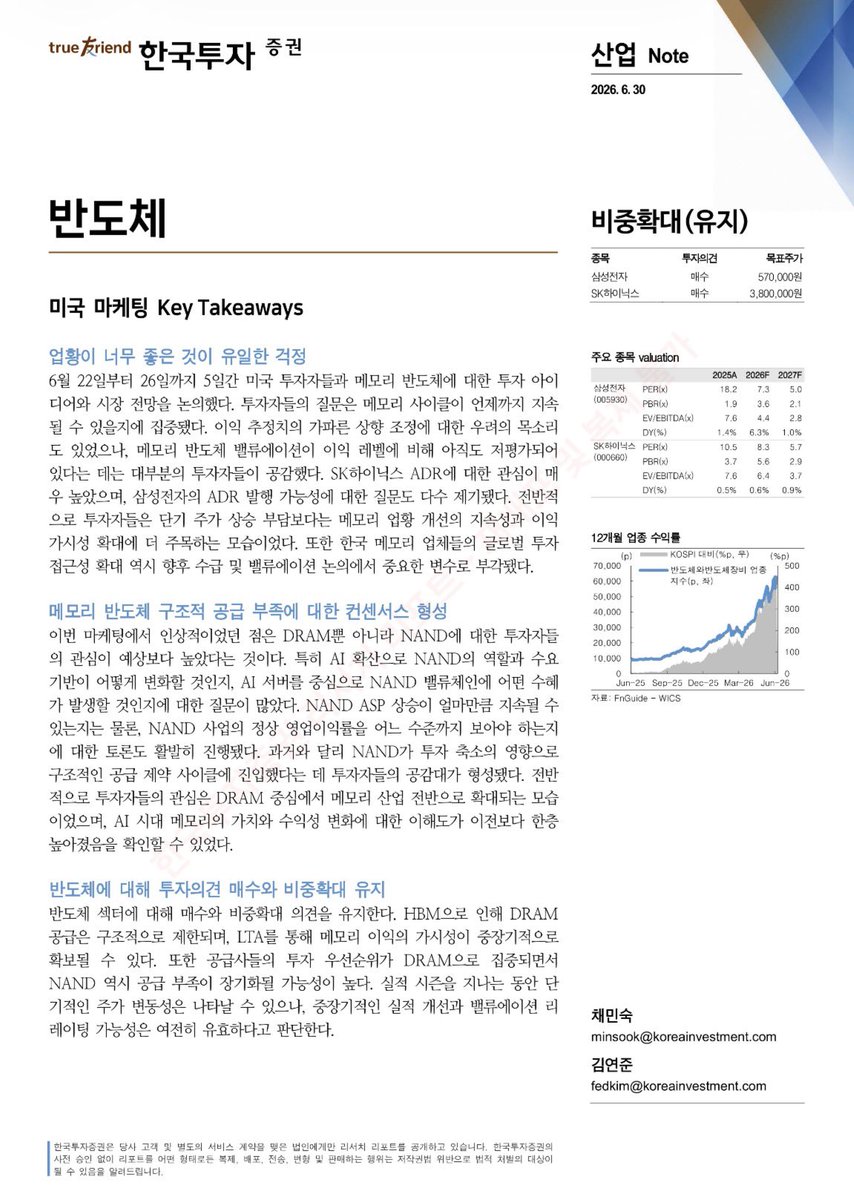
메모리 사이클 어디까지 가나, 미국 투자자들이 던진 질문들
(한국투자증권, 채민숙, 김연준)
- 6월 22일부터 26일까지 닷새간 미국 투자자들을 만나 메모리 반도체 관련 미팅을 진행함
- 이익 추정치가 가파르게 오른 데 대한 우려도 있었지만, 투자자 대부분은 밸류에이션이 이익 레벨에 비해 여전히 낮다는 데 공감함
- SK하이닉스 ADR에 대한 관심이 컸고, 삼성전자도 ADR을 발행할 가능성이 있는지 묻는 투자자가 많았음
- DRAM뿐 아니라 NAND를 향한 관심도 예상보다 컸는데, AI 서버 수요가 NAND 밸류체인에 어떤 수혜를 줄지가 주요 질문이었음
- 투자 축소 영향으로 NAND 역시 공급이 구조적으로 제한되는 국면에 들어섰다는 데 투자자들이 공감함
- 3분기부터는 PC와 스마트폰 고객사가 가격을 더 올리기 어려워지고, 서버 고객사는 LTA 가격이 반영되면서 하반기 DRAM ASP 상승폭이 상반기보다 둔화될 전망임
- 27년 HBM 가격은 26년 대비 100퍼센트 이상 오를 것으로 보고, HBM4는 3.0달러, HBM4e는 3.3달러 수준을 모델에 반영함
- 시장은 이보다 높은 가격을 기대하지만, HBM 특성상 범용 DRAM과 같은 이익률까지 오르긴 어렵다고 봄
- 젠슨 황 방한 당시 엔비디아가 SK하이닉스와 HBM을 포함한 LTA를 체결했고, 삼성전자와 마이크론도 엔비디아와 LTA를 맺을 것으로 기대됨
- LTA 때문에 가격 상승이 제한되더라도, DRAM 계약 시장은 스팟 시장과 달리 물량과 장기 파트너십을 우선하기 때문에 공급사 입장에서 손해로 보기는 어려움
- 고객사들은 28년 이후 신규 팹 물량까지 알고 있으면서도 먼저 장기계약을 제안했는데, 이는 공급 부족이 단기에 끝나지 않을 거라는 신호로 해석됨
- 마이크론 SCA는 계약 디테일을 시장과 공유한 점에서 긍정적으로 평가하고, 삼성전자와 SK하이닉스 LTA와도 조건이 비슷한 것으로 파악함
- 메모리 공급사 5곳 모두 3년에서 5년짜리 LTA를 비슷한 조건으로 맺고 있는데, 이는 메모리 비즈니스 모델 자체가 달라지고 있음을 보여줌
- NAND 공급사들은 점유율 확대보다 수익성을 우선하면서 공급 부족 국면을 만들어가고 있다고 판단함
- 제한된 캡엑스가 HBM 중심 DRAM 투자에 먼저 배분되면서, NAND 증설은 상대적으로 더디게 진행되고 있음
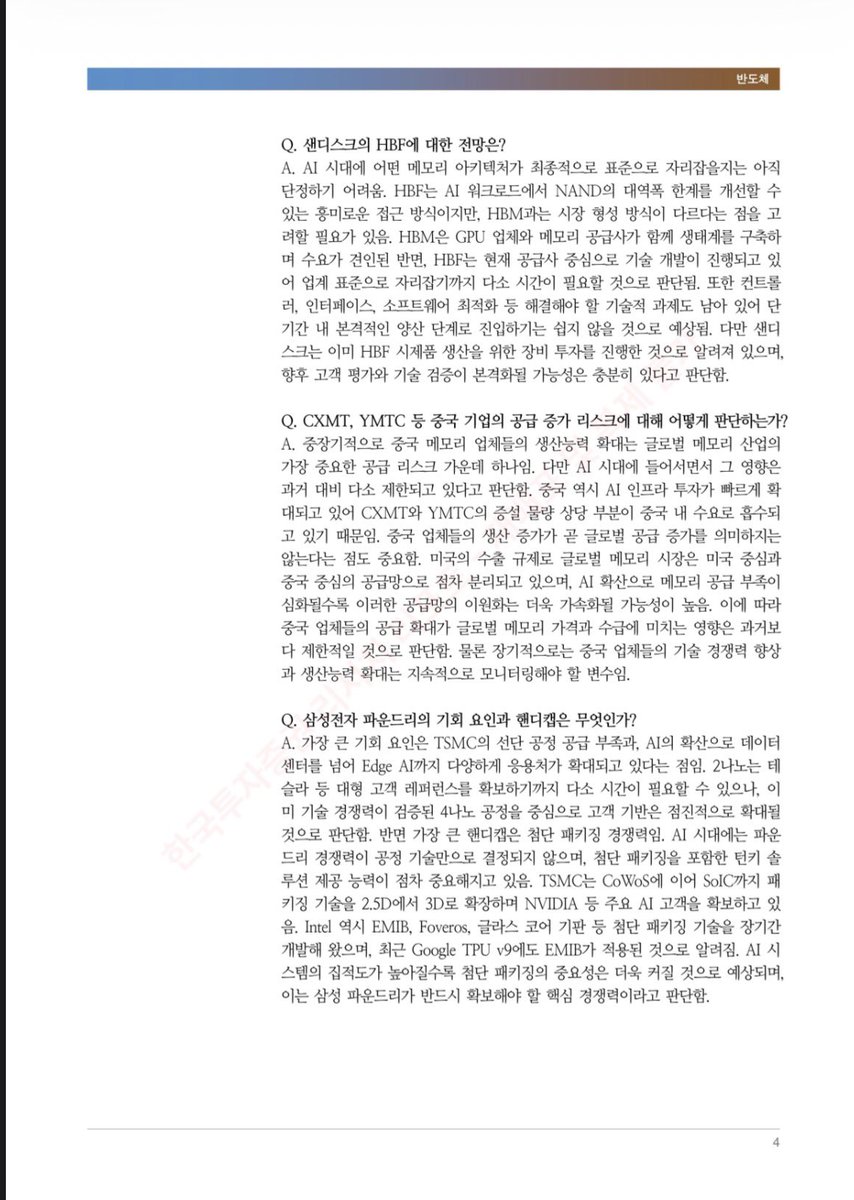
- 샌디스크 HBF는 NAND의 대역폭 한계를 보완할 흥미로운 시도지만, HBM과 달리 공급사 중심으로 개발이 진행되고 있어 표준으로 자리 잡기까지 시간이 걸릴 전망임
- 컨트롤러와 인터페이스, 소프트웨어 최적화 등 풀어야 할 기술 과제도 남아 있어 단기 양산은 쉽지 않을 것으로 봄
- CXMT와 YMTC 등 중국 메모리 업체의 증설은 중장기 리스크지만, 늘어난 물량 상당 부분이 중국 내 AI 수요로 흡수되고 있어 영향은 과거보다 제한적이라고 평가함
- 미국 수출 규제로 메모리 공급망이 미국 중심과 중국 중심으로 점차 나뉘는 모습도 나타나고 있음
- 삼성전자 파운드리는 TSMC의 선단 공정 공급 부족과 엣지 AI 확산을 기회로 보고, 4나노 고객 기반을 발판 삼아 점진적으로 확대할 수 있을 것으로 봄
- 다만 첨단 패키징에서는 TSMC와 인텔이 앞서 있어, 삼성전자가 반드시 따라잡아야 할 부분으로 지적됨
- 반도체 섹터에 대해서는 매수와 비중확대 의견을 유지하며, 단기 변동성은 있어도 중장기 밸류에이션 리레이팅 가능성은 여전히 유효하다고 봄
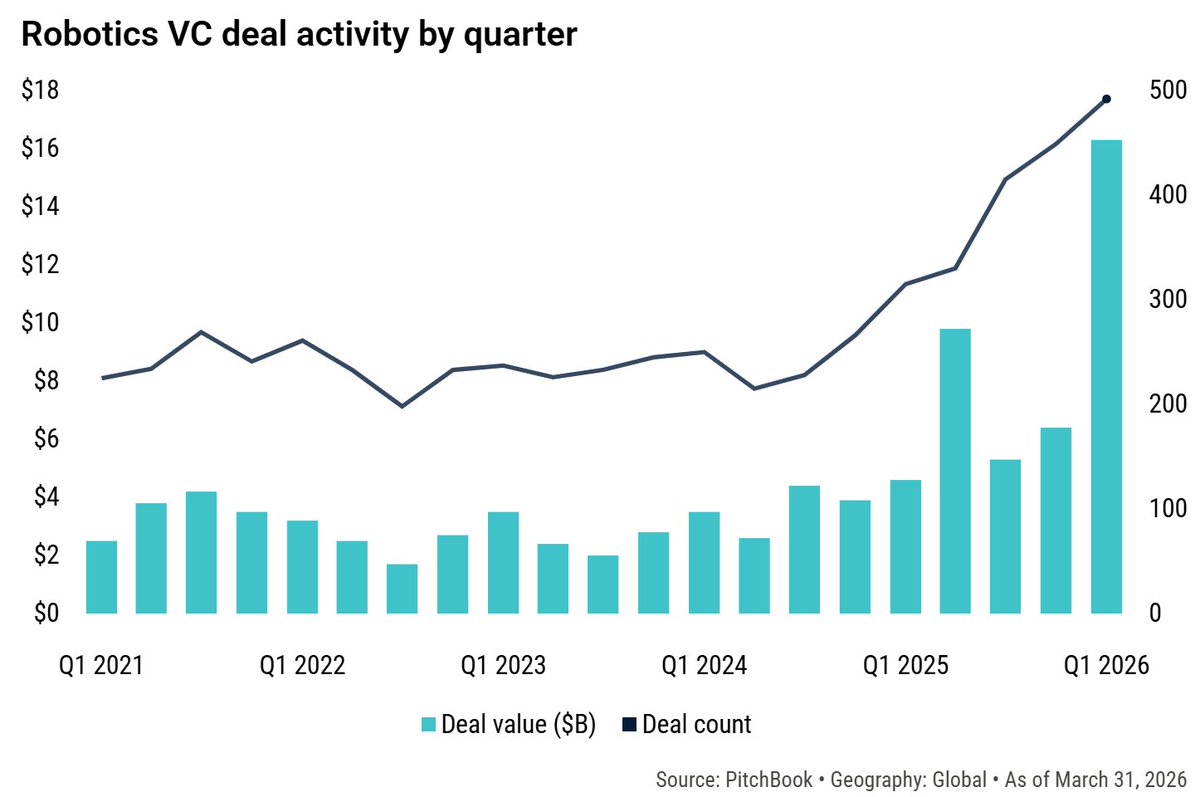
Robotics is moving so fast.
I expect deal value to 10x in the upcoming years.
With private capital flowing into companies that can manufacture at scale + win paying customers.
Some of the biggest deals so far this year include:
-> Saronic (US) w/ $1.75B Series D in March for autonomous naval vessels.
-> Skild AI (US) w/ $1.4B round for humanoid software.
-> Apptronik (US) w/ $0.94B Series A for industrial humanoids.
-> Mind Robotics spun out from $RIVN and raised $0.9B YTD.
There'll be plenty of public investment opportunities though.
Either by investing upstream in the suppliers that make up humanoid's BOM e.g. in actuators or perception systems.
In a similar style to the AI supply chain, going upstream to find where the winners are.
Or via pure-play robotics companies selling B2B and B2C once production ramp hits in a year or two.
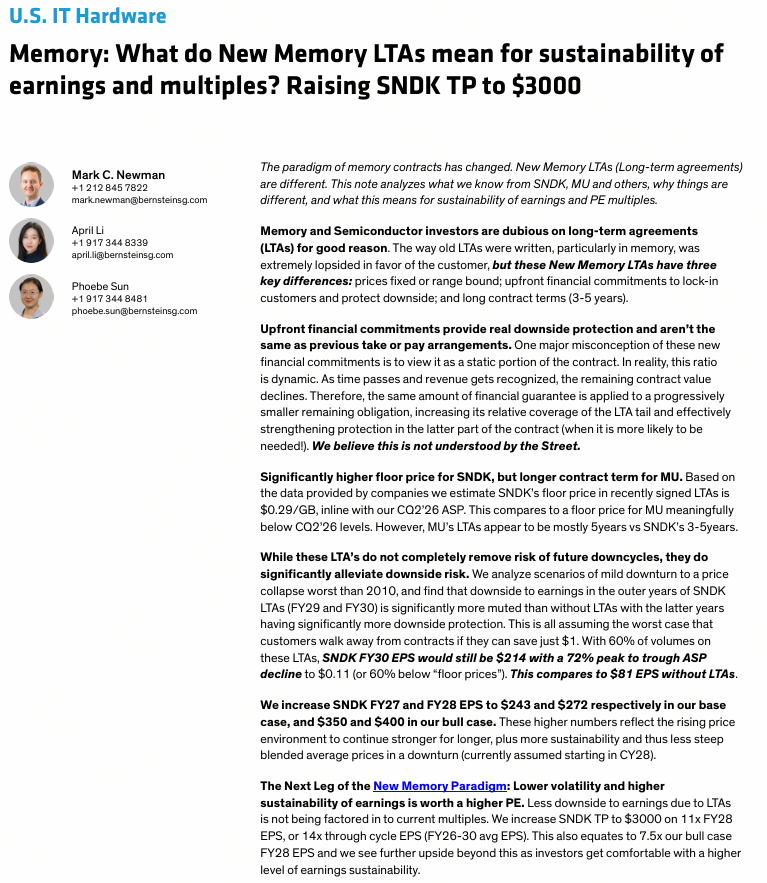
Bernstein raises their $SNDK price target to $3000, arguing that the new LTAs are different due to (1) prices fixed or range bound; (2) upfront financial commitments to lock-in customers and protect downside; and (3) long contract terms (3-5 years)
$3000 price target based on 11x FY28 EPS estimate of $272 / share
KIS: On Memory LTAs
With suppliers' commodity DRAM operating margins already at 80% and gross margins above 90%, prices cannot be raised endlessly on supply and demand dynamics alone. What matters is that at price levels where supplier operating margins exceed 80%, it was the customers, not the suppliers, who first actively proposed three to five year long term agreements. The customers are not unaware of Samsung and SK Hynix's fab plans, and they know that new fab output begins contributing to supply from 2028 onward. The fact that they nonetheless proposed long term agreements covering 2028 and beyond first is evidence that the memory supply shortage will not end within a short period. The key point is that suppliers have used this to secure, for the first time in memory history, a contract structure that sustains high margins over an extended period.
Comparing Micron's LTA with those of Samsung and SK Hynix, SK Hynix has only a price floor with no price ceiling, while Samsung, similar to Micron, is understood to include both a price ceiling and a price floor in its LTA terms. The structure of collecting a portion of annual revenue upfront as advance payments is also similar. The advance payment is a binding condition that prevents arbitrary volume changes after the contract is signed. However, unlike SanDisk, Samsung, and SK Hynix, Micron's advance payment is presumed to be structured as refundable upon maintenance of the contract rather than deducted from revenue. The LTA contract period is similar across all memory suppliers at three to five years per customer. Customers who have already completed their contracts maintain three to five year terms beginning in 2Q26 and running through 2028 or 2030. The fact that all five memory suppliers (Samsung, SK Hynix, Micron, Kioxia, SanDisk), and not a single supplier alone, are signing similar three to five year LTAs is what explains the structural change in the memory business model.
>> Lenovo: Rising memory prices are the “new normal”; elevated DRAM and NAND pricing to persist beyond 2030
• The era of cheap digital devices is coming to an end. Lenovo warned that DRAM and NAND flash prices have already entered a structural upcycle, and that even if major suppliers continue to expand capacity, prices are unlikely to return to early-2025 levels.
Higher costs are being passed through across the entire industry. Going forward, all types of electronic devices, including PCs and smartphones, are expected to face sustained price-increase pressure, with higher prices becoming the “new normal” beyond 2030.
I find it hard to understand why some people are interpreting Micron’s latest LTA signing as the end of the memory price upcycle.
Signing an LTA ultimately means that the amount of supply in the market that has not yet been locked up is shrinking. In other words, the later a customer signs an LTA, the greater the pressure they face to secure stable supply, and the stronger their FOMO becomes.
Over time, the fear of failing to secure enough memory will only intensify. That creates an environment where memory makers can secure LTAs on increasingly favorable terms.
I do not think this LTA marks the end of price increases. If anything, I think it is closer to the beginning.
$SNDK could seriously be a $650B+ company especially if HBF materialises as expected.
I'm just intuitively guessing given that's where their upcoming growth vector is.
Modelling EPS for Sandisk/memory is a waste of time right now. It's impossible coming up with any half decent assumptions on volumes/ASPs.
I'm just looking out to the next couple years and going long on the TAM (and therefore EPS) expansion.
New $SNDK HBF Patent:
Analysis in plain English (hopefully):
The patent is about training models, which flash is supposedly bad at.
The reason they could file it is that they found the loophole where it doesn't cover full training. Rather, it covers fine-tuning via a method called LoRA which keeps almost everything static.
Instead of retraining the whole model, you freeze it & train only a tiny add-on bolted to the side. The frozen part never changes during the process.
Sandisk's insight is if the big part never changes, you don't need expensive memory to hold it....you just need to read it, over and over again.
And reading is the one thing that cheap flash is perfectly fine at.
So the patent parks the frozen giant model on cheap flash + keeps only the tiny changing part on the expensive fast memory.
Quite elegant imo since it doesn't try to fix flash's weakness. It just makes it irrelevant.
Imo the accurate way to frame this patent is that it widens HBF's tam from pure inference into training.
And the encouraging thing for Sandisk is that the programme behind this looks real rather than theoretical e.g. partnership w/ SK hynix to turn hbf into the industry standard.
Ofc, patents aren't revenue. What'll actually matter is qualification/shipments. I.e. roadmaps.
From my understanding though, first hbf chips sample later this yr w/ first products using them arriving some time in 2027.
---
Patent number: US 2025/0390733 A1
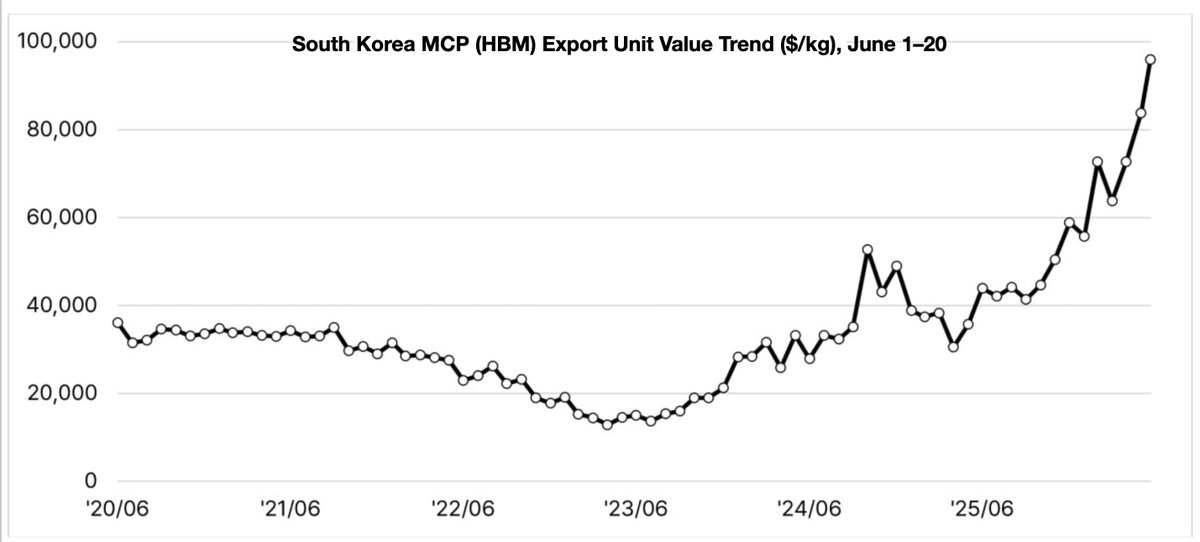
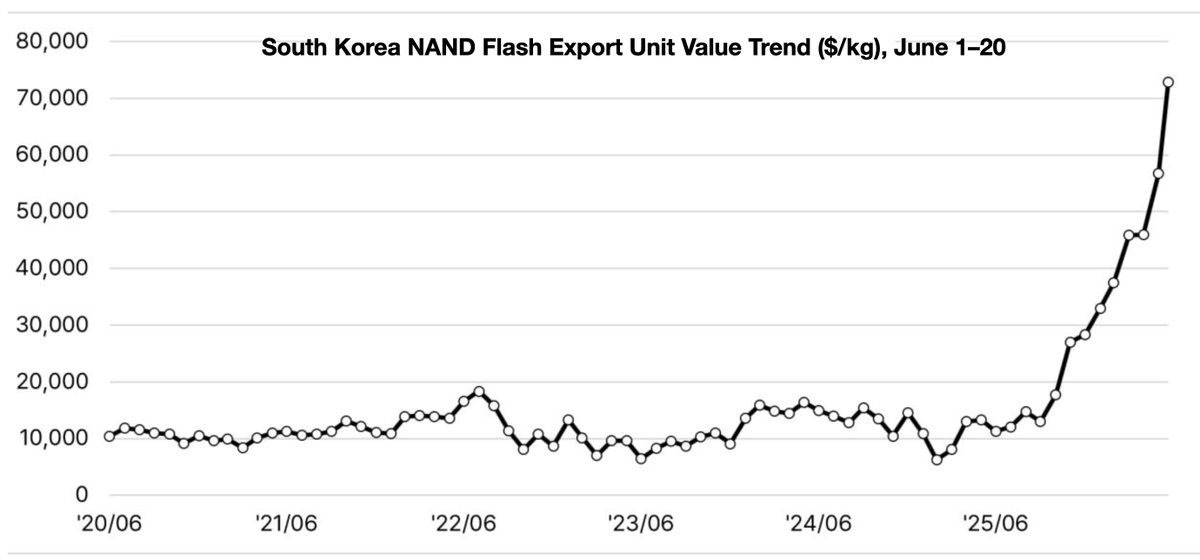
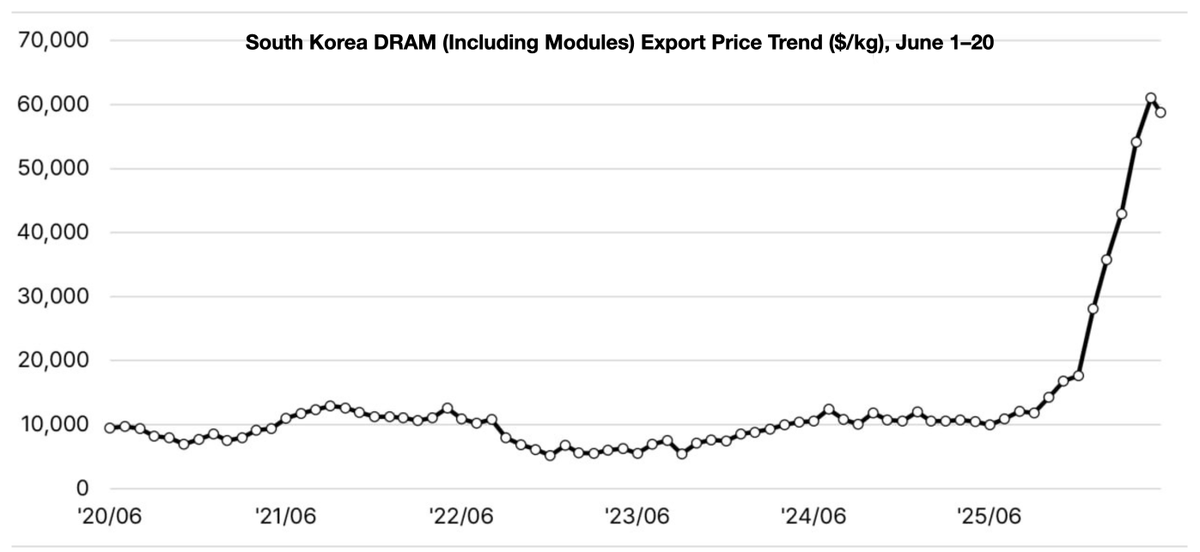
Korea’s June semiconductor export unit prices
(Historical figures are based on full-month data, while June 2026 figures are based on June 1–20 preliminary data)
- DRAM (excluding modules) export unit price: $82,260/kg, up 576% Y/Y and up 6% M/M
- DRAM (including modules) export unit price: $58,740/kg, up 491% Y/Y and down 4% M/M
- Flash memory export unit price: $72,784/kg, up 546% Y/Y and up 28% M/M
- MCP (HBM) export unit price: $95,939/kg, up 119% Y/Y and up 15% M/M
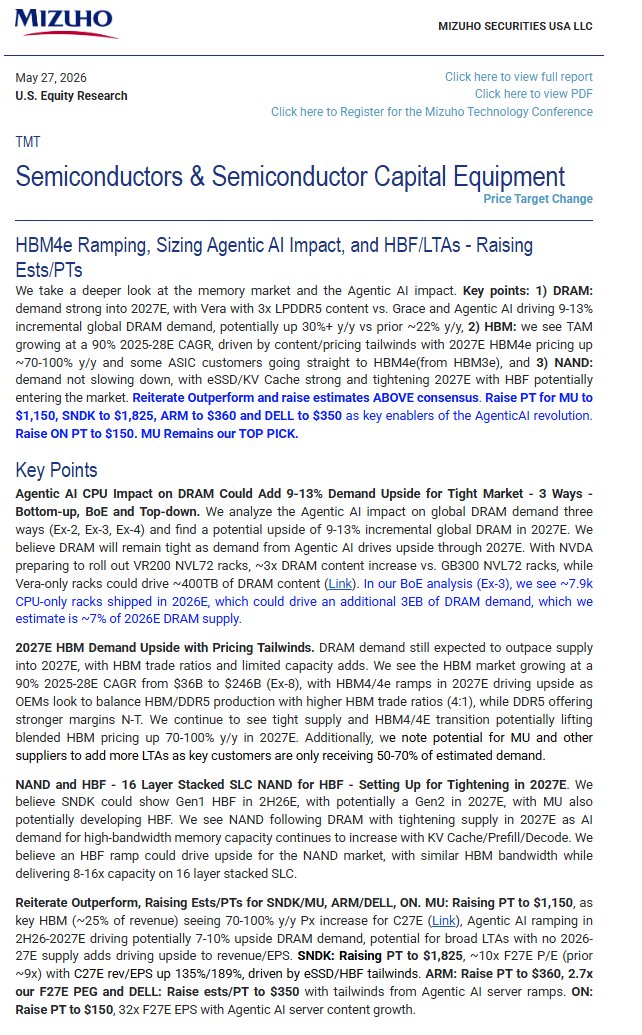
$MU / $SNDK Mizuho pounding table, again:
DRAM demand still expected to outpace supply into 2027E, with HBM trade ratios and limited capacity adds.
We see NAND following DRAM with tightening supply in 2027E as AI demand for high-bandwidth memory capacity continues to increase with KV Cache/Prefill/Decode.