Proving ordinary Nigerians CAN own homes | Developer @ Acquiluxe | Author: The Nigerian Wealth Path | Join 200+ families building wealth through Real Estate.
🚨 BRUTAL TRUTH: You will NEVER own a home in Nigeria.
Not because you're lazy.
Because the math is RIGGED.
In Lagos, you need to earn ₦319 MILLION/year to afford a ₦45M home.
You earn just ₦7M/year.
Let me show you the numbers that prove home ownership is dead 🧵👇
@Nairametrics Get a piece of land in a developing location & build little by little (incrementally). Trust me, home ownership is the fastest way out of poverty. Don’t buy any land you can’t use now or bother about stocks.. you can’t possibly out-invest those with large pockets. Build first!
I hope this message finds you at the right time
Ladies dating men in their 30s — this video is a must-watch. You’ll learn valuable lessons that could change how you approach your relationship.
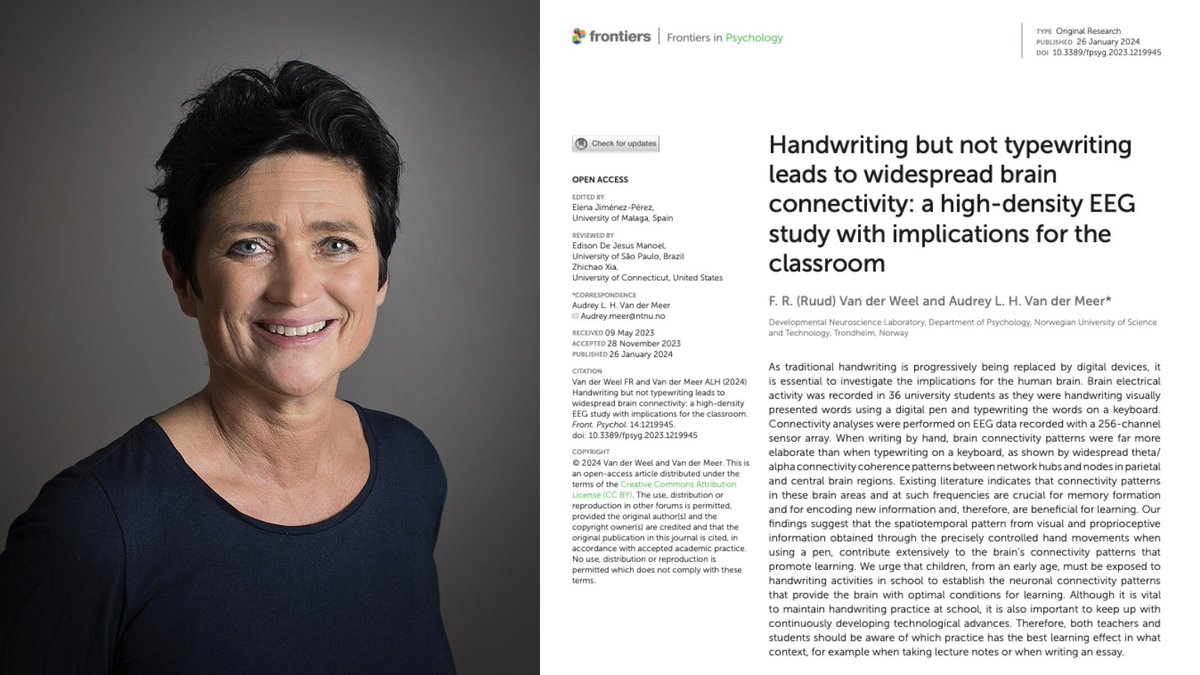
A Norwegian neuroscientist spent 20 years proving that the act of writing by hand changes the human brain in ways typing physically cannot, and almost nobody outside her field has read the paper.
Her name is Audrey van der Meer.
She runs a brain research lab in Trondheim, and the paper that closed the argument was published in 2024 in a journal called Frontiers in Psychology. The finding is brutal enough that it should have changed every classroom on Earth.
The experiment was simple. She recruited 36 university students and put each one in a cap with 256 sensors pressed against their scalp to record brain activity. Words flashed on a screen one at a time.
Sometimes the students wrote the word by hand on a touchscreen using a digital pen, and sometimes they typed the same word on a keyboard. Every neural response was recorded for the full five seconds the word stayed on screen.
Then her team looked at the part of the data most researchers had ignored for years, which is how different parts of the brain were communicating with each other during the task.
When the students wrote by hand, the brain lit up everywhere at once.
The regions responsible for memory, sensory integration, and the encoding of new information were all firing together in a coordinated pattern that spread across the entire cortex. The whole network was awake and connected.
When the same students typed the same word, that pattern collapsed almost completely.
Most of the brain went quiet, and the connections between regions that had been alive seconds earlier were nowhere to be found on the EEG.
Same word, same brain, same person, and two completely different neurological events.
The reason turned out to be something nobody had really paid attention to before her work. Writing by hand is not one motion but a sequence of thousands of tiny micro-movements coordinated with your eyes in real time, where each letter is a different shape that requires the brain to solve a slightly different spatial problem.
Your fingers, wrist, vision, and the parts of your brain that track position in space are all working together to produce one letter, then the next, then the next.
Typing throws all of that away. Every key on a keyboard requires the exact same finger motion regardless of which letter you are pressing, which means the brain has almost nothing to integrate and almost no problem to solve.
Van der Meer said it plainly in her interviews.
Pressing the same key with the same finger over and over does not stimulate the brain in any meaningful way, and she pointed out something that should scare every parent who handed their kid an iPad.
Children who learn to read and write on tablets often cannot tell letters like b and d apart, because they have never physically felt with their bodies what it takes to actually produce those letters on a page.
A decade before her, two researchers at Princeton ran the same fight using a completely different method and ended up at the same answer. Pam Mueller and Daniel Oppenheimer tested 327 students across three experiments, where half took notes on laptops with the internet disabled and half took notes by hand, before testing everyone on what they actually understood from the lectures they had watched.
The handwriting group won by a wide margin on every question that required real understanding rather than surface recall.
The reason was hiding in the transcripts of what the two groups had actually written down.
The laptop students typed almost word for word, capturing more total content but processing almost none of it as they went, while the handwriting students physically could not write fast enough to transcribe a lecture in real time, which forced them to listen carefully, decide what actually mattered, and put it in their own words on the page.
That single act of choosing what to keep was the learning itself, and the keyboard had quietly skipped the choosing and skipped the learning along with it.
Two studies. Two countries. Same answer.
Handwriting makes the brain work. Typing lets it coast.
Every note you have ever typed instead of written went into your brain through a thinner pipe. Every meeting, every book highlight, every idea you captured on your phone instead of on paper was processed at half depth.
You did not forget those things because your memory is bad. You forgot them because typing never woke the part of the brain that would have made them stick.
The fix is the thing your grandmother already knew.
Pick up a pen. Write the thing down. The slower road is the faster one.
"Until death, all defeat is psychological." - Marcus Aurelius
Refuse everything that would lead most people to give up.
Refuse it.
Rise from the dead 1000 times.
Commit to never stay down & never give up.
Everything you want is on the other side of struggle.
If you are broke and the first thing that comes into your mind is selling property to make more money, then you are walking on very dangerous terrain. It is not a sustainable way out of the problem of insufficient income.
If you now have to sell the property to pay off debts, then maybe you should seriously consider a career change and give up entrepreneurship.
I have seen former "big men" go through this phase and finally be saved when they open up, and their friends rally around them. This is why African politicians will always support corruption. Their income is never enough to sustain their lifestyle.
This is also what leads to all the bad side deals in the private sector and why they exclude outsiders from their circle.
For those in sports and entertainment, it is brutal. When Davido mentioned that his Dad would send him $300k after a show, I laughed because the man probably knows his burn rate and cash cycle better than anyone.
You can't plan a life around doing one-off deals, but you can plan a life around working with a group of people to generate constant income. The reason the Lebanese, Indians, and others are better businessmen in Africa is that the business groups they form are equivalent to corporations, with proper support and planning.
We have cooperatives, but they don't function the way the Lebanese and Indians in Africa do theirs. Most people in our cooperatives are typically there for emergency loans or crisis support. They don't see them as an active business organization that is responsible for their regular income.
An Indian friend I grew up with was one of the richest people I knew, but was also one of the most frugal. Any fancy car he was driving was usually one that he imported for sale. He was the one who wanted me to buy houses in Calabar almost 30 years ago at 100k Naira each, but I didn't see the value then. He bought several and housed his staff there.
He was always "switched on" and in moneymaking mode, and we did some interesting deals together while he still had his factories selling regular cheese balls and biscuits. That regular income from those factories was sacrosanct. Those were his core products; the side deals were for extra income.
For me, those side deals were my main source of income until my cousin, Lateef Belo-Osagie, made me see the folly of consulting and tech deals. He told me to go and get a job. I struggled with this until I took the course at HBS with @JosephBFuller, who gave us the truth about consulting and services. It was a zero equity game.
Find products to build and sell daily, or join a corporation or group that does. The lawyer guy who kept his 9-5 in the tweet I quoted earlier is very smart because a constant income source lets you plan better. The best business people I know sell something almost every hour. Sometimes, every minute.
If you don't have more income coming in than outgoing expenses, you are definitely going to end up in financial trouble. If you are in a group that does business together, you should all aim to generate regular income by selling products consistently.
Before we were chased away from the POS agent business by those with more resources, my dashboard showing regular income from those transactions used to give me more joy than anything else. These days, it is Stripe. Each sale gives me joy.
@Madridghost1 This is so apt!. I’m a living testimony as an employer. I don suffer like mad. You’ll see people talk during interviews like they know what they’re doing. Oya employ them na.. they’ll ruin your business for you! 💔
On May 1st, CBN's new rules kick in.
Most Nigerians don't know what's changing.
The ones who don't?...they'll find out the hard way when they can't access their own money.
Ten things every Nigerian must know before May 1st or else you gonna learn the hard way🧵
thread