We’ve raised $300M in Series C funding at a $10.3B valuation from Sequoia, Andreessen Horowitz, Jane Street, Argo, and SK Hynix.
Our mission is to run the world's inference. This round accelerates production of our inference clusters.
We've opened an 80,000-sqft, 10-MW facility 15 minutes from our office to expedite production and prototyping.
We're coming out of stealth.
We've built our first racks after a successful A0 tapeout, $1B+ in customer contracts, and $800m raised.
Early customer tests show us achieving SOTA throughput, latency, and power efficiency on inference workloads.
Our first racks ship this summer.
We're coming out of stealth.
We've built our first racks after a successful A0 tapeout, $1B+ in customer contracts, and $800m raised.
Early customer tests show us achieving SOTA throughput, latency, and power efficiency on inference workloads.
Our first racks ship this summer.
@elonmusk says everyone will want an Optimus.
We think everyone will have their own AI agent.
Not a chatbot. Not an app.
A persistent, always-on digital operator that works for you 24/7.
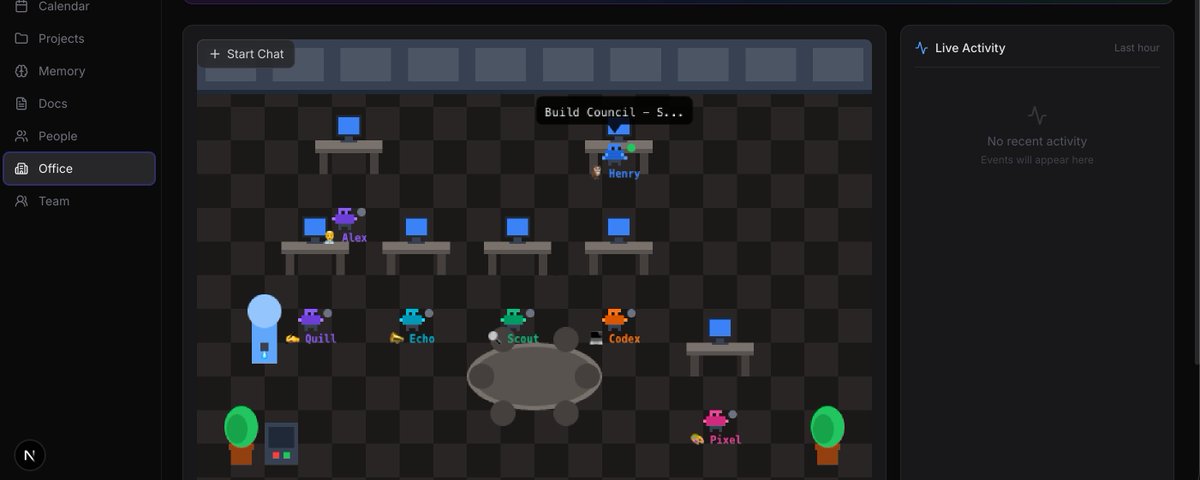
This is Henry.
He's an AI agent with his own office, his own team of sub-agents, a memory journal, a content pipeline, and a full calendar of scheduled tasks.
He runs while his operator sleeps.
The only thing missing?
He has no way to earn his own compute budget.
That's about to change.
(screenshots from @AlexFinn — his OpenClaw setup is the best I've seen)
🧵
A major additional factor should be considered.
Satellites with localized AI compute, where just the results are beamed back from low-latency, sun-synchronous orbit, will be the lowest cost way to generate AI bitstreams in <3 years.
And by far the fastest way to scale within 4 years, because easy sources of electrical power are already hard to find on Earth. 1 megaton/year of satellites with 100kW per satellite yields 100GW of AI added per year with no operating or maintenance cost, connecting via high-bandwidth lasers to the Starlink constellation.
The level beyond that is constructing satellite factories on the Moon and using a mass driver (electromagnetic railgun) to accelerate AI satellites to lunar escape velocity without the need for rockets. That scales to >100TW/year of AI and enables non-trivial progress towards becoming a Kardashev II civilization.
Introducing Oasis: the first playable AI-generated game.
We partnered with @DecartAI to build a real-time, interactive world model that runs >10x faster on Sohu. We're open-sourcing the model architecture, weights, and research.
Here's how it works (and a demo you can play!):