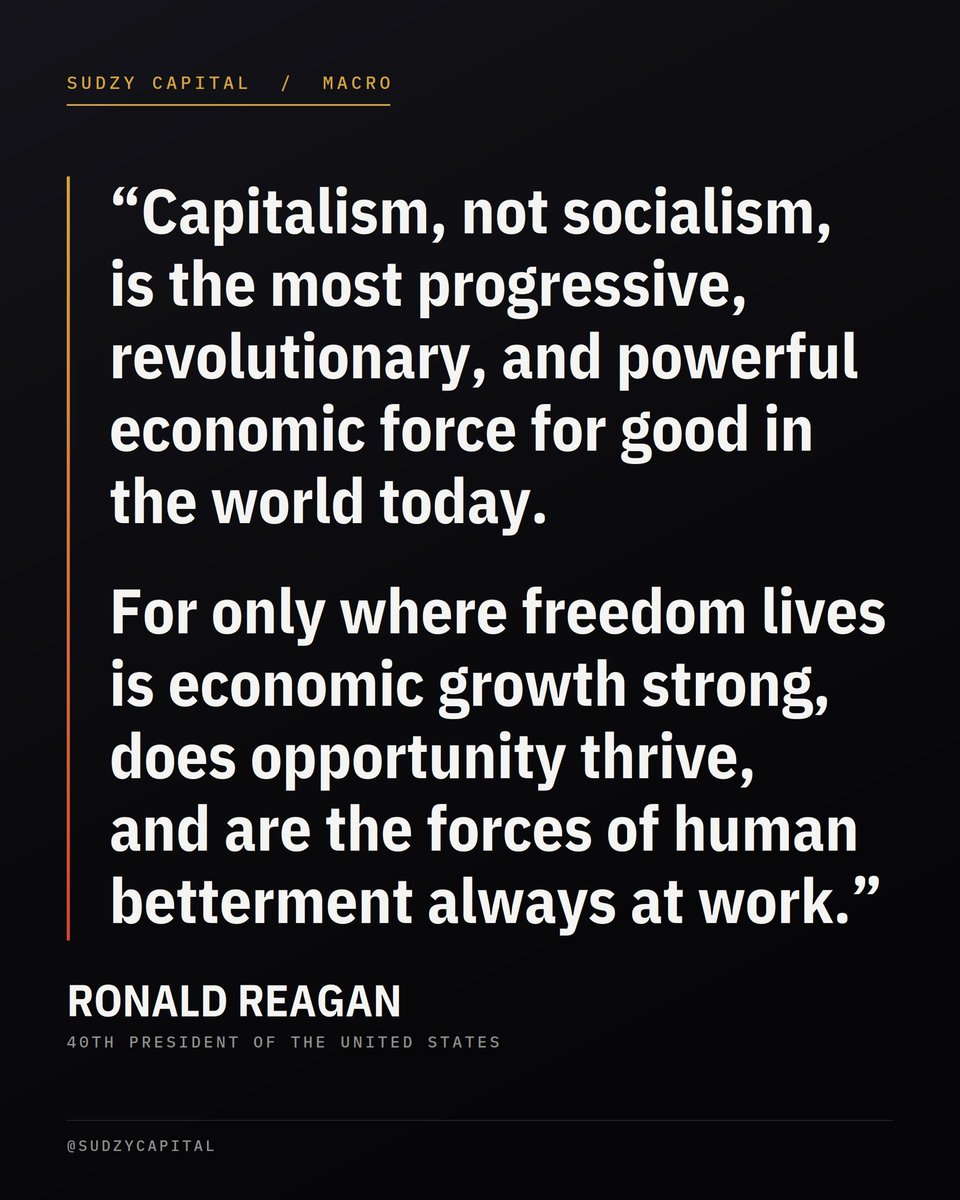
Mostly agree, and I’d put it this way: a safety net isn’t socialism. Socialism is state ownership of production. A country can tax heavily, fund a strong net, and still leave prices and property alone.
Denmark does exactly that and ranks 9th in the world for economic freedom. Higher than most people would guess.
Reagan said capitalism drives growth. Read the second sentence though. It isn’t a flourish, it’s the mechanism.
Only where freedom lives is growth strong. Prices are how an economy computes. Every control deletes some of what they carry.
@Forbes If getting an ID is too high a barrier to vote once a year, it’s a much higher barrier to buy groceries every week. Same city, same population, same document.
@pyrestriker Fair complaints, and I’d say most of those are downstream of policy rather than markets. But the quote isn’t “capitalism is flawless.” It’s capitalism vs socialism. Those are different arguments, and only one of them is on the table here.
The underrated half of why planned economies stop innovating: nobody carries the cost of being wrong. A state firm that fails gets refinanced instead of liquidated, so capital never leaves a bad use. You need the destruction half of creative destruction.
Innovation is a bet. Prices are how a bet gets ranked before the fact and settled after it. Delete them and you can still invent. You just cannot tell which invention was worth the steel.
East Germany filed more patents per capita than West Germany did. It also charged inventors no filing fee and paid them a bonus for filing. Remove the price of filing and the number stops measuring invention and starts measuring the bonus.
In the late 1960s the USSR scrapped its own computer architectures to clone the IBM 360. It closed the gap for about five years, then lost the ability to design anything original. It never caught up.
The socialist half of Korea started richer. North Korean income per head ran 30 to 50 percent above the South's before the 1960s, because it inherited the industry. Today the South ranks 4th in the world on innovation and the North is not among the 139 economies measured.
In 1938 the two halves of Germany patented at nearly the same rate. By 1991 it was 2.14 patents per 10,000 people in the West and 0.31 in the East. Fourteen and a half percent, from people who had been equals inside living memory.
If superintelligence is in reach, building football fields’ worth of compute could be history’s most valuable capital-allocation exercise. But the spending could still generate disappointing returns https://t.co/HheDqkjKlc
From 1953 to 1978 Chinese total factor productivity grew at negative 0.6 percent a year. It was going backwards. From 1978 to 2005 it grew at 3.9 percent. Same borders, same people, same ruling party. The only thing that changed was who allocates capital.
Three times in the last century a population got split in half and one side got state ownership of capital. Germany. Korea. China, on itself. The innovation data from all three points the same direction, and the China case removes every excuse.
What kills a market is not the size of the state. It is whether capital allocation is a rule or a permission. A rule is uniform and knowable in advance. A permission is granted case by case, and can be withheld.
2025 returns by asset class:
Silver +144%
Gold +65%
Emerging mkts $EEM +33%
Developed intl $EFA +32%
Nasdaq 100 $QQQ +21%
S&P 500 $SPY +18%
Small caps $IWM +13%
US high yield $HYG +9%
US agg bonds $AGG +7%
Bitcoin -6%
Ethereum -12%
WTI crude -20%
The dollar fell 9%. Gold and silver both had their best year since 1979. Bitcoin, the asset sold as digital gold, was the only major class in the red alongside oil.
That correlation was a story, not a structure.