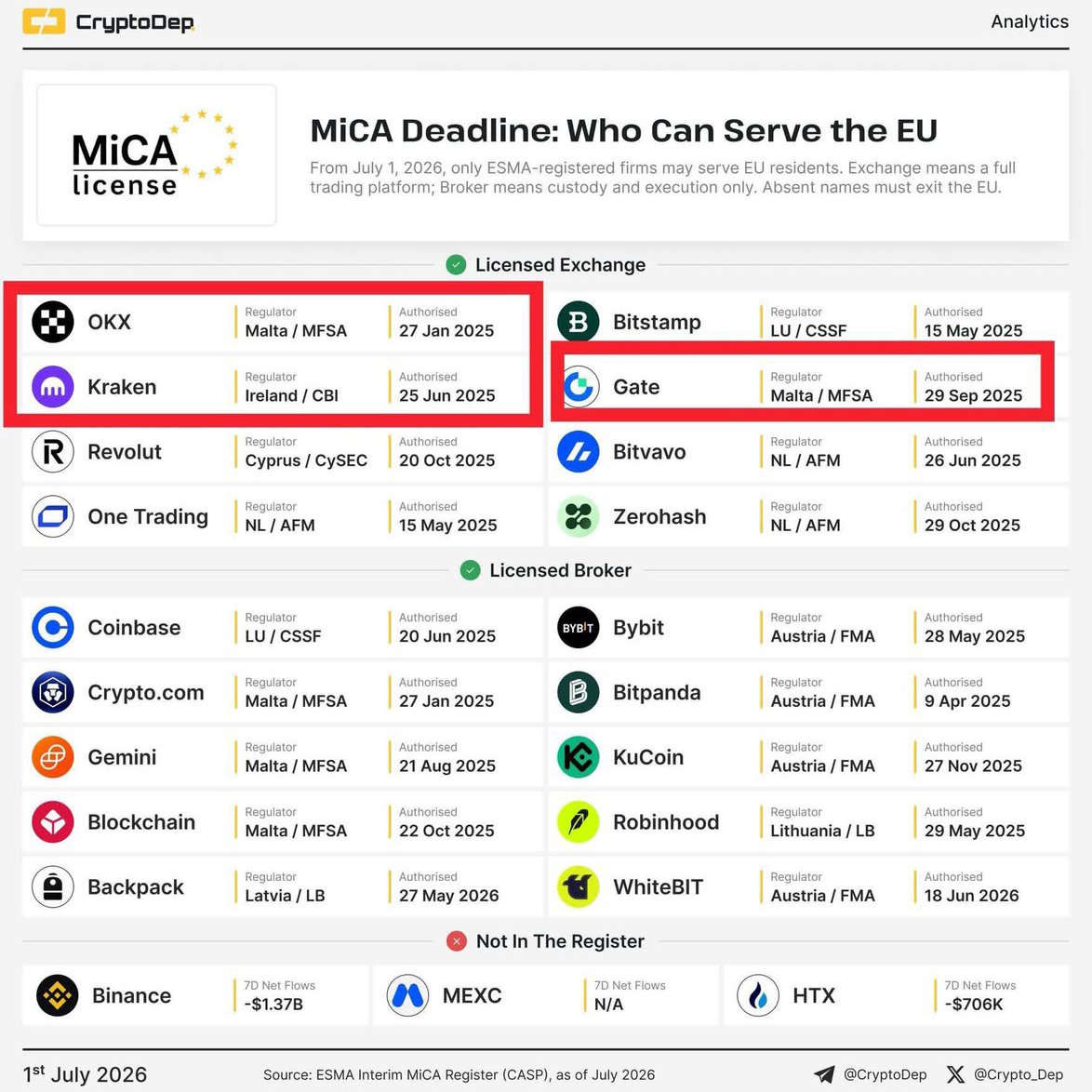
💬 PIONEERS — While Binance is locked out of Europe, OKX and https://t.co/EhKLaVTUYB just became fully MiCA compliant. What does this mean for Pi's regulated future? 🏛️🔥
BREAKING: The MiCA deadline has passed, and the EU's regulated crypto landscape is now clear. 🇪🇺
As of July 1, 2026, only ESMA-registered firms can legally serve EU residents. The result?
🔹 OKX – Fully authorized (Malta/MFSA) ✅
🔹 https://t.co/EhKLaVTUYB – Fully authorized (Malta/MFSA) ✅
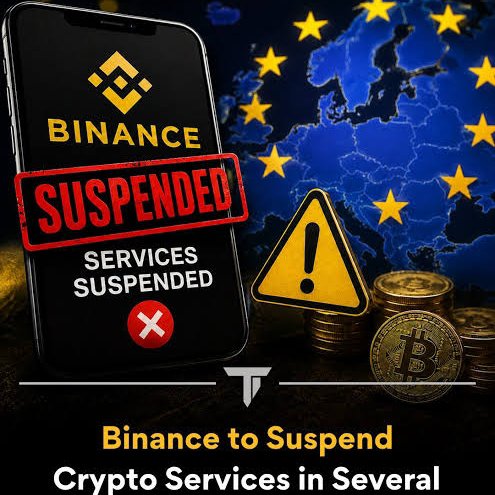
🔹 Binance – NOT on the register. Withdrew its Greek application and is now restricting services in France, Italy, Poland, and Spain
Here's the Pi connection:
Both OKX and https://t.co/EhKLaVTUYB have already completed Pi Network's KYB (Know Your Business) verification. They are authorized to hold Pi Mainnet wallets and are part of Pi's official ecosystem.
While Binance faces regulatory setbacks in Europe, Pi's partner exchanges are fully compliant and ready to serve EU Pioneers. 🧠
👇 Does this change your view on which exchange is best positioned for Pi's future in regulated markets? Drop your take below. 🔁
#PiNetwork #MiCA #OKX #Gateio #CryptoRegulation
SoloHost expands the utility of Pi Nodes beyond just blockchain validation.
Released in Beta on Pi2Day 2026, SoloHost on Pi Desktop gives Pioneers new ways to use their computers to run local apps, AI utilities, distributed computing, and other compute-based use cases.
Pioneers can also remotely engage with the corresponding app through mobile devices on Pi Browser.
SoloHost also lets developers build and list these local apps through an open, permissionless framework to reach the over 420,000 Pi Node operators who are already running Pi Desktop.
Local is key. With SoloHost streamlining access to local applications through Pi Desktop, people can benefit from AI while keeping their data on their own devices, not third-party remote servers.
This means:
- More privacy.
- More control.
- Less reliance on cloud services
Learn more at https://t.co/lMgJBEMbYj
MiCA rules are now in effect across Europe.
Kraken is already MiCA + MiFID compliant, so your trading just keeps going.
Up to 21% APY*, regulated perpetual futures, xStocks, and easy EUR transfers.
Switch now. Every deposit you make this month is a shot at €1M.
https://t.co/hmuLvZfQ2I
As MiCA-related changes take effect today in the EU, we want to reassure affected users that we remain committed to supporting you through this transition with clarity, care, and responsibility.
Your assets remain safe on Binance, held on a 1:1 basis, and affected users will continue to have access to the options already communicated to them, including transfers and withdrawals where applicable.
We know regulatory changes can be disruptive, and we want you to know we are working hard behind the scenes to engage closely with regulators and deliver the best possible path forward for our users.
We are contacting affected users directly with next steps. If you have questions about your account, please reach out to Binance Customer Support through our official channels.
The stablecoin race just entered a new phase.
Yesterday, @openstandard announced Open USD (OUSD) , a dollar-backed stablecoin backed by a consortium of 140+ global companies spanning payments, banking, fintech, crypto, and enterprise technology.
The founding members include Visa, Mastercard, American Express, Stripe, Coinbase, BlackRock, Google, Shopify, BNY Mellon, DBS, Standard Chartered, BBVA, Fireblocks, and many more.
But the announcement isn't significant because it's "another stablecoin."
It's significant because it challenges the business model behind today's largest stablecoins.
Instead of concentrating reserve income with a single issuer, Open USD proposes a different approach:
✅ Zero mint and redeem fees
✅ No artificial volume limits
✅ Reserve yield shared with ecosystem partners (after a management fee)
✅ Independent consortium governance instead of a single controlling issuer
The goal is simple: align incentives across the entire ecosystem so businesses have a reason to build, integrate, and distribute the stablecoin, not just use it.
Even before launch, Stripe has announced plans to make OUSD its default stablecoin for businesses, while Coinbase confirmed support across Base and other chains. The initial rollout is expected later this year, including Solana.
The market reacted immediately. Shares of Circle (USDC issuer) fell sharply as investors weighed how a consortium-led model could reshape stablecoin economics.
Why this matters?
Stablecoins are increasingly becoming payments infrastructure, not just trading assets.
For businesses moving money globally, the questions are evolving from:
Which stablecoin has the largest market cap?
to:
Which ecosystem offers the strongest distribution?
Which network provides the best economics for partners?
Which infrastructure scales seamlessly across payments, remittances, commerce, and settlements?
At Onramp Money, we see this as another signal that the industry is moving toward more interoperable, incentive-aligned financial infrastructure. As adoption grows, what will matter most isn't just the stablecoin itself, but how easily businesses and users can move between fiat and digital assets across markets.
The next chapter of stablecoin adoption won't be won by technology alone.
It will be won by distribution, accessibility, and seamless on/off-ramp experiences.
What do you think—does a consortium-led model have what it takes to accelerate global stablecoin adoption?
🚨 Hoy ha pasado algo que casi nadie está explicando bien, y conviene que lo entiendas porque dice mucho de hacia dónde va esto.
Se ha lanzado Open USD (OUSD), una nueva stablecoin. Pero lo importante no es "otra stablecoin más"... es QUIÉN está detrás.
Más de 140 empresas que normalmente se pelean a muerte entre sí, juntas en el mismo proyecto: Visa, Mastercard, American Express, BlackRock, Google, Samsung, Stripe, Coinbase... y sí, Ripple también.
¿Y por qué se juntan todos? Aquí está la jugada, y es brillante.
Hasta ahora el negocio de las stablecoins funcionaba así: tú le das tu dinero a Circle (los de USDC), ellos emiten el token, y con TU dinero compran deuda de EEUU y se quedan ellos casi todo el rendimiento. Dinero gratis para el emisor.
OUSD le da la vuelta a la tortilla: el rendimiento se reparte entre las empresas que participan. La stablecoin deja de ser el negocio y pasa a ser solo la tubería. Un estándar compartido en vez de un emisor que se lo queda todo.
¿Y a quién le sienta esto como una patada? A Circle.
Hoy mismo sus acciones cayeron casi un 16%.
Ni Circle, ni Tether, ni PayPal están invitados a la fiesta. Normal.
Y ahora fíjate en quién dirige esto, porque lo explica TODO. El CEO de Open Standard (la empresa detrás de OUSD) es Zach Abrams, cofundador de Bridge. ¿Y qué es Bridge? La infraestructura de stablecoins que Stripe compró por 1.100 millones de dólares en 2024.
O sea: esto es, en el fondo, una jugada del ecosistema Stripe.
Por eso de entrada OUSD NO sale en todas partes. Sale nativo en Solana desde el día uno (donde Bridge ya tiene toda la fontanería montada y rodada) y en Tempo, que es la propia blockchain de pagos de Stripe.
No es casualidad ni ideología: lanzan donde el equipo fundador ya tiene la infraestructura funcionando.
¿Y las demás cadenas? Aquí te aviso, porque he visto a medios soltar alegremente "sale en Solana, Stellar, Base y Polygon".
Cuidado: eso NO lo ha confirmado Open Standard. Lo único sólido es Solana + Tempo el día uno. El resto es especulación de periodistas mirando qué cadenas están entre los socios.
No te lo creas hasta que salga la documentación técnica.
Y la cosa no estará del todo operativa hasta más adelante en 2026 — no hay fecha firme todavía.
Ahora, la pregunta que de verdad importa para nosotros: ¿qué pinta Ripple ahí?
Y aquí te voy a ser sincero, sin venderte humo: Ripple est�� en la lista de socios, pero eso NO significa que OUSD vaya a funcionar sobre la XRP Ledger.
La XRPL es, como mucho, un riel más entre varios posibles.
Y el centro técnico de todo esto no es la XRPL... es Bridge + Tempo, o sea, Stripe. Ripple está en la periferia estratégica, no en el núcleo.
Ripple está jugando a estar sentada en TODAS las mesas que importan.
Es estrategia de cobertura: "yo me pongo en todos los raíles posibles y ya veremos cuáles ganan". Inteligente, pero hay que llamarlo por su nombre.
Y ojo al detalle que nadie te va a decir, porque no vende: aunque OUSD acabara corriendo sobre la XRPL, las transacciones ahí cuestan fracciones de céntimo. Eso quemaría un goteo ridículo de XRP.
Que la red se use NO significa automáticamente que el token suba.
Lo llevo diciendo tiempo: una cosa es la utilidad de la red, otra muy distinta que ese valor llegue al token.
Resumen para que te lo lleves claro:
✅ Bueno para Ripple como empresa/infraestructura (está en la mesa de los grandes).
⚠️ Neutro para el precio de XRP a corto (el mecanismo que conecta uso → precio sigue siendo flojo).
💥 Muy malo para Circle (le acaban de montar una coalición en contra).
🏗️ Y en el fondo, esto huele a Stripe: su CEO viene de Bridge, sale en su cadena Tempo, y el núcleo técnico es suyo.
Esto va de raíles, no de tokens. Y el que entienda esa diferencia, va a leer este mercado mucho mejor que el que solo mira el precio.
¿Qué opináis? ¿Ripple cubriéndose las espaldas o tiene una carta que aún no enseña? 👇
Open USD from @openstandard, backed by Visa and Mastercard, is coming to the Stellar network.
Designed with businesses in mind, Open USD is built to scale: open, low-cost, high-throughput, and broadly accessible.
An Open Letter of Resignation and Frustration To the Pi Core Team,
I am writing this to formally announce that I am done. Effective immediately, I am resigning as a Pioneer and severing my involvement with the Pi Network.
I didn't join this ecosystem to be a spectator to a never-ending cycle of empty promises.
I joined because I believed in the vision. But that belief has been completely eroded by your perpetual tendency to dangle "upcoming" features in front of us while failing to deliver the actual, usable infrastructure required for a real ecosystem.
You constantly push us to build, providing us with developer tools like Pi Studio and various app interfaces, yet you keep us in a sandbox.
How am I supposed to build anything of substance when the fundamental building blocks—the Pi AMM, Pi Liquidity, the Launchpad, the DEX—are always “coming soon”? You ask developers to invest their time, talent, and resources into your ecosystem, yet you withhold the very tools needed to make those applications functional and successful.
It is disrespectful to the developers who have actually put in the work to try and grow this network.
We are tired of the perpetual “roadmap” updates that lead nowhere. We are tired of the broken promises that keep us waiting for utilities that should have been prioritized years ago.
You talk about decentralized finance, yet you keep us tethered to a system that lacks the basic liquidity and exchange mechanisms required to function.
You have turned what could have been a revolutionary project into an exercise in frustration.
I am taking my energy, my skills, and my vision elsewhere—to ecosystems that actually respect their developers enough to provide the tools necessary to ship products, rather than just talking about them.
Do not expect me back. I am finished with the waiting game.
@Omer_Versheer
Former Pioneer
@PiCoreTeam@nkokkalis@Chengdiao
Pi Network launches 'Pi Sign-in'! Stop juggling dozens of passwords: use your Pi account to log in to third-party sites securely. A single, verified, and simple identity. Pi is becoming the key to your daily digital life. #PiNetwork#PiSignIn
1️⃣ A new #PiNetwork update inside the official pi-apps/pi-platform-docs repository introduces Pi Sign-In documentation. The important signal is not the file itself, but what it represents: a standardized identity gateway designed to connect Pi users with external digital services
Happy Pi2Day pioneers!
Real utility isn't just a roadmap goal—it is something you build day by day, line by line.
This #Pi2Day, we aren’t just celebrating a digital currency. We are celebrating how the global Pioneer community is changing how we travel and work.
A thread
You need to understand how massive the Pi Network GCV is but yet i was the only one who stood up to them & told them they should shut the fvvk up that Pi will never trade for that amount especially before $PI listed.
I was dragged & bullied online for months. I still made videos lecturing them how impossible it is, my 𝕏 account was massively reported by the Indian Pi Network community. But today how far, they are now seeing the truth.
I literally invited them to come on space so i can lecture them about it, i did this for months & you wey hungry carry enter Airdrop yesterday, you look me finish say na me you wan use make impressions 😂
Dem never bite you for preeq before na why. No worry you go learn new thing..
Pi2Day (tomorrow, June 28) is a moment to engage with new product releases and gain insight into the direction and priorities of the network.
Reminder: This year, Pioneers also have a timely opportunity to take part in app utilities expansion, community growth, and ecosystem development feedback before the events end tomorrow on June 28.
Participate in the two initiatives, the vibe coder campaign and Pi Launchpad Testnet token, now and stay tuned tomorrow for Pi2Day!
https://t.co/CCff3IuRQv
Although I have always emphasized that the real benefit and the proper way to begin using the system is through its applications, products, and services within the ecosystem, many people are only looking for cashing out or swapping through a DEX. What they fail to realize is that this is simply one of the services that will be available within the ecosystem itself
Cashing out will be possible through @onrampmoney providers, @BanxaOfficial,@ZyptoApp and other institutions that are joining the ecosystem. This can all be done directly through the wallet or seamlessly within the Pi applications themselves
When everything begins, it will all be ready. Everything will already be in place, so don't worry
And here we are, at our decisive moment
@PiCoreTeam #PiNetwork