The Pi2Day 2026 Ecosystem Quest saw incredible participation with over 2.56 million Pioneer participants, and over 1.78 million of them completing every step to claim this year’s special-edition badge.
Congratulations to everyone who celebrated Pi2Day by exploring the Pi ecosystem and the new Pi2Day releases: SoloHost, Pi-Sign-in, and PiVerify.
Learn more in the Pi app.
Pi Network @PiCoreTeam joins RoboPay as a payment partner. Pi will be used to pay for robot services across the Fabric network.
RoboPay was built to enable AI agents to discover, hire, coordinate, and pay robots autonomously onchain, transforming robots from connected machines into autonomous economic actors capable of providing real-world services.
Today, that same infrastructure extends beyond AI.
Tens of millions of Pi users will have access to robot services directly through the use of currency that they already hold. Once available, the anticipated robot services may include requesting a delivery robot to bring groceries, dispatching a security robot to patrol a property, scheduling an inspection robot for industrial facilities, or interacting with humanoid assistants in retail and hospitality. Autonomous labor may become as accessible as any digital service.
This partnership marks a fundamental shift in how humans are able to interact with robotics. Instead of purchasing robots themselves, users will be able to simply purchase outcomes. Physical intelligence becomes an on-demand service that is discoverable, programmable, and instantly payable through a shared economic network.
By connecting humans, AI agents, and robots through the same payment infrastructure, RoboPay and Pi have created the foundation for an open machine economy, where autonomous labor can participate in everyday commerce alongside real people.
The future isn't just AI that can think. It's an economy where humans, AI, and robots are all able to transact, collaborate, and create value together.
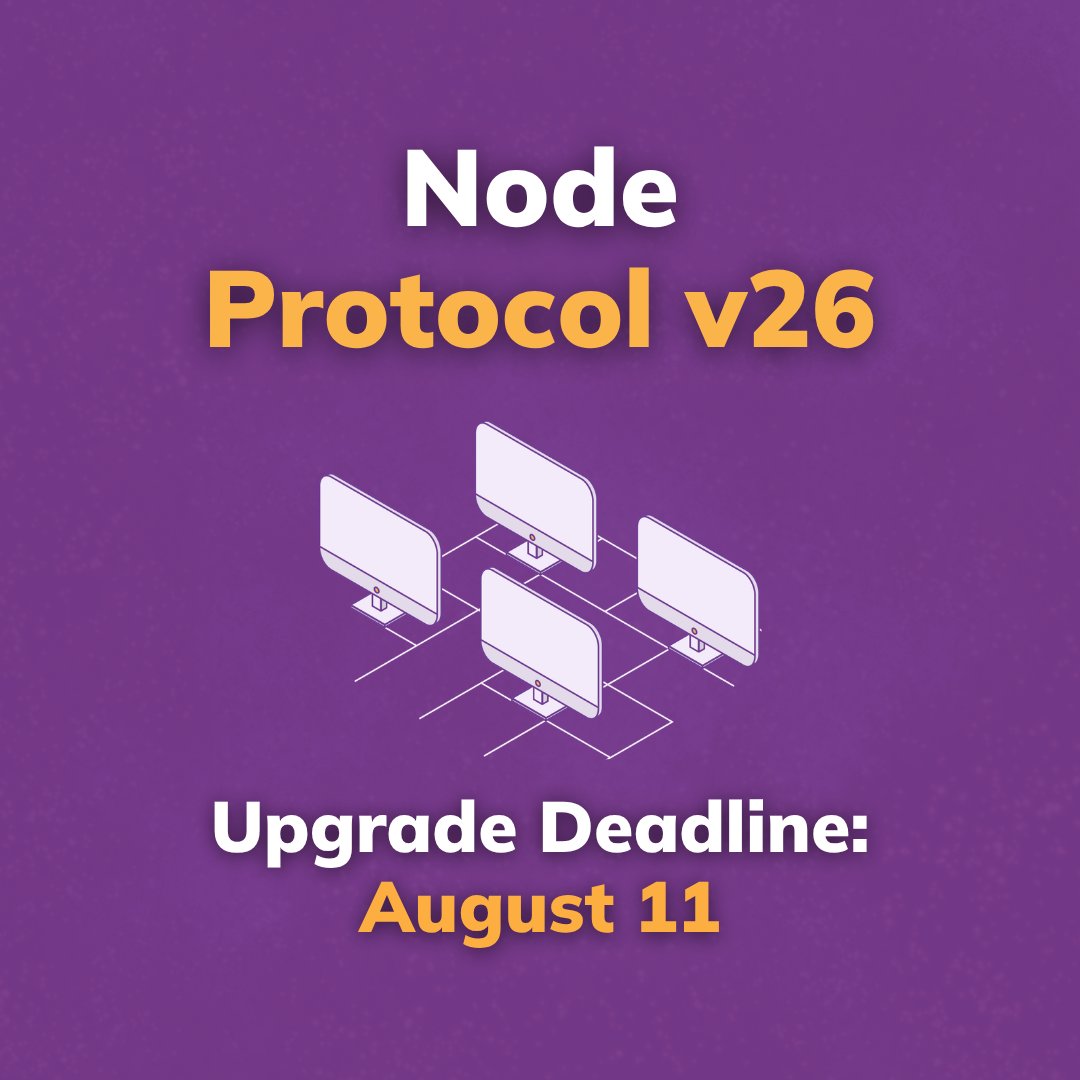
Reminder: the Pi Mainnet is upgrading to Protocol v26. All Mainnet node operators must complete the upgrade by August 11 to remain connected to the network.
Protocol v26 is a major milestone that improves contract safety, state management, interoperability, and cryptographic capabilities ahead of the final planned upgrade, Protocol v27.
Details here https://t.co/LHI1F0JHLm
In the Pi Launchpad model, projects issue tokens as tools to acquire users for their applications and integrate those tokens directly into product functionality, such as access, payments, rewards, and governance.
Instead of being taken by the issuing project, the proceeds of Pi from their token launch go to a liquidity pool with the ecosystem token, which bootstraps a healthy liquidity foundation from the start.
For the SLICE test launch on Testnet, this results in a liquidity pool containing SLICE and Test-Pi. In addition to matching individual buyers and sellers through a traditional decentralized order book on the Pi DEX, the pool uses an automated market maker algorithm to calculate swaps based on the amounts of both assets it currently holds.
Learn more about how the SLICE liquidity pool works.
https://t.co/BJEb5ijQcr
Pi Launchpad has completed the distribution of its second Testnet token, SLICE!
Explore the post-launch experience and see how liquidity pools work through the new price tracking feature!
The Launchpad app in Pi Browser shows individual allocation details, the launch and effective token prices, access to the SLICE liquidity pool, and a chart tracking changes in the SLICE price relative to Test-Pi.
Go to the Pi mining app to learn more about the SLICE launch and liquidity pool mechanics.
A billionaire investor says if you bet against every AI company today, you’d be rich in five years, and the CEO of Coinbase [Brian Armstrong] quietly agrees it might be a bubble.
[Nikhil] “If I were to take every private company in AI and short their stock today, in five years, I might make money. It feels a bit like the Internet bubble.”
[Brian] “I probably somewhat agree. The open source models are really like six months behind, and they’re like 99% cheaper or more for inference. So it’s entirely possible a larger percentage of the workload goes to these models that are 99% cheaper.”
The Pi mining app side menu and app profile page have been redesigned!
As the first step of a broader mining app design refresh, this update makes important Pioneer info and ecosystem features easier to find, understand, and navigate. Tap the hamburger (☰) icon in the top left of the Pi mining app to check it out.
Since the mining app is a central part of the Pioneer experience and its interface has supported the Pi community’s growth to over 60 million engaged Pioneers, changes to its design and user experience must be introduced thoughtfully and iteratively to improve clarity, style and usability while maintaining core functionalities.
Go to the Pi mining app to learn more, and provide feedback on the new design and style!
I taught JEE physics for years. That paper breaks strong kids in three hours.
This exam is five hours of theory and five hours of lab work, and these five did close to perfect scores on it.
Let me tell you what actually happened.
The International Physics Olympiad is the world championship of school physics. It was the 56th edition. Held in Bucaramanga, Colombia, from July 5 to 12.
381 students. More than 85 countries. Every one of them the best physics student their country could find.
India sent five kids.
All five came back with gold.
Their names are Kanishk Jain from Pune. Riddhesh Anant Bendale from Indore. Rishit Garg from Dwarka in Delhi. Shresth Suraiya from Mumbai. Svarit Joshi from Ahmedabad.
We know a hundred cricketers by their nickname and not one of these boys. :)
That clean sweep put India at joint World Number One. Tied with China, Russia, Kazakhstan, South Korea and Taiwan.
Those are countries that pour serious money and national pride into science education. We are standing level with them.
Now here is what the exam actually was.
Two papers. Each five hours long.
The theory paper had three problems. One on the thermodynamics of paramagnetic cooling. One on the photoionisation of ozone. One on the dynamics of electron positron pairs.
The experimental paper was another five hours in a lab, working through heat transfer and thermodynamic processes in fluids.
That means you get given equipment you have never seen, and you have to design your own experiment, take your own readings, handle the errors, and reach a real answer.
Not multiple choice. No shortcuts. No pattern recognition. You either understand physics or you sit there for five hours.
HBCSE says the Indian students were near perfect on theory and excellent on the practical too.
Now, this was India's 27th appearance at the IPhO.
Across all those years, about 44 percent of Indian students have won gold, 41 percent silver, 10 percent bronze.
In the last ten years, every single Indian student has come home with a medal. 62 percent gold, 38 percent silver.
Not one kid has gone and come back empty handed in a decade.
Five golds in one year has happened only twice. This year, and in 2018.
So who built this.
The programme is run by HBCSE, the Homi Bhabha Centre for Science Education. It sits under TIFR, which sits under the Department of Atomic Energy.
They run the whole funnel. A national exam, then a national olympiad, then a brutal selection and training camp, and out of everyone in the country, five kids get on a plane.
The team was led by Professor Anwesh Mazumdar of HBCSE-TIFR and Dr Leena Joshi from St Xavier's College, Mumbai.
The scientific observers were Professor Ananda Dasgupta from IISER Kolkata and Nisha Kelkar from Gogate-Joglekar College in Ratnagiri.
Yes. Ratnagiri. A college in a small coastal town in Maharashtra.
This is public education doing something the private coaching industry could never do on its own.
The coaching industry is very good at one thing. Teaching you to solve a known problem fast.
That is what JEE and NEET reward, and I say that with love because I was part of that world.
But an olympiad paper does not have a known type. There is no shortcut chapter. There is no formula sheet that saves you. You have to sit with a problem you have never seen and think.
That is a completely different muscle. And a government funded centre has been quietly building it in Indian teenagers for 27 years.
So yes, be proud. Loudly.
HBCSE also shared that around 64 percent of India's olympiad medallists go on to do a PhD.
But only about 32 percent of medallists end up settling in India.
I do not say that to spoil the moment. These kids owe the country nothing. They earned every option they have.
But it should tell us something. We are excellent at finding this talent. We are excellent at training it. We are still not great at giving it somewhere worth staying.
Congratulations Kanishk, Riddhesh, Rishit, Shresth and Svarit. This is one of the best things an Indian did this year and most of the country will never hear about it.
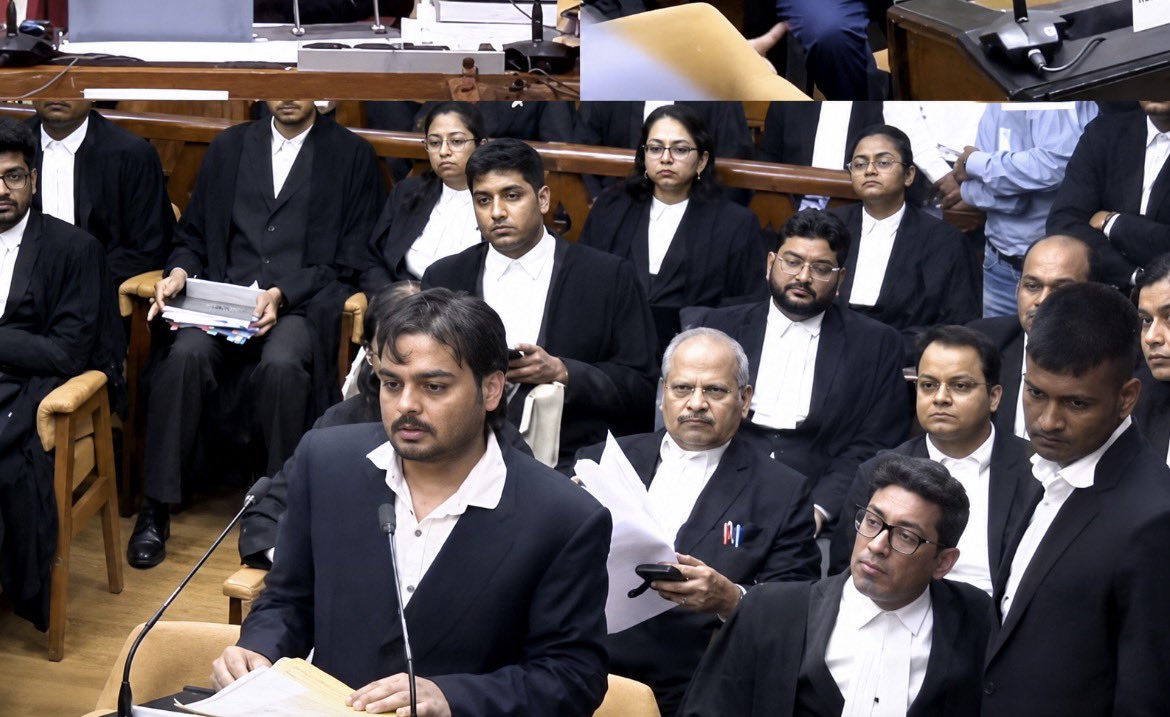
Prabal Pratap, you’re our hero.
We, the people of India, salute you, young man.
You risked your career and showed the judiciary its place by breaking the norm, replacing “Your Honour” with “Mr. Judicial Servant.” You reminded them that they are servants of the Indian judiciary and the people of India. You did what the people of the Republic of India wanted to do. You represent the ongoing condition and sentiments of the 1.4 billion people of this country.
Thank you for your service.
Thank you, Prabal Pratap. 🙏🏻🫡🇮🇳
Pi App Studio has released two updates to help creators build more engaging and useful app experiences.
1. Backend support enables persistent user experiences for newly created App Studio apps: Apps can save and retrieve user-specific data across sessions, enabling experiences that continue even after users leave and return.
2. AI-assisted App Planning Phase: Creators can develop their ideas with the help of AI before App Studio generates the app. This helps guide creators from an initial idea toward a more complete app concept in a more interactive and dynamic way.
Go to the Pi mining app to learn more, and create new apps with these features today!
Pi2Day 2026 reflects how Pi’s utility continues to grow through infrastructure and participation.
- Through SoloHost, Pi Desktop and Nodes can support new local AI app and compute use cases
- Pi Sign-in can help connect those experiences across users, devices, and services
- PiVerify can extend Pi’s real-human verification capabilities to third-party clients.
Together, these releases point to a broader direction for the ecosystem: Pi products are built both for the Pi ecosystem and to extend Pi services and resources to the external world. This, in turn, enriches and strengthens the Pi ecosystem.
Pi’s practical utility is built not only by product releases but by the Pioneers, Node operators, developers, KYC validators, app teams, merchants, and third-party services that use them, test them, and build on them.
Read the Pi2Day 2026 blog to learn more
https://t.co/5hkl8TAxxQ
SoloHost expands the utility of Pi Nodes beyond just blockchain validation.
Released in Beta on Pi2Day 2026, SoloHost on Pi Desktop gives Pioneers new ways to use their computers to run local apps, AI utilities, distributed computing, and other compute-based use cases.
Pioneers can also remotely engage with the corresponding app through mobile devices on Pi Browser.
SoloHost also lets developers build and list these local apps through an open, permissionless framework to reach the over 420,000 Pi Node operators who are already running Pi Desktop.
Local is key. With SoloHost streamlining access to local applications through Pi Desktop, people can benefit from AI while keeping their data on their own devices, not third-party remote servers.
This means:
- More privacy.
- More control.
- Less reliance on cloud services
Learn more at https://t.co/lMgJBEMbYj
PiVerify is a KYC identity verification service available to third-party companies, making Pi’s real-human verification capabilities available outside the Pi ecosystem.
With PiVerify, external platforms can verify their users, reduce fake or duplicate accounts, and support compliance-related identity workflows.
For businesses and platforms, the need is straightforward: many digital services need to know whether users are real people. Verified identities are needed for any meaningful transactions, especially in real-world economies.
PiVerify services are also paid for in Pi, which increases Pi utility.
By making this infrastructure available to third parties, the Pi2Day 2026 PiVerify release extends the utility of Pi’s verified identity technology and resources beyond Pi’s own apps and services.
Learn more at https://t.co/azUeoeGENF