6 months ago, this business wasn't on Google Maps.
Today they get 80+ calls a week.
Here's exactly what we did 👇
The starting point:
→ Ranked outside the top 20 for their main service keyword
→ GBP was unverified, half-filled, zero photos
→ NAP inconsistent across 30+ directories
→ No reviews in 8 months
→ Website had no location pages at all
Basically invisible. If you searched their exact service + city, a competitor 12 miles away outranked them.
What we changed (in order):
1. Fixed the foundation
Verified GBP, corrected the primary category (this alone moved the needle), added all secondary categories, service areas, and 40+ geo-tagged photos.
2. NAP consistency sweep
Audited every citation. Corrected or removed the inconsistent ones. Google needs one clean signal, not 30 conflicting ones.
3. Built real location pages
Not doorway pages actual pages with local landmarks, service specifics, embedded maps, and LocalBusiness + Service schema on each.
4. Weekly GBP posts + Q&A
Consistency beats intensity. 2 posts a week, every week, with UTM tracking so we knew exactly what converted.
5. Review engine
Simple SMS follow-up after every job. Went from 11 reviews to 90+ — and we responded to every single one.
6. Proximity + AI visibility
Optimized for how people actually search now — "near me," voice, and AI answer engines pulling from GBP data.
The result after 6 months:
→ Top 3 in the Map Pack for 14 keywords
→ 80+ calls per week
→ 340% increase in GBP direction requests
→ Cost per lead down 62% vs. their old Google Ads spend
The lesson:
Local SEO isn't magic. It's boring consistency applied to the right signals.
Most businesses skip the foundation and jump straight to "more content." That's backwards.
Fix the profile. Fix the citations. Build the pages. Show up weekly. Ask for reviews.
That's it. That's the whole playbook.
PS: If you're not in the top 3, comment "AUDIT" and I'll tell you why.
#seo #localseo #gbp #geo
Broke? Jobless? Feeling stuck?
Google is paying $1,500 a day — and you don’t need a resume.
All it takes is:
📱 A phone
🌐 Internet
⏱ 5 minutes a day
✅ Like this post
💬 Comment “Google”
🔁 Retweet
👣 Make sure you’re following so I can DM you the details
300+ Google calls in 3 months.
Here’s the HVAC SEO playbook I’d use again.
Most HVAC companies try to rank for everything.
That’s the problem.
You don’t need to beat the biggest HVAC company in your city.
You need to become the best result for the right searches.
Here’s how I’d do it:
1. Start with high-intent services
Don’t focus only on:
“HVAC contractor + city”
Go after searches like:
→ AC repair + city
→ Emergency AC repair + city
→ AC replacement + city
→ 24/7 AC repair + city
Create a dedicated page for each important service.
Make the service clear on your website and GBP.
2. Focus on review momentum
A competitor may have 1,000+ reviews.
You probably won’t catch them overnight.
But you can build reviews consistently.
Ask after every completed job.
→ SMS follow-up
→ QR code
→ Easy review link
→ Genuine replies to reviews
Don’t just chase their total.
Build your momentum.
3. Break the city into smaller markets
Your city isn’t one market.
Look at:
→ Older neighborhoods
→ New-build areas
→ Downtown
→ Family suburbs
→ Retirement communities
→ Nearby towns
Build useful location pages around the areas you actually serve.
Don’t copy-paste the same page.
Make each one useful and locally relevant.
4. Make your GBP match your services
Your GBP shouldn’t just say:
“HVAC contractor.”
Use relevant categories and clearly list the services you actually offer.
Then connect those services to dedicated website pages.
The goal is simple:
Make it obvious what you do, where you do it, and who you help.
5. Use GBP content to show what you actually do
Don’t post random updates.
Post things customers care about:
→ Emergency AC repair
→ Recent repair jobs
→ Before/after work
→ Seasonal maintenance tips
→ Heatwave preparation
→ AC replacement advice
Your content should help customers choose you, not just fill your GBP.
6. Build local authority
I’d rather have a few strong local links than hundreds of random ones.
Look for:
→ Local property managers
→ Real estate websites
→ Local business organizations
→ Community websites
→ Local “best HVAC” lists
Local relevance matters.
7. Keep your website + GBP aligned
Your:
→ Services
→ Locations
→ Business name
→ Phone
→ Branding
→ Business information
should all tell the same story.
The clearer your business entity is, the easier it is for search engines to understand your relevance.
The real strategy?
You don’t need to rank #1 for every HVAC keyword.
Own a few high-value services.
Win key neighborhoods.
Build reviews consistently.
Stay relevant.
Then expand.
That’s how you build local visibility without trying to beat everyone at once.
P.S. Business owners & agencies: if you want more consistent local leads, DM me “SEO.”
Old SEO tricks are not enough anymore.
If you want to rank on Google AND show up in AI search...
Focus on:
• Give clear answers at the top of your content.
• Keep your content fresh and updated.
• Add sources for important facts.
• Use schema like FAQs and How-To.
• Build strong topic clusters.
• Earn backlinks and community mentions.
• Get mentioned alongside the keywords you want to rank for.
And don’t overlook this:
Original research, data, and studies can help make you the source others trust.
SEO today is more than keywords and backlinks.
It’s about being useful, trusted, and easy for both Google and AI to understand.
And honestly?
That was always the real goal.
#seo #aiseo #geo
300+ Google calls in 3 months.
Here’s the HVAC SEO playbook I’d use again.
Most HVAC companies try to rank for everything.
That’s the problem.
You don’t need to beat the biggest HVAC company in your city.
You need to become the best result for the right searches.
Here’s how I’d do it:
1. Start with high-intent services
Don’t focus only on:
“HVAC contractor + city”
Go after searches like:
→ AC repair + city
→ Emergency AC repair + city
→ AC replacement + city
→ 24/7 AC repair + city
Create a dedicated page for each important service.
Make the service clear on your website and GBP.
2. Focus on review momentum
A competitor may have 1,000+ reviews.
You probably won’t catch them overnight.
But you can build reviews consistently.
Ask after every completed job.
→ SMS follow-up
→ QR code
→ Easy review link
→ Genuine replies to reviews
Don’t just chase their total.
Build your momentum.
3. Break the city into smaller markets
Your city isn’t one market.
Look at:
→ Older neighborhoods
→ New-build areas
→ Downtown
→ Family suburbs
→ Retirement communities
→ Nearby towns
Build useful location pages around the areas you actually serve.
Don’t copy-paste the same page.
Make each one useful and locally relevant.
4. Make your GBP match your services
Your GBP shouldn’t just say:
“HVAC contractor.”
Use relevant categories and clearly list the services you actually offer.
Then connect those services to dedicated website pages.
The goal is simple:
Make it obvious what you do, where you do it, and who you help.
5. Use GBP content to show what you actually do
Don’t post random updates.
Post things customers care about:
→ Emergency AC repair
→ Recent repair jobs
→ Before/after work
→ Seasonal maintenance tips
→ Heatwave preparation
→ AC replacement advice
Your content should help customers choose you, not just fill your GBP.
6. Build local authority
I’d rather have a few strong local links than hundreds of random ones.
Look for:
→ Local property managers
→ Real estate websites
→ Local business organizations
→ Community websites
→ Local “best HVAC” lists
Local relevance matters.
7. Keep your website + GBP aligned
Your:
→ Services
→ Locations
→ Business name
→ Phone
→ Branding
→ Business information
should all tell the same story.
The clearer your business entity is, the easier it is for search engines to understand your relevance.
The real strategy?
You don’t need to rank #1 for every HVAC keyword.
Own a few high-value services.
Win key neighborhoods.
Build reviews consistently.
Stay relevant.
Then expand.
That’s how you build local visibility without trying to beat everyone at once.
P.S. Business owners & agencies: if you want more consistent local leads, DM me “SEO.”
The Local SEO Tools Cheat Sheet (Save This)
Everyone's obsessed with AI.
Meanwhile the boring tools are still winning local rankings.
1/ Keyword Research
↳ Ahrefs
↳ Semrush
↳ AlsoAsked
↳ Keyword Insights
↳ ChatGPT
2/ Content / AI Tools
↳ ChatGPT
↳ Jasper
↳ Surfer SEO
↳ Frase
↳ Clearscope
↳ Grammarly
3/ On-Page Optimization
↳ Yoast SEO
↳ Surfer SEO Audit
↳ Page Optimizer Pro
↳ Screaming Frog
↳ Rank Math
↳ Google PageSpeed Insights
4/ Backlinks
↳ Ahrefs
↳ Semrush
↳ BrightLocal
↳ Whitespark
↳ Majestic
5/ Local SEO & Citations
↳ BrightLocal
↳ Whitespark
↳ Synup
↳ Yext
↳ Local Falcon
↳ Moz Local
6/ Analytics & Reporting
↳ Google Search Console
↳ GA4
↳ Looker Studio
↳ Google Business Profile
↳ Google Tag Manager
Six categories. 30+ tools. Zero guesswork.
Most agencies overcomplicate this. Pick one from each, master it, move on.
-----
📄 Save for later
♻️ Share and help others learn.
🔔 Follow me @SunailLocalSEO for more like this.
#seo #localseo #seotools
The Local SEO Tools Cheat Sheet (Save This)
Everyone's obsessed with AI.
Meanwhile the boring tools are still winning local rankings.
1/ Keyword Research
↳ Ahrefs
↳ Semrush
↳ AlsoAsked
↳ Keyword Insights
↳ ChatGPT
2/ Content / AI Tools
↳ ChatGPT
↳ Jasper
↳ Surfer SEO
↳ Frase
↳ Clearscope
↳ Grammarly
3/ On-Page Optimization
↳ Yoast SEO
↳ Surfer SEO Audit
↳ Page Optimizer Pro
↳ Screaming Frog
↳ Rank Math
↳ Google PageSpeed Insights
4/ Backlinks
↳ Ahrefs
↳ Semrush
↳ BrightLocal
↳ Whitespark
↳ Majestic
5/ Local SEO & Citations
↳ BrightLocal
↳ Whitespark
↳ Synup
↳ Yext
↳ Local Falcon
↳ Moz Local
6/ Analytics & Reporting
↳ Google Search Console
↳ GA4
↳ Looker Studio
↳ Google Business Profile
↳ Google Tag Manager
Six categories. 30+ tools. Zero guesswork.
Most agencies overcomplicate this. Pick one from each, master it, move on.
-----
📄 Save for later
♻️ Share and help others learn.
🔔 Follow me @SunailLocalSEO for more like this.
#seo #localseo #seotools
Everyone's using AI to write blogs.
Almost nobody is using it correctly.
The mistake: "Write me a 1500 word blog about roofing."
That's how you get 1,500 words nobody reads.
My actual workflow:
1. Scrape the top 10 ranking pages
2. Extract what they ALL cover (that's the baseline)
3. Find what NONE of them cover (that's your win)
4. AI writes the baseline, I write the win
5. Add schema, internal links, real photos
AI does the boring 60%. You do the 40% that ranks.
Unpopular opinion:
keyword density is dead and you're wasting your life.
Nobody at Google is counting how many times you said "emergency plumber Leeds."
What they're measuring:
→ Did the user come back to search after clicking you?
→ How long did they stay?
→ Did they take an action?
Write for the human.
The algorithm is watching the human, not your text.
How to get your business mentioned by ChatGPT:
1. Get cited on sites AI trains on (Wikipedia, Reddit, industry directories)
2. Answer questions in plain language AI quotes clarity, not cleverness
3. Add FAQ schema with real questions people ask
4. Build entity consistency same name, same description, everywhere
5. Get mentioned in listicles ("best X in Y") AI loves lists
None of this is keyword stuffing.
All of it is being genuinely, verifiably the answer.
You picked your GBP category in about 30 seconds.
It's the single biggest Maps ranking factor you control.
"Contractor" and "Roofing Contractor" are not a small difference.
One of them shows up when someone searches for a roofer. The other doesn't exist.
How to fix it in 10 minutes:
1. Search your main keyword in Google Maps
2. Click the top 3 results
3. Check their primary category (it's shown right under the business name)
4. Match the pattern
5. Then add every relevant secondary category they're free and they widen your net
One caveat that trips people up:
Your PRIMARY category carries far more weight than secondaries. Don't pick a broad one and stuff the specific ones underneath. Pick the specific one as primary.
This is free. It takes ten minutes. It's probably the highest-impact thing most local businesses could do this month.
And almost nobody revisits it after setup.
P.S. Go check yours. What's your primary category and is it the right one?
You picked your GBP category in about 30 seconds.
It's the single biggest Maps ranking factor you control.
"Contractor" and "Roofing Contractor" are not a small difference.
One of them shows up when someone searches for a roofer. The other doesn't exist.
How to fix it in 10 minutes:
1. Search your main keyword in Google Maps
2. Click the top 3 results
3. Check their primary category (it's shown right under the business name)
4. Match the pattern
5. Then add every relevant secondary category they're free and they widen your net
One caveat that trips people up:
Your PRIMARY category carries far more weight than secondaries. Don't pick a broad one and stuff the specific ones underneath. Pick the specific one as primary.
This is free. It takes ten minutes. It's probably the highest-impact thing most local businesses could do this month.
And almost nobody revisits it after setup.
P.S. Go check yours. What's your primary category and is it the right one?
My top tip for local SEOs:
Cut the dead weight.
Most GBP-linked websites carry pages that do nothing but dilute local relevance.
Time to prune:
➪ Old service-area pages you no longer operate in
➪ Duplicate/thin location pages
➪ Zero-traffic blog posts with no local intent
➪ Outdated NAP or promo pages
Don't worry about fewer indexed pages.
It's not a loss. It's consolidation.
Fewer pages means more relevance flowing to the location pages that actually convert.
More relevance means better local pack rankings.
Audit your site. Kill the dead weight.
Free 7-day Local SEO plan.
No opt-in
No DM
Just do it:
Day 1 — Claim + fully complete your GBP (every field)
Day 2 — Add 20 real photos, geotagged
Day 3 — Ask your 10 happiest customers for reviews
Day 4 — Fix NAP consistency across 15 directories
Day 5 — Write 1 service page per service (not one combined page)
Day 6 — Add LocalBusiness + Service schema
Day 7 — Post your first GBP post + set a weekly reminder
That's it. That's the $2k/month service.
Bookmark it.
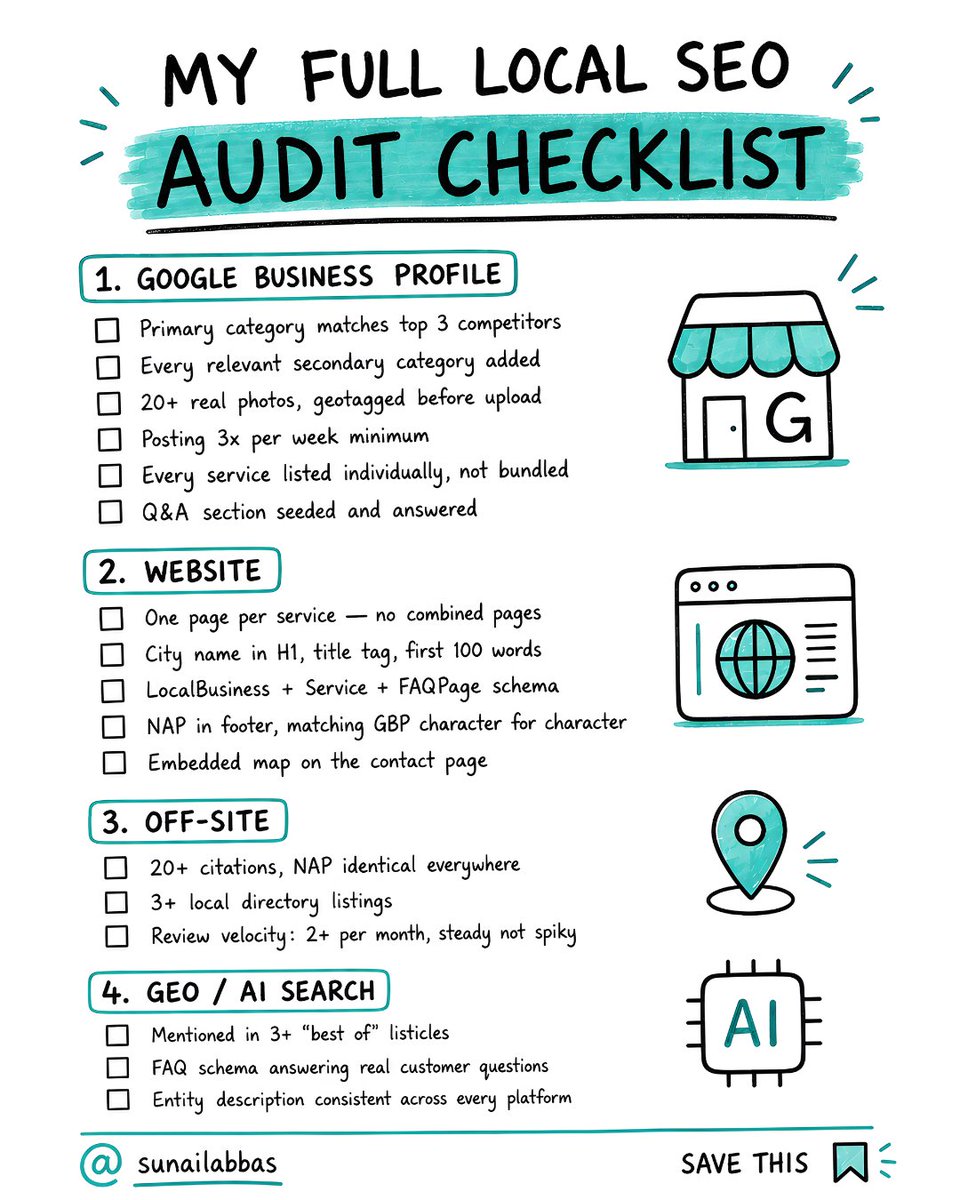
Here's my full local SEO audit checklist.
The one I charge clients for. Today it's free.
GOOGLE BUSINESS PROFILE
→ Primary category matches top 3 competitors
→ Every relevant secondary category added
→ 20+ real photos, geotagged before upload
→ Posting 3x per week minimum
→ Every service listed individually, not bundled
→ Q&A section seeded and answered
WEBSITE
→ One page per service no combined pages
→ City name in H1, title tag, first 100 words
→ LocalBusiness + Service + FAQPage schema
→ NAP in footer, matching GBP character for character
→ Embedded map on the contact page
→ Phone number clickable on mobile
OFF-SITE
→ 20+ citations, NAP identical everywhere
→ 3+ local directory listings
→ Review velocity: 2+ per month, steady not spiky
GEO / AI SEARCH
→ Mentioned in 3+ "best of" listicles
→ FAQ schema answering real customer questions
→ Entity description consistent across every platform
That's the audit. Run it. Fix what's broken.
Genuinely do it yourself. The methods aren't the hard part. Execution is.
—
Save this one.
P.S. Tell me how many did you pass?
#seo #localseo #geo