ANYONE WHO THINKS MICHAEL SAYLOR IS JUST SOME MANIAC WHO TAKES OUT DEBT TO BUY BITCOIN NEEDS TO WATCH THIS INTERVIEW.
THIS IS ONE OF THE MOST SOUND AND RATIONAL EXPLANATIONS FOR WHY SAYLOR IS GOING SO HARD AND SO FAST INTO BITCOIN.
GREAT LISTEN.
A quick note on U.S. crypto ownership & usage. Estimates vary based on who is asking and how. The @federalreserve focuses on recent usage, while independent polls track ownership.Bottom line: all credible data points to tens of millions of Americans engaging with crypto.
• The Fed's latest 2025 SHED data puts past-12-month crypto use at ~10% of U.S. adults (26–27M people).
• A @MorningConsult poll (for @coinbase) found 20% (~52M) currently own crypto.
• @Ipsos polling found ~18% have owned or used it.
Whether you measure active use or ownership, these numbers are substantial—not fringe.
TOM LEE IN 2019 ON BITCOIN: “WE THINK THE BEST APPROACH FOR MOST PEOPLE IS TO PUT 1% MAYBE 2% INTO BTC.”
CNBC: “I STILL THINK THAT’S CRAZY.”
MORGAN STANLEY 2026: “WE RECOMMEND A 7% ALLOCATION INTO BTC.” 🚀
BREAKING: 🇮🇷 IRAN JUST LAUNCHED AN INSURANCE PLATFORM ACCEPTING BITCOIN AND CRYPTO FOR STRAIT OF HORMUZ TO BYPASS SANCTIONS.
OIL TANKERS PAYING INSURANCE IN BITCOIN 🤯
BITCOIN IS NOW THE WORLD RESERVE CURRENCY
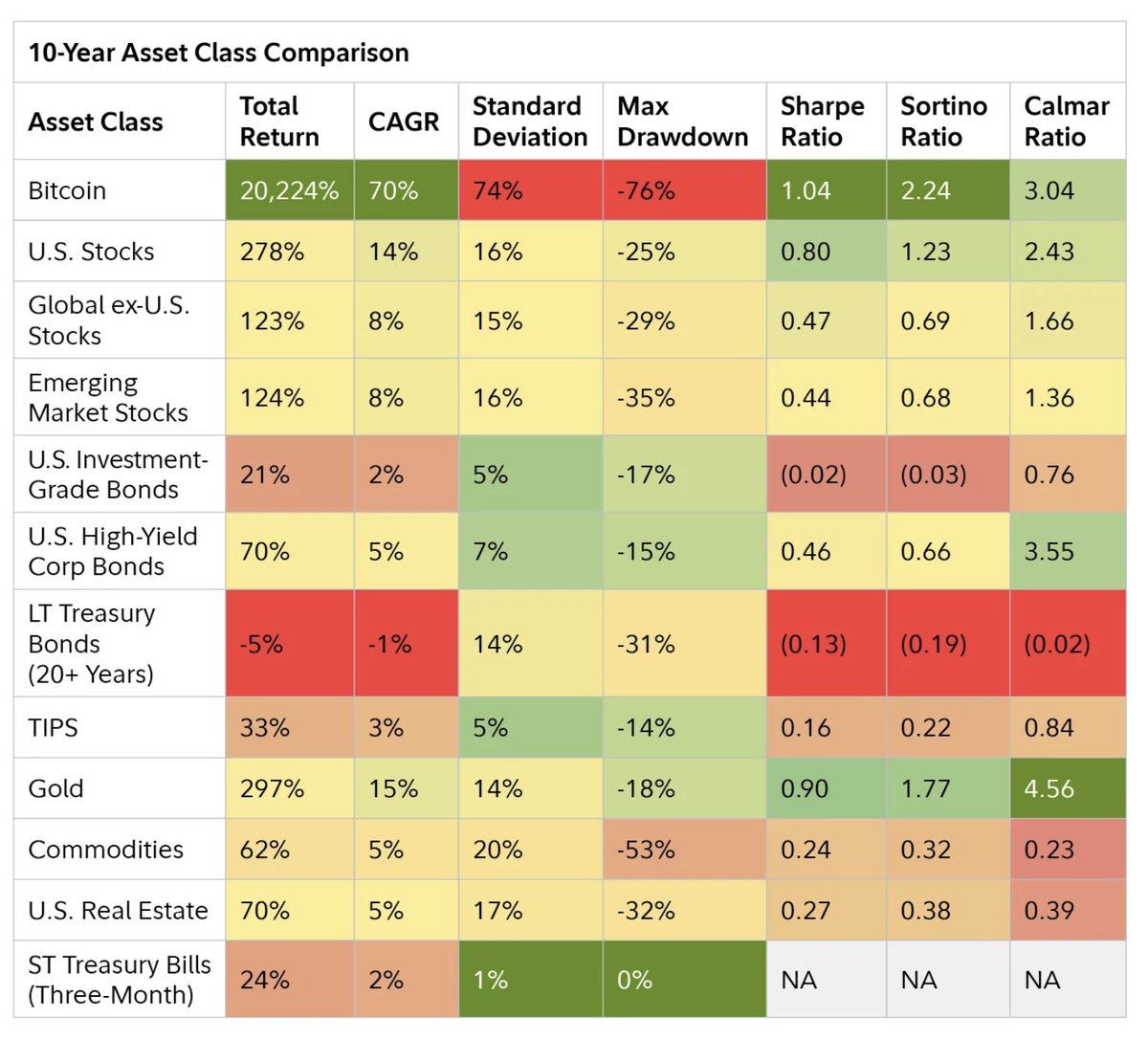
BITCOIN LEADS ALL ASSETS IN RETURNS AND RISK-ADJUSTED PERFORMANCE OVER 10 YEARS
A new “10-Year Asset Class Comparison” from Fidelity @DigitalAssets shows:
• Bitcoin delivered the highest returns and highest volatility
• Strong Sharpe and Sortino ratios indicate outsized compensation for that risk
• Bonds posted weak returns with negative risk-adjusted metrics
• Most bond returns are negative after inflation
• Gold outperformed stocks on a risk-adjusted basis over the decade
JUST IN: Morgan Stanley's Amy Oldenburg says the bank putting bitcoin on their balance sheet is "something you may see going forward. It's not totally out of the question." 👀
JUST IN: Billionaire Tim Draper says it's now irresponsible for companies to not hold bitcoin.
"Because when Silicon Valley Bank went out of business, we almost saw the domino effect, we almost lost all the banks." 👀
JUST IN: 🇺🇸 Four-star military officer Admiral Samuel Paparo confirms the USA is running a Bitcoin node.
"We have a node on the Bitcoin network right now. We're doing a number of operational tests to secure and protect networks using the Bitcoin protocol."
🇺🇸 US TREASURY SECRETARY JUST SAID LIVE IN FRONT OF CONGRESS THAT BITCOIN AND CRYPTO IS GOING TO BE A VERY IMPORTANT PAYMENT RAIL 🤯
THE UNITED STATES IS GOING ALL IN
EVERY OTHER NATION WILL FOLLOW 🚀
A 4-Star Admiral just told Congress that Bitcoin is a tool of power projection.
Three years ago, the Pentagon tried to suppress the thesis that predicted this exact moment.
This changes everything.
🇺🇸 BANKING GIANT CHARLES SCHWAB JUST OFFICIALLY RECOMMENDED UP TO 7% ALLOCATION TO BITCOIN 🤯
THEY HAVE 50 MILLION USERS HOLDING TRILLIONS IN CAPITAL
TIGHTEN YOUR SEATBELTS 🚀
JUST IN: 🇺🇸 United States Indo-Pacific Commander, Admiral Samuel Paparo, advises the Senate that "Bitcoin shows incredible potential as a computer science tool."
"Bitcoin is a reality, it is a valuable computer science tool as a power projection."
A thought on Michael @saylor, $MSTR, Bitcoin, and stewardship:
One way to understand Saylor’s role is through the idea of stewardship.
He was not entrusted with everything all at once.
At the start, MicroStrategy made an initial Bitcoin allocation that, at the time, looked bold but was still limited compared to what would come later. That first move was a test of stewardship. Could he take a scarce, valuable asset, hold conviction through volatility, communicate clearly, and manage it faithfully over time?
He did.
And because he did, he was gradually trusted with more.
That is a pattern we see everywhere in life: prove faithful with a little, and over time you may be trusted with much more.
In that sense, the Bitcoin network and the capital markets have “voted” on Saylor’s trustworthiness.
Not because he is perfect.
Not because he is beyond criticism.
But because he demonstrated a rare combination of conviction, consistency, transparency, and endurance.
He took responsibility for a small treasury position.
He held through chaos.
He kept explaining the thesis.
He kept building.
And now he is stewarding a much larger pool of capital.
That is not just a financial story.
It is a moral one.
Most people think constantly about market risk.
Very few think deeply enough about human risk.
Human risk is the risk that:
* leaders abuse power
* central bankers debase currency
* politicians overspend
* institutions change the rules
* incentives become corrupt
* savers are diluted slowly and quietly
That is the hidden risk embedded in fiat systems.
Bitcoin was built to reduce exactly that kind of risk.
It does not depend on the wisdom of a small group of people.
It does not ask us to trust a committee.
It does not rely on the moral integrity of politicians.
It replaces human discretion with rules:
fixed supply,
transparent ledger,
predictable issuance,
decentralized verification.
In other words, Bitcoin is not merely an asset.
It is a monetary network designed to reduce human risk.
That is why Saylor’s role matters.
He is not just buying Bitcoin.
He is helping build a bridge for others into a system where their savings are less exposed to corruption, manipulation, and human failure.
That is a profound form of stewardship.
He is taking the trust the market gave him and using it to expand access to a more reliable store of value.
A store of value not based on promises.
Not based on politics.
Not based on money printing.
Not based on the character of central planners.
But based on rules.
And I think that is where many people misunderstand what is happening.
They think the story is:
“Saylor took a big risk on Bitcoin.”
The deeper story may be:
“Saylor proved he could steward scarce capital wisely, and in response, more capital flowed to him so he could help scale a monetary system that asks less of flawed human beings.”
That is why his work resonates with so many people.
He is not merely trying to outperform.
He is trying to re-architect trust.
He is helping build a world where people do not have to place so much blind faith in governments, bureaucrats, or monetary authorities just to preserve the value of their labor.
And that matters because human risk is everywhere, and most of it is badly underestimated.
People spend years trying to measure volatility while ignoring corruption.
They obsess over quarterly fluctuations while ignoring currency debasement.
They fear price movement while trusting broken institutions.
Bitcoin flips that equation.
It says the bigger danger is not short-term volatility.
The bigger danger is long-term exposure to human discretion inside the money itself.
Saylor was trusted with a little, proved to be a good steward, and is now trusted with much more.
But the point is bigger than Saylor.
The point is that capital is flowing toward people and systems that can reduce human risk.
And Bitcoin may be the most important system ever built for that purpose.