I’ve built a lot of workflows in Genesis (my Agentic Harness).
A lot of things that used to require effort now just happen.
Stuff gets done faster. Follow-ups happen. Context carries forward. Small tasks disappear.
But I still keep asking myself: is this actually moving the needle, or am I just getting very efficient at motion?
That feels like the real AI question for builders right now.
Not “can it automate work?” Can it create clarity, leverage, and outcomes, or just remove friction so you can keep running in circles faster?
Are you kind of becoming more productive, but less original?
I’ve noticed this in myself lately. I reach for an LLM so fast now. For ideas, phrasing, names, replies.
But I’m starting to wonder what happens when you never sit with your own thoughts long enough to surprise yourself.
Maybe I’m getting faster. Maybe I’m getting flatter too.
Does anyone else feel this?
Live thinking on Genesis right now:
I’m trying to decide how much autonomy to give the agent overall.
Option A: Push for more independence after one review → faster workflows, but higher chance of subtle mistakes.
Option B: Keep tighter approval loops → safer, but I stay bottlenecked and it doesn’t feel like a real teammate yet.
Current lean: Hybrid with the new “voice memory” layer. Let it handle routine tasks at high confidence, flag the rest for me.
The real goal is it multiplies my judgment without replacing it.
Anyone else wrestling with autonomy levels in your agents? What’s working or failing for you?
#BuildInPublic #AIAgents
When does an AI agent start feeling like a real teammate instead of just a tool?
For me it’s when it remembers my standards, carries context across tasks, and starts working with my judgment instead of needing constant hand-holding.
Still early days with Genesis, but getting closer.
What’s the moment your agent felt like a teammate?
#BuildInPublic #AIAgents
The most interesting part of Anthropic’s global workspace paper is not the consciousness debate.
It is the shift in how we may evaluate AI.
Today, we mostly ask: did the model give the right answer?
But for agents doing real work, that may not be enough.
The better question is: what was the model relying on before it acted?
Wrote a short founder take on why this matters.
https://t.co/EoipXvVatb
"When intelligence is plentiful, volition is valuable. The people who are going to make a difference are not the ones who seek relaxation and passively use AI to work less. They are the ones who will seek improvement and actively wrestle with AI to develop their own mental capabilities and accomplish more." https://t.co/gDEy4aABwo
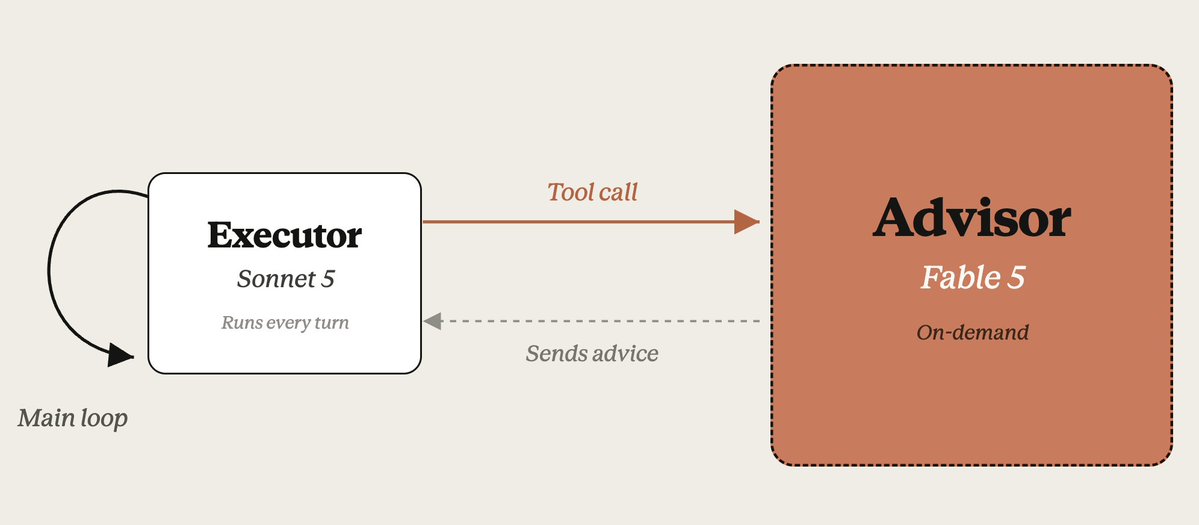
A few patterns we frequently use with Fable 5:
Use Fable 5 as an "advisor."
An executor (Sonnet 5) calls Fable 5 for guidance.
Most tokens are billed at the lower executor rate.
Looking to connect with founders, builders, vibe coders, AI enthusiasts, entrepreneurs, and startup teams.
If you’re actively building a product, company, codebase, or a crazy idea, let’s connect.
Still building. 80 days in and learning every day. If you’re deep in agentic systems too - especially the real daily workflow side - I’d genuinely like to compare notes.What’s your experience been like? 👇
Agents don’t give you new skills.
They give you more of the ones you already have. I built an agent platform called Genesis.
Then I spent 80 days actually living inside it - cold outreach, coding, idea development, the full co-founder workload.
My whole view of “agentic” systems completely changed.
This is exactly why onboarding matters so much more than most agent builders admit.If your first step is “write a config file,” you’ve already filtered out everyone who needed the tool most.